Up to 35% of the heat produced by a radiator mounted on an external wall can disappear straight into the brickwork behind it. Radiator reflector panels cost less than £20 for a whole-house pack and take under an hour to fit. That combination sounds almost too good to be true, and in some homes, it genuinely is. In others, the scepticism is entirely justified.
Radiator reflector panels do work in the right context. In solid-wall uninsulated homes they can save around £10 to £25 a year at a cost of under £20 for a whole-house pack. If your home already has wall insulation or the radiator sits on an internal wall, you are unlikely to notice any difference.
- Only fit reflector panels on radiators mounted on external walls, on internal walls they provide no measurable benefit.
- Solid-wall Victorian and Edwardian homes without wall insulation see the biggest gains, as up to 35% of radiator heat can otherwise escape into the brickwork.
- A whole-house pack costs under £20 and takes under an hour to fit, making it one of the lowest-cost home energy measures available in 2026.
- Choose foil-backed foam or multi-layer foil products over plain foil, plain foil degrades faster and performs less consistently behind a hot radiator.
- Fit the panel as close to the back of the radiator as possible without touching it, covering the full width and height of the radiator for maximum effect.
- Do not treat reflector panels as a substitute for cavity wall or solid wall insulation, they address surface radiant loss only, not conductive heat loss through the wall fabric.
- Get your wall type confirmed before buying, in a modern well-insulated new-build, reflector panels are unlikely to produce any noticeable change in warmth or energy bills.
- What a Radiator Reflector Panel Actually Is (And What It Is Not)
- The Science Behind Heat Loss at External Walls
- The Honest Verdict, Do They Work and by How Much
- What Type of Home Gets the Most Benefit
- Types, Products and What You Should Actually Buy in 2026
- How to Fit Them Correctly, The Steps Most People Skip
- Common Mistakes Homeowners Make, And What Installers Actually Say
- How Radiator Reflectors Fit Into a Wider Energy Saving Plan
Radiator reflector panels do work, but the savings are modest, context-dependent, and heavily influenced by how well you fit them. In a solid-wall Victorian terrace with no wall insulation, the right panel correctly installed can reduce heat loss through that wall section and improve room comfort noticeably. In a modern new-build or on a radiator sitting against an internal wall, you will achieve almost nothing. This article explains the science, the honest numbers, where they genuinely help, and what most guides quietly skip over.
What a Radiator Reflector Panel Actually Is (And What It Is Not)
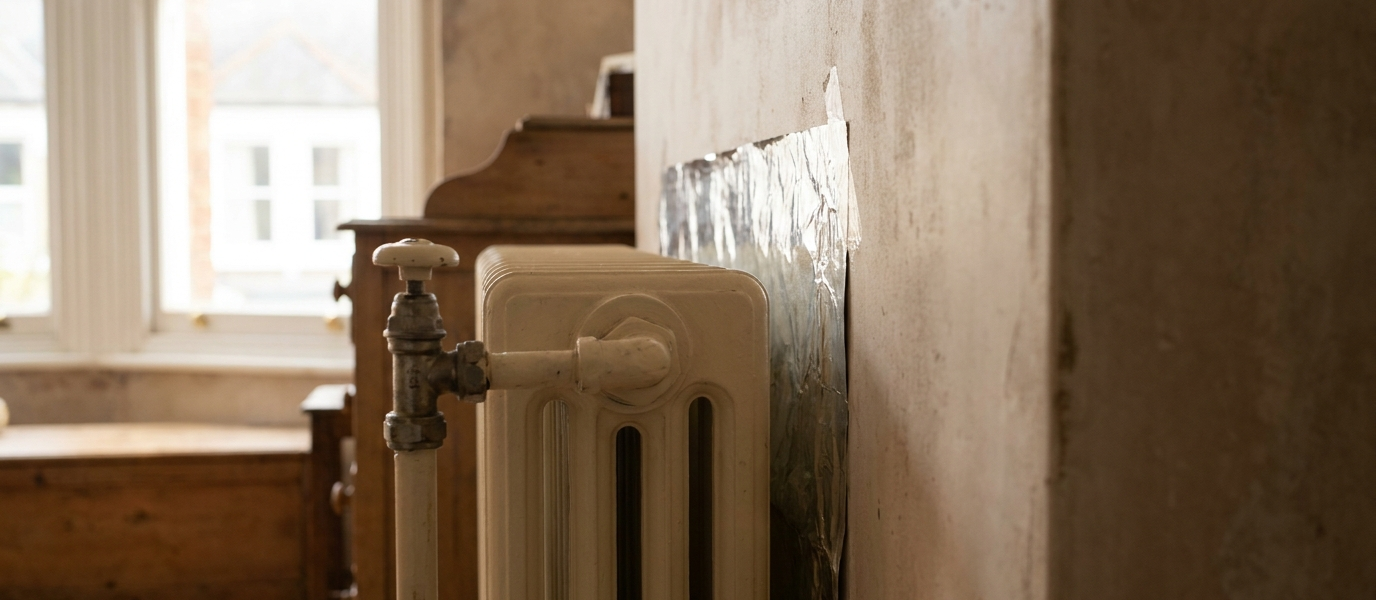
A radiator reflector panel is a thin sheet of reflective material, typically foil, foil-backed foam, or a multi-layer foil product, fitted between the back of a radiator and the wall surface behind it. Its purpose is to redirect infrared heat energy back into the room rather than allowing it to travel into and through the wall.
That definition sounds straightforward, but the product is frequently misunderstood, and that misunderstanding leads to disappointment. A radiator reflector panel is not insulation in the conventional sense. It does not slow the conduction of heat through the wall fabric the way mineral wool or rigid foam board would. It is not a draught excluder and will do nothing about gaps around skirting boards, pipework, or window frames. It is not a substitute for cavity wall insulation or solid wall insulation. Treating it as any of these things will lead you to spend £15 and then conclude the product is useless, when the actual problem was an unrealistic expectation.
In the UK market in 2026, you will encounter two main product types. The first is a basic single-layer reflective foil, often sold in rolls and cut to size. The second, and meaningfully superior, is a foil-faced multi-layer panel with a built-in air gap mechanism, sometimes called a spacer layer. This might be a product with a quilted or cellular structure, or one that includes adhesive foam strips to hold the foil away from the wall.
Here is the detail that most competing articles on this subject never mention, and it is the single most important technical point in this entire piece. The air gap between the foil surface and the wall is what makes the panel effective, not the foil material itself. Reflective foil in direct contact with a masonry wall has very limited thermal benefit because conduction bypasses the reflective mechanism entirely. A crumpled panel pressed flat against the plaster, or a cheap foil sheet taped directly to the wall, loses most of its theoretical performance. The foil must face the back of the radiator with a clear air space, ideally 10 to 20mm, separating it from the wall surface. That gap is where the thermal resistance comes from.
The Science Behind Heat Loss at External Walls
To understand why reflector panels have any effect at all, it helps to understand how radiators actually lose heat, because they do it in three distinct ways simultaneously.
Convection is the dominant mechanism for most radiators. Hot water heats the metal fins or panels, which warm the air directly touching them. That air rises, cooler air draws in from below, and circulation distributes heat around the room. This is the useful part. Conduction occurs wherever the radiator is in physical contact with something else, brackets, pipework, and to a lesser extent the air immediately around it. Radiation is the emission of infrared energy in all directions, including directly backwards into the wall. It is this radiated component that reflector panels are built to address.
External walls are a specific problem because the materials they are made from actively conduct heat outward. A typical 225mm solid brick wall, the kind you find in most Victorian and Edwardian terraces, has a U-value of around 2.1 W/m²K. That means for every square metre of wall, roughly 2.1 watts escape for every degree of temperature difference between inside and outside. On a cold January day with internal temperatures around 20°C and external temperatures near freezing, the heat loss through an uninsulated solid brick wall is continuous and substantial. A radiator sitting directly against that wall is not just heating your room, it is effectively heating the wall too, and some of that energy keeps travelling outward.
Cavity wall construction, which became standard from roughly the 1920s onwards, reduces this problem but does not eliminate it. An unfilled cavity wall, and a significant proportion of UK cavity wall homes still have unfilled cavities either because retrofit injection was never carried out, or because the cavity was deemed unsuitable, has a U-value of around 1.6 W/m²K. Still far higher than insulated construction.
Based on Energy Saving Trust assessments and academic work including trials conducted at Leeds Beckett University, the heat loss through the wall section immediately behind a radiator can be measurably higher than through adjacent wall sections, because the radiator is actively concentrating thermal energy at that point. The reflector panel intercepts a portion of the radiated component before it reaches the wall surface. The physics is sound. The question is always how much of that effect translates into lower bills and warmer rooms in practice.
The Honest Verdict, Do They Work and by How Much
Radiator reflector panels do work. The physics is real, the mechanism is valid, and independent testing confirms measurable heat retention. However, the savings are modest and the figures often cited in marketing materials represent best-case scenarios rather than typical outcomes.
The most honest summary of the evidence is this. In a well-suited home, typically a pre-1920 solid-wall property with no wall insulation, correctly fitted reflector panels are associated with reductions in heat loss through the treated wall sections that translate to roughly 1 to 3% off overall heating bills. Some studies, including work referenced by the Energy Saving Trust, suggest figures closer to 6% in the worst-insulated solid-wall homes where multiple radiators are on external walls and the panels are properly installed. These are not invented numbers, but they do represent optimal conditions.
| Home Type | Wall Construction | Expected Benefit | Worth Fitting |
|---|---|---|---|
| Victorian / Edwardian terrace | Solid brick, uninsulated | Moderate to good, up to 6% in best cases | Yes, strongly |
| 1920s–1980s semi or terrace | Cavity wall, unfilled | Modest, 1–3% | Yes, on external wall radiators |
| 1920s–1980s semi or terrace | Cavity wall, filled | Minimal | Marginal benefit only |
| Mid-terrace flat or maisonette | Mixed, only end walls external | Modest on end-wall radiators only | Selectively, on end walls |
| Post-2000 new-build | Insulated cavity or framed | Negligible | Not worth the effort |
At 2026 gas prices, around 6.24p per kWh under Ofgem‘s January 2026 price cap, the financial arithmetic is relatively kind. A multi-pack covering five or six radiators typically costs £10 to £20. Even a 1 to 2% saving on a heating bill of £900 to £1,200 per year represents £9 to £24 annually, putting payback inside a single heating season in many cases. But that arithmetic only holds if the panels are fitted correctly and on the right radiators. Fitted carelessly on internal walls in a modern home, the payback period is infinite because the saving is essentially zero.
Where reflectors make little meaningful difference: radiators on internal walls (the heat they emit stays within the building envelope regardless), any home with well-insulated cavity walls or external wall insulation already in place, and new-builds built to post-2010 Part L building regulations where fabric efficiency is already high.
What Type of Home Gets the Most Benefit
The clearest winners are pre-1920 solid-wall properties. In a typical 3-bed Victorian terrace with 9-inch solid brick walls and no external or internal wall insulation, every radiator on an external wall is essentially sitting in front of a large, cold thermal sink. In these homes, the wall plaster behind a radiator can feel noticeably cool even when the radiator is running, because heat is conducting through the brickwork faster than the room can absorb the radiator’s output. These are the homes where reflector panels make a tangible, perceptible difference to comfort in rooms near external walls, and where the energy saving, while still modest, is at its most credible.
A frequently overlooked middle ground is the 1920s to 1980s cavity wall home with an unfilled cavity. Many homeowners in this group assume their walls are adequately insulated simply because they are cavity construction. In reality, an empty cavity provides some improvement over solid brick but is far from the performance of a filled cavity. If you are unsure whether your cavity has been filled, your EPC certificate will state it, or you can request a check from an insulation installer, some offer free surveys. Radiators on the external walls of these homes can still benefit meaningfully from reflector panels.
Flats and mid-terrace properties present a specific calculation. In a mid-terrace house, only the front and rear walls are external. In a flat, depending on position, the external wall count may be even lower. It makes no sense to fit reflectors on every radiator in these homes. The practical approach is to identify which radiators are actually on external walls, which requires knowing your building’s layout honestly, and fit reflectors only there.
Before buying anything, carry out a simple diagnostic on a cold day. Walk through your home and place your palm flat against the interior plaster surface of each external wall. In a solid-wall or poorly insulated home, the plaster will feel genuinely cold to the touch. In a well-insulated home, it will feel closer to room temperature. Cold plaster means heat is leaving through that wall, and a reflector on any radiator attached to it is a worthwhile addition. Warm plaster means the wall is already retaining heat well, and reflectors will do very little.
Types, Products and What You Should Actually Buy in 2026
The UK market in 2026 offers products ranging from simple rolls of reflective foil to engineered multi-layer panels with built-in spacer systems. The price range runs from around £8 for a basic roll covering several radiators up to £30 to £35 for premium multi-layer packs with spacers included. The correlation between price and performance is real, but the most important feature is not brand or price, it is whether the product maintains an air gap.
| Product Type | Typical Cost (2026) | Air Gap Provided | Ease of Fitting | Best Suited To |
|---|---|---|---|---|
| Single-layer foil roll | £8–£12 | No, DIY gap required | Moderate (requires improvised spacers) | Confident DIYers who will create proper gap |
| Multi-layer foil panel with foam spacer | £15–£25 | Yes, built in | Easy | Most homeowners, best balance of cost and performance |
| Premium engineered panel with rigid spacer | £25–£35 | Yes, larger gap, more stable | Easy to moderate | Solid-wall homes where maximum performance is wanted |
| Marketplace foil sheets (unbranded) | £3–£8 | No, and usually not achievable with product design | Simple but largely ineffective | Not recommended |
When evaluating a product, look for packaging that references independent test data, BSRIA testing, Energy Saving Trust assessment, or university trial references carry weight. Avoid products whose only performance claims are manufacturer-generated figures with no independent verification cited. Look also for clear sizing guidance, because undersizing is one of the most common fitting errors and a panel that covers only 60% of the radiator’s back face delivers a fraction of its theoretical benefit.
link to draughtproofing guide for homeowners
Ultra-cheap single foil sheets sold on marketplace platforms as radiator reflectors are not inherently useless, but they require a level of installation care that most buyers will not apply. Without a spacer mechanism, the foil will tend to rest against the wall or crumple against the radiator brackets, eliminating the air gap entirely. If you purchase this type of product, you must engineer your own spacer solution, which is achievable but adds time and effort that makes the price saving less compelling.
How to Fit Them Correctly, The Steps Most People Skip
Fitting a radiator reflector panel is not difficult, but the steps that matter most are consistently the ones that DIY guides gloss over. Follow these in order and you will get close to the product’s rated performance. Rush or skip steps two and three and you may as well not bother.
- Measure the radiator accurately before purchasing. Measure the full width and height of the back panel of the radiator, not the visible front face, not the wall space, but the actual back surface. Most people underestimate this and buy too small. The reflector panel should cover the entire back face. A panel that leaves the upper quarter of a radiator uncovered will lose a disproportionate amount of effectiveness, because radiated heat intensity is highest near the top where water enters the radiator at its hottest.
- Create or confirm the air gap before securing the panel. If your product includes foam or rigid spacers, check they are intact and properly positioned before fitting. If your product is a plain foil roll, cut strips of 15mm foam tape or small pieces of cardboard approximately 20mm thick and position them at regular intervals across the wall surface before placing the foil over them. The foil must not touch the wall. A gap of 10 to 20mm is the functional target. This is the single most important step, and it is the one most often skipped.
- Secure the panel without compressing the air gap. Use the adhesive strips or clips provided, or light masking tape at the edges only. Do not press the panel flat against the wall, do not tape it tightly across its full surface, and do not pin it so firmly that the spacers compress. The foil surface must remain facing the back of the radiator with clear air behind it.
- Run a heating cycle and test the result. After the radiator has been running for at least 30 minutes, reach carefully behind the top of the radiator, the area where the hottest water enters, and feel the wall surface through the panel. You should notice that the wall plaster feels significantly cooler than it would without the panel. If the wall still feels very warm, the panel is either undersized, has lost its air gap, or is not positioned correctly. Adjust before the next heating cycle.
link to thermostatic radiator valve guide
Common Mistakes Homeowners Make, And What Installers Actually Say
The first and most corrosive mistake is expecting to see a measurable difference on a single energy bill. Heating costs are influenced by ambient temperature, how many hours the heating runs, occupant behaviour, and dozens of other variables. A reflector panel fitted in October will not produce a bill in November that is clearly and attributably lower than the previous November. The variables are too noisy. Homeowners who judge the product by one month’s direct bill comparison will almost always conclude it has done nothing, even when it has. The realistic way to assess performance is to compare comfort in specific rooms over a full heating season, and to treat any bill reduction as a background improvement rather than an itemised saving.
The second mistake, and the one that installers I have spoken to describe most consistently, is purchasing reflector panels as an alternative to proper wall insulation. In a solid-wall Victorian terrace, the gap between the comfort and energy performance of an uninsulated wall and a properly internally or externally insulated one is enormous. Reflector panels address a fraction of the heat loss mechanism. They are, to use one installer’s phrase, comparable to putting a better letterbox flap on a front door that has no weather seal, no insulation, and stands slightly ajar. Useful at the margins, but the big problem remains. link to solid wall insulation options guide
The third mistake is fitting reflectors on every radiator in the home regardless of wall type. In a mid-terrace house, this means fitting panels behind radiators on internal walls where the heat was never going anywhere useful in the first place. The thermal energy from an internal wall radiator stays within the building envelope. There is nothing to reflect. Homeowners who take a blanket approach to this product end up with the same modest savings as those who only fitted on external walls, because the external wall radiators are doing all the work, but with more effort and a messier installation.
The fourth observation is perhaps the most useful for setting expectations. In solid-wall Victorian terraces I have visited where reflectors were correctly fitted on all external-wall radiators, the homeowners most often reported the benefit in terms of comfort rather than bill savings. Rooms that previously felt cold near the external walls, even with the radiator running, felt more evenly warm. The perceptible difference in thermal comfort can precede any bill movement by weeks or months, and for many people in older homes it is a more immediate and motivating improvement than a line on a spreadsheet.
How Radiator Reflectors Fit Into a Wider Energy Saving Plan
Radiator reflector panels belong at the low-cost, no-grant end of the home energy improvement spectrum. They sit alongside draught-proofing, thermostatic radiator valves (TRVs), and smart heating controls as measures that cost little, require no professional installation, and deliver incremental rather than transformational gains. They are worth doing, but only after, or ideally alongside, the measures that deliver the largest returns.
The priority hierarchy for most UK homeowners in 2026 is well established. Loft insulation, if absent or thin, is the highest-return measure in most homes and costs relatively little. Cavity wall insulation, for homes where the cavity is unfilled and suitable, is similarly high return. Draught-proofing around doors, windows, and pipework penetrations addresses a significant source of heat loss at very low cost. Reflector panels come after these.
The grants worth knowing about in 2026 are significant for homeowners who qualify. ECO4 (the Energy Company Obligation scheme, currently in its fourth phase) funds major insulation and heating upgrades for low-income and vulnerable households, delivered through energy suppliers. GBIS (the Great British Insulation Scheme, administered by Ofgem and DESNZ) targets loft and wall insulation for lower EPC-rated homes, with eligibility based on council tax band and EPC rating rather than income alone. Neither scheme covers radiator reflector panels directly, they are too low-cost and low-impact to qualify for grant funding, but getting the larger measures completed under these schemes first makes the marginal contribution of reflector panels more meaningful, because the wall’s baseline performance improves. link to ECO4 eligibility guide
For homeowners considering a heat pump under the Boiler Upgrade Scheme (BUS), which in 2026 offers a £7,500 grant towards air source heat pump installation, the reflector question takes on a slightly different character. Heat pumps operate at lower flow temperatures than gas boilers, typically 35 to 45°C rather than 60 to 80°C, which means the radiative heat loss component from each radiator is lower to begin with. In a heat pump home, good wall insulation matters far more than reflector panels, because the system’s efficiency depends heavily on the building fabric retaining heat effectively rather than on redirecting what little radiation the cooler radiators produce.
Verifying Quality and Avoiding Misleading Claims
Radiator reflector panels are not a regulated product in the way that heating equipment is. There is no MCS (Microgeneration Certification Scheme) equivalent, no Gas Safe Register, no NICEIC or NAPIT approval process. Any manufacturer can print performance claims on a packet without independent verification, and many do. This absence of regulation means the burden of evaluation falls entirely on the buyer.
When assessing a product, look for specific references to external testing. BSRIA (the Building Services Research and Information Association) conducts independent assessments of building products and its methodology is credible. References to Energy Saving Trust assessments or university-conducted trials, particularly where the trial methodology is described rather than just cited, carry genuine weight. A product that references only its own internal testing, or offers percentage savings without explaining the test conditions, deserves scepticism.
Watch for performance claims that blend best-case and average-case figures without distinguishing between them. A claim that a product “can save up to 45% of heat loss behind the radiator” might be technically defensible under specific laboratory conditions, but it tells you nothing about what you will experience in your 1930s semi in February. The relevant question is always what the saving is as a percentage of total home heating energy, and under what conditions that figure was measured.
The marketing language to treat with particular caution includes phrases like “significant savings,” “dramatically reduces heat loss,” and unqualified claims about bill reductions expressed as pound figures without specifying the home type or baseline. These are not necessarily false, but they are not transparently useful either. The honest figures, 1 to 3% for most homes, up to 6% in the best-suited properties, are less exciting but far more actionable.
If you are buying online, check the product listing for sizing information, installation guidance, and whether the air gap question is addressed at all. A product description that does not mention the air gap, or that shows installation photographs with the foil pressed directly against the wall, is a reliable signal that the seller either does not understand the mechanism or is not prioritising your results.
For most homeowners in solid-wall or unfilled-cavity properties, a well-chosen multi-layer panel with a built-in spacer, fitted correctly on every radiator against an external wall, is a genuinely worthwhile addition to a home energy strategy. The financial case is modest but real. The comfort case, particularly in older homes on cold days, is often more immediately convincing. Just do not expect it to substitute for the insulation your walls probably need, treat it as the finishing touch on a properly sequenced improvement plan, and it will earn its place.
Frequently Asked Questions
In solid-wall uninsulated homes, reflector panels can reduce heat loss from that wall section meaningfully, with some estimates suggesting savings of £10 to £25 per year across a whole house. In well-insulated or new-build homes the saving is negligible. At under £20 for a full-house pack, payback in the right property can be under two years.
Yes, a Victorian terrace with solid brick walls and no wall insulation is the best-case scenario for reflector panels. Heat loss through external walls in these properties is significant, and a correctly fitted reflector panel can redirect a meaningful portion of radiant heat back into the room. They will not replace solid wall insulation, which costs £8,000 to £22,000, but they are a useful low-cost measure.
Remove the panel from packaging and cut it to match the width and height of your radiator if needed. Slide or clip it between the back of the radiator and the wall, ensuring it sits flat against the wall surface and covers the full radiator area. Most products are self-adhesive or use the existing radiator bracket fixings, no tools required for the majority of standard UK panel radiators.
Multi-layer foil products and foil-backed foam panels outperform plain foil sheets, which degrade with repeated heat cycling. Look for products that specify heat resistance above 80u00b0C and cover at least the full radiator footprint. Brands sold through UK DIY retailers typically cost £8 to £18 for a pack covering four to six radiators.
If your cavity walls are already filled with insulation, reflector panels will make little to no difference, the wall behind the radiator is already significantly better at retaining heat. If your cavity walls are unfilled, getting cavity wall insulation installed first is the higher-priority measure, with average costs around £500 to £1,500 depending on property size, and grants available through the Great British Insulation Scheme.