More than 1.4 million UK homes now have solar panels installed, generating clean electricity from daylight and cutting household energy bills by an average of £500 to £1,000 per year. With electricity prices remaining high and panel technology improving year on year, 2026 is one of the strongest moments in a decade to consider solar for your home. This guide covers everything you need to know, from how the technology works to what you’ll pay, what grants are available, and how to choose the right system for your property.
How Solar Panels Work
Photovoltaic (PV) solar panels convert sunlight, specifically the photons in daylight, directly into electricity through the photovoltaic effect. Each panel is made up of solar cells, typically constructed from silicon wafers. When photons strike the silicon, they knock electrons loose, creating a flow of direct current (DC) electricity.
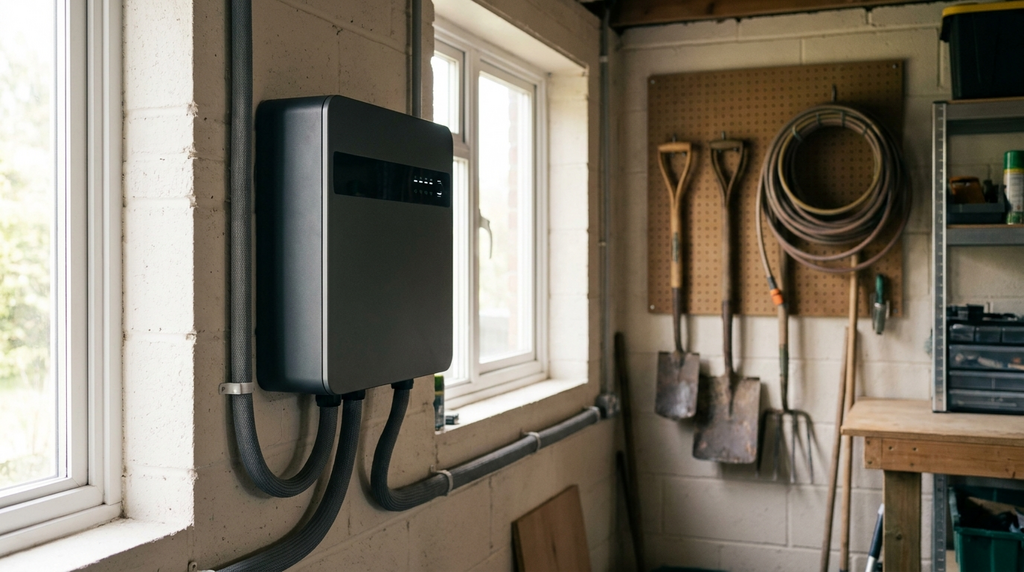
That DC electricity travels from your panels into a device called an inverter, which converts it into alternating current (AC), the standard form of electricity used by your appliances and the national grid. A generation meter records how much electricity your system produces, and a smart export meter tracks any surplus you export back to the grid.
It’s a common misconception that solar panels only work in direct sunshine. They generate electricity from daylight, including on overcast days, though output is reduced. A typical UK system produces around 850 to 1,100 kWh of electricity per kWp of installed capacity per year, lower than southern Europe, but more than enough to make a meaningful difference to your bills.
The Main Components of a Solar PV System
- Solar panels, the panels themselves, mounted on your roof or ground frame
- Inverter, converts DC to AC electricity; string inverters handle the whole array, microinverters work at individual panel level
- Generation meter, measures total electricity produced by your system
- Export meter, records surplus electricity sent to the grid
- Battery storage (optional), stores unused daytime generation for evening use
- Monitoring app or display, lets you track output and consumption in real time
Types of Solar Panels Available in the UK
Not all solar panels are the same. The three main panel technologies differ in efficiency, appearance, cost, and suitability for different roof types and budgets.
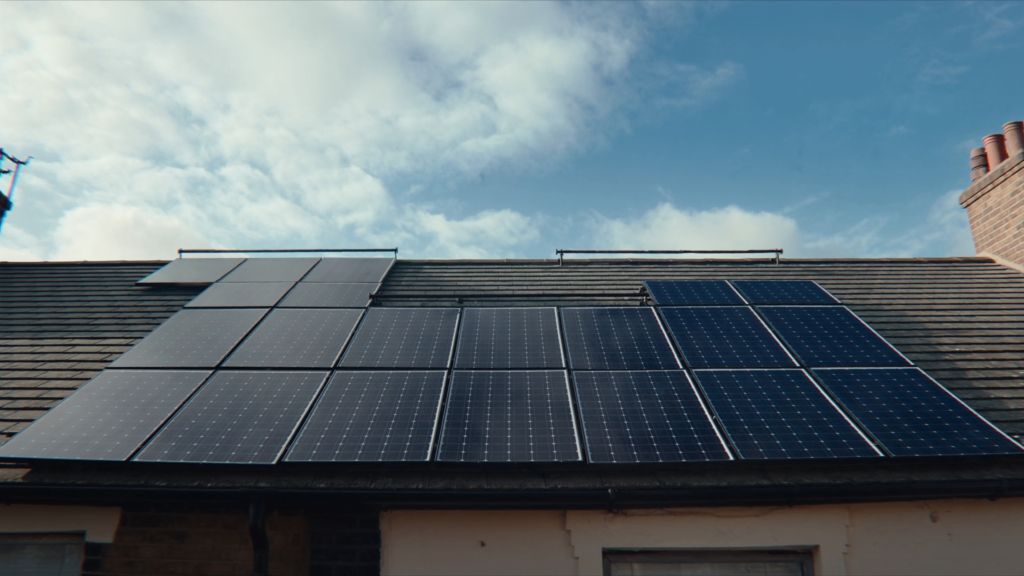
Monocrystalline panels are made from a single silicon crystal and are the most efficient type widely available, typically achieving 20–24% efficiency. They perform better in lower light conditions and have a sleek, uniform black appearance. Most premium installations in 2026 use monocrystalline panels.
Polycrystalline panels are made from multiple silicon fragments fused together. They’re slightly less efficient (15–18%) and have a blue-speckled appearance. They’re cheaper to manufacture but have largely been displaced in the UK market by falling monocrystalline prices.
Thin-film panels use a different deposition process and are flexible and lightweight, useful on flat commercial roofs or in specialist applications. They’re less efficient (10–13%) and less common in domestic UK installations, but the technology continues to improve.
For most UK homeowners in 2026, monocrystalline panels represent the best balance of performance, longevity, and value. Many installers now offer half-cut cell or bifacial variants that push efficiency even higher and reduce the impact of partial shading.
| Panel Type | Typical Efficiency | Appearance | Best For | Relative Cost |
|---|---|---|---|---|
| Monocrystalline | 20–24% | Uniform black | Most UK homes | Medium–High |
| Polycrystalline | 15–18% | Blue speckled | Budget installs | Low–Medium |
| Thin-film | 10–13% | Flat, dark | Flat roofs, specialist use | Variable |
| Half-cut cell | 21–25% | Uniform black | Shaded or complex roofs | Medium–High |
There is also a growing category of solar thermal panels, which use the sun’s energy to heat water rather than generate electricity. These are a distinct technology from PV panels and work particularly well for reducing hot water bills.
How Much Do Solar Panels Cost in 2026
Solar panel costs have fallen dramatically over the past decade and have stabilised in recent years at a point where payback periods for most UK homes sit between 7 and 12 years. System prices vary depending on how many panels you need, the panel brand and technology, your roof type, and whether you include battery storage.
The table below shows indicative costs for a standard rooftop solar PV installation in 2026, including panels, inverter, mounting hardware, and installation labour, but excluding battery storage.
| System Size | Typical Panels | Annual Output (Est.) | Typical Installed Cost | Best For |
|---|---|---|---|---|
| 3 kWp | 6–8 panels | 2,550–3,300 kWh/yr | £5,500–£7,000 | Flats, small homes, 1–2 people |
| 4 kWp | 8–10 panels | 3,400–4,400 kWh/yr | £7,000–£9,000 | Average 3-bed home, 2–3 people |
| 6 kWp | 12–15 panels | 5,100–6,600 kWh/yr | £9,500–£12,500 | Larger homes, 4+ people, EV charging |
| 8 kWp | 16–20 panels | 6,800–8,800 kWh/yr | £12,000–£16,000 | Large homes, high consumption, battery ready |
| 10 kWp | 20–25 panels | 8,500–11,000 kWh/yr | £15,000–£20,000 | Maximum self-sufficiency, EV and heat pump |
Adding battery storage typically adds £3,000–£7,000 to the total cost depending on capacity (measured in kWh). A 5 kWh battery suits a small to medium home; a 10 kWh battery is more appropriate for larger households or those aiming to maximise self-consumption.
Solar PV installations are currently zero-rated for VAT in the UK, meaning you pay 0% VAT on both the equipment and installation, a significant saving versus the standard 20% rate.
Benefits of Solar Panels for UK Homeowners
The financial and practical case for solar panels in the UK has strengthened considerably since 2022, driven by higher energy prices and improved panel efficiency. Here’s what you can realistically expect.
Bill Savings
A typical 4 kWp system on a south-facing roof in England generates around 3,400–3,800 kWh per year. With the average UK unit rate at approximately 24–28p per kWh in 2026, that is a gross generation value of roughly £800–£1,000 per year. How much of that translates to actual savings depends on how much electricity you self-consume, homes occupied during the day can self-consume 50–70% of their generation, while homes where all occupants are out during the day may self-consume as little as 25–30% without a battery.
Smart Export Guarantee (SEG) Income
Any surplus electricity you export to the grid earns you a payment under the Smart Export Guarantee (SEG). Export rates from energy suppliers vary from around 4p to 20p per kWh, with the best tariffs currently offered by Octopus Energy, E.ON Next, and others. A typical household exporting 30–40% of its generation might earn £150–£400 per year in SEG payments on top of bill savings.
Property Value
Research consistently shows that solar panels add value to UK homes. A 2023 study by the solar trade body Solar Energy UK found that homes with solar panels sold for 4–14% more than equivalent properties without them, and sold faster. An EPC rating improvement (solar typically moves a home from D to C or C to B) also affects mortgage products and rental income for landlords.
Carbon Reduction
A 4 kWp UK solar system offsets approximately 1 tonne of CO₂ per year, based on the current grid carbon intensity. Over a 25-year system life, that’s around 25 tonnes, equivalent to planting roughly 400 trees.
Energy Independence
Generating your own electricity insulates you from wholesale energy price spikes. Paired with battery storage and a heat pump or electric vehicle, solar can power a very large proportion of a home’s total energy needs from a single roof installation.
Grants and Funding for Solar Panels in the UK
The UK government has significantly expanded support for home energy improvements, and solar panels are a major beneficiary of several active schemes in 2026.
Great British Insulation Scheme and ECO4
The Energy Company Obligation (ECO4) scheme requires energy suppliers to fund energy efficiency measures for low-income and fuel-poor households. Solar panels are included as an eligible measure for qualifying homes. If your household income is below a certain threshold or you receive certain benefits, you may be entitled to a fully or partially funded installation. Contact your energy supplier or the Simple Energy Advice service to check eligibility.
GB Energy and the Warm Homes Plan
The government’s Warm Homes Plan, being rolled out from 2025–2026 through Great British Energy, includes grants and low-interest loans for solar panels for owner-occupiers and social housing tenants. Grants of up to £7,500 are available for eligible households, with means-tested criteria that prioritise lower-income homeowners. The scheme is administered through local authorities and approved installer networks.
0% VAT on Solar Installations
As noted above, all residential solar PV and solar thermal installations benefit from zero-rated VAT under HMRC rules introduced in 2022 and extended indefinitely. This represents an immediate 20% saving on installation costs compared to most other home improvement work.
Smart Export Guarantee
While not a grant, the SEG is a government-mandated payment scheme. All licensed energy suppliers with more than 150,000 customers are legally required to offer an export tariff to solar owners. You need a smart meter to participate, and rates vary by supplier, shopping around for the best SEG tariff can add hundreds of pounds to your annual returns.
Social Housing and Local Authority Schemes
Scotland, Wales, and various English local authorities run their own solar grant programmes. Scotland’s Home Energy Scotland scheme offers interest-free loans of up to £15,000 for renewable energy installations including solar. Check your local council’s website and the relevant national energy agency for the most current programmes.
How to Choose the Right Solar Panels for Your Home
Choosing solar panels involves more than picking the highest wattage panel on the market. The right system depends on your roof, your energy habits, your budget, and your long-term goals.
Assess Your Roof
South-facing roofs at a pitch of 30–40 degrees deliver the best annual output in the UK. East or west-facing roofs produce around 15–20% less energy annually but can still offer strong returns. North-facing roofs are generally not suitable for solar PV. Your roof should be structurally sound and ideally free from significant shading from chimneys, trees, or adjacent buildings between 10am and 3pm, the peak generation window.
Size the System to Your Consumption
A common mistake is over-sizing a system beyond what your roof can support or under-sizing to save money upfront. Review your last 12 months of electricity bills to establish your annual consumption in kWh. As a rough guide:
- Under 2,500 kWh/year, 3 kWp system likely sufficient
- 2,500–4,000 kWh/year, 4–5 kWp is the sweet spot for most UK homes
- 4,000–6,000 kWh/year, 6–8 kWp, particularly if adding an EV or heat pump
- Over 6,000 kWh/year, 8–10 kWp, with battery storage strongly advisable
Panel Brand and Warranty
Look for panels with a 25-year performance warranty guaranteeing at least 80–85% of original output at end of life. Reputable manufacturers include SunPower, LG Solar (now through authorised distributors), Panasonic, Jinko Solar, and Q Cells. Avoid brands with weak warranty terms or no UK service presence, a 25-year warranty is only valuable if the company still exists in 25 years.
Inverter Choice
Your inverter is the heart of the system. A string inverter (brands: SolarEdge, Fronius, SMA) handles all panels together and is cost-effective for unshaded roofs. Microinverters (brands: Enphase) attach to each panel individually, improving performance on complex or partially shaded roofs and providing panel-level monitoring. SolarEdge’s power optimiser system offers a middle ground. Inverters typically carry a 10–12 year warranty and may need replacing once during the system’s 25+ year life.
Installer Accreditation
Only use installers certified under the Microgeneration Certification Scheme (MCS). MCS certification is a requirement for accessing the Smart Export Guarantee and most government grants. Ask for evidence of MCS certification, check the MCS installer database online, and get at least three quotes before committing.
Solar Panel Installation, What to Expect
A standard domestic solar PV installation typically takes one to two days for the physical work. Here’s the process from first contact to first generation.
- Initial survey and quote, A reputable installer will visit your home to assess the roof structure, orientation, shading, and your electricity usage before quoting. Beware of companies that quote without a site visit.
- System design, The installer produces a system layout, including panel positions, cable routing, and inverter location. You’ll receive a predicted annual output figure based on your specific site.
- Permitted development check, Most domestic solar installations in England and Wales fall under permitted development rights and don’t require planning permission, provided the panels don’t project more than 200mm from the roof surface and the property isn’t in a conservation area or listed. Scotland and Wales have slightly different rules. Your installer should confirm this.
- Grid connection notification, Your installer notifies your Distribution Network Operator (DNO) about the new generation capacity. For systems under 3.68 kW per phase, this is usually a simple notification process. Larger systems may require a formal application and take several weeks.
- Installation day, The installation team mounts the racking system on your roof, fits the panels, runs DC cables to the inverter (usually in your loft or utility room), connects the inverter to your consumer unit, and installs the generation meter. A competent team of two can typically complete a 4 kWp system in a single working day.
- Electrical commissioning and testing, The system is tested, the inverter is configured, and monitoring access is set up on your phone or tablet.
- MCS certificate and documentation, You receive an MCS installation certificate, which you need to register for the Smart Export Guarantee with your energy supplier.
Common Problems and How to Maintain Your Solar Panels
Solar PV systems are remarkably low-maintenance, but they’re not zero-maintenance. Understanding the common issues helps you catch problems early and protect your investment.
Routine Cleaning
Dust, bird droppings, lichen, and pollen reduce panel output. In the UK, rainfall clears most surface dirt naturally, but a professional clean every 2–3 years is advisable, particularly in areas with high bird activity or near farmland. A single heavily soiled panel can reduce whole-string output by 10–20% on a string inverter system. Never use abrasive cleaners or high-pressure washers on panels.
Inverter Faults
The inverter is the most likely component to develop a fault. Most modern inverters have remote monitoring that alerts you to issues via app. Common symptoms of inverter problems include the system generating significantly less than expected on sunny days, warning lights on the inverter display, or the system not generating at all. Inverter replacements cost £500–£1,500 including installation.
Shading Changes
Trees grow. Neighbouring extensions get built. New sources of shading that weren’t present at installation can noticeably reduce output. Monitor your system output year on year using your monitoring app, a consistent downward trend beyond normal panel degradation (around 0.5% per year) warrants investigation.
Panel Degradation
All solar panels lose output slightly over time, typically 0.3–0.5% per year for quality monocrystalline panels. A panel warranted at 25 years should still be producing at least 80–85% of its original rated output at the end of the warranty period. This is gradual and expected; it’s only a concern if degradation appears faster than the warranty guarantees.
Roof and Mounting Checks
Have the mounting hardware and flashings inspected every 5–10 years, particularly if you notice any movement or unusual sounds during high winds. Water ingress around poorly installed fixings is rare but serious. A good installer uses proper lead or EPDM flashing around roof penetrations.
Solar Panels for Specific Property Types
Solar PV is not one-size-fits-all. Different property types require different approaches, and some require specialist solutions.
Flats and Apartments
Flat-dwellers face the most significant barriers to solar, you don’t own the roof, and shared ownership complicates installation. However, solutions exist: some freeholders and managing agents agree to rooftop installations with shared benefit arrangements, and community solar schemes allow flat-dwellers to part-own a nearby ground-mounted or commercial roof installation. Shared ownership solar products have expanded significantly in 2025–2026.
Listed Buildings and Conservation Areas
Permitted development rights don’t apply to listed buildings or properties in conservation areas. Planning permission is required, and approval is not guaranteed. In practice, rear or hidden roof slopes are sometimes approved; front-facing installations rarely are. Solar roof tiles, which replace conventional roof tiles with photovoltaic ones, are increasingly considered by planners as a less visually intrusive option.
Ground-Mounted Solar Panels
If your roof is unsuitable, wrong orientation, heavily shaded, structurally weak, or simply too small, a ground-mounted solar array in your garden or land may be a viable alternative. Ground-mounted systems are easier to clean, can be optimally angled, and can be expanded more easily than rooftop systems. They typically cost £500–£1,000 more than equivalent rooftop installations due to additional groundwork and cabling.
Monitoring and Maximising Your Solar Output
Installing solar is the first step. Getting the most from your system over its lifetime requires some active engagement, especially in the first year.
Most modern inverters include Wi-Fi-connected monitoring, accessible through an app (Fronius Solar.web, SolarEdge mySolarEdge, Enphase Enlighten, and others). Your monitoring app shows live generation, daily totals, monthly summaries, and often alerts for faults. Check it regularly in the first few months to establish your system’s normal output patterns.
Shift high-energy tasks, dishwasher, washing machine, tumble dryer, EV charging, to daytime hours to maximise self-consumption. A basic plug-in timer costs under £10 and can shift appliance cycles to your peak generation window. Smart home systems and solar diverters (such as the Eddi by myenergi) can automatically divert surplus generation to your hot water tank, achieving near-zero hot water costs during summer months.
Pairing solar with an electric vehicle transforms the economics dramatically. An EV charging at home consumes 2,000–4,000 kWh per year, much of which can come from your solar panels if you charge during daylight hours or using a smart charger with solar integration. This can effectively eliminate fuel costs for a typical driver.
Explore the Full World of Solar for Your Home
Solar panels are a broad category with a range of technologies, applications, and complementary products. The subtopics below take each area in depth, if you’re ready to install, exploring storage, or assessing whether solar suits your specific property.
- Solar Panel Installation, Everything about the installation process: choosing an installer, what happens on the day, grid connection, and the documentation you need.
- Solar Panel Battery Storage, How home batteries work, which brands lead the UK market, how to size a battery for your home, and the honest numbers on whether storage stacks up financially.
- Solar Thermal Panels, A distinct technology that uses the sun to heat your water rather than generate electricity. Often overlooked, solar thermal can cover 50–70% of a household’s annual hot water demand.
- Solar Panel Maintenance, Routine care, fault diagnosis, cleaning schedules, and when to call a professional to protect your investment over a 25-year system life.
- Solar Panels for Flats, The specific challenges and solutions for flat-dwellers, including leasehold arrangements, community solar, and new shared ownership models.
- Ground-Mounted Solar Panels, For homes where the roof isn’t suitable. Planning rules, costs, performance benefits, and how to design a ground-mounted system that works for your land.