Uninsulated suspended timber floors account for up to 15% of a typical UK home’s total heat loss, making underfloor insulation one of the most cost-effective upgrades available to homeowners in older properties. The Energy Saving Trust estimates that properly installed underfloor insulation can save households between £60 and £120 per year on heating bills, with the insulation itself typically paying back its installation cost within five to seven years. For the roughly 7.5 million UK homes with suspended timber ground floors, this is a significant and often overlooked opportunity to improve comfort and reduce energy waste.
How Underfloor Insulation Works
Underfloor insulation works by creating a thermal barrier between the cold air beneath your floor and the living space above. The mechanism depends on your floor construction type, but the underlying principle is the same: reducing the rate at which heat conducts downward through the floor structure and escapes into the ground or subfloor void.
In a suspended timber floor, the type found in most pre-1930s UK homes, the floorboards sit on joists, which in turn rest on sleeper walls above a ventilated void. Cold air circulates in this void to prevent timber rot, but it also draws heat away from the floor above. Insulation material is fitted between the joists, resting on netting, rigid supports, or friction-fitting boards, cutting off the pathway for heat to escape while allowing the void to remain ventilated.
In a solid concrete floor, the mechanism works differently. There is no void, so insulation is laid either above the existing concrete slab (beneath a new screed or floor covering) or, less commonly, beneath the slab during new construction. This is a more disruptive process but can be highly effective, particularly in combination with underfloor heating systems.
The thermal performance of any insulation material is measured by its R-value (resistance to heat flow) or, inversely, its U-value (how much heat passes through per square metre). Building Regulations in England and Wales require a U-value of 0.25 W/m²K or lower for ground floors in new builds and major renovations. Most well-installed underfloor insulation in existing homes achieves a U-value of around 0.20–0.30 W/m²K, depending on the insulation depth and material chosen.
Types of Underfloor Insulation
Choosing the right insulation material is critical to getting good performance and long-term durability. Each type has specific applications where it excels.
Mineral Wool (Glass Wool and Rock Wool)
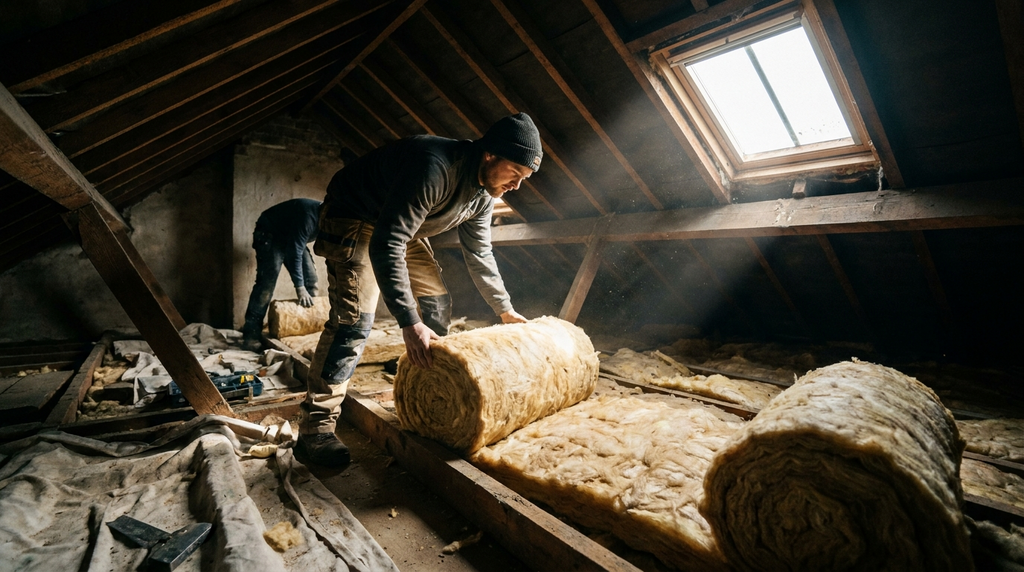
Mineral wool is the most widely used material for insulating suspended timber floors. It is cut to fit between joists, supported by netting or rigid clips, and provides excellent thermal performance at a relatively low material cost. It is also breathable, which is important in suspended floor voids where moisture management matters. Rock wool is denser and slightly more resistant to moisture than glass wool. That makes it preferable in wetter subfloor conditions.
Rigid Foam Boards
Rigid insulation boards, including expanded polystyrene (EPS), extruded polystyrene (XPS), and polyisocyanurate (PIR), are most commonly used in solid floor insulation. They are laid above the concrete slab before a new screed is poured. PIR boards offer the highest thermal performance per millimetre of thickness, with thermal conductivity values as low as 0.022 W/mK, making them ideal where floor height is limited.
Spray Foam
Spray polyurethane foam (SPF) is applied directly to the underside of floorboards from below, either through the subfloor void or via access panels. It adheres and expands to fill gaps. This provides both insulation and draught exclusion. However, spray foam has attracted significant controversy in the UK mortgage market: lenders have refused or withdrawn mortgage offers on properties where spray foam has been applied to roof timbers or floor structures, citing concerns about structural assessment and future removal costs. If you are considering spray foam underfloor insulation, seek written confirmation from your mortgage lender beforehand and use a contractor affiliated with the British Board of Agrément (BBA).
Natural and Recycled Materials
Options such as sheep’s wool, cellulose (recycled newspaper), and cork are available for homeowners prioritising low-embodied-carbon materials. These tend to cost more than mineral wool but offer good thermal performance and are fully breathable. Sheep’s wool in particular has natural moisture-regulating properties that suit suspended floor applications well.
| Material | Typical Thermal Conductivity (W/mK) | Best Application | Approximate Material Cost per m² |
|---|---|---|---|
| Mineral Wool (Rock/Glass) | 0.032–0.044 | Suspended timber floors | £3–£8 |
| PIR Rigid Board | 0.022–0.028 | Solid floor overlay | £8–£18 |
| EPS Rigid Board | 0.030–0.038 | Solid floor overlay | £5–£12 |
| Spray Foam (SPF) | 0.026–0.040 | Suspended floors (underside) | £15–£25 installed |
| Sheep’s Wool | 0.035–0.040 | Suspended timber floors | £10–£20 |
How Much Does Underfloor Insulation Cost in 2026
Installation costs vary significantly based on floor type, property size, access conditions, and the insulation material selected. The figures below reflect typical market rates for professional installation in 2026.
| Property Type / Scenario | Floor Area | Insulation Type | Estimated Installed Cost | Estimated Annual Saving |
|---|---|---|---|---|
| Mid-terrace, suspended timber floor | 40–50 m² | Mineral wool with netting | £800–£1,400 | £60–£90 |
| Semi-detached, suspended timber floor | 55–70 m² | Mineral wool with netting | £1,200–£2,000 | £80–£110 |
| Detached house, suspended timber floor | 80–120 m² | Mineral wool with netting | £1,800–£3,500 | £100–£150 |
| Solid concrete floor overlay | 40–50 m² | PIR board + screed | £2,500–£5,000+ | £70–£120 |
| Crawl space access (difficult access) | Any | Spray foam | Add 20–40% premium | Variable |
Labour typically accounts for 50–70% of the total installed cost for suspended floor jobs, as the process involves working in confined subfloor spaces. For solid floor overlays, the screed and any associated work (raising door frames, kitchen units, skirting boards) can add substantially to the overall cost. Always obtain at least three quotes and check that contractors are registered with a relevant trade body such as CIGA (the Cavity Insulation Guarantee Agency) or hold a relevant TrustMark registration.
DIY installation is feasible for suspended timber floors with reasonable access, typically reducing costs by 40–60%. Mineral wool rolls and supporting netting kits are widely available from builders’ merchants. However, working in subfloor voids carries risks including contact with older building materials, poor air quality, and restricted movement, always wear appropriate PPE and never work alone.
Benefits of Underfloor Insulation
The case for insulating your ground floor goes well beyond simple energy savings. Here are the specific, evidence-backed advantages for UK homeowners.
- Reduced heat loss: A well-insulated ground floor can reduce floor heat loss by up to 70%, directly cutting the energy your boiler needs to maintain comfortable indoor temperatures.
- Lower energy bills: Households with gas central heating in older semi-detached or terraced homes typically save £70–£120 per year after installation. With energy prices remaining elevated through 2025–2026, these savings are more significant than historical estimates suggested.
- Improved thermal comfort: Cold floors are one of the most common comfort complaints in older UK homes. Insulating the floor eliminates the chill that makes rooms feel cold even when they are nominally heated, and reduces radiant heat loss from occupants’ feet.
- Noise reduction: Mineral wool and natural fibre insulation between floor joists provides meaningful acoustic insulation, reducing sound transmission from below, useful in homes near busy roads or with rooms above garages.
- Draught elimination: Suspended timber floors are often the source of significant draughts through gaps between boards. Insulation installed from below, combined with surface-level draught proofing, can cut unwanted air infiltration substantially.
- Improved EPC rating: Adding underfloor insulation can raise your home’s Energy Performance Certificate (EPC) band by one to two levels in some cases, which has implications for property value and mortgage eligibility under evolving green finance products.
- Carbon reduction: A typical semi-detached home with gas heating could reduce its annual CO₂ emissions by approximately 200–350 kg per year through underfloor insulation alone.
How to Choose the Right Underfloor Insulation
The single most important factor in choosing your insulation approach is your floor construction type. Getting this wrong, for example, using a non-breathable material in a poorly ventilated subfloor void, can cause more problems than it solves.
Identify Your Floor Type First
You can usually determine your floor type by knocking on the floor: a hollow sound indicates a suspended timber floor; a dull, solid sound indicates a concrete slab. In most UK homes, properties built before approximately 1930 have suspended timber floors throughout the ground floor. Post-war properties more commonly have solid concrete ground floors, though suspended floors remained common in many regional building traditions through the 1950s and 1960s. If in doubt, your installer or a surveyor can confirm during a pre-survey visit.
Check Subfloor Access and Void Height
For suspended floors, an installer needs to access the void beneath the boards, either via an existing access hatch or by lifting a section of flooring. Void height matters: a clearance of at least 500mm (600mm is preferable) allows a person to work comfortably from below. Shallower voids may require access from above, which increases disruption and cost. Where there is no access and the void is too shallow for manual installation, spray foam from below through drilled access points may be the only viable option, subject to the mortgage lender caveats noted above.
Consider Moisture and Ventilation
Suspended floors must remain ventilated to prevent timber decay. Any insulation material used should be breathable (mineral wool, sheep’s wool, cellulose) rather than a vapour barrier material. Never use closed-cell foam or non-permeable boards in a suspended floor void that relies on natural ventilation, this traps moisture and can cause rot in joists and floorboards within a few years.
Thickness and Performance Targets
Current Building Regulations recommend achieving a U-value of 0.25 W/m²K or better for ground floors. To hit this target with mineral wool in a standard joist depth of 150mm, you need approximately 100–150mm of insulation. For PIR boards in a solid floor overlay, 60–80mm is typically sufficient to achieve equivalent performance. That makes it better where floor height gain is restricted.
Budget and Payback Period
For most homeowners, the simple payback period on professionally installed underfloor insulation is between 10 and 20 years, longer than loft insulation but comparable to cavity wall insulation for solid floor scenarios. However, if you qualify for grant funding (see below), the payback period can shorten to five years or fewer. Prioritise underfloor insulation if your home already has good loft and wall insulation, as you are likely losing a disproportionate share of heat through the floor.
Underfloor Insulation Installation, What to Expect
Understanding the installation process helps you prepare your home, set realistic expectations, and evaluate quotes properly.
Suspended Timber Floor, Professional Installation
- Survey and access assessment: The installer surveys the subfloor void, checks joist depth and spacing, identifies any existing services (pipes, cables), and checks for signs of damp or rot. This typically takes 30–60 minutes.
- Access preparation: If no hatch exists, the installer will lift one or more floorboards to gain entry. Furniture in affected rooms may need to be moved.
- Netting installation: Polypropylene netting is stapled to the underside of the joists to support the insulation batts. This creates a cradle between each joist bay.
- Insulation fitting: Mineral wool batts are cut to length and dropped into the netting-supported bays, friction-fitting snugly against the joists and the underside of the floorboards. Care is taken around pipes and cables to maintain safe clearances.
- Draught sealing: The perimeter of the floor, where floor meets wall, is sealed with appropriate draught-excluding materials to prevent cold air bypassing the insulation at the edges.
- Reinstatement: Lifted floorboards are replaced and secured. A typical 50–70 m² job takes one to two days for a professional two-person team.
Solid Floor Overlay, Professional Installation
Solid floor insulation is significantly more disruptive. The process involves clearing the room entirely, removing existing floor coverings, laying rigid insulation boards on the concrete slab, installing a damp-proof membrane if required, pouring or laying a new screed, and finally applying the finish floor covering. Door frames, skirting boards, kitchen units, and radiator pipes may all need adjustment to accommodate the increased floor height, typically 80–120mm of gain. Allow at least one week of disruption per room, and plan carefully around kitchen and bathroom work where connections to services add complexity.
Access from Above, Lifting Floorboards Yourself
If you are taking a DIY approach to a suspended floor, the process mirrors the professional method but requires more preparation. Rent a floor board saw to avoid cutting through hidden cables. Use a stud detector and RCD-protected extension lead for any power tools. Wear an FFP2 or P100 respirator, safety goggles, and disposable coveralls. Work with a partner and ensure someone knows you are working in the subfloor space at all times.
Grants and Funding for Underfloor Insulation in 2026
The UK government’s energy efficiency funding landscape has evolved significantly, and several schemes exist in 2026 that can substantially reduce or eliminate the cost of underfloor insulation for eligible households.
The Great British Insulation Scheme (GBIS)
The Great British Insulation Scheme, administered by Ofgem, requires energy suppliers to install insulation measures in homes with an EPC rating of D or below. Underfloor insulation is an eligible measure. Households in the lower two-thirds of the Council Tax bands (A–D in England, equivalent bands in Scotland and Wales) and those receiving qualifying benefits may receive fully funded or heavily subsidised installation. Contact your energy supplier directly, or use the government’s Simple Energy Advice service to check your eligibility.
The Energy Company Obligation (ECO4)
The ECO4 scheme remains active through 2026 and focuses on the most energy-inefficient homes and fuel-poor households. Underfloor insulation qualifies under ECO4. To access funding, your home typically needs to have an EPC rating of E, F, or G, and you or a household member should be receiving a means-tested benefit such as Universal Credit, Pension Credit, or Child Tax Credit. Installers approved under ECO4 can confirm eligibility and arrange the work at no cost to qualifying households.
Local Authority Flexible Eligibility (LA Flex)
Under LA Flex provisions within ECO4, local councils can refer households to the scheme even without a qualifying benefit if they can demonstrate low income or vulnerability. Around 50% of ECO4 funding can be allocated via this route, meaning even households not on benefits may qualify if their council is actively using LA Flex. Contact your local authority’s energy efficiency team to enquire.
Scotland, Wales, and Northern Ireland
Devolved schemes run alongside UK-wide obligations. In Scotland, Warmer Homes Scotland provides free energy efficiency measures including underfloor insulation for eligible households. In Wales, the Warm Homes Programme offers similar support. Northern Ireland has the Affordable Warmth Scheme for eligible households. Each has its own eligibility criteria, so check the relevant national government website for current terms.
Cashback and Finance Products
Several high street and specialist green lenders now offer 0% or low-interest finance for energy efficiency improvements, including underfloor insulation. Some energy suppliers offer cashback schemes for customers upgrading multiple measures simultaneously. The Boiler Upgrade Scheme does not directly fund insulation, but improving your floor insulation first can reduce the required heat pump output, which may lower the installed cost of a heat pump and thus increase the effective value of the £7,500 BUS grant.
Common Problems and Maintenance
Underfloor insulation is low-maintenance by nature, but there are specific failure modes to be aware of, particularly in older properties where conditions in the subfloor void can change over time.
Insulation Sagging or Falling
In suspended floor installations, mineral wool batts supported only by netting can sag or fall if the netting degrades or was inadequately fixed at installation. This is particularly common in installations more than 15–20 years old, or where cheaper netting materials were used. Signs include cold patches on specific areas of your floor in winter, or a noticeable improvement when the floor is walked on that then fades. Reinstatement requires re-lifting boards and replacing the netting support system, a straightforward remediation job for an experienced installer.
Moisture and Mould
If subfloor ventilation is compromised, by blocked air bricks, debris accumulation in the void, or landscaping changes that raise the external ground level, moisture can build up in the void and eventually affect the insulation and timber structure. Check external air bricks twice a year to ensure they are clear of debris, soil, or plant growth. If you notice musty smells from ground floor rooms or signs of dampness in floor coverings, arrange a subfloor inspection before the issue progresses to timber decay.
Pest Intrusion
Subfloor voids can attract rodents and insects, and some natural insulation materials (sheep’s wool, in particular) can be attractive nesting material. Ensure all air bricks are fitted with intact mesh guards, and check for signs of pest activity during any access work. PIR or EPS rigid boards in solid floor applications are not susceptible to pest damage in normal circumstances.
Thermal Bridging at Perimeter
A common installation shortcoming is failing to insulate the perimeter of the floor adequately, where joists are built into the wall. This creates thermal bridging, pathways of high heat loss that partially negate the benefit of insulating the main floor area. A good installer will use short lengths of insulation board or cut mineral wool to fill the perimeter joist bays and seal the junction between floor and wall. If you are reviewing an existing installation, check whether perimeter treatment was included.
Impact on Underfloor Heating Systems
If you are planning to install or already have an underfloor heating (UFH) system, insulation beneath the heating element (not above it) is essential. Without sub-UFH insulation, a significant portion of the heat generated by the system is lost downward rather than warming your living space. For water-based UFH in screed, a minimum of 50mm PIR beneath the pipework is standard; for electric UFH mats on solid floors, even 25mm of rigid insulation beneath the mat significantly improves system efficiency and response time.
Inspection Schedule
- Check external air bricks every six months for blockages
- Inspect subfloor void every five years (via access hatch or lifted board) for signs of moisture, sagging insulation, or pest activity
- After any significant drainage work or landscaping near the house, re-inspect the void for water ingress
- Review the EPC assessment after installation to confirm the improvement has been recorded correctly
Underfloor Insulation and Building Regulations
For most straightforward underfloor insulation jobs in existing homes, replacing like-for-like floor coverings or adding insulation to an existing void, full Building Regulations approval is not required. However, if the work forms part of a larger renovation, or involves raising floor levels (which can affect fire escape routes or means of access), a Building Regulations application may be needed. When in doubt, contact your local building control office before starting work.
Under Part L of the Building Regulations (Conservation of Fuel and Power), any insulation work in an existing dwelling should aim to achieve the practicable minimum U-value of 0.25 W/m²K. This is not always achievable in shallow-void or restricted-access situations, but the aim should be to get as close to this target as the physical constraints allow. The Great British Insulation Scheme closed on 31 March 2026. It funded insulation measures only and never covered windows or glazing.
Listed buildings and properties in conservation areas may face additional restrictions on certain types of floor modification, particularly if the original floor finishes are of heritage significance. The floor insulation itself is generally not subject to listed building consent requirements, but any associated alterations to the floor structure may be. Check with your local planning authority if your property has listed status.
Underfloor Insulation in the Context of a Whole-House Retrofit
Underfloor insulation delivers its best results as part of a coordinated whole-house approach to energy efficiency. In isolation, the savings are real but modest, the true power of floor insulation comes when it works alongside effective wall and roof insulation to create a building envelope with minimal heat loss pathways. A home where the loft is insulated to 270mm, cavity walls are filled, and the ground floor is insulated will use dramatically less energy than one where any single element is left unaddressed.
For homeowners planning a heat pump installation, underfloor insulation is particularly valuable. Heat pumps operate most efficiently when the home they serve has a low heat loss rate, measured in kilowatts. Reducing floor heat loss by 70% through insulation directly reduces the required heat pump output, which in turn lowers the capital cost of the system and improves its seasonal coefficient of performance (SCOP). A home achieving a ground floor U-value of 0.25 W/m²K versus an uninsulated U-value of 1.0 W/m²K could reduce floor heat loss in a 60 m² ground floor area by approximately 1.5–2.0 kW on a design day, meaningful savings that compound over a heating season.
The ideal retrofit sequence for most UK homes is: loft insulation first (highest return, lowest cost and disruption), then wall insulation, then floor insulation. However, if your property already has loft and wall insulation, moving directly to floor insulation is the logical next priority, and given the potential grant funding available, there may be no better time to act.