What External Wall Insulation Actually Does for Your Home
External wall insulation (EWI) can reduce heat loss through solid walls by up to 45%, cutting annual heating bills by £300–£500 for a typical semi-detached house. Around 8 million UK homes have solid walls, pre-1920s properties built before cavity construction became standard, and these walls lose roughly twice as much heat as an insulated cavity wall. EWI wraps the outside of your property in a continuous layer of insulating material, eliminating cold bridges, improving airtightness, and transforming the thermal performance of your home without disrupting your interior space. It is one of the most impactful single upgrades a UK homeowner can make to an energy-inefficient property.
How External Wall Insulation Works
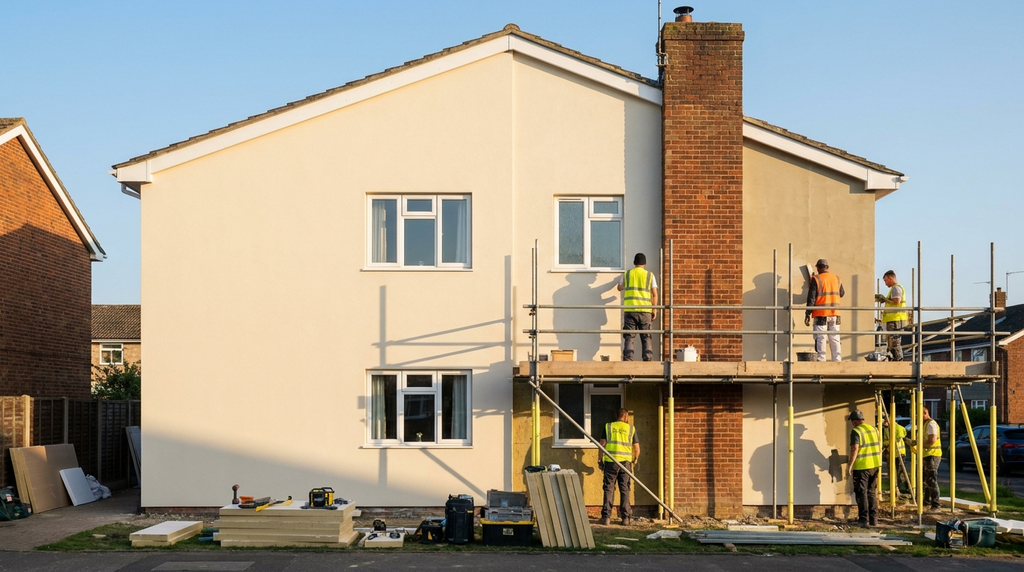
Your home loses heat through every surface that separates warm interior air from cold outdoor air. In a solid-walled property, the external walls typically account for around 35% of total heat loss, more than the roof or floor. EWI addresses this by attaching a rigid or semi-rigid insulation board directly to the outside face of your existing masonry, then finishing it with a reinforced render, cladding, or brick slip system.
The insulation material has a very low thermal conductivity (lambda value), measured in W/mK. The lower the lambda, the better the material resists the flow of heat. A 100mm layer of expanded polystyrene (EPS), for example, has a U-value contribution that can bring a solid brick wall from approximately 2.1 W/m²K down to around 0.30 W/m²K, well within the Building Regulations Part L target of 0.30 W/m²K for existing walls.
Because the insulation wraps continuously around the building, it also eliminates thermal bridging, the weak points at window reveals, floor junctions, and structural elements where heat escapes disproportionately through uninsulated sections. This is a major advantage over internal insulation, which often leaves these junctions unresolved. The outer render or cladding layer provides weatherproofing, so the insulation itself is never exposed to moisture.
The system also raises the temperature of your internal wall surfaces, which reduces condensation and the risk of mould growth, a genuine health benefit in older, cold homes.
Types of External Wall Insulation Systems
EWI is not a single product, it is a system comprising an insulation layer and a finish layer. The choice of each affects cost, performance, appearance, and suitability for your property.
Insulation Board Materials
- Expanded Polystyrene (EPS): The most widely used material in the UK. Lambda value around 0.032–0.038 W/mK. Cost-effective, widely available, and compatible with most render finishes. Typically installed at 90–150mm thickness.
- Mineral Wool (Rock or Stone Wool): Slightly higher lambda value (0.034–0.040 W/mK), so requires a thicker layer to match EPS performance. Better fire resistance and vapour permeability, important for breathable walls in older buildings. Often preferred for heritage or listed properties where planning guidance recommends breathable systems.
- Phenolic Foam: The best thermal performance available, with lambda values as low as 0.020–0.022 W/mK. Thinner boards achieve the same U-value, which is useful where planning restrictions limit how much the building line can be extended. More expensive than EPS.
- Polyisocyanurate (PIR): Similar performance to phenolic foam at around 0.022–0.025 W/mK. Common where a slim profile is needed.
- Wood Fibre: A natural, breathable option with a lambda of around 0.038–0.042 W/mK. Increasingly used on traditional solid-wall buildings where vapour permeability is critical. Higher cost but strong environmental credentials.
Finish Systems
The insulation boards are always covered by a protective and decorative finish. The main options are through-coloured render (a multi-coat acrylic, silicone, or mineral render applied over a reinforcing mesh embedded in adhesive), brick slips (thin brick-effect tiles that replicate the appearance of traditional masonry), and rainscreen cladding (panels of fibre cement, timber, or metal fixed over a ventilated cavity). Render is the most common and cost-effective. Brick slips are popular for planning-sensitive areas. Cladding suits modern or commercial-style aesthetics.
How Much Does External Wall Insulation Cost in 2026
EWI is one of the more significant home improvement investments, and costs vary considerably based on property size, chosen system, and site complexity. The figures below reflect 2026 UK market rates including materials and labour for a standard installation.
| Property Type | Approx. Wall Area | EPS Render System | Mineral Wool Render System | Phenolic Foam System |
|---|---|---|---|---|
| Mid-terrace house | 50–70 m² | £6,000–£9,000 | £7,500–£11,000 | £9,000–£13,000 |
| End-terrace or semi-detached | 80–110 m² | £9,000–£14,000 | £11,000–£17,000 | £13,000–£20,000 |
| Detached house (medium) | 120–160 m² | £13,000–£20,000 | £16,000–£24,000 | £18,000–£27,000 |
| Detached house (large) | 180–250 m² | £18,000–£28,000 | £22,000–£33,000 | £25,000–£38,000 |
What Affects the Final Price
- Scaffolding: Typically adds £800–£2,500 depending on property height and access complexity. It is unavoidable for most EWI projects.
- Window and door reveals: Insulating around openings is fiddly work. Deep reveals require additional labour and materials, particularly on properties with many windows.
- Existing render removal: If your walls have failing or loose render, this must be stripped before installation, add £500–£2,000 depending on extent.
- Brick slip or cladding finishes: Premium finishes cost 20–40% more than standard silicone render.
- Detailing around features: Soffits, bay windows, dormers, and decorative cornices all increase complexity and cost.
| Cost Component | Typical Range | Notes |
|---|---|---|
| Insulation boards (supply) | £15–£45 per m² | EPS cheapest, phenolic most expensive |
| Render system (supply and fix) | £25–£55 per m² | Silicone renders at upper end |
| Labour | £35–£60 per m² | Varies by region, London/SE higher |
| Scaffolding | £800–£2,500 per project | Fixed cost regardless of system type |
| Planning application (if required) | £206–£462 | Only needed in designated areas or for listed buildings |
On a cost-per-m² basis, most EWI projects land between £80 and £150 per m² fully installed. A typical semi-detached house with 90m² of treatable wall area and a standard EPS render system therefore falls in the £7,500–£13,500 range after any applicable grants. Payback periods depend heavily on your current energy costs and heating system, but range from 15 to 25 years without grants, falling to 8–15 years with funding support.
Benefits of External Wall Insulation
The case for EWI extends well beyond lower energy bills, though those savings are the primary driver for most homeowners.
Energy Savings and Carbon Reduction
A solid-walled UK home typically loses around 8,000–12,000 kWh of heat per year through its external walls alone. Effective EWI can reduce this by 35–45%, saving 2,800–5,400 kWh annually. At 2026 electricity and gas tariff rates, this translates to savings of approximately £300–£500 per year for an average gas-heated semi-detached property. Homes using oil or electric heating will see larger savings given higher fuel costs per kWh.
From a carbon perspective, reducing gas consumption by 4,000 kWh per year saves approximately 730kg of CO₂ annually, equivalent to around 3,000 miles driven in a typical petrol car.
EPC Rating Improvement
EWI is one of the most powerful measures for improving your home’s Energy Performance Certificate (EPC) rating. A solid-walled home typically sits at EPC band E or F. EWI alone can push a property into band C or D, which is increasingly important as mortgage lenders, lettings legislation, and home buyers pay closer attention to energy ratings. From 2025 onwards, rental properties face tighter EPC requirements, and EWI is often the only realistic route to compliance for solid-walled landlords.
Comfort and Indoor Air Quality
Cold wall surfaces cause discomfort through radiant heat loss, even in a room heated to 21°C, sitting near a cold solid wall at 8°C makes you feel chilly. EWI brings internal wall surface temperatures up significantly, making rooms genuinely more comfortable at lower thermostat settings. The elimination of condensation also removes the conditions that allow black mould to grow, improving indoor air quality particularly in bedrooms and bathrooms.
Property Protection and Weatherproofing
A quality EWI render system seals cracks, bridges minor defects in the masonry, and provides a durable weatherproof skin. This protects the underlying brickwork from freeze-thaw damage, water ingress, and biological growth. Some installers warrant their render systems for 25 years, and well-maintained EWI on a solid property can extend the functional life of the external wall envelope significantly.
Aesthetic Refresh
If your home’s exterior render or brickwork is tired, stained, or cracked, EWI provides a complete cosmetic renewal as a natural by-product of the installation. The new render finish comes in a wide range of colours and textures. For properties that look worn or dated, this is a meaningful additional benefit.
How to Choose the Right External Wall Insulation
The right EWI system depends on your property’s construction, your planning context, your budget, and your performance targets. Use the following framework to make an informed decision.
Is Your Wall Solid or Cavity
EWI is the primary solution for solid walls, those built as a single continuous mass of brick, stone, or block with no internal cavity. If your home was built after around 1930 and has cavity walls that have not yet been insulated, cavity wall insulation is significantly cheaper and should be your first step. Read our Cavity Wall Insulation guide to understand whether your home qualifies and what the process involves. Homes built between roughly 1920 and 1975 may have narrow or steel-tied cavities that cannot be filled, making EWI a viable alternative.
Breathability Requirements
Older solid-wall properties, particularly those built with lime mortar and soft brick, need to breathe. Trapping moisture within the wall structure causes decay and damp problems. For these properties, choose a vapour-open system using mineral wool insulation with a mineral or silicone render, or a wood fibre board system. EPS and phenolic foam are less vapour-permeable and can be problematic on some traditional constructions. An experienced surveyor or EWI specialist should assess this before specification.
Planning Permission Considerations
In most cases, EWI on a standard house falls under permitted development rights, you do not need planning permission. However, you will need to apply if your property is in a Conservation Area, is a listed building, or if the work would materially alter the external appearance in a way that contradicts local planning policy. Article 4 Directions in some local authority areas also remove permitted development rights for EWI. Always check with your local planning authority before proceeding.
Thickness and Build-Out
EWI adds physical depth to your walls, typically 90–150mm for EPS, 80–120mm for mineral wool, and 60–100mm for phenolic or PIR. This build-out has practical implications: window and door frames may need to be extended, drainage pipes rerouted, and soffits adjusted. If your property is close to a boundary, the additional thickness may become a planning consideration. Where build-out is severely restricted, a high-performance slim-profile phenolic system allows you to achieve good U-values within a tighter envelope.
Installer Accreditation
Always use an installer registered with the Competent Person Scheme for EWI, specifically SWIGA (Solid Wall Insulation Guarantee Agency) registered companies, or installers carrying PAS 2030 and PAS 2035 certification. These accreditations ensure the installation meets the technical standard required for grant funding and provide access to long-term product warranties. Never commission EWI from a contractor who cannot demonstrate these credentials.
External Wall Insulation Installation, What to Expect
A typical EWI installation on a semi-detached house takes 5–10 working days, depending on complexity. Understanding the process helps you prepare and manage the disruption effectively.
- Survey and specification: A technical surveyor visits to assess wall construction, condition, existing finishes, and any damp or structural issues. The system is specified at this stage, with U-value calculations confirming the insulation thickness required.
- Scaffold erection: A full scaffold is erected around the areas to be treated, typically taking half a day. The scaffold will remain in place throughout the installation and render curing period.
- Surface preparation: Any loose render, unstable masonry, or defective pointing is repaired. The wall surface must be structurally sound and clean before boards are applied.
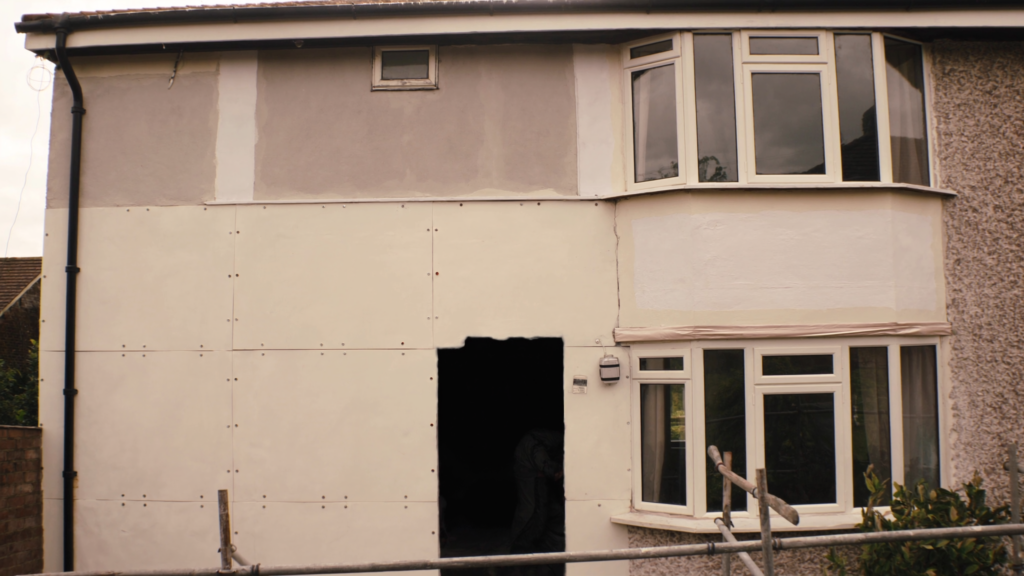
- Insulation board fixing: Boards are fixed using a combination of adhesive mortar and mechanical fixings (purpose-designed plastic or metal anchors driven into the masonry). Board joints are staggered to eliminate continuous vertical joints. Around windows and doors, boards are cut precisely and pre-formed corner beads installed.
- Reinforcing mesh application: A fibreglass reinforcing mesh is embedded into a basecoat adhesive applied over the boards. This mesh provides impact resistance and prevents cracking in the render system. Corner beads, stop beads, and expansion joints are fitted at this stage.
- Primer application: A primer coat is applied to the basecoat layer to prepare the surface for the final render and ensure consistent colour and adhesion.
- Final render or finish: The decorative topcoat is applied, either a through-coloured silicone, acrylic, or mineral render, or the first fixing of brick slips or cladding. Textured finishes are typically applied with a float to create the specified surface pattern.
- Detailing and clean-up: Window sills, soffits, drainage brackets, and meter boxes are reinstated. Scaffolding is struck once the render has fully cured, typically 48–72 hours after final coat in dry conditions.
During installation, your exterior will be mostly obscured by scaffold and sheeting. There is minimal disruption to interior life, no rooms need to be cleared and no internal access is required for a standard EWI project.
Grants and Funding for External Wall Insulation
External wall insulation is an expensive measure, but UK government support can reduce or even eliminate the upfront cost for qualifying households. The funding landscape in 2026 includes several overlapping schemes.
Great British Insulation Scheme
The Great British Insulation Scheme closed on 31 March 2026. It funded insulation measures only and never covered windows or glazing. EWI is an eligible measure. Eligibility is means-tested, households receiving qualifying benefits (including Universal Credit, Pension Credit, and Child Tax Credit) are prioritised, and a broader group based on Council Tax band and EPC rating may also qualify. Contact your energy supplier directly to apply, or use the government’s online eligibility checker.
Energy Company Obligation (ECO4)
The ECO4 scheme requires energy suppliers to fund energy efficiency upgrades for fuel-poor and low-income households. EWI is one of the primary qualifying measures. ECO4 runs until March 2026, with a successor scheme expected thereafter. Households in receipt of means-tested benefits with homes in EPC band E, F, or G typically qualify for free or heavily subsidised EWI.
Home Upgrade Grant (HUG2) and Successor Schemes
The Home Upgrade Grant targeted owner-occupied, off-gas-grid homes in England with poor energy ratings. While HUG2 completed in 2025, the government committed to continuing support for off-gas properties through successor programmes. Check your local authority for current area-based schemes, as many councils run their own additional funding pots backed by the Warm Homes Fund.
VAT Relief
Since April 2022, EWI installation on residential properties attracts 0% VAT, down from 20% previously. This effectively provides a 16.7% cost reduction compared to pre-2022 pricing. The zero rate applies to both materials and labour, provided the work meets the qualifying conditions (installation in a dwelling by a registered installer).
Scotland, Wales, and Northern Ireland
Homeowners outside England should check devolved schemes: Warmer Homes Scotland (Scottish Government), Nest and Optimised Retrofit (Welsh Government), and the Affordable Warmth Scheme (Northern Ireland). Each has its own eligibility criteria but broadly covers low-income and fuel-poor households for EWI and other major insulation measures.
Common Problems and Maintenance
EWI systems are low-maintenance by design, but like any external building element they require periodic attention to perform well over their intended lifespan.
Render Cracking
Hairline cracking in the render topcoat is the most common issue, and usually cosmetic rather than structural. It typically results from thermal movement, application in poor conditions, or inadequate reinforcing mesh in the basecoat. Hairline cracks in a good silicone render are generally self-sealing due to the material’s flexibility. Wider cracks, particularly at window reveals or expansion joints, should be investigated by the installing company and resealed with appropriate filler or sealant.
Impact Damage
The lower sections of EWI systems, typically below 2 metres, are vulnerable to impact from ladders, garden equipment, and accidental collisions. Most systems use a higher-density board and double mesh layer at ground level, but damage can still occur. Small areas of render damage are straightforward to repair; board damage requires cutting out and replacing the affected section. Use an accredited installer for repairs to maintain warranty validity.
Water Ingress at Details
The junctions where the EWI system meets windows, doors, soffits, and pipe penetrations are the most vulnerable points for water ingress. These are sealed with flexible sealant at installation, but sealant has a finite lifespan, typically 10–15 years. Inspect these details annually and reseal any gaps or cracks before they allow water behind the system. Penetrating damp into the insulation layer significantly reduces performance and is expensive to remedy.
Biological Growth
Algae and moss can colonise render surfaces, particularly on north- or east-facing elevations that stay damp for long periods. Most modern silicone renders include biocide additives that resist growth for 10–15 years. Once this protection diminishes, periodic washing with a dilute biocide solution (every 5–7 years) maintains appearance and prevents staining. Avoid pressure washing, which can damage the render surface.
Ongoing Inspection Routine
- Annually: Check all sealant joints around windows, doors, and service penetrations. Look for any cracks wider than 0.5mm.
- Every 3–5 years: Clean the render surface if biological growth is visible. Check the condition of window sills and their junction with the EWI system.
- Every 10–15 years: Reseal all flexible joints as preventative maintenance. Consider a light decorative overcoat if colour has faded significantly.
- After any storm damage: Inspect for impacts, displaced sections, or compromised flashings.
External Wall Insulation and Planning Rules
Understanding permitted development rights for EWI prevents costly mistakes and project delays. In England, EWI on a house (not flat) falls under Class A of the General Permitted Development Order, meaning no planning application is required provided the work does not involve a listed building and the property is not in a Conservation Area, World Heritage Site, National Park, or Area of Outstanding Natural Beauty. In these designated areas, prior approval or full planning permission is required, and the local planning authority will consider the visual impact on the character of the area.
In practice, EWI with a render finish that closely replicates the original wall appearance, same colour, similar texture, is more likely to gain approval in sensitive areas than a dramatically different finish. Brick slip systems are specifically built to address this concern and have a strong track record of planning approval in Conservation Areas where original brickwork is being replicated.
For flats and maisonettes, any external works affecting the building’s appearance typically require freeholder consent and, in most cases, planning permission. If you own a flat, engage with your managing agent or freeholder at the earliest stage, whole-building EWI projects covering all flats simultaneously are significantly more cost-effective and are more readily fundable through grant schemes.
Is External Wall Insulation Right for Your Home
EWI is the right choice when your home has solid walls that cannot be cavity-filled, when internal insulation would significantly reduce floor area or disturb internal finishes, or when you want to combine energy improvement with exterior renovation. It is the most thermally effective solution for solid-walled properties and the only approach that also eliminates thermal bridging at junctions.
It is a less natural fit for properties in conservation areas where matching the original appearance is difficult, for homes very close to boundaries where the build-out would cause problems, or for properties where planning restrictions cannot be navigated. In these cases, internal wall insulation deserves serious consideration as an alternative, though it will not match the whole-wall thermal performance of a well-specified EWI system.
For the majority of solid-walled UK homeowners, particularly those in EPC bands E, F, or G who are eligible for grant support, external wall insulation represents the single most impactful investment available. The combination of genuine energy savings, comfort improvement, EPC uplift, property protection, and aesthetic renewal makes a compelling case that goes well beyond the headline heating bill reduction.