The typical 1930s semi-detached loses heat at a rate of 10–12 kW, costing roughly £1,200–£1,500 a year to heat at 2026 prices
A 1930s semi-detached home with uninsulated walls loses heat at a rate of 10–12 kW in cold weather, according to DESNZ Housing Stock Condition Data (DESNZ, 2026). This means the heating system must supply that much energy every hour to maintain a comfortable indoor temperature. At the Ofgem price cap projected for 2026 at £0.28 per kWh for gas (Ofgem, 2026), the annual heating cost for such a home is roughly £1,200 to £1,500.
Actual costs vary depending on your location, your thermostat setting, and how much insulation you already have. The key decision for any 1930s home is choosing the right insulation package for its specific construction. These homes typically have one of three wall types: solid brick (9-inch thick), an uninsulated cavity (a gap between two brick layers), or a mix of both. Many also have suspended timber ground floors and uninsulated lofts.
Cavity-wall insulation is the most cost-effective single measure, payback in under three years
Most 1930s homes with cavity walls have unfilled cavities, typically 50–70mm wide. The Energy Saving Trust identifies cavity-wall insulation as the priority measure for these homes (Energy Saving Trust, 2026).
The typical cost for a semi-detached home is £600 to £1,200, with annual savings of £200 to £300 (Energy Saving Trust Insulation Calculator, 2026). The U-value, a measure of how quickly heat passes through a material, improves from roughly 1.5 W/m²K to 0.5 W/m²K (BRE Domestic Insulation Standards, 2026). This means the wall loses heat at one-third of the previous rate.
The Great British Insulation Scheme closed on 31 March 2026. It funded insulation measures only and never covered windows or glazing. Eligibility depends on your household income and the energy performance rating of your home.
Solid-wall insulation costs £8,000–£14,000 but cuts heat loss by 45–50%
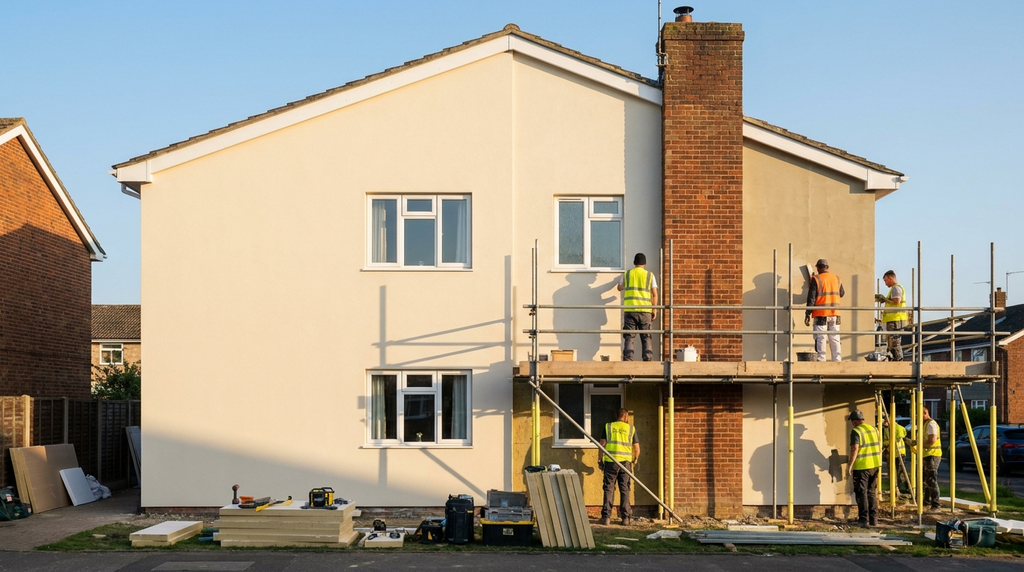
Many 1930s homes have solid brick walls, 9 inches thick with no cavity. These cannot be filled with cavity-wall insulation. Historic England notes that solid walls require either internal or external solid-wall insulation (Historic England, 2026).
External wall insulation for a semi-detached home costs £8,000 to £14,000 (Energy Saving Trust, 2026). The U-value improves from 2.1 W/m²K to 0.3 W/m²K (BRE Domestic Insulation Standards, 2026). DESNZ models show this reduces heat loss by 45–50%, saving £400 to £600 per year on heating bills (DESNZ, 2026).
Planning permission may be required for external insulation if your home is in a conservation area or is a listed building (GOV.UK, 2026). Check with your local planning authority before starting work.
Loft insulation is a prerequisite, topping up from 100mm to 270mm saves £200–£300 a year
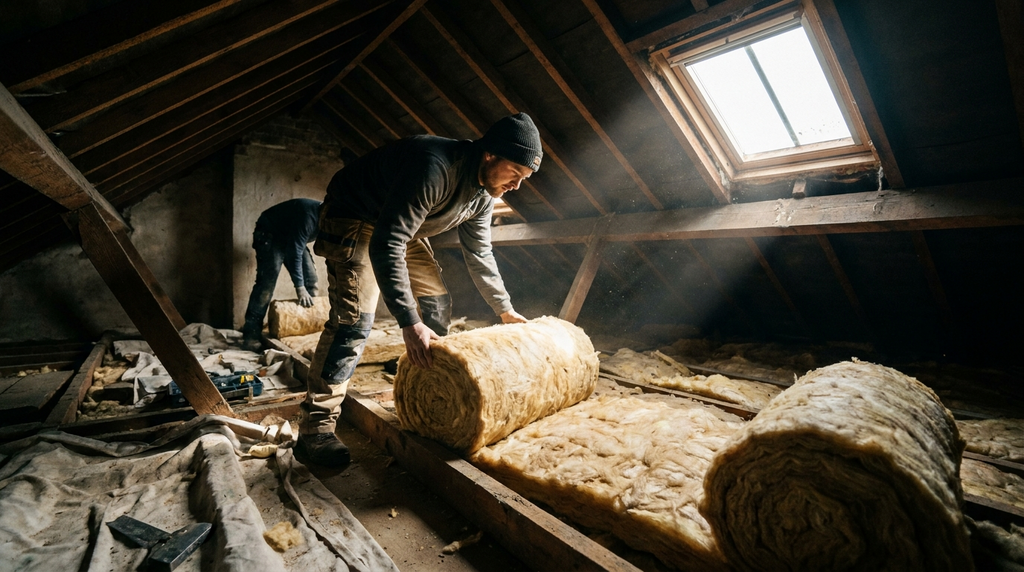
Most 1930s homes have less than 100mm of loft insulation. The 2026 recommended depth is 270mm (Energy Saving Trust, 2026). Topping up from 100mm to 270mm costs £200 to £400 for a DIY job on a typical semi-detached (Energy Saving Trust Insulation Calculator, 2026).
The annual saving is £200 to £300 (Energy Saving Trust, 2026). The Great British Insulation Scheme closed on 31 March 2026. It funded insulation measures only and never covered windows or glazing.
Quick numbers, cost, saving, and payback for the three main measures
| Measure | Typical cost | Annual saving | Payback period | U-value improvement |
|---|---|---|---|---|
| Cavity-wall insulation | £600–£1,200 | £200–£300 | 2–3 years | 1.5 to 0.5 W/m²K |
| Solid-wall insulation (external) | £8,000–£14,000 | £400–£600 | 15–25 years | 2.1 to 0.3 W/m²K |
| Loft insulation top-up (to 270mm) | £200–£400 | £200–£300 | 1–2 years | 0.5 to 0.16 W/m²K |
Sources: Energy Saving Trust Insulation Calculator (2026); BRE Domestic Insulation Standards (2026); DESNZ Energy Efficiency Savings Model (2026); Ofgem Price Cap Projection (2026).
The direct answer you should install cavity-wall insulation first, then loft insulation, and consider solid-wall insulation only if your home has solid walls
Cavity-wall insulation is the priority because it is cheap, quick, and has the fastest payback, under three years for most homes. Loft insulation is the near-essential second step, with minimal disruption and a payback of one to two years.
Solid-wall insulation is only necessary for homes with solid walls. You can check by measuring the wall thickness at a window or door reveal. If the total thickness is 9 inches (230mm) or more, the wall is likely solid brick. If it is less than 9 inches, it is probably a cavity wall.
For most 1930s semi-detached homes with cavity walls, the optimal package is cavity fill plus a loft top-up. This combination costs £800 to £1,600 total and saves £400 to £600 per year. How to check if your 1930s home has cavity or solid walls
Eligibility and certification, you need an MCS-certified installer for cavity-wall insulation to qualify for grants
The Microgeneration Certification Scheme (MCS) is required for all insulation installed under the Great British Insulation Scheme (GOV.UK, 2026). For cavity-wall insulation, the installer must also be registered with the Cavity Insulation Guarantee Agency (CIGA) to qualify for the 25-year guarantee (MCS, 2026; CIGA, 2026).
The Great British Insulation Scheme closed on 31 March 2026. It funded insulation measures only and never covered windows or glazing.
Before hiring an installer, check the MCS register at mcs.org.uk or the TrustMark database at trustmark.org.uk. What to check before hiring an insulation installer