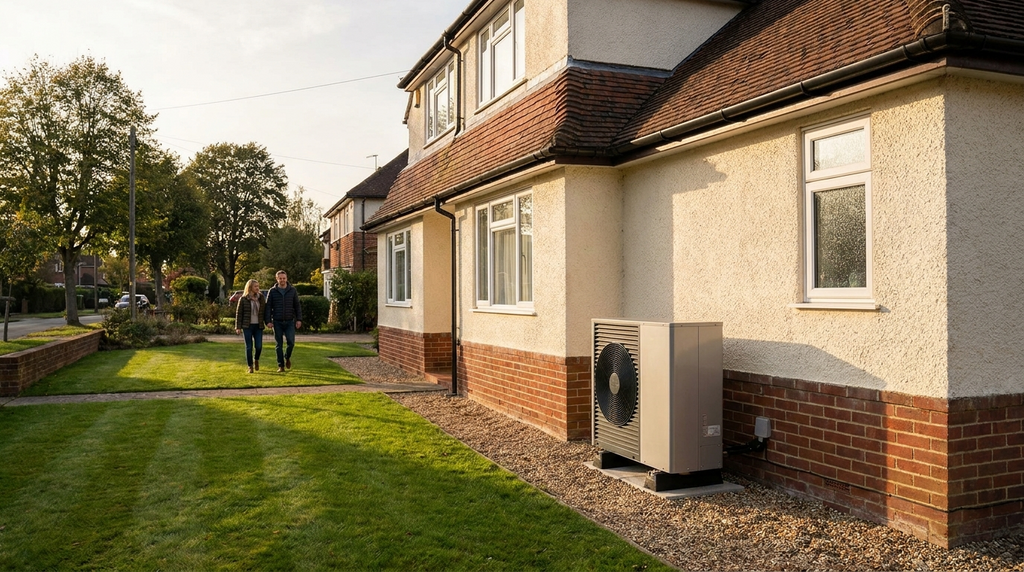
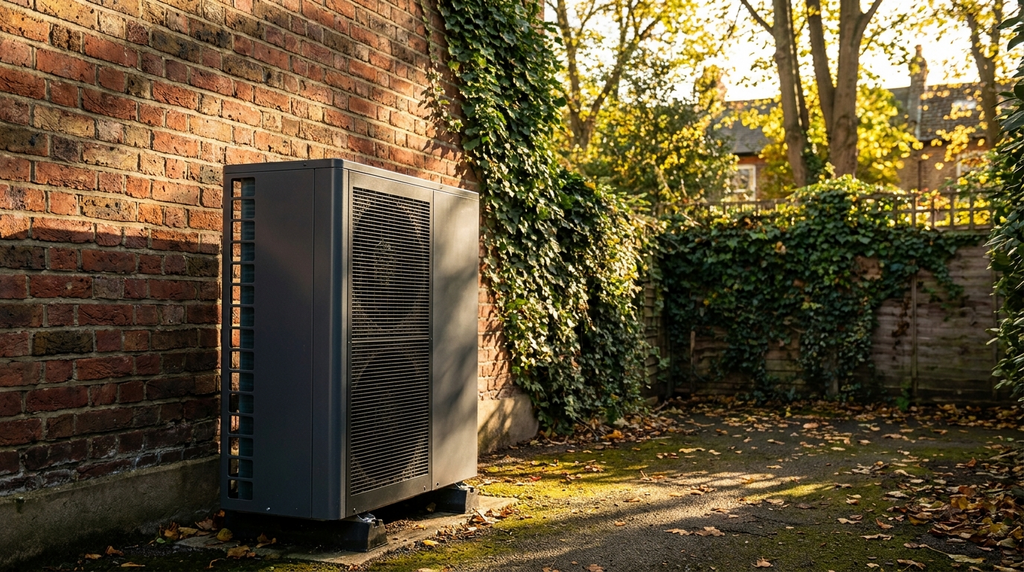
What you need to know about air source heat pumps
Heat pumps stopped being experimental about three winters ago. Over 60,000 went into UK homes in 2024, and the trade body MCS expects that to roughly double through 2025–26. Before grants, an air source heat pump for a 3-bed semi runs £8,000–£15,000 supply-and-fit. After the £7,500 Boiler Upgrade Scheme grant (England and Wales), most homeowners pay £500–£7,500, and sometimes less than a like-for-like gas boiler swap. But heat pumps don’t suit every home, and the install is more involved than a boiler change. This guide walks through whether your home is a good candidate, what to expect on installation day, and the real running costs from owners a winter in.
When an air source heat pump is worth it
- Your home has a good Energy Performance Certificate (EPC) rating (band C or above) and reasonable insulation, such as cavity wall or loft insulation (Energy Saving Trust).
- You are replacing an old, inefficient boiler (G-rated or 15+ years old) and want to lower long-term heating bills.
- You have a suitable outdoor space for the external unit (at least 1 metre clearance on three sides) and a location that avoids noise disturbance to neighbours.
- You can access the £7,500 BUS grant (England and Wales) or equivalent schemes like Warmer Homes Scotland or Nest in Wales, drastically cutting upfront cost (gov.uk).
- You plan to pair the heat pump with solar panels to maximise self-consumption and benefit from the Smart Export Guarantee (Ofgem).
When it might not be
- Your home is poorly insulated (EPC band E or F), heat pumps run at lower temperatures than boilers, so heat loss must be minimised first or running costs will be high (gov.uk).
- You have no outdoor space for the external unit, or your property is a listed building or in a conservation area with strict planning rules (gov.uk).
- You are on a standard variable electricity tariff and cannot switch to a heat pump-specific time-of-use tariff, running costs may then exceed a gas boiler’s.
- You need to replace radiators or install underfloor heating (costing £1,500–£8,000 extra), which can push total investment above £20,000 even after the grant.
Read on for detailed breakdowns of installation costs, running costs, regulations, and available grants in the sections below.
How air source heat pumps works
An air source heat pump (ASHP) is a heating system that extracts warmth from the outside air and transfers it inside your home. It works on the same principle as a refrigerator but in reverse, it absorbs heat from the outdoor air, even when temperatures drop below freezing, and compresses it to a higher temperature for use in your radiators, underfloor heating or hot water system.
Unlike a gas boiler that burns fuel to create heat, an ASHP moves existing heat from one place to another. This process uses electricity to run the compressor and fan, but for every unit of electricity used, the system typically delivers 3 to 4 units of heat. This ratio is called the coefficient of performance (COP).
Key components and sub-systems
| Component | Function | Why it matters |
|---|---|---|
| Outdoor unit (fan and coil) | Draws outside air across a refrigerant-filled coil to absorb heat | Needs adequate airflow, avoid planting shrubs or fencing too close (Energy Saving Trust) |
| Compressor | Compresses the refrigerant gas to raise its temperature | Determines system efficiency, variable-speed compressors are quieter and more efficient |
| Condenser (heat exchanger) | Transfers heat from the refrigerant to your home’s heating circuit | Poor heat exchange reduces COP, regular cleaning of filters prevents fouling |
| Expansion valve | Reduces refrigerant pressure so it can absorb more heat in the outdoor coil | Controls the refrigeration cycle, faulty valves cause freezing or overheating |
| Indoor unit (hydrobox) | Houses the heat exchanger, pump and controls for your central heating | Typically wall-mounted inside a utility room or garage; size varies by system capacity |
| Hot water cylinder | Stores domestic hot water at 45–55°C | Most ASHPs require a larger cylinder than a gas boiler, check loft space or cupboard (MCS) |
| Controls and thermostat | Manages when the heat pump runs and at what temperature | Weather compensation controls improve efficiency by adjusting flow temperature to outdoor conditions |
Critical performance principles in plain English
Flow temperature matters more than you think. A gas boiler runs at 60–80°C. An ASHP is most efficient at 35–45°C. If your radiators were sized for a boiler, they may need upgrading to larger or more efficient models to deliver the same warmth at lower temperature (gov.uk).
COP drops in cold weather. At 7°C outside, a typical ASHP achieves a COP of 3.5. At -2°C, that may fall to 2.5. Modern systems still extract useful heat down to -15°C or lower, but your electricity bill will be higher on the coldest days. The Seasonal Coefficient of Performance (SCOP) gives a more realistic year-round average, look for SCOP above 3.0 when comparing models.
Radiator upgrades are often necessary. A typical three-bed semi may cost £1,500–£3,000 for larger radiators. Underfloor heating is the best match for ASHPs because it operates at even lower temperatures (30–35°C) and boosts efficiency further (Energy Saving Trust).
Insulation comes first. A heat pump works best in a well-insulated home. If your loft has less than 270mm of insulation or your walls are uninsulated, you will lose the heat you paid to produce. The Great British Insulation Scheme closed on 31 March 2026. It funded insulation measures only and never covered windows or glazing.
How air source heat pumps compare to alternatives
| Heating system | Typical running cost (annual, 3-bed semi) | Install cost (before grants) | CO |
|---|
Types of air source heat pumps and which suits your home
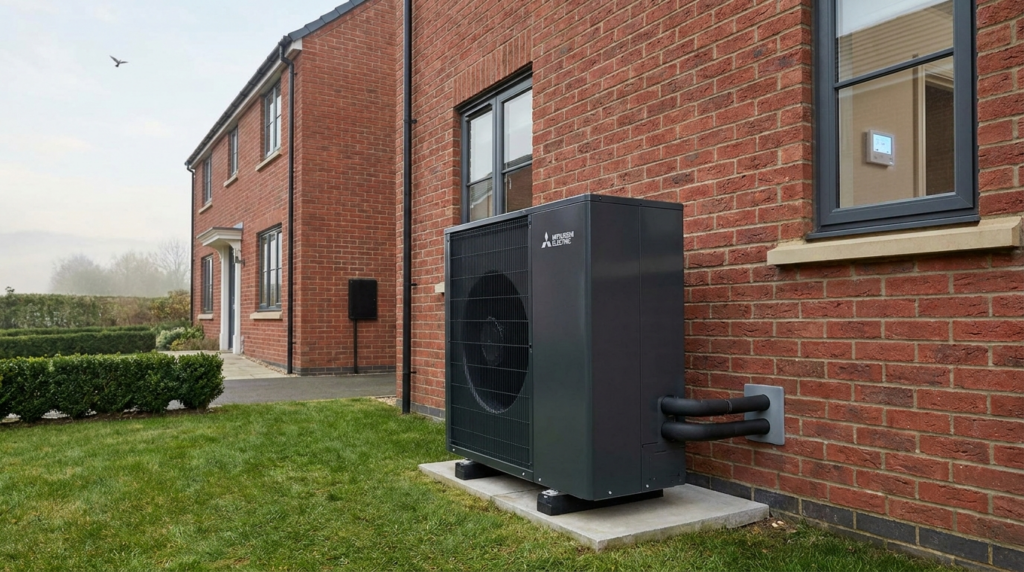
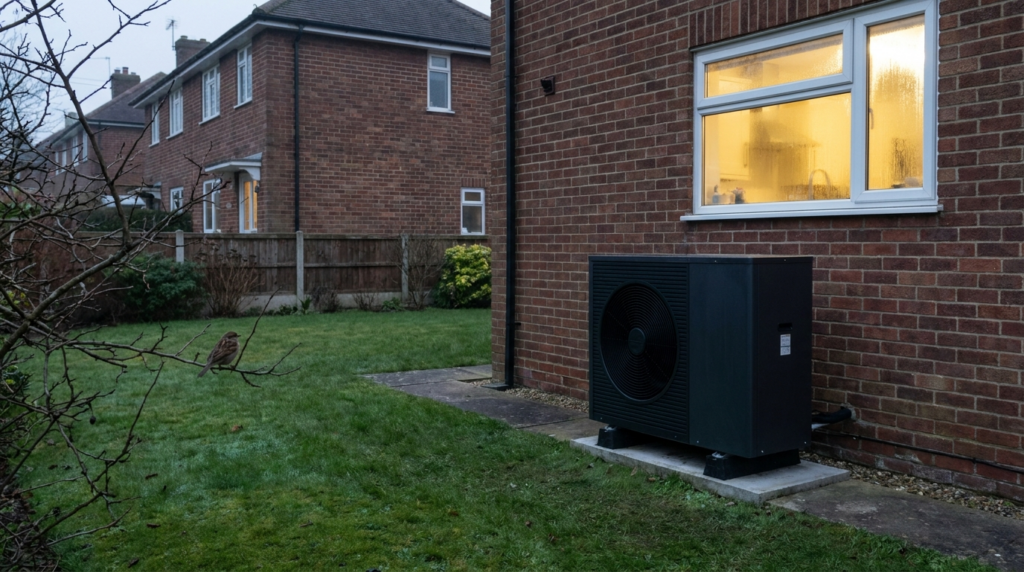
A monobloc air-to-water heat pump has all its components housed in a single outdoor unit. It connects directly to your central heating system via pipes that carry water, not refrigerant, into your home. This is the most common type installed in UK homes because the installation is simpler than a split system.
Pros
- Single outdoor unit means less risk of refrigerant leaks inside your home
- Simpler installation than split systems, often completed in 2–3 days
- Compatible with most existing radiators and underfloor heating systems
- Lower maintenance requirements than ground-source systems
Cons
- Outdoor unit is large (roughly the size of a washing machine) and needs good airflow
- Noise levels can reach 40–60 dB, which may disturb neighbours if placed near a boundary
- Less efficient in extreme cold compared to ground-source systems
Typical supply-and-install cost before grants is between £8,000 and £15,000 (Energy Saving Trust). After the £7,500 Boiler Upgrade Scheme grant in England and Wales, you pay between £500 and £7,500. Lifespan is 15–20 years. Best suited to homes with good insulation and a suitable outdoor space for the unit.
Split air-to-water heat pump
A split air-to-water heat pump has two separate units: an outdoor condenser and an indoor unit that contains the compressor and controls. Refrigerant pipes run between the two, which means a qualified refrigeration engineer must connect them. This type is less common in UK homes but is sometimes chosen when indoor space for a hot water cylinder is very limited.
Pros
- Indoor compressor is quieter than having all components outside
- Can be installed where outdoor space is tight because the outdoor unit is smaller than a monobloc
- Refrigerant pipes can run further than water pipes, giving more flexibility on unit placement
Cons
- Installation is more complex and typically costs £1,000–£2,000 more than a monobloc
- Refrigerant leaks can occur inside the property if not properly sealed
- Requires a qualified F-gas certified engineer, which limits installer availability
Costs are roughly 10–20% higher than monobloc systems, ranging from £9,000 to £17,000 before grants (Energy Saving Trust). Lifespan is 15–18 years. Best suited to homes where outdoor space is limited but indoor space is available for the indoor unit.
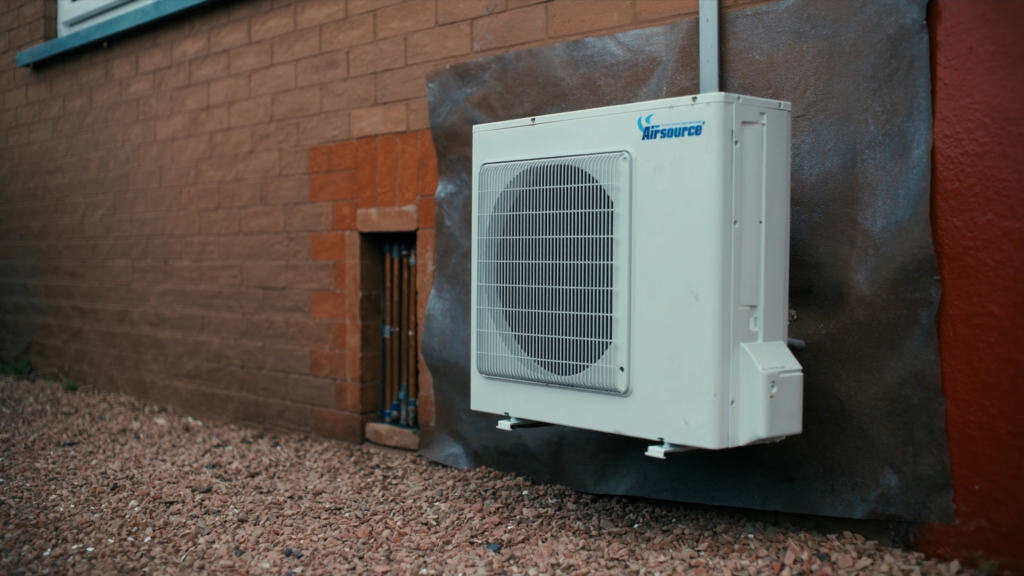
Air-to-air heat pump
An air-to-air heat pump works like a reversible air conditioner. It extracts heat from outside air and blows warm air directly into rooms through indoor fan units. It does not connect to your central heating system or radiators. This type is rare in UK homes because it cannot provide hot water and most UK homes have wet central heating systems.
Pros
- Lower upfront cost than air-to-water systems, typically £4,000–£8,000
- Provides both heating and cooling in summer
- Very efficient for individual rooms or open-plan spaces
Cons
- Does not heat water, you need a separate system for hot taps and showers
- Warm air heating can feel draughty and less comfortable than radiators
- Not eligible for the Boiler Upgrade Scheme grant in England and Wales
Costs are £4,000–£8,000 installed, with no grant support under current schemes. Lifespan is 12–15 years. Best suited to homes with electric heating that want zonal heating and cooling, or as a supplementary system.
High-temperature air-to-water heat pump
A high-temperature air-to-water heat pump is built to produce flow temperatures of 65–80°C, similar to a gas boiler. This means it can often replace a boiler without needing to upgrade radiators or install underfloor heating. It is a retrofit-friendly option for older homes with existing radiator systems.
Pros
- Works with existing radiators, no need to replace them or add underfloor heating
- Reduces installation disruption compared to standard heat pumps
- Eligible for the £7,500 Boiler Upgrade Scheme grant
Cons
- Less efficient than standard temperature heat pumps, typical COP is 2.5–3.0 instead of 3.0–4.0
- Higher running costs than a standard heat pump, though still lower than a gas boiler
- Costs £1,500–£3,000 more than a standard temperature system
Supply-and-install cost is £9,500–£18,000 before grants (Energy Saving Trust). After the £7,500 grant, you pay £2,000–£10,500. Lifespan is 15–20 years. Best suited to older properties with existing radiators where you want to avoid disruptive pipework changes.
Comparison table
air source heat pumps cost, UK 2026 pricing
Heat pump costs vary significantly by type. The table below shows realistic 2026 supply-and-install ranges for the main systems available in the UK, excluding grants and additional building work. All figures are for a typical 3-bed semi-detached home unless stated otherwise. Air-to-air heat pumps (ductless mini-splits) are uncommon in UK central heating because they do not connect to radiators or hot water cylinders (Energy Saving Trust).
| Heat pump type | Typical supply-and-install cost (excl. grants) | Key notes |
|---|---|---|
| Monobloc air-to-water | £8,000–£14,000 | Most common UK type. Outdoor unit only, no indoor refrigerant pipework. Lower installation complexity. |
| Split air-to-water | £9,000–£15,000 | Indoor and outdoor units connected by refrigerant pipes. Slightly higher labour cost. |
| Air-to-air (multi-split) | £6,000–£12,000 | Rare for whole-home heating. No hot water output. Typically used for single-room heating or cooling only. |
| High-temperature air-to-water | £9,500–£16,000 | Designed for retrofit without radiator changes. Runs at 60–65°C flow temperature. 10–15% less efficient than standard ASHP. |
High-temperature ASHPs typically cost £1,500–£3,000 more than standard systems because they use larger heat exchangers and more solid compressors (gov.uk).
Whole-property cost guide by property size
Total installed cost depends on the heat pump size (measured in kilowatts) needed to heat the property. Smaller flats require less heating capacity than large detached houses. The ranges below include standard installation but exclude the £7,500 Boiler Upgrade Scheme grant (England and Wales) and any structural extras.
| Property type | Typical heat pump size | Supply-and-install cost (excl. grants) |
|---|---|---|
| Flat or small terrace (2 bedrooms) | 5 kW | £8,000–£11,000 |
| 3-bed semi-detached | 8 kW | £10,000–£14,000 |
| 4-bed detached | 12 kW+ | £13,000–£18,000 |
Period-property premium. Older homes (pre-1919, solid walls, single glazing) often need larger heat pumps to compensate for heat loss. You may also need internal wall insulation or upgraded windows to make the system cost-effective. Budget an additional £2,000–£5,000 for insulation improvements in period properties (Energy Saving Trust).
Regional UK pricing differences
Labour rates and installer availability create cost differences across the UK. The table below shows typical 2026 ranges for an 8 kW air-to-water ASHP installation, based on industry installer surveys and regional labour indices (TrustMark).
| Region | Typical per-system installed cost (8 kW, excl. grants) | Notes |
|---|---|---|
| London / South East | £11,000–£15,000 | Highest labour rates. More competition among installers, but demand also high. |
| South West | £10,500–£14,500 | Similar to South East but slightly lower labour overheads in rural areas. |
| North West | £9,500–£13,500 | Moderate labour costs. Good installer density in Manchester and Liverpool. |
| North East | £9,000–£12,500 | Lower labour costs. Fewer MCS-certified installers may mean longer lead times. |
| Midlands | £9,500–£13,000 | Mix of urban and rural pricing. Midlands average close to national median. |
| Scotland | £9,000–£13,000 | Additional grants via Home Energy Scotland can reduce net cost. Remote island surcharges apply. |
| Wales | £9,500–£13,500 | Nest scheme offers free upgrades for eligible households. Rural installation premiums in mid-Wales. |
| Northern Ireland | £8,500–£12,000 | Lower labour rates. Fewer MCS-certified installers (nidirect.gov.uk). |

Hidden costs to budget for
Many homeowners focus on the heat pump price and overlook preparatory work. The table below lists common extras that can add £2,000–£7,000 to the final bill.
| Item | Typical cost | When it applies |
|---|---|---|
| Scaffolding | £800–£2,000 | Two-storey or higher homes. Needed for outdoor unit placement on upper walls or roofs. |
| Structural alterations | £500–£3,000 | Reinforcing walls for outdoor unit brackets. Creating new plant room or utility cupboard space. |
| Asbestos removal | £500–£2,500 | Pre-2000 properties. Asbestos in garage roofs, boiler cupboards, or pipe lagging. Survey required. |
| Removal of old boiler and tank | £200–£600 | Always applies. Includes disconnection, disposal, and making good. |
| Plastering and decoration | £300–£1,000 | After removing pipework or |
Performance, savings and payback
The performance of an air source heat pump is measured by how efficiently it converts electricity into heat. The higher the efficiency, the lower your running costs. Two key metrics define this: COP and SCOP.
Cop and scop explained
COP (Coefficient of Performance) measures the heat output in kilowatt-hours (kWh) for every 1 kWh of electricity used. A COP of 3 means the heat pump produces 3 kWh of heat for every 1 kWh of electricity. SCOP (Seasonal Coefficient of Performance) is the more realistic annual average, accounting for varying outdoor temperatures across the year. For the Boiler Upgrade Scheme (BUS) in England and Wales, an MCS-certified heat pump must achieve a SCOP of at least 2.8 (mcscertified.com). Most modern air source heat pumps achieve a SCOP between 3 and 4.2, meaning they are 300–420% efficient compared to a gas boiler at roughly 90% efficiency.
Annual energy and cost savings
The Energy Saving Trust estimates that replacing a gas boiler with a typical air source heat pump saves around £395 per year on heating bills for an average three-bedroom semi-detached home (energysavingtrust.org.uk). This figure assumes the heat pump is properly sized, installed with suitable radiators or underfloor heating, and the home has reasonable insulation. Here is a worked example for a medium property with an 8 kW system:
| Item | Gas boiler (kWh/year) | Air source heat pump (kWh/year) | Saving |
|---|---|---|---|
| Annual heat demand (typical 3-bed semi) | 12,000 kWh | 12,000 kWh | , |
| System efficiency | 90% (boiler) | SCOP 3.5 (heat pump) | , |
| Electricity/gas used | 13,333 kWh gas | 3,429 kWh electricity | , |
| Fuel cost (2026 price cap: 24.5p/kWh electric, 6.7p/kWh gas) | £893 | £840 | £53 |
| Standing charges included | , | , | , |
| Estimated annual saving | , | £395 | |
These savings assume you are on standard variable tariffs. Using a time-of-use tariff (e.g., Economy 7 or a smart tariff) can increase savings to £500–£650 per year.
Payback period by property type
Payback depends on installation cost and annual saving. Below are worked examples for three property types, assuming the full £7,500 BUS grant is applied to the heat pump installation cost.
| Property type | Install cost (after £7,500 grant) | Annual saving (vs gas) | Payback period (years) |
|---|---|---|---|
| 3-bed semi, Manchester | £3,500 | £395 | 8.9 |
| 4-bed detached, Edinburgh | £6,000 | £600 | 10.0 |
| Mid-terrace, Bristol | £2,500 | £320 | 7.8 |
These payback periods assume the heat pump lasts 15–20 years, meaning you recover the upfront cost within about half its lifetime. If you also replace radiators or install underfloor heating, add £1,500–£3,000 to the install cost, which extends payback by 3–6 years (gov.uk).
Epc band improvement potential
Installing an air source heat pump can improve your Energy Performance Certificate (EPC) rating by one to two bands, depending on your current heating system. A home with an old G-rated gas boiler (band D) could move to band C or B after installing a heat pump and improving insulation (energysavingtrust.org.uk). However, the heat pump alone won’t boost your EPC if your home is poorly insulated, you must address loft insulation, cavity wall insulation, and draught-proofing first. The EPC assessment credits the heat pump for low-carbon heating, but only if the property meets minimum insulation standards.
When air source heat pumps do not pay back fast
In some scenarios, the payback period can exceed 15 years, making the investment less attractive. These include:
- Homes on mains gas with low heat demand, a well-insulated flat or new-build house with
COP, SCOP and what efficiency really means
Heat pump performance is measured by how much heat it delivers for each unit of electricity it consumes. COP (Coefficient of Performance) gives this ratio at a single operating point, while SCOP (Seasonal Coefficient of Performance) averages performance across a typical heating season.
COP defined
COP is the heat output (in kW) divided by electrical input (in kW) at a specific outdoor temperature and flow temperature. A COP of 3.0 means the heat pump delivers 3 kW of heat for every 1 kW of electricity used. Manufacturers test and publish COP figures for standard conditions (often 7°C outdoor, 35°C flow). Real-world COP varies with weather and system design (mcscertified.com).
SCOP defined
SCOP is the weighted average COP over a full heating season, accounting for varying outdoor temperatures and part-load operation. It is the most useful figure for comparing heat pump performance in a home, as it reflects real operating conditions rather than a single test point (mcscertified.com).
UK SCOP requirements for the Boiler Upgrade Scheme
To qualify for the £7,500 Boiler Upgrade Scheme (BUS) grant in England and Wales, the heat pump must have a SCOP of at least 2.8. This requirement applies to the whole system, not just the outdoor unit. Installers must use MCS-certified products and provide a SCOP declaration as part of the application (gov.uk).
What affects SCOP in real homes
Several factors determine whether your heat pump achieves a SCOP of 3.0 or higher:
- Flow temperature, Lower flow temperatures (35°C–45°C) produce higher SCOPs. Higher flow temperatures (50°C–60°C) reduce efficiency sharply.
- Weather compensation, Controls that adjust flow temperature based on outdoor temperature improve SCOP by avoiding unnecessary high-temperature operation.
- Radiator sizing, Larger radiators or underfloor heating allow lower flow temperatures, boosting SCOP. Undersized radiators force high flow temperatures and lower performance.
- Insulation, Better insulated homes need less heat, so the heat pump runs at lower power and higher SCOP.
Flow temperature and typical SCOP
| Flow temperature | Typical SCOP |
|---|---|
| 35°C | 3.5–4.0 |
| 45°C | 2.8–3.3 |
| 50°C</td |
Sizing a heat pump and the radiator question
An air source heat pump will only work efficiently if it is correctly sized for your home. This is not a matter of matching the output of your old gas boiler. A heat pump runs at lower temperatures for longer periods, so the installer must calculate exactly how much heat your property loses before choosing the system.
Heat-loss calculation requirement
The Microgeneration Certification Scheme (MCS) standard MIS 3005 requires a detailed room-by-room heat-loss calculation before any heat pump is installed. The installer measures wall construction, insulation levels, window types, floor area and ceiling height for every room. These figures determine the total heat demand in kilowatts (kW) at the coldest expected outdoor temperature. Without this calculation, the system will be oversized, cycling on and off inefficiently, or undersized, leaving your home cold in winter. MCS-certified installers are required to follow MIS 3005 as a condition of certification (mcscertified.com).
Typical heat pump sizes for UK homes
Most UK homes have a heat demand far lower than the output of their old boiler. A well-insulated three-bedroom semi-detached house typically requires a heat pump rated between 5 kW and 7 kW. A larger or less efficient property, for example a four-bed detached home with solid walls, may need an 8 kW to 12 kW system. The installer’s heat-loss calculation, not the size of your old boiler, determines the correct rating.
Radiator output at lower flow temperatures
A gas boiler typically heats water to 70°C. A heat pump operates most efficiently at much lower flow temperatures, usually between 35°C and 45°C. Because warm air rises more slowly from cooler radiators, the output of each radiator is significantly reduced at these temperatures. A standard radiator designed for a 70°C flow may deliver less than half its rated output at 45°C. To compensate, radiators must be larger, either upsized (taller, wider or deeper) or replaced entirely with models designed for lower-temperature systems.
| Flow temperature | Typical radiator output vs rated output at 70°C |
|---|---|
| 70°C (gas boiler) | 100% (rated output) |
| 45°C (heat pump) | Roughly 45-55% |
| 35°C (efficient heat pump) | Roughly 25-35% |
If your existing radiators are already oversized, for example, in a well-insulated home, they may work adequately with a heat pump without replacement. The installer’s heat-loss calculation will confirm this. In most cases, at least some radiators need upgrading. The cost to upgrade radiators in a typical three-bed semi is between £1,500 and £3,000 (energysavingtrust.org.uk).
Underfloor heating advantage
Underfloor heating is the most compatible emitter for a heat pump because it operates at even lower temperatures, typically 30°
Heat pump noise, siting and permitted development
Air source heat pumps (ASHPs) produce noise from their fan and compressor, similar to an air conditioning unit. The UK requires installers to follow a specific noise calculation before installation, and most domestic ASHPs can be fitted under permitted development rules. Understanding these limits helps you avoid neighbour disputes and the need for planning permission.
MCS 020 noise calculation
Every MCS-certified installer must complete an MCS 020 noise assessment before fitting an ASHP. This calculation predicts the noise level at the nearest neighbouring property’s window or door. The result must not exceed 42 decibels (dB) at night or 45 dB during the day, measured at the neighbour’s boundary or habitable room opening (mcscertified.com).
The calculation takes into account:
- the heat pump’s sound power level (supplied by the manufacturer)
- distance from the unit to the neighbour’s property
- barriers such as fences, walls or hedges
- reflective surfaces that could amplify noise
If the predicted level exceeds 42 dB, the installer must either choose a quieter model, move the unit further from the boundary, or add acoustic screening. You should ask your installer for a copy of the MCS 020 calculation before work begins.
Permitted development criteria
Most ASHP installations in England qualify as permitted development, meaning you do not need planning permission, provided all of the following conditions are met (planningportal.co.uk):
- The heat pump is installed on a single dwelling or block of flats.
- The outdoor unit’s volume does not exceed 0.6 cubic metres.
- The unit is at least 1 metre from the property boundary.
- If installed on a flat roof, the unit is at least 1 metre from the roof edge.
- The installation complies with the MCS 020 noise limits.
If your property is a listed building or in a conservation area, national park, area of outstanding natural beauty, or world heritage site, permitted development rights may be restricted. You will likely need planning permission in these cases (gov.uk).</
Flow temperatures and retrofitting an old home
Air source heat pumps produce heat at lower temperatures than gas boilers. A typical gas boiler runs at 65-75°C flow temperature. An ASHP operates most efficiently at 35-50°C. This difference matters because the efficiency of a heat pump, measured by its Coefficient of Performance (COP), drops sharply as the flow temperature rises. At 35°C flow, a modern ASHP might achieve a COP of 3.5 or higher. At 55°C, that can fall to around 2.5 (Energy Saving Trust). Lower flow temperatures mean lower electricity bills and better carbon savings.
To run at low flow temperatures, your home must lose heat slowly. That means good insulation, loft insulation, cavity wall fill, and draught-proofing. If your radiators were sized for a 75°C flow, they will deliver less heat at 45°C. You may need larger radiators or underfloor heating to distribute enough warmth. A typical 3-bed semi requires radiator upgrades costing £1,500-£3,000 (TrustMark). Underfloor heating adds £3,000-£8,000.

High-temperature heat pumps for older homes
If your home has solid walls, single glazing, or poor insulation, a standard low-temperature ASHP may struggle to keep you warm. A high-temperature heat pump (HTHP) can deliver flow temperatures of 60-65°C, close to a gas boiler. This allows a direct swap without replacing radiators or installing underfloor heating. The cost premium over a standard ASHP is £1,500-£3,000 (Energy Saving Trust).
HTHPs work well in older properties where insulation upgrades are difficult or expensive. However, their COP is lower, typically 2.0-2.5 at 60°C flow. That means running costs are higher than a low-temperature system. You still benefit from the £7,500 Boiler Upgrade Scheme grant (England and Wales), bringing the outlay for a medium-sized system from £10,000-£14,000 down to £2,500-£6,500 (gov.uk).
Insulation prerequisite under PAS 2035
Since 2021, most government-funded heat pump installations in England must follow PAS 2035, the standard for whole-house retrofit. This requires a survey to assess your home’s heat loss before installation. If your insulation is poor, the installer must recommend upgrades as a condition of the grant. Loft insulation to 270mm, cavity wall fill, and draught-proofing are typical minimums (TrustMark).
UK regulations, country by country
Air source heat pump installations must comply with building regulations and installer standards across the UK. The rules differ between England, Scotland, Wales and Northern Ireland, so checking the correct national requirements is essential before you proceed.
Four-nation overview
| Nation | Document / regulation | Key requirement for air source heat pumps | Source URL |
|---|---|---|---|
| England | Approved Document L (2021 edition) | Heat pump must meet minimum efficiency standards; heating system design must achieve a seasonal coefficient of performance (SCOP) of at least 2.5 for new installations in existing dwellings. | gov.uk |
| Scotland | Scottish Building Standards Technical Handbook – Domestic (Section 6: Energy) | Heat pumps must meet a minimum SCOP of 2.5 for replacement systems; new-build heat pumps must achieve a SCOP of 2.8. | legislation.gov.uk |
| Wales | Welsh Building Regulations – Approved Document L (Wales) 2022 | Same SCOP requirements as England for existing dwellings; new homes must meet a fabric energy efficiency standard equivalent to a 31% improvement over 2013 levels. | gov.wales |
| Northern Ireland | Technical Booklet F1 (Conservation of fuel and power) 2022 | Heat pump SCOP must be at least 2.5; systems must be built to meet the dwelling’s heat load as calculated using SAP 2012. | nidirect.gov.uk |
Approved Document L, heating efficiency
Approved Document L sets the minimum energy efficiency standards for heating systems in England and Wales. For air source heat pumps, the regulation requires the system to achieve a seasonal coefficient of performance (SCOP) of at least 2.5 in existing dwellings and 2.8 in new-build homes (gov.uk). This means the heat pump must deliver at least 2.5 units of heat for every unit of electricity it uses over the heating season.
If your home has poor insulation or single-glazed windows, the heat pump may struggle to meet this SCOP. You may need to upgrade loft insulation, cavity wall insulation or windows before installation. A registered installer from the Microgeneration Certification Scheme (MCS) will calculate your home’s heat loss and confirm whether the proposed system meets Approved Document L requirements (mcscertified.com).
Approved Document F, ventilation
Approved Document F covers ventilation in England and Wales. Air source heat pumps operate at lower flow temperatures than gas boilers, which can reduce natural air movement through the home. This may increase the risk of condensation, damp and mould if ventilation is inadequate (gov.uk).
Building regulations require that any heating system change does not worsen indoor air quality. Your installer should check existing ventilation, such as extractor fans in kitchens and bathrooms, trickle vents on windows, or a whole-house mechanical ventilation system. If ventilation is insufficient, you may need to add extractor fans or upgrade to a mechanical ventilation heat recovery system before the heat pump is installed. Failure to meet Approved Document F can result in enforcement action from your local building control authority (gov.uk).
Boiler Upgrade Scheme rules
The Boiler Upgrade Scheme (BUS) provides a grant of £7,500 toward the cost of an air source heat pump in England and Wales. To qualify, the installation must be carried out by an MCS-certified installer and the system must meet MCS standards (gov.uk).
The property must have a valid Energy Performance Certificate (EPC) with no outstanding recommendations for loft or cavity wall insulation. You must also have an eligible existing heating system, typically a gas, oil or electric boiler. The grant is deducted from the installer’s quote before you pay, so you do not need to claim it yourself. Applications are processed by Ofgem, and the installer submits the claim on your behalf (ofgem.gov.uk).
The BUS is available until 2028, with funding allocated on a first-come, first-served basis. Once the annual budget is exhausted, new applications are paused until the next financial year.
Microgeneration Certification Scheme installer standards
The Microgeneration Certification Scheme (MCS) sets the technical and quality standards for heat pump installations. All installations funded by the Boiler Upgrade Scheme, the Energy Company Obligation (ECO) or the Great British
Planning permission for air source heat pumps
Most air source heat pump installations in England fall under permitted development rights, meaning you do not need a full planning application. However, strict conditions apply, and some properties are excluded entirely. The rules differ in Scotland, Wales and Northern Ireland.
Permitted development conditions
In England, an air source heat pump can be installed without planning permission provided all of the following conditions are met (planningportal.co.uk):
- The pump is installed on a flat roof or on the ground, not on a wall facing a highway.
- The outdoor unit is at least 1 metre from the boundary of your property.
- The volume of the outdoor unit does not exceed 0.6 cubic metres.
- The installation complies with the Microgeneration Certification Scheme (MCS) standards or equivalent.
- No part of the pump protrudes beyond the plane of any roof slope facing a highway.
When you need full planning permission
You must submit a full planning application in these situations (gov.uk):
- Conservation areas, permitted development rights are removed for air source heat pumps in conservation areas. You will need express consent.
- Listed buildings, any heat pump installation that affects the character of a listed building requires listed building consent and planning permission (gov.uk).
- Article 4 directions, your local council may have removed permitted development rights for specific streets or neighbourhoods.
- National Parks, Areas of Outstanding Natural Beauty (AONB) and World Heritage Sites, permitted development rights are more restricted, often requiring full planning permission.
- Flats and maisonettes, permitted development rights do not apply to these properties.
Specific complications for air source heat pumps
Even where permitted development applies, noise limits and siting rules create practical constraints:
- Noise limits, the outdoor unit must not exceed 42 decibels when measured 1 metre from the nearest neighbouring property. This is the same limit applied to domestic air conditioning units.
- Boundary distances, the 1-metre rule means small gardens or narrow side passages may rule out a ground-mounted pump.
- Visual impact in conservation areas, councils may refuse permission if the pump is visible from a highway or public space, even if you apply for full consent.
- Listed building interiors, internal wall insulation needed for heat pump efficiency may alter historic fabric, requiring separate listed building consent.
Decision flow for homeowners
Use this five-step check before buying or installing (energysavingtrust.org.uk):
- Check your property type, if you live in a flat, maisonette, listed building or conservation area, you likely need permission.
- Check for Article 4 directions, contact your local council planning department or check their website.
- Measure your available space, confirm you have at least 1 metre clearance from boundaries and a suitable location not facing a highway.
- Check noise compliance, ensure the MCS-certified model you choose meets the 42 dB limit at the neighbour’s boundary.
- Apply for permission if needed, submit a householder planning application via the Planning Portal. Expect a decision within 8 weeks.
Cost of getting it wrong
Installing without required permission carries real financial risk. Local authorities can issue an enforcement notice requiring removal or relocation of the heat pump (<a href="https://www.gov.uk/planning-permission
Installer certification and finding the right one
Using a certified installer for an air source heat pump is not optional under UK building regulations. When a heat pump is installed, the installer must provide a Building Regulations Compliance Certificate to confirm the work meets standards for safety, efficiency and electrical work. Without this certificate, your installation is not legally compliant, which can cause problems if you sell your home or need to make an insurance claim (gov.uk).
Certification also unlocks access to grants. The Boiler Upgrade Scheme (BUS) in England and Wales requires the installer to be certified under the Microgeneration Certification Scheme (MCS) or an equivalent scheme. Without MCS certification, you cannot claim the £7,500 grant (gov.uk). Certification gives you legal protection, grant eligibility, and a clear route to resolve problems if the system fails.
| Scheme | Run by | What it certifies | Issues a Certificate of Compliance | Source URL |
|---|---|---|---|---|
| MCS (Microgeneration Certification Scheme) | MCS Service Company | Design, installation and commissioning of microgeneration systems including heat pumps | Yes, MCS certificate required for BUS grant | mcscertified.com |
| TrustMark | TrustMark (government-endorsed) | Consumer protection, trading standards compliance, and quality of workmanship | No, scheme focuses on trader vetting, not installation compliance | trustmark.org.uk |
| PAS 2030 | UKAS-accredited certification bodies | Design and installation of energy efficiency measures, including heat pumps, under ECO and government schemes | Yes, issued by certification body for ECO-funded work | gov.uk |
| F-Gas certification | Environment Agency (or equivalent devolved body) | Handling and recovery of fluorinated greenhouse gases in refrigerant circuits | No, company certificate for legal refrigerant handling | gov.uk |
The three-quote rule
Get at least three quotes from MCS-certified installers before deciding. Compare these details across every quote:
- Total price, including VAT, labour, materials, and any scaffolding or electrical work
- Exact specification, make and model of the heat pump, indoor unit, hot water cylinder, and controls
- Performance metric, the quoted Seasonal Coefficient of Performance (SCOP) at your property’s design conditions
- Certification number, each installer’s MCS certificate number, which you can verify on the MCS website (mcscertified.com)
- Payment terms, deposit percentage, stage payments, and final payment schedule
- Warranty, length of manufacturer warranty and any additional installer warranty
- Insurance-backed guarantee, whether included and for how many years
Quotes that avoid giving these details in writing should be treated with caution.
Red flags
- High-pressure sales tactics demanding a same-day decision to secure a “discount”
- Deposit request exceeding 25% of the total cost before any work begins
- No written specification, only verbal promises about the system and price
- Installer cannot provide their MCS or F-Gas certification number for you to verify
- Refusal to provide an insurance-backed guarantee or unclear terms on what it covers
- No Gas Safe Register registration if the installer will work on existing gas pipework (gassaferegister.co.uk)
- Quote significantly lower than other two, typically a sign of undersized equipment or poor materials
Grants and funding for air source heat pumps in 2026
Several UK government schemes can reduce the upfront cost of an air source heat pump. The most significant is the Boiler Upgrade Scheme (BUS) in England and Wales, which offers a fixed £7,500 grant. Other programmes target low-income households or residents of Scotland, Wales, and Northern Ireland. Eligibility, grant amounts, and application routes vary by scheme and region.
| Scheme | Region | Eligible for air source heat pumps? | Typical max grant | How to apply | Source URL |
|---|---|---|---|---|---|
| Boiler Upgrade Scheme (BUS) | England & Wales | Yes | £7,500 | Apply via your MCS-certified installer; they handle the claim on your behalf | gov.uk/apply-boiler-upgrade-scheme |
| ECO4 | England, Scotland & Wales | Yes (for eligible low-income households) | Variable (covers full or partial cost) | Contact your energy supplier or a local ECO4 installer; eligibility assessed by Ofgem | ofgem.gov.uk/eco |
| Great British Insulation Scheme | England, Scotland & Wales | No (insulation only) | Not applicable | Check eligibility via gov.uk/apply-great-british-insulation-scheme | gov.uk/apply-great-british-insulation-scheme |
| Home Energy Scotland Loan | Scotland | Yes | Up to £7,500 interest-free loan (plus grant top-up for some households) | Apply through Home Energy Scotland; installer must be PAS 2030 certified | homeenergyscotland.org |
| Warm Homes Scotland | Scotland | Yes (for fuel-poor and low-income households) | Up to 100% of cost (grant-based) | Check eligibility via warmerhomesscotland.com | warmerhomesscotland.com |
| NEST (NHS Wales Energy Savings Trust) | Wales | Yes (for fuel-poor households) | Full cost covered in most cases | Apply through nest.gov.wales | nest.gov.wales |
| Northern Ireland Sustainable Energy Programme | Northern Ireland | Yes (grants and interest-free loans available) | Up to £7,500 grant | Apply via nidirect.gov.uk | nidirect.gov.uk |
VAT on energy-saving materials in 2026
Air source heat pumps and their installation are subject to reduced VAT of 0% in Great Britain until March 2027. This rate applies to the supply and installation of energy-saving materials, including heat pumps, under HMRC Notice 708/6. The zero rate covers the heat pump unit, labour, and any necessary ancillary works such as pipework or electrical connections. It does not apply to standalone purchases of equipment without installation. In Northern Ireland, the reduced rate is 5% under separate arrangements.
Listed buildings VAT
The zero rate for approved alterations to listed buildings was withdrawn in October 2012, so listed-building work is standard-rated for VAT. Listed building consent may still be required. This includes heat pumps that replace existing heating infrastructure. The work must be part of a qualifying renovation or alteration. Check with a VAT specialist or your installer to confirm eligibility under HMRC Notice 708/6.
How to apply (general process)
- Check eligibility, Confirm your region,
The buying process, survey to install
Buying an air source heat pump is a significant investment. Following a structured process helps you secure a properly designed system from a reputable installer. The steps below outline what to expect from initial research through to final sign-off.
- Initial research, Before contacting installers, confirm the type of heat pump suitable for your home. Most UK properties use a monobloc system, which sits outside and connects directly to your heating pipework. Key performance metrics to understand include the Seasonal Coefficient of Performance (SCoP), which measures efficiency across the year, a SCoP above 3.0 is typical for a well-installed system (Energy Saving Trust). Ensure any installer you consider is certified under the Microgeneration Certification Scheme (MCS), which is required to access the Boiler Upgrade Scheme grant. Certification under PAS 2030 or TrustMark also indicates competence (TrustMark).
- Get at least 3 quotes from certified installers, Use the MCS installer database at mcscertified.com and cross-check installers on TrustMark. For refrigerant handling, the installer must hold F-Gas certification. Avoid any company that cannot provide proof of these credentials. Each quote should be site-specific, not a generic estimate.
- Compare quotes on full specification, not just price, A lower upfront cost may mean undersized equipment, cheaper components, or inadequate design. Compare the quoted heat loss calculation (in kW), the specific heat pump model and its SCoP, the scope of radiator or underfloor heating upgrades, and the warranty length. A typical 3-bed semi will require radiator upgrades costing £1,500-£3,000 (gov.uk).
- Survey visit, The installer should conduct a full heat loss survey using industry-standard software. They will measure room sizes, window areas, insulation levels, and existing radiator sizes. Ask them to explain the proposed pipework route and where the outdoor unit will sit, it must have good airflow and be at least 1 metre from boundaries or windows. The survey should also confirm whether your electrical consumer unit has capacity for the heat pump.
- Contract and cooling-off period, Under the Consumer Contracts Regulations, if the contract is signed away from the installer’s business premises (e.g., at your home), you have a 14-day cooling-off period to cancel without penalty (legislation.gov.uk). The contract must clearly state the full price, payment schedule, system specification, and warranty terms.
- Deposit, A deposit of up to 25% of the total cost is standard. Never pay the full amount upfront. If the installer asks for more than 25%, consider it a warning sign. Use a credit card for payments over £100 to gain Section 75 protection.
- Survey-to-install lead time, After the survey, expect 4 to 8 weeks before installation. Delays can occur due to equipment availability or the need for electrical upgrades. The installer should provide a confirmed start date in writing.
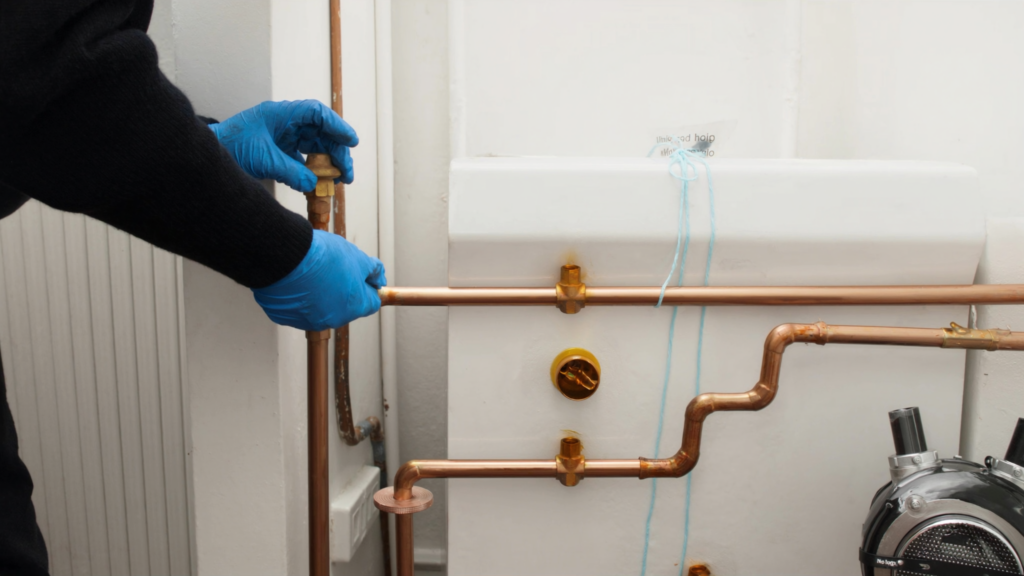
- Installation day, The installation typically takes 2 to 4 days. The outdoor unit will be mounted on a concrete plinth or wall bracket, and the indoor unit (hydrobox) installed near your existing hot water cylinder or boiler location. Pipework will be insulated and routed through an external wall. The installer should leave the site clean and demonstrate the system controls to you before leaving.
- Sign-off and certificates, After installation, you must receive an MCS certificate and a Building Regulations Compliance Certificate (from your local building control body or a competent person scheme). These documents are required to claim the £7,500 Boiler Upgrade Scheme grant and for selling your home later. The installer should also register the system with the manufacturer for warranty purposes.
- Snagging, common minor issues, After the system runs for a few days, check for: unusual noise from the outdoor unit (normal fan hum is fine, but rattling indicates poor fixings); rooms that are slower to heat than others (possible balancing issue); and any error codes on the control panel. Report these to your installer within the first week. Most warranties cover parts and labour for the first 2 years, but the manufacturer’s warranty on the compressor often extends to 7 years.
Red flags, when to walk away
- Installer cannot provide MCS, TrustMark, or F-Gas certification on request
- Quote is based on a phone survey or online form only, with no site visit
- Deposit demanded above 25% of the total cost
- Installer refuses to provide a room-by-room heat loss calculation</li
More on air source heat pumps
- Radiator oversize factor explained for low flow temperatures
- Ground Source vs Air Source Heat Pumps for UK Homes
- Air source heat pump running costs (2026)
- Replace gas boiler with heat pump in an old house
- Underfloor Heating vs Radiators With a Heat Pump
- Heat Pump Electrical Upgrade UK 2026
- How do heat pumps work for hot water?
- Pairing a Heat Pump with Solar Panels, Real-World Returns