Heat pumps work in older UK homes, the key is insulation, not the age of the house
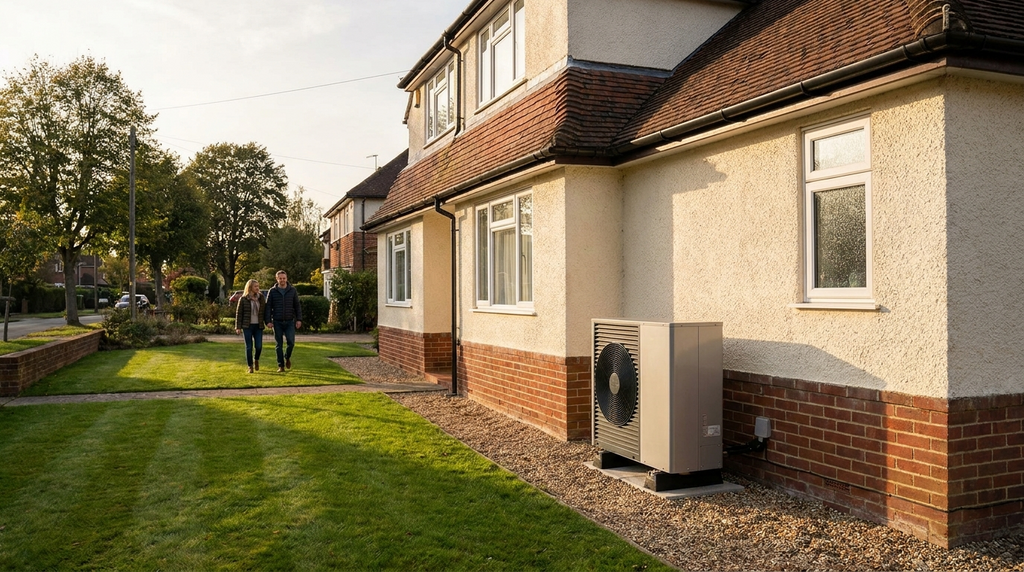
If you own a Victorian terrace or a 1930s semi, you may have heard that heat pumps only suit modern, well-insulated homes. That is not correct.
A heat pump can work in any home built before 1990, provided the building fabric is upgraded to reduce heat loss to an acceptable level.
The UK government’s Heat and Buildings Strategy confirms that over 80% of homes in England are suitable for a heat pump with standard insulation measures (DESNZ, 2026). The limiting factor is the home’s heat loss, measured in kilowatts (kW), not the year it was built. The Energy Systems Catapult’s Electrification of Heat Demonstration found that heat pumps installed in older homes performed reliably when the building fabric was addressed first (Energy Systems Catapult, 2023).
The upfront cost difference heat pump vs gas boiler in a pre-1990 home
The average cost of an air-source heat pump installation in a UK home built before 1990 is £10,000–£14,000 after the £7,500 Boiler Upgrade Scheme grant (GOV.UK, 2026). By comparison, a new gas boiler installation costs £2,500–£4,000 (Checkatrade, 2026).
However, a heat pump in an older home nearly always requires additional expenditure. Radiator upgrades typically cost £1,500–£3,000, and loft or wall insulation adds £1,000–£3,500. These are not optional extras for an efficient system, the heat pump will struggle to reach target temperatures without them. The Energy Saving Trust notes that insulation costs vary widely by property type but are essential for heat pump performance (EST, 2026).
Running cost comparison heat pump vs gas boiler for a typical older home
For a 3-bedroom semi-detached home built in the 1930s, annual heating cost with a gas boiler at 80% efficiency is £1,200–£1,500 under the January 2026 Ofgem price cap (Ofgem, 2026). The same home with a heat pump achieving a Seasonal Coefficient of Performance (SCOP) of 3.0 costs £850–£1,100 per year, assuming a standard electricity tariff of 28p/kWh (Ofgem, 2026).
The heat pump is cheaper to run when the home has at least 200mm of loft insulation and cavity wall insulation where possible. Without those measures, the heat pump’s SCOP drops and running costs approach or exceed those of a gas boiler. The Energy Saving Trust publishes detailed running cost tables showing this relationship (EST, 2026).
Quick numbers heat pump suitability for an older UK home
| Home type | Typical heat loss (kW) | Recommended heat pump size | Estimated annual running cost (vs gas boiler) | Grant-eligible |
|---|---|---|---|---|
| Pre-1919 terrace | 10–12 kW | 11–12 kW | £1,100 (£1,500 gas) | Yes, with insulation upgrades |
| 1930s semi | 8–10 kW | 10 kW | £950 (£1,350 gas) | Yes |
| 1960s bungalow | 7–9 kW | 9 kW | £850 (£1,200 gas) | Yes |
| 1980s detached | 6–8 kW | 8 kW | £750 (£1,100 gas) | Yes |
Data based on Ofgem price cap rates and EST running cost models. Heat loss figures are typical for each home type with basic insulation in place.
The insulation rule what your home needs before a heat pump installation
The minimum requirement is 200mm loft insulation and cavity wall insulation if your home has cavity walls, which is typical for homes built after 1920. For solid-wall homes built before 1920, external or internal wall insulation is often needed, costing £8,000–£15,000 (EST, 2026).
A heat pump installer must perform a heat-loss calculation under MCS 022 standards before quoting. If the home loses more than 10 kW, they will not install without insulation upgrades (MCS, 2026). This is non-negotiable, the heat pump must be sized to match the home’s actual heat loss, not the age of the building.
comparing insulation options for solid wall homes
Eligibility and installer verification for heat pumps in older homes
To qualify for the £7,500 Boiler Upgrade Scheme grant, the installer must be MCS-certified and the heat pump must be on the MCS product database (GOV.UK, 2026). You can check an installer’s MCS status at mcs-certified.com (MCS register, 2026).
Installers must also be TrustMark-registered for consumer protection (TrustMark, 2026). Gas Safe Register is irrelevant for heat pumps, the installer must be a qualified electrician, registered with NICEIC or NAPIT, for the electrical work. The electrical connection and any fuse board upgrades must comply with Part P of the Building Regulations.
Heat pump performance in cold weather does it work in a UK winter for an older home?
A modern heat pump with an SCOP of 3.0 or higher can deliver heat at outdoor temperatures as low as -15°C (DESNZ, 2026). The UK’s average winter temperature is 4°C (Met Office, 2026), well within the operating range.
At -5°C, a heat pump’s COP drops from 3.0 to roughly 2.5. Even at that lower efficiency, the heat pump still delivers heat at a lower cost per kWh than a gas boiler because the COP of 2.5 means 2.5 units of heat for each unit of electricity. At 28p/kWh electricity, that is 11.2p per kWh of heat, compared to 6.5p per kWh for gas, but the heat pump only runs during the coldest hours, so the overall winter bill remains lower.
The direct answer will a heat pump work in an older UK home?
Yes, a heat pump will work in an older UK home, provided the home’s heat loss is reduced to 10 kW or less through insulation upgrades, and the system is sized correctly by an MCS-certified installer. The age of the building is not a barrier, the condition of the building fabric is the deciding factor.
With the £7,500 Boiler Upgrade Scheme grant, the upfront cost is comparable to a boiler replacement when insulation costs are included. The Energy Saving Trust confirms that heat pumps are suitable for the vast majority of UK homes, including those built before 1990, as long as the property meets the heat-loss threshold (EST, 2026).
what to expect from a heat pump installation survey