Ground source heat pumps extract renewable thermal energy stored in the ground beneath your property, delivering three to five units of heat for every single unit of electricity consumed. In the UK, a well-installed ground source heat pump system can achieve a Coefficient of Performance (COP) of between 3.5 and 4.5, meaning running costs can be significantly lower than a conventional gas boiler once the system is properly sized and integrated. With the UK government committed to phasing out new gas boiler installations by 2035, ground source heat pumps represent one of the most efficient and future-proof heating solutions available to UK homeowners right now.
How Ground Source Heat Pumps Work
The principle behind a ground source heat pump is deceptively simple: the ground beneath your feet has a remarkably stable temperature of between 8°C and 12°C year-round, regardless of surface weather conditions. This stored solar energy is what your heat pump taps into.
The system works through a continuous thermodynamic cycle involving three main components: a ground loop, a heat pump unit, and your home’s heat distribution system.
- The ground loop is a network of pipes buried in your garden or drilled into the earth. These pipes are filled with a mixture of water and antifreeze (typically glycol). As this fluid circulates through the loop, it absorbs heat from the surrounding ground.
- The heat pump unit receives this slightly warmed fluid and passes it through a heat exchanger. A refrigerant inside the pump evaporates, is compressed by an electrically driven compressor, and releases its stored energy at a much higher temperature, typically between 35°C and 55°C.
- The heat distribution system, usually underfloor heating or large-format radiators, then delivers this warmth throughout your home. Hot water for taps and showers is also produced via a hot water cylinder included in the system.
The entire process is reversed in summer if your system includes a cooling function, drawing heat out of your home and depositing it back into the ground. This is a significant advantage of ground source over other heating technologies.
Types of Ground Loop Systems
The way the ground loop is installed fundamentally determines the cost, disruption, and performance of your system. There are three main configurations used in UK residential installations.
Horizontal Ground Loops
Pipes are laid in trenches typically 1.2 to 1.8 metres deep across a large area of your garden. This is the most common and cost-effective approach, but it requires significant land, roughly 200 to 400 square metres of usable garden for an average three-bedroom home. The trenches are backfilled after installation, and the garden recovers within one to two growing seasons.
Vertical Boreholes
Where land is limited, vertical boreholes are drilled to depths of 80 to 200 metres. A single borehole can typically support 4 to 6 kW of heat pump output, so a 12 kW system might require two or three boreholes. Drilling is more expensive but causes minimal surface disruption and tends to deliver more consistent performance because deep ground temperatures are extremely stable.
Slinky Coil Systems
A variation on the horizontal approach, slinky coils are loops of pipe coiled in a spiral and laid horizontally or vertically in narrower trenches. They extract more heat per metre of trench, reducing the land footprint by around 30 to 40% compared to straight horizontal runs, though at a marginally higher installation cost per metre.
In rare cases where a property has access to a pond, lake, or river, open-loop or water source ground systems can be used, drawing water directly and returning it at a slightly lower temperature. These require Environment Agency permits but can achieve COPs above 5.0 in favourable conditions.
How Much Does a Ground Source Heat Pump Cost in 2026
Ground source heat pump systems represent a significant upfront investment, but costs have stabilised in recent years as the UK installer market has matured. The total installed cost depends primarily on the system output required, the type of ground loop, and the complexity of your home’s existing heating infrastructure.
| Property Size | Recommended Output | Horizontal Loop Cost | Vertical Borehole Cost | Total Installed Range |
|---|---|---|---|---|
| 2-bed flat / small terrace | 5–8 kW | £4,000–£6,000 | £6,000–£9,000 | £14,000–£22,000 |
| 3-bed semi-detached | 8–12 kW | £6,000–£9,000 | £9,000–£14,000 | £18,000–£28,000 |
| 4-bed detached | 12–16 kW | £9,000–£13,000 | £14,000–£20,000 | £22,000–£38,000 |
| Large detached / rural | 16–24 kW | £13,000–£18,000 | £20,000–£30,000 | £30,000–£55,000 |
These figures include the heat pump unit itself, the ground loop installation, a hot water cylinder, controls, and commissioning. They assume the existing distribution system (radiators or underfloor heating) is already compatible. Upgrading radiators throughout a typical three-bedroom home adds a further £2,000 to £5,000. Electrical supply upgrades, typically from single-phase to three-phase supply for larger systems, may add £1,000 to £3,000 in some rural properties.
Running Cost Breakdown
| Cost Factor | Ground Source Heat Pump | Notes |
|---|---|---|
| Annual electricity use (avg. 3-bed) | 3,000–5,000 kWh | Depends on insulation and COP achieved |
| Estimated annual running cost | £900–£1,500 | At 2026 average unit rate of ~28p/kWh |
| Annual service cost | £150–£300 | Manufacturer service contracts available |
| Expected system lifespan | 20–25 years (pump); 50+ years (ground loop) | Ground loops carry long warranties |
Benefits of Ground Source Heat Pumps
The case for ground source heat pumps goes beyond energy bills. Here are the most significant advantages, backed by real-world performance data.
- Exceptional efficiency: A ground source heat pump with a seasonal COP of 4.0 produces 4 kWh of heat for every 1 kWh of electricity used. Compare this to an A-rated gas condensing boiler operating at 90% efficiency, and the difference in energy consumption is dramatic, particularly as electricity from renewable sources continues to decarbonise.
- Low carbon heating: The Carbon Trust estimates that a ground source heat pump powered by the UK grid produces approximately 30 to 60% fewer carbon emissions than a gas boiler today, with that figure improving year-on-year as grid electricity gets cleaner. On a fully green tariff, the carbon reduction exceeds 80%.
- Consistent performance in cold weather: Unlike air source systems, which see efficiency drop as outdoor air temperatures fall, ground source systems maintain their performance throughout winter because ground temperatures remain stable. This is particularly valuable in northern England, Scotland, and exposed rural locations.
- Dual-function capability: Many modern ground source heat pump units can operate in reverse during summer to provide passive or active cooling, a benefit that will become increasingly valuable as UK summers warm.
- Property value uplift: Research by the Nationwide Building Society and the Energy Saving Trust suggests that properties with heat pumps and EPC ratings of A or B can command a premium of 5 to 10% over equivalent properties with lower ratings in many UK markets.
- Quiet operation: The heat pump unit sits inside your home (typically in a utility room, garage, or plant room) and generates minimal noise, around 40 to 50 decibels during operation, similar to a quiet refrigerator. There is no external unit making noise in your garden.
- Low maintenance requirements: Ground source heat pumps have fewer moving parts than combustion heating systems. Annual servicing is recommended but the systems are mechanically straightforward, and ground loops require virtually no maintenance once installed.
Is Your Home Suitable for a Ground Source Heat Pump
Ground source heat pumps are not universally appropriate for every UK property, and assessing suitability before committing to an installer is essential. The three key factors are land availability, heat demand, and the existing or planned heat distribution system.
Land and Access Requirements
For horizontal loops, you need roughly 1.5 times the area of the floor space you wish to heat, a 150 m² home typically needs 225 to 400 m² of accessible garden, free from tree roots, hard landscaping, and subsurface structures. The ground must be accessible to a small excavator during installation. If your garden is smaller than approximately 150 m², vertical boreholes become the practical alternative. Borehole drilling rigs require vehicle access of at least 3 metres width.
Heat Loss and Insulation Standards
Ground source heat pumps deliver heat most efficiently at lower flow temperatures, ideally 35°C to 45°C, which is only effective in well-insulated homes. A property with a heat loss above 150 W/m² will struggle to maintain comfortable temperatures without oversizing the system significantly, driving up both capital and running costs. Before installing a heat pump of any kind, addressing loft insulation (minimum 270mm), cavity or solid wall insulation, and double or triple glazing will dramatically improve performance and reduce the system size required.
Hot Water Demand
Ground source heat pumps produce domestic hot water efficiently, but they require a hot water cylinder (typically 200 to 300 litres) because they cannot provide instant hot water in the same way a combi boiler does. If you are replacing a combi boiler, you will need to allocate space for a cylinder, a practical consideration in smaller homes.
How to Choose the Right Ground Source Heat Pump
Selecting the correct system involves several decisions beyond simply picking a brand. Here is a practical framework for UK homeowners.
Establish Your Heat Loss Figure First
A proper heat loss calculation to BS EN 12831 standards should be carried out by your installer before any equipment is specified. This tells you the maximum heat demand of your property in kilowatts, which directly determines the size of heat pump required. Be wary of any installer who quotes a system size without visiting your property and conducting this assessment.
Choose a Ground Loop Type to Match Your Site
If you have sufficient garden space, horizontal loops offer lower installed costs and good performance. If land is limited or you want minimal surface disruption, specify vertical boreholes. Ask installers to provide a ground survey or geological assessment before finalising borehole depths, ground conditions vary significantly across the UK, with chalk, clay, and granite all having different thermal conductivity ratings that affect how many metres of borehole you need.
Evaluate Key Technical Specifications
- Seasonal COP (SCOP): Look for a declared SCOP of 4.0 or above at the B0/W35 test condition (ground temperature 0°C, flow temperature 35°C). This figure reflects real-world UK ground conditions more accurately than peak COP.
- Inverter-driven compressors: Modern variable-speed inverter compressors modulate output to match your actual heat demand rather than cycling on and off. This improves efficiency by 15 to 25% over fixed-speed units and extends equipment life.
- Integrated hot water capability: Confirm the unit can heat domestic hot water to 55°C or above to prevent Legionella, most modern units include a periodic high-temperature pasteurisation cycle.
- Smart controls and monitoring: The best systems include web-connected controls allowing you to monitor performance, adjust schedules, and receive alerts. Some integrate with smart home systems.
Check Installer Credentials
In the UK, installers must be MCS (Microgeneration Certification Scheme) certified for your system to qualify for the Boiler Upgrade Scheme grant. Always verify MCS certification through the official MCS database. Look for membership of the Ground Source Heat Pump Association (GSHPA) as a further quality indicator. Obtain at least three written quotes including heat loss calculations, ground loop design specifications, and projected SCOP figures.
Ground Source Heat Pump Installation, What to Expect
Understanding the installation process helps you plan realistically and avoid surprises. A typical residential ground source heat pump installation takes between five and fifteen days depending on the ground loop type and system complexity.
- Site survey and heat loss assessment (Day 1): A qualified installer visits your home, measures room dimensions, assesses insulation levels, examines existing pipework, and conducts a full heat loss calculation. They assess your garden for ground loop suitability and may arrange a ground investigation or geological survey.
- System design and quotation (Week 1–2 after survey): The installer produces a system design specifying heat pump output, ground loop configuration, cylinder size, and any distribution system upgrades needed. You receive a detailed written quotation.
- Groundworks (Days 2–5 on site): For horizontal loops, a mini excavator opens trenches across your garden. Ground is backfilled after pipe laying. For vertical boreholes, a drilling rig accesses the site and drills to the required depth over two to four days. Drill cuttings are removed from site. Expect some noise and disturbance during this phase.
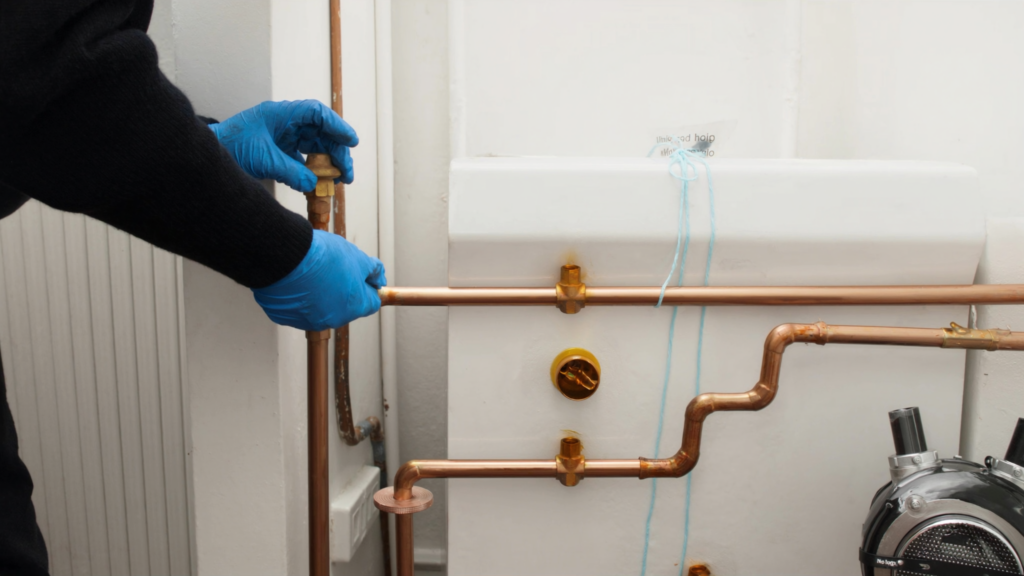
- Pipe connections and pressure testing (Day 5–6): Ground loop pipes are connected to the heat pump unit inside your home via insulated pipework. The entire ground loop is pressure-tested and flushed before being filled with antifreeze solution.
- Heat pump and cylinder installation (Days 6–9): The heat pump unit, hot water cylinder, buffer vessel (if required), and controls are installed in your plant room or utility space. Electrical connections are made by a qualified electrician.
- Commissioning and handover (Day 10–12): The system is commissioned, settings optimised for your home, and flow temperatures set. Your installer should walk you through the controls, explain the expected seasonal performance curve, and provide documentation for your MCS certificate.
- Post-installation monitoring (Weeks 2–8): Most quality installers offer a follow-up visit after the first few weeks of operation to check performance data and fine-tune settings. This is particularly important through the first heating season.
Grants and Funding for Ground Source Heat Pumps in 2026
The UK government has made heat pump adoption a central pillar of its domestic decarbonisation strategy, and there are several financial incentives available to homeowners in 2026.
The Boiler Upgrade Scheme
The Boiler Upgrade Scheme (BUS) provides a one-off grant of £7,500 towards the cost of installing a ground source heat pump in England and Wales. This grant is paid directly to your MCS-certified installer, reducing your upfront payment. To qualify, your property must have a valid EPC (Energy Performance Certificate) with no outstanding recommendations for loft or cavity wall insulation. Applications are made by the installer on your behalf before installation begins. The scheme is administered by Ofgem and has been extended through to 2028 under current government commitments.
Scotland-Specific Support
Scottish homeowners may access additional support through Home Energy Scotland, which offers interest-free loans of up to £15,000 for heat pump installations, alongside cashback grants of up to £7,500 for ground source systems. These can be combined with the BUS grant. This provides significant combined support in some cases. Contact Home Energy Scotland directly for current eligibility criteria, as funding rounds can open and close throughout the year.
The ECO4 Scheme
Lower-income households or those receiving certain benefits may qualify for fully funded heat pump installations through the Energy Company Obligation (ECO4) scheme, which runs until March 2026 and is expected to be succeeded by a successor programme. Eligibility is assessed on income and property energy efficiency band.
VAT Relief
Ground source heat pump installations qualify for zero-rated VAT under current HMRC rules for energy-saving materials, saving you 20% compared to standard-rated goods and services. This applies to both the equipment and installation labour.
Smart Export Guarantee
While not a grant, if you pair your ground source heat pump with solar PV panels, the Smart Export Guarantee (SEG) allows you to sell surplus electricity back to the grid, potentially offsetting a portion of your heat pump running costs. Some households with well-insulated homes and solar generation report near-zero net heating costs during spring and autumn months.
Common Problems and Ground Source Heat Pump Maintenance
Ground source heat pump systems are generally reliable, but understanding potential issues helps you act quickly when something goes wrong and maintain peak performance year-round.
Underperformance and Low COP
The most common issue reported by UK owners is lower-than-expected efficiency. This is almost always caused by one of three factors: the system was undersized during design, the flow temperature is set too high (above 50°C regularly), or the heat distribution system (particularly radiators) is insufficiently sized for the lower flow temperatures heat pumps use. If your system is logging COP figures below 3.0, request a performance review from your installer. Adjusting the heating curve settings on the control unit is often the first and most cost-effective fix.
Ground Loop Issues
Leaks in the ground loop are rare but can occur at joint connections. A noticeable drop in system pressure, or frost damage to plants directly above buried pipes in summer, can indicate a leak. Ground loops should be pressure-monitored by the heat pump’s control system, most modern units will alert you to a pressure loss before it becomes a serious problem.
Compressor Faults
The compressor is the component most likely to require replacement over the system’s lifetime. Most manufacturers offer 5-year compressor warranties as standard, with extended warranties available to 10 years. Compressor replacement typically costs £1,500 to £3,000 including labour and is generally covered by manufacturer warranty if the system has been properly maintained.
Routine Maintenance Schedule
- Annual service: An MCS-qualified engineer should inspect refrigerant pressures, check electrical connections, clean filters, verify antifreeze concentration in the ground loop, and review performance data logs. Budget £150 to £300 per year.
- Every 3–5 years: Ground loop antifreeze solution should be tested and replaced if degraded. This is a simple task but often overlooked, degraded antifreeze reduces thermal transfer efficiency and can cause corrosion.
- Annually by owner: Check and clean the air filters on any fan coil units, ensure the plant room remains adequately ventilated, and review the performance statistics available through your controls or app. Any sustained drop in SCOP figures warrants a call to your service engineer.
- As needed: Bleed radiators if system pressure drops or you notice cold spots, this applies equally to heat pump systems as to conventional heating. Keep the area around the heat pump unit clear for access and ventilation.
Ground Source Heat Pumps and Home Integration
Getting the best from a ground source heat pump depends on the unit itself and on how the system integrates with every other element of your home’s energy and heating strategy.
The most efficient setups combine a ground source heat pump with underfloor heating throughout the ground floor and oversized radiators upstairs. Underfloor heating operates effectively at flow temperatures of 30°C to 40°C, which is comfortably within the optimal output range of a ground source system and maximises your seasonal COP.
Adding a thermal store or buffer vessel to your system design allows the heat pump to run in longer, more efficient cycles rather than short-cycling in response to small heat demands. This is particularly beneficial in homes where occupancy patterns create uneven heating demands throughout the day. A buffer vessel of 50 to 100 litres is typically sufficient for residential systems.
Pairing your heat pump with solar PV is increasingly common and financially logical. A 4 kWp solar PV array generating approximately 3,500 kWh per year in the UK midlands can offset a significant portion of the electricity consumed by your heat pump, particularly in spring and autumn when heating demand and solar generation align well. Time-of-use electricity tariffs designed specifically for heat pump owners, such as Octopus Cosy or similar products, offer reduced rates during off-peak hours and are worth exploring to further reduce running costs.
Finally, smart heating controls capable of weather compensation are essential companions to a ground source heat pump. Weather-compensating controls automatically adjust the flow temperature based on outdoor conditions. This ensures the system runs at the lowest possible flow temperature that still meets your home’s heat demand, directly maximising COP throughout the season.
Planning Permission and Legal Considerations
In most cases, installing a ground source heat pump in England, Scotland, and Wales is covered by permitted development rights, meaning you do not need to apply for planning permission. However, there are exceptions: properties in conservation areas, listed buildings, or Areas of Outstanding Natural Beauty may require consent, and it is always worth confirming with your local planning authority before work begins.
For vertical borehole systems, you may need to notify the Environment Agency or Natural Resources Wales, particularly if drilling near a water source protection zone. Your drilling contractor will typically handle these notifications as part of the installation process. A ground investigation report may be required to confirm there are no contaminated land issues at the borehole location.
The MCS certificate issued upon completion is your proof of compliance, your gateway to the Boiler Upgrade Scheme grant payment, and a valuable document for property sales. Keep it alongside your EPC and building regulations compliance certificate. Some local authorities require a building regulations application for the internal heating system changes; your installer should advise on this and can often manage the notification on your behalf under a competent person scheme.