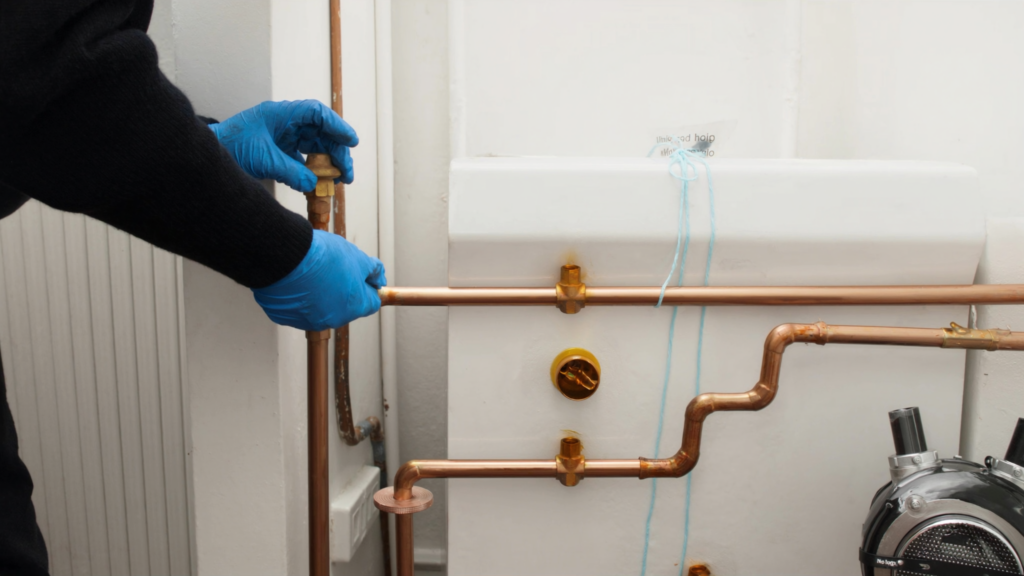
MCS 021, the Heat Emitter Guide that UK heat pump installers size radiators from, tells them to multiply each room’s heat loss by 3.1 before choosing a radiator for a system designed to run at 41-45°C. At 51-55°C that multiplier drops to 1.90. Those two numbers decide whether your existing radiators stay on the wall or go in a skip, and on a typical 12,000 kWh annual heat demand, running hot rather than fixing the emitters costs around £420 a year in electricity.
According to the DESNZ-funded Electrification of Heat trial, run by Energy Systems Catapult and reported in December 2024, heat pumps running at 35°C flow returned a median COP of 3.50 against 2.38 at 55°C. At Ofgem’s capped electricity rate of 26.11p/kWh for 1 July to 30 September 2026, that is 7.5p per kWh of delivered heat against 11.0p. Across 12,000 kWh of heat, the gap is about £420 a year. Your radiators are what let you sit at the cheap end of that range.
The number that decides everything is mean water temperature, not flow temperature
Almost every argument about radiator sizing goes wrong at the first step, because people compare a flow temperature to a delta-T as if they were the same scale. They are not.
A radiator’s catalogue output is measured to BS EN 442 at a delta-T of 50°C. Delta-T here means the mean water temperature minus the room air temperature. The reference condition is 75°C flow, 65°C return and a 20°C room. Mean water temperature is 70°C, and 70 minus 20 gives delta-T 50.
Now run the same radiator on a heat pump at 45°C flow. Heat pumps are usually designed around a 5°C drop across the system, so the return is 40°C. Mean water temperature is 42.5°C. The room is still 20°C. Delta-T is 22.5, less than half the test condition.
This is where the widely repeated claim that “a radiator at 55°C still gives about 75% of its rated output” comes from, and it is wrong. Whoever first published it read 55°C flow as delta-T 40. At 55°C flow with a 10°C drop, mean water temperature is 50°C and delta-T is 30, which gives roughly 51% of rated output. Delta-T 40 corresponds to something nearer 65°C flow. If a salesperson quotes you 75% at 55°C, they have confused two different numbers and their sizing will be short by around a third.
Why radiator output collapses as the water cools
Radiator output does not fall in a straight line with temperature. It follows a power curve. For a steel panel radiator, output divided by rated output equals (delta-T divided by 50) raised to the power of about 1.3. The 1.3 figure is the EN 442 exponent, and squote’s heat pump sizing notes use it under that name.
The table below is computed from that formula rather than quoted from a single source. It cross-checks exactly against P&H Engineering, whose published worked example puts the temperature correction factor at 0.354 for a mean water temperature of 42.5°C in a 20°C room. That is (22.5/50) to the power 1.3 to three decimal places. In P&H’s example a radiator rated 3,500W at delta-T 50 drops to 1,239W on temperature alone, and to 1,189W after a further connection-type factor of 0.96 for bottom-opposite-end pipework.
One warning about reading the table. The first five rows use a 10°C drop between flow and return, which is how gas boiler systems are designed. The last four use a 5°C drop, which is how heat pump systems are designed. That switch is why the gap between the 55/45 row and the 50/45 row looks smaller than the pattern above it would lead you to expect. Compare rows by their delta-T column, not by their flow temperature.
| Flow / return | Drop across system | Mean water temp | Delta-T | Output vs catalogue | Oversize needed |
|---|---|---|---|---|---|
| 75/65°C | 10°C | 70°C | 50 | 100% | 1.00x |
| 70/60°C | 10°C | 65°C | 45 | 87% | 1.15x |
| 65/55°C | 10°C | 60°C | 40 | 75% | 1.34x |
| 60/50°C | 10°C | 55°C | 35 | 63% | 1.59x |
| 55/45°C | 10°C | 50°C | 30 | 51% | 1.94x |
| 50/45°C | 5°C | 47.5°C | 27.5 | 46% | 2.18x |
| 45/40°C | 5°C | 42.5°C | 22.5 | 35% | 2.82x |
| 40/35°C | 5°C | 37.5°C | 17.5 | 26% | 3.91x |
| 35/30°C | 5°C | 32.5°C | 12.5 | 16% | 6.06x |
Read the last two columns together. Dropping from 75°C flow to 45°C flow does not cost you a quarter of the heat. It costs you about two thirds of it.
The MCS oversize factors, and what your installer is actually obliged to do
The maths above is the physics. The numbers installers reach for come from MCS 021, the Heat Emitter Guide for Domestic Heat Pumps. Its own wording is blunt: multiply the room heat loss in watts by the oversize factor to determine the required emitter output at a mean water to air temperature difference of 50°C. MCS adds that the oversize factor is the same thing installers call a heat transfer multiplier.
Be clear about the status of that document, because plenty of sites overstate it. MCS 021 is guidance, not a compliance duty. In the current MCS Heat Pump Standard for installation, MIS 3005-I:2025, MCS 021 appears once, in section 5 “Publications, Reference and Further Reading”, among documents contractors may use to “further research topics if they need to do so”. The companion design standard, MIS 3005-D:2025, does not mention MCS 021, the Heat Emitter Guide or the word “oversize” anywhere. The factors below are the industry’s working reference. They are not a rule your installer can be held to.
| Design flow temperature | Oversize factor for plain radiators | What that means in practice |
|---|---|---|
| Up to 35°C | 6.8x | Radiators rarely viable; underfloor territory |
| 36-40°C | 4.3x | Almost every radiator needs replacing |
| 41-45°C | 3.1x | Typical modern heat pump design point |
| 46-50°C | 2.4x | Some existing double convectors survive |
| 51-55°C | 1.90x | The Part L boiler design point |
| 56-60°C | 1.6x to 1.8x | Efficiency penalty starts to bite hard |
| 61-65°C | 1.30x | Close to old boiler behaviour |
Three things are worth knowing about that table. It is more conservative than the raw physics, deliberately, because it carries margin for connection type, paint, curtains and furniture. For plain radiators the factor is the same whatever the room’s specific heat loss, with one exception: at 56-60°C flow the figure is 1.8x for rooms under 30 W/m² and 1.6x for everything else. And the version installers still quote from is Issue 2.1, dated 1 May 2015 and carrying DECC copyright, so the star ratings on your survey report come from a document written before the current Building Regulations, before the Boiler Upgrade Scheme and before the flow temperatures most modern heat pumps are actually designed around.
That age matters in one specific way. MCS 021 was drafted when a “low temperature” heat pump system commonly meant 45°C to 55°C. Manufacturers now routinely sell units rated to 60°C and above, and Part L’s notional dwelling assumes 45°C for an air source heat pump. The guide’s conservatism is doing useful work at 45°C. At the 61-65°C end it is describing a machine that is now sold as normal rather than exotic, so treat the 1.30x figure as the least reliable row on the table.
The popular shorthand “you need to double your radiators for a heat pump” is only correct at around 50°C flow. It systematically undersizes exactly the low-temperature systems that produce the efficiency gain you were buying.
Where the real obligations sit
Two clauses in MIS 3005-D:2025 do bind an MCS contractor, and both are more useful to a homeowner than the star chart.
- Clause 3.4.4. Where a design proposes a flow temperature above 55°C, the installer must also provide an alternative design at 55°C or lower, and must explain the efficiency and energy consumption differences to you so that you can choose. If you are handed a single 60°C design and no alternative, the contractor has skipped a step.
- Clause 3.8.1. Before installation starts, a written design pack must exist covering specific room heat losses in W/m², the type and dimensions of every emitter, the design flow temperature before any blending valve, and, in MCS’s own words, “the design emitter temperature based on the worst performing room”. That last phrase is the weakest-link rule written into the standard. Ask for a copy.
Fan assistance changes the arithmetic more than panel size does
MCS 021 lists separate factors for fan-assisted emitters, and the difference is large enough to rescue rooms where no bigger panel will fit.
| Design flow temperature | Plain radiator | Fan convector or fan-assisted radiator | Fan coil unit |
|---|---|---|---|
| Up to 35°C | 6.8x | 4.3x | 5.0x |
| 36-40°C | 4.3x | 3.1x | 3.5x |
| 41-45°C | 3.1x | 2.4x | 2.6x |
| 46-50°C | 2.4x | 2.0x | 2.1x |
| 51-55°C | 1.90x | 1.70x | 1.70x |
The fan coil column looks odd and it is reproduced faithfully. On MCS’s numbers a fan coil unit never beats a fan convector, matches it at 51-55°C, and at 61-65°C scores 1.40x against a plain radiator’s 1.30x, which is worse. MCS gives no explanation. On these figures a fan convector or fan-assisted radiator is the better low-temperature choice of the two.
A fan-assisted radiator is a panel with a small electric fan in the base that pushes room air across the fins. It draws a few watts, it is audible on boost in a quiet bedroom, and it needs a fused spur. That is the trade for the output.
The MCS worked example, and what it actually shows
MCS 021 runs one room through four scenarios. It is an illustrative calculation adapted from CIBSE’s Domestic Heating Design Guide, not a real customer, and the assumptions are stated in the guide: the room is in London with a design outside air temperature of -1.8°C, it starts single-glazed and poorly insulated, and the heating is assumed to run continuously. The room measures 4.9m by 2.7m, or 13.2m².
Start with the existing radiator, and note the trap built into the first two lines.
- Room heat loss: 1,671W. Specific heat loss 1,671 / 13.2 = 126 W/m².
- Existing radiator: 1600mm long, 700mm high, 103mm deep, double panel.
- Rated output at a mean water to air difference of 60°C: 2,349W.
- Rated output at a mean water to air difference of 50°C: 2,349 x 0.825 = 1,938W.
- Oversize factor: 1,938 / 1,671 = 1.2. Temperature Star Rating: none. Required flow temperature: above 60°C.
So a perfectly ordinary 1600 x 700 double panel, in a room with a perfectly ordinary heat loss, fails outright. It cannot even reach 60°C flow, let alone 45°C. MCS’s own comment is that a specialist heat pump would be needed to run at those temperatures and that you must therefore take action.
The guide then changes one variable at a time, and the result is the part worth committing to memory.
- Improve the fabric only. Cavity wall insulation, A-rated double glazing, 50mm of underfloor insulation and careful draught-proofing cut the heat loss from 1,671W to 976W. The oversize factor becomes 1,938 / 976 = 2.0, which scores two stars and allows 55°C flow.
- Replace the radiator only. A 1600mm x 700mm x 135mm deep double convector, the same frontal area as the original, is rated 3,269W. Against the original 1,671W heat loss that gives 3,269 / 1,671 = 2.0. Two stars, 55°C flow. Identical outcome.
- Do both. 3,269 / 976 = 3.4. Four stars, and 45°C flow.
Neither single measure gets the room to 45°C. Insulation alone and a new radiator alone land on precisely the same two stars and the same 55°C. Only doing both reaches the flow temperature a modern heat pump is designed around. Anyone who tells you insulation alone will rescue your existing emitters at 45°C, or that a bigger radiator alone will, is contradicted by the source they are citing.
It is also worth running the failing radiator against the oversize table to see the size of the hole. At 45°C flow the room needs 1,671 x 3.1 = 5,180W. The existing radiator delivers 1,938W. The shortfall is 3,242W, so you would need roughly 2.7 times the radiator output you have, in that one room, before any fabric work.
The pre-2000 catalogue trap
Look again at those first two lines of the worked example. MCS quotes the existing radiator at 2,349W, then immediately multiplies by 0.825 to get 1,938W. That 0.825 is the pre-2000 catalogue correction, and MCS applies it without comment.
The NHBC best practice guide for domestic heat pumps spells out why. Manufacturers’ rated output tables published before the year 2000 were based on a mean water to room air temperature difference of 60°C, typically 80°C mean water in a 20°C room. Later tables use 50°C, in line with BS EN 442.
Apply MCS’s own 0.825 and 17.5% of the catalogue figure disappears, which is 411W on this radiator. Apply the EN 442 power curve instead, (50/60) to the power 1.3, and you get 0.79, so the loss is 21%. Either way, a number pulled from an old specification sheet is describing a hotter system than yours. Check the delta-T printed at the top of any output table before you use it, and if it says 60, divide.
What to actually buy when a room fails
This is the question the star chart never answers. MCS 021’s own examples do, and they point at depth rather than length.
The replacement in the worked example keeps exactly the same frontal area as the radiator it replaces, 1600mm by 700mm. The only thing that changes is depth, from 103mm to 135mm, which turns a double panel into a double convector by adding a second set of fins. Output goes from 1,938W to 3,269W. That is 69% more heat from 32mm of extra depth and not one millimetre of extra wall. If a room fails, the first thing to price is a deeper radiator in the same footprint, not a longer one.
Where depth or length is genuinely constrained, MCS 021 gives two routes, both with named products and rated outputs. Both are sized to deliver the 3,024W that the improved 976W room needs at its target flow temperature.
| Emitter, from MCS 021 examples | Size, length x height x depth | Rated output at delta-T 50 |
|---|---|---|
| Existing double panel, section 2.1 | 1600 x 700 x 103mm | 1,938W |
| Double convector replacement, section 2.3 | 1600 x 700 x 135mm | 3,269W |
| Myson Premier HE PM 70 DC 160, section 4.2 | 1600 x 700 x 135mm | 3,249W |
| Two of Myson Premier HE PM 70 DC 80, section 4.2 | 2 x 800 x 700 x 135mm | 3,210W combined |
| Jaga Strada DBE Type 11, fan-assisted, section 4.3 | 400 x 950 x 118mm | 3,114W |
| Two of Jaga Strada DBE Type 11, section 4.3 | 2 x 800 x 650 x 118mm | 3,068W combined |
Two practical readings. Splitting one long radiator into two shorter ones on different walls costs almost nothing in output, 3,210W against 3,249W, and solves the case where a single 1.6m run will not fit. And the fan-assisted unit delivers 3,114W from 400mm of wall, a quarter of the length of the panel doing the same job, which is what makes it the answer in a hallway or behind a door. MIS 3005-D:2025 acknowledges the constraint directly, noting that listed buildings or other design limitations may prevent the use of larger heat emitters.
Before ordering anything, measure the sill height above the radiator and the projection into the room. A 135mm double convector sits about 32mm further into the room than a 103mm double panel, which is enough to foul a door swing or a skirting run in a narrow hallway.
Reading your existing radiators before anyone surveys them
Radiators are mostly convectors. NHBC puts the maximum radiated share for a single panel at a 65°C average surface temperature at 40%. Add heat transfer fins to make a double convector and the radiated share falls to as little as 15%. The other 85% moves by convection. That is why fin count, rather than wall area, drives output at low temperature, and why a slim designer radiator that looks enormous can perform worse than a stubby double convector.
Walk round with a tape measure and a torch and record, for each radiator:
- Height, length and depth in millimetres. Depth is the one people forget and the one that matters most.
- Number of panels and number of fin sets. A single panel with no fins is K1, single panel plus fins is P1, two panels with two fin sets is K2, three panels and three fin sets is K3.
- Whether the pipes enter at bottom opposite ends, bottom same end, or top and bottom. Connection type carries its own correction factor, 0.96 for bottom opposite end in P&H Engineering’s worked example.
- Pipe diameter at the valve. Anything under 15mm is microbore, and it matters more than the radiator does.
- Anything obstructing airflow, since a boxed-in or curtained radiator loses convection output.
Rooms fail in a predictable order, and the reason is in the design temperatures. MIS 3005-D:2025 takes its internal design temperatures from CIBSE Guide A: 22°C for a bathroom, 21°C for a living or dining room, 18°C for bedrooms, halls, landings and kitchens. Run those through the delta-T maths at 45°C flow, where mean water temperature is 42.5°C, and an identical radiator gives 21% less output in a 22°C bathroom than in an 18°C bedroom, purely because the air it is fighting is warmer. Bathrooms also tend to have towel rails, which have low output for their size. That combination is why bathrooms usually fail first. Living rooms with large glazed areas fail on heat loss rather than on radiator size.
The weakest link rule, and why one small radiator taxes the whole house
This is the rule that changes how you should read a quote. A wet heating system runs at one flow temperature, set by whichever room needs the highest. Upgrading eight radiators out of nine leaves you running the entire system at the ninth radiator’s temperature. MCS builds this into its design standard, requiring the written design to state the design emitter temperature “based on the worst performing room”.
NHBC works the cost through with a scenario where underfloor heating is designed at 45°C and first-floor radiators are also sized for 45°C. The homeowner asks for smaller radiators upstairs, which pushes those rooms up to 55°C. The designer’s answer is that the whole system must then run at 55°C and be blended back down to 45°C for the underfloor circuits, cutting whole-system efficiency by about 15%.
Fifteen per cent of the running cost of a heat pump, applied every winter for twenty years, is a far larger sum than the £200 or so it costs to replace one radiator. If a survey shows a single problem room, fixing that room is usually the highest-return item on the whole quote.
Microbore, where pipework rather than panel size sets the ceiling
Here is the trap that no amount of radiator shopping solves. A heat pump moves heat by circulating far more water at a smaller temperature drop. Installer Online puts heat pump flow rates at roughly four times those of a gas boiler, a direct consequence of designing to a 5°C drop rather than a 20°C one. A 5kW unit needs around 14 litres per minute, a 7kW around 19, a 10kW around 29 and a 12kW around 35.
Water in a heating pipe has to stay within an acceptable velocity band. The Energy Saving Trust’s Green Heat Toolkit for installers gives 0.5 to 1.5 m/s, with best practice around 0.9 to 1.0 m/s. Below that range you get poor heat transfer and air problems. Above it you get noise and erosion. Its worked example shows a 1,308W room requiring 0.0625 litres per second, which reaches 1.04 m/s in 10mm pipe and only 0.42 m/s in 15mm.
So a bigger radiator cannot always help you. If the pipe feeding it will not carry the litres per minute that its rated output demands without exceeding 1.5 m/s, the panel will never reach that output whatever the catalogue says.
Two opposite myths need correcting here. Microbore does not automatically have to be ripped out, since the EST example shows 10mm pipe working comfortably for a modest room load. But equally, newer homes are not automatically the easy ones. The Electrification of Heat trial found that the three property types least consistently recommended for a heat pump were mid-terrace houses on space grounds, pre-1919 properties on fabric grounds, and post-2001 properties, specifically because they commonly have microbore pipework under 15mm. Installers were reluctant to retrofit onto microbore precisely because lower temperatures need higher flow rates, which raise velocity and pressure loss.
The cost of getting this wrong is measured in days. The same trial reported typical installs of 2 to 4 days including new emitters and thermal storage. Where microbore pipework had to be replaced, the install ran to around 8 to 10 days. That is the single biggest hidden cost on the emitter side of a heat pump quote.
What emitter work actually costs in 2026
MyJobQuote’s 2026 UK cost guide, last updated on 11 July 2026, puts an average radiator replacement at around £200. Labour alone runs £70 to £100, at hourly rates of £50 to £100 for radiator work.
| Job | Typical UK cost, 2026 |
|---|---|
| Small radiator, supplied and fitted | £100-£200 |
| Medium radiator, supplied and fitted | £200-£300 |
| Large radiator, supplied and fitted | £300+ |
| Supply-only panel radiator, small to large | £20-£120 |
| Supply-only column radiator | £115-£380 |
| Supply-only designer radiator | £180-£500 |
| Supply-only cast iron radiator | £120-£750 |
| Whole house, 2-bed with 4-5 radiators | £600-£1,000 |
| Whole house, 3-bed with 6-8 radiators | £900-£1,600 |
Those figures cover plain panel radiators and the decorative alternatives. Fan-assisted radiators and fan convectors sit outside the guide entirely, and no UK cost source I could verify publishes a typical fitted price for them. Expect to pay more than a panel of the same output, and budget for an electrician as well as a plumber, because the fan needs a fused spur. Ask for the fan-assisted option to be priced as a line item rather than assuming it lands near the panel prices above.
Set against those figures, the Electrification of Heat trial found new heat emitters were installed with 93% of heat pumps, and new thermal storage in 81% of homes. Energy efficiency upgrades to the building itself happened in only 15% of properties. Emitter work is the normal case. The fabric-plus-emitter route that MCS 021’s own example shows is the one almost nobody took.
The Boiler Upgrade Scheme pays £7,500 towards an air source or ground source heat pump, £5,000 for a biomass boiler and £2,500 for an air-to-air heat pump, with an extra £1,500 available until March 2027 where the property runs on oil or LPG with no mains gas connection. That grant is a fixed contribution to the installation rather than a reimbursement of emitter costs. Radiator and pipework upgrades come out of the same fixed sum, which is why two quotes for the same heat pump can leave wildly different balances to pay.
How this differs across the four UK nations
The physics is identical everywhere. The design temperature, the rules and the money are not.
Start with the design temperature, because it feeds every heat loss figure in your survey. MIS 3005-D:2025 requires contractors to size to the outside design temperatures in CIBSE Guide A Table 2.5, and the spread across the UK is wide enough to change what your radiators need to do.
| Location | Altitude | Design outside temp, 99% | Design outside temp, 99.6% |
|---|---|---|---|
| Glasgow | 5m | -3.5°C | -5.9°C |
| Birmingham | 96m | -3.2°C | -5.1°C |
| Edinburgh | 35m | -3.2°C | -5.4°C |
| Manchester | 75m | -2.7°C | -4.5°C |
| London | 25m | -1.7°C | -3.0°C |
| Belfast | 68m | -1.5°C | -3.2°C |
| Cardiff | 67m | -1.5°C | -3.1°C |
| Plymouth | 27m | -0.2°C | -1.5°C |
A Glasgow house is sized to -3.5°C where a Plymouth house is sized to -0.2°C, a 3.3°C spread that flows straight into every room’s heat loss and therefore into every radiator. If your quote does not state which figure it used, that is the first question to ask. MCS also allows contractors to choose the 99.6% column instead, which is colder again and removes the need for an intermittent-heating uplift.
- Building regulations are devolved. The Approved Document L wording quoted below is the England edition. Scotland, Wales and Northern Ireland each set their own energy standards, so confirm the applicable design flow temperature requirement with your local building control body.
- Boiler Upgrade Scheme grants cover England and Wales only. GOV.UK states the scheme is open to people in England and Wales.
- Scotland has a separate route. Households there may be able to get an interest-free loan or grant for home energy improvements instead.
- Northern Ireland’s Boiler Replacement Scheme has closed and there is no equivalent grant.
- Ofgem’s price cap covers England, Scotland and Wales. Northern Ireland has its own regulator and separate tariffs, so the 26.11p/kWh electricity and 7.33p/kWh gas figures used here do not apply there.
Turning a gas boiler down uses exactly the same check
This is where most readers will save money this year rather than in five years’ time.
Nesta’s work on boiler flow temperatures found that if combi boilers were optimised, households could reduce gas use, costs and emissions by 8%. Nesta notes that most condensing boilers across the UK are set to flow temperatures of 70-80°C, and that the lower the flow temperature, the lower the return temperature and the more efficiently the boiler condenses. Its Money Saving Boiler Challenge led to roughly 3.1 million households turning their flow temperature down, with more than 214,000 using the online tool between October 2022 and March 2023.
Take an illustrative household burning 11,500 kWh of gas a year, which is roughly a 3-bed semi. At Ofgem’s capped gas rate of 7.33p/kWh for July to September 2026, that is about £843 of gas before standing charges. An 8% reduction is roughly £67 a year, for an adjustment that takes two minutes and costs nothing.
The catch is the same emitter check. A condensing boiler turned down only keeps the house warm if the radiators can still deliver at the lower mean water temperature. The MCS factor for 51-55°C is 1.90x, far more forgiving than the 3.1x needed at 45°C, which is why most existing UK radiator systems cope with a boiler turn-down when they would fail a heat pump assessment. Turn the boiler down in October, live with it through a cold snap, and note which rooms struggle. Those are precisely the rooms that would need new emitters if you later fit a heat pump. You have run the survey for free.
The Part L rule is narrower than most sites claim, and it changes in 2027
Under Building Regulations in England, Approved Document L Volume 1, 2021 edition, paragraph 5.10 requires wet heating systems to be sized to operate at a maximum flow temperature of 55°C or lower. Comparison and installer sites routinely report this as “all new boilers must now run at 55°C”. That is not what it says.
The duty applies where a wet heating system is newly installed or fully replaced, meaning the appliance, the emitters and the associated pipework. A straight boiler swap that leaves the existing radiators and pipes in place does not trigger the 55°C emitter sizing requirement. Paragraph 5.10 also carries an explicit exception where 55°C is not feasible, and names insufficient space for larger radiators as a qualifying reason, with the system then designed to the lowest design temperature possible.
Paragraph 5.8 is the one worth quoting back at an installer. It requires the specification to be based on an appropriate heat loss calculation and a recognised sizing methodology, such as the CIPHE Plumbing Engineering Services Design Guide, and says systems should not be significantly oversized. Part L’s notional dwelling assumes 55°C for a gas boiler with radiators and 45°C for an air source heat pump with radiators, with weather compensation and a 250% space heating efficiency.
Check the edition before you quote a paragraph number at anyone. MHCLG has published a 2026 edition of Approved Document L Volume 1 which takes effect on 24 March 2027 for most building work, and 24 September 2027 for higher-risk building work. Three things move in it. The 55°C rule is renumbered 4.10. Its feasibility exception is narrowed to “In existing dwellings”, so new-build has no escape from 55°C. And the sizing paragraph becomes 4.9, now requiring the heat loss calculation in BS EN 12831-1 specifically, with an accompanying note naming CIPHE, CIBSE, the Heat Pump Association and the Microgeneration Certification Scheme as bodies producing appropriate sizing guidance. If you are planning work into 2027, that is the version your building control body will be applying.
When the answer is to do nothing yet
Several situations call for holding off rather than spending.
- You are replacing a boiler like for like. Do not buy new radiators on the strength of a misread Part L. Turn the new boiler down instead and see what happens.
- You have not had a room-by-room heat loss calculation. Every number in this guide depends on that one input. Sizing radiators from floor area, or from the old radiator’s size, repeats whatever mistake was made in 1987.
- Insulation work is on your list anyway. In the MCS example, fabric work cut the room’s heat loss from 1,671W to 976W and moved it from no stars to two. It did not on its own make the existing radiator adequate at 45°C, but it halved the size of the radiator the room would eventually need. Doing radiators first means paying for emitters sized against a heat loss you are about to reduce.
- Your pipework is microbore and untested. Get the velocity calculation done before ordering panels. A 5,180W radiator on a pipe that cannot feed it is money burned.
- You are replacing one cold radiator reactively. If the system is heading for a heat pump within a few years, size that replacement for the future flow temperature now, not for 75°C. A deeper panel in the same footprint costs very little extra today.
What to ask for before you sign, and by when
Only 66% of properties surveyed in the Electrification of Heat trial were recommended as suitable for a heat pump within the trial’s constraints, which tells you the survey is the decision point rather than a formality. Ask for these, in writing, before any deposit changes hands. Items 1, 2 and 6 are things an MCS contractor already has to produce under MIS 3005-D:2025.
- The room-by-room heat loss figures, in watts and in W/m², with the design external temperature stated and the CIBSE location it came from. Check it against the table above for your city.
- The design flow temperature before any blending valve, and the design emitter temperature based on the worst performing room. Both are required in the written design pack.
- The oversize factor applied at that flow temperature. If the design flow temperature is 45°C, expect 3.1x for plain radiators.
- The required output and actual output for every radiator, both quoted at delta-T 50, with the delta-T of the source data confirmed. Anything sourced from a pre-2000 table needs correcting by 0.825 or worse.
- A list of every room that fails, and what flow temperature the system would need if those rooms were left alone. That number, set against the design figure, is the 15% efficiency question in your own house.
- An alternative design at 55°C or lower, with the efficiency and consumption difference explained, if the proposed design runs hotter than 55°C. Clause 3.4.4 requires it and gives you the choice.
- Pipe diameters and a flow velocity check for any run under 15mm, with the resulting m/s figure set against the 0.5 to 1.5 m/s band.
- A priced line item for fan-assisted emitters in any room where a larger panel will not fit, including the electrical work. At 45°C the factor falls from 3.1x to 2.4x.
On timing: the extra £1,500 Boiler Upgrade Scheme uplift for oil and LPG properties without mains gas runs until March 2027, so if you are off the gas grid, book the survey in 2026 rather than leaving it to the final months. If you are staying on gas, turn the boiler flow temperature down to 60°C this October and keep a note of every room that underperforms over the winter. That list is worth more than any quote, and it costs nothing to produce.
Frequently Asked Questions
MCS 021 sets the oversize factor for plain radiators at 3.1x for a design flow temperature of 41-45C, 2.4x at 46-50C and 1.90x at 51-55C. You multiply each room's calculated heat loss in watts by that factor to get the radiator output needed from a manufacturer's delta-T 50 catalogue figure. MCS 021 is a reference guide rather than a rule your installer can be held to: the current MCS heat pump installation standard lists it only under further reading.
Around 65%. At 45C flow with a 5C drop, the mean water temperature is 42.5C, so in a 20C room the delta-T is 22.5 rather than the delta-T 50 used for catalogue ratings. P&H Engineering's worked example shows a radiator rated 3,500W falling to 1,239W on temperature alone, and to 1,189W once a 0.96 connection-type factor for bottom-opposite-end pipework is also applied.
On its own, usually not. In MCS 021's worked example, cutting a room's heat loss from 1,671W to 976W lifts the existing 1,938W radiator from no stars to two stars, which allows 55C flow but not 45C. Replacing the radiator alone gives exactly the same two-star result. Only doing both reaches four stars and 45C flow.
Often not. The MCS factor at 51-55C is 1.90x, far more forgiving than the 3.1x needed at 45C, so most existing UK radiator systems cope. Nesta found that optimising combi boilers could cut household gas use, costs and emissions by 8%, worth roughly £67 a year on 11,500 kWh at capped July 2026 rates.
Sometimes. The Energy Saving Trust's installer toolkit shows 10mm pipe carrying a 1,308W room at 1.04 m/s, inside the acceptable 0.5 to 1.5 m/s band. The decision turns on run length and per-radiator load. The DESNZ trial found post-2001 homes were among the hardest to retrofit because of microbore under 15mm.
No. The scheme pays a fixed £7,500 towards an air or ground source heat pump, with an extra £1,500 until March 2027 for oil or LPG properties off the mains gas grid. Radiator and pipework work comes out of that same fixed sum. The scheme is open to people in England and Wales only.