Underfloor heating is now installed in over 1 in 8 new UK homes. That makes it one of the fastest-growing home heating technologies in the country. Unlike traditional radiator systems, which heat a room from a single point and create uneven temperature pockets, underfloor heating distributes warmth evenly across the entire floor surface, producing a more comfortable living environment while operating at lower water temperatures that can cut heating bills by up to 25% when paired with a modern heat pump.
How Underfloor Heating Works
Underfloor heating operates on a simple but highly effective principle: rather than blasting hot air from a high-temperature source like a radiator, it turns your entire floor into a large, low-temperature radiant heat emitter. Because the heated surface area is enormous compared to a radiator, the system only needs to reach around 35–45°C to heat a room effectively, compared to the 65–80°C required by a conventional radiator circuit.
There are two distinct types of underfloor heating system, each using a different heat source:
- Wet (hydronic) underfloor heating pumps warm water through a network of cross-linked polyethylene (PEX) or polybutylene pipes embedded in or laid on top of the floor. The pipes connect to a manifold, which distributes water from your boiler or heat pump to each zone.
- Electric (dry) underfloor heating uses a mat or loose wire containing electrical heating elements laid beneath the floor covering. The elements convert electricity directly into heat and are controlled by a thermostat.
In a wet system, a pump circulates water from the heat source through the manifold and into the pipe loops. Each loop covers a defined zone, typically a single room. This allows you to control temperatures independently. Thermostats open and close actuators on the manifold to regulate flow. The floor surface itself rarely exceeds 29°C (the maximum safe surface temperature recommended for comfort and floor material integrity), and radiant heat rises gently and evenly from the floor upwards, warming people and objects directly rather than simply heating the air.
Electric systems work on the same radiant principle but are self-contained within the floor build-up. They heat up and cool down faster than wet systems, typically reaching temperature in 30–60 minutes, making them better suited to rooms used intermittently, like bathrooms.
Types of Underfloor Heating Explained
Understanding the differences between system types helps you match the right solution to your property. The key variables are your heat source, your floor construction, and how you use each room.
Wet Systems
Wet systems are the dominant choice for whole-house heating in new builds and major renovations. Pipes can be embedded in a screed (a sand and cement layer that acts as a thermal mass), clipped into insulation panels, or run through low-profile overlay systems designed for retrofit. Screed systems typically require the floor to be raised by 80–150mm, while modern overlay systems add as little as 15mm to the floor height. Wet systems are compatible with gas boilers, combi boilers Guide to Combi Boilers, system boilers Guide to System Boilers, and heat pumps, though they perform best when paired with a heat pump due to the low-temperature water requirement.
Electric Systems
Electric systems require no pipework, no manifold, and minimal floor depth, often just 3–4mm for a mat system. Installation is straightforward, which keeps labour costs low. The trade-off is running cost: at typical 2026 UK electricity prices of around 24p per kWh, electric underfloor heating costs more to run than a wet system connected to a gas boiler or heat pump. Electric systems make financial sense for smaller areas (under 10–15m²), rooms on upper floors where screed is impractical, or as a comfort supplement to an existing heating system.
How Much Does Underfloor Heating Cost in 2026
Costs vary significantly depending on system type, floor area, installation complexity, and if you’re building new or retrofitting. The table below gives realistic 2026 supply-and-install price ranges for UK homeowners.
| System Type | Floor Area | Supply Cost | Installation Cost | Total Estimated Cost |
|---|---|---|---|---|
| Electric mat (bathroom) | 5–8m² | £150–£300 | £200–£350 | £350–£650 |
| Electric mat (kitchen/living room) | 15–25m² | £400–£800 | £400–£700 | £800–£1,500 |
| Wet system, screed (single room) | 20–30m² | £500–£900 | £800–£1,400 | £1,300–£2,300 |
| Wet system, screed (whole house new build) | 80–120m² | £2,000–£4,000 | £3,000–£6,000 | £5,000–£10,000 |
| Wet system, retrofit overlay | 80–120m² | £3,000–£5,500 | £3,500–£6,500 | £6,500–£12,000 |
| Wet system, suspended timber floor | 80–120m² | £2,500–£4,500 | £4,000–£7,000 | £6,500–£11,500 |
These figures include VAT at 5% (the reduced rate that applies to energy-saving materials in residential properties). Additional costs to factor in include a new manifold (£300–£800 per zone depending on complexity), a smart thermostat per zone (£80–£250 each), and any screed or floor preparation work. In a retrofit, you may also need to raise door frames and adjust skirting boards if the floor height increases significantly.
Running Costs
Running costs depend heavily on your heat source and insulation standard. A well-insulated 120m² home with wet underfloor heating connected to an air source heat pump can expect annual heating costs of £700–£1,100, compared to £900–£1,400 running the same system from a modern gas condensing boiler. Electric underfloor heating in the same home would cost significantly more, around £1,800–£2,800 per year, underlining why electric systems are best reserved for supplementary or small-area use.
Benefits of Underfloor Heating
The advantages of underfloor heating go beyond the obvious luxury of warm feet on a cold morning. Here are the evidence-backed reasons UK homeowners are choosing it:
- Energy efficiency gains of up to 25%. Because underfloor heating operates at lower flow temperatures (35–45°C) compared to radiators (65–80°C), the heat source works less hard. When paired with a heat pump, this efficiency advantage is compounded, heat pumps are most efficient at low flow temperatures, achieving a Coefficient of Performance (COP) of 3.5–4.5 versus 2.5–3.0 for radiator-based systems.
- Even, comfortable heat distribution. Radiant heat warms surfaces and people directly, reducing the convective air movement that radiators create. This means less dust circulation, which is particularly beneficial for allergy sufferers.
- No wall space lost to radiators. Freeing up wall space gives you more flexibility in furniture arrangement and interior design, a meaningful benefit in smaller UK homes and apartments.
- Reduced noise. Radiator systems can click, gurgle, and bang as they expand and contract. Underfloor systems operate silently.
- Long lifespan. Quality PEX pipe embedded in screed carries a manufacturer warranty of 25–50 years. Electric heating mats typically last 15–25 years when correctly installed.
- Property value uplift. Underfloor heating is increasingly viewed as a premium feature; estate agents report it can add 1–3% to a property’s market value, particularly in mid-to-upper price brackets.
- Compatibility with renewable energy. As the UK grid becomes greener and heat pumps become the default replacement for gas boilers, underfloor heating’s low-temperature requirements make it one of the most future-proof heating distribution systems available.
How to Choose the Right Underfloor Heating
The right system depends on four key factors: your property type, your heat source, your floor construction, and your budget. Work through these in order and the decision becomes straightforward.
New Build or Retrofit
In a new build or full renovation where the floor is being dug up anyway, a wet screed system is almost always the best choice. The incremental cost is modest when groundwork is already happening, and you get the most efficient, durable result. In a retrofit where you cannot raise floor heights by more than 15–20mm, an overlay wet system or electric mats are more practical. If you have suspended timber floors, specialist timber-specific wet systems (which sit within the joist space) avoid any floor height change entirely.
Heat Source Compatibility
Wet underfloor heating works with gas boilers, system boilers, heat pumps, and biomass boilers. If you have or plan to install an air source or ground source heat pump Guide to Ground Source Heat Pumps, underfloor heating is strongly recommended, the pairing unlocks the full efficiency potential of the heat pump. If your existing gas boiler has a flow temperature below 55°C and your home is well insulated, it will also run a wet UFH system competently.
Floor Covering
Not all flooring materials conduct heat with equal efficiency. Stone, ceramic tile, and polished concrete are ideal, they absorb, store, and re-emit heat well. Engineered wood is generally compatible if it carries a UFH approval and the surface temperature stays below 27°C. Solid wood, thick carpet, and heavy rugs reduce heat transfer significantly and can cause the system to overheat and the floor material to warp. Always check the manufacturer’s UFH approval before specifying flooring.
Zoning Requirements
Every room with underfloor heating should be independently zoned and thermostatically controlled. A good system design will give you a separate zone for each room or open-plan area, a manifold with one actuator per zone, and individual thermostats, ideally smart thermostats that learn your schedule and integrate with your broader home energy system.
| Scenario | Recommended System | Key Reason |
|---|---|---|
| New build with heat pump | Wet screed system | Maximum efficiency, lowest running costs |
| Retrofit, solid ground floor | Wet overlay or electric mat | Avoids major structural work |
| Retrofit, suspended timber floor | Wet between-joist system | No floor height increase needed |
| Bathroom or small room only | Electric mat | Low installation cost, quick response |
| Extension to existing wet system | Wet system added to existing manifold | Uses existing heat source infrastructure |
Underfloor Heating Installation, What to Expect
Understanding the installation process helps you plan your project timeline, prepare your home, and ask the right questions of your installer. Here is what a typical wet screed installation involves, from survey to commissioning.
- Survey and design. A competent installer will survey your home, calculate heat loss for each room (in watts per square metre), and design a pipe layout that delivers the required output. They will specify pipe diameter, spacing, and the flow temperature needed. This stage typically takes 1–2 hours on site plus office time for calculations.
- Subfloor preparation. The existing floor surface must be clean, level, and dry. Insulation boards (typically 50–100mm of rigid foam insulation) are laid to prevent heat loss downwards. Building Regulations Part L require a minimum U-value, so don’t skimp on insulation depth.
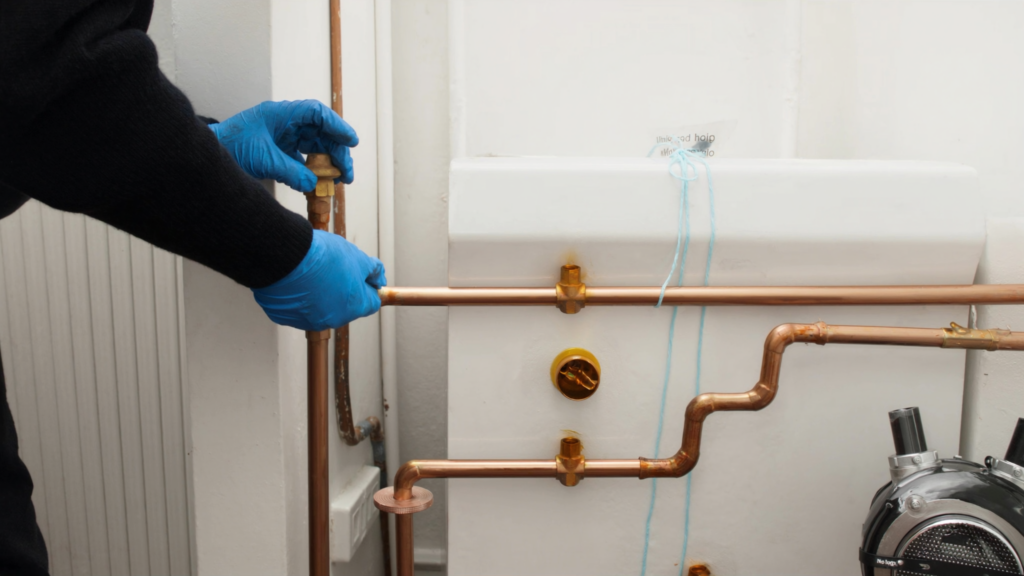
- Manifold installation. The manifold is fixed to the wall, usually in a purpose-built housing, and connected to the heat source pipework. Actuators are fitted to each zone port.
- Pipe laying. PEX or polybutylene pipe is clipped or stapled to the insulation in pre-designed loops, typically in a serpentine or spiral pattern. Pipe spacing is usually 150–300mm depending on the heat output required. Each loop is a single continuous run with no joints beneath the screed.
- Pressure testing. Before screed is poured, the system is pressure tested to 6 bar (held for at least 24 hours) to confirm there are no leaks. This is a critical step, never allow screed to be poured without a witnessed pressure test.
- Screed pour. Liquid screed (anhydrite) or sand-cement screed is poured over the pipework to the specified depth, typically 65–75mm over the top of the pipe. Liquid screed is increasingly preferred because it flows around pipes without air pockets, cures more evenly, and can be walked on in 24–48 hours.
- Curing and drying. Screed must cure before the heating is turned on. Anhydrite screed requires a minimum of 7 days before any controlled heating, then a gradual commissioning protocol: start at 25°C for 3 days, then raise by 5°C per day to the maximum working temperature. This process prevents cracking. Total screed drying to flooring-ready moisture levels (below 0.5% CM for liquid screed) typically takes 4–8 weeks depending on thickness and ventilation.
- Commissioning and balancing. Once dry, the installer balances the manifold flows, connects the thermostats, and commissions the system, confirming correct zone operation and flow temperatures. A commissioning certificate should be provided.
For electric systems, installation is considerably simpler: the mat or cable is laid on the subfloor, a thermostat with a floor probe is wired in, and the floor covering is applied on top. Total installation time for a bathroom electric mat is typically 2–4 hours.
Grants and Funding for Underfloor Heating
Underfloor heating itself is not directly grant-funded as a standalone measure, but it qualifies for financial support when installed as part of a broader energy efficiency or heat pump project.
Boiler Upgrade Scheme (BUS)
The UK Government’s Boiler Upgrade Scheme provides grants of £7,500 for air source heat pumps and £7,500 for ground source heat pumps (as of 2026). Because underfloor heating significantly improves heat pump performance, many installers recommend specifying UFH at the same time as the heat pump installation. The grant applies to the heat pump itself, reducing the overall capital cost of the combined project.
Great British Insulation Scheme
Improved insulation under and around a UFH system is essential for performance. The Great British Insulation Scheme closed on 31 March 2026. It funded insulation measures only and never covered windows or glazing.
ECO4 Scheme
The Energy Company Obligation (ECO4) scheme funds energy efficiency improvements for low-income and fuel-poor households. While UFH is not a direct ECO4 measure, related works that improve the home’s suitability for low-temperature heating may qualify.
VAT
A practical but often overlooked saving: underfloor heating installation in a residential property qualifies for the reduced rate of VAT at 5%, rather than the standard 20%. On a £10,000 installation, that is a £1,500 saving. Ensure your installer applies the correct rate, some incorrectly charge 20% on materials.
Scotland, Wales and Northern Ireland
Homeowners in Scotland may access additional support through Home Energy Scotland, which offers interest-free loans of up to £15,000 for heat pumps and related measures including underfloor heating. Wales operates the Warm Homes Programme, which supports energy efficiency improvements for eligible households.
Common Problems and Maintenance
A correctly designed and installed underfloor heating system is remarkably low-maintenance. Most problems arise from poor design, incorrect commissioning, or inappropriate floor coverings. Here is what to watch for and how to keep your system in good health.
System Not Reaching Temperature
The most common complaint in the first heating season is that the system “doesn’t feel warm enough.” This usually has one of three causes: the screed has not fully dried (residual moisture insulates the pipe), the flow temperature is set too low, or the room has higher heat loss than calculated (e.g. inadequate insulation or a poorly sealed extension). A good installer will revisit and adjust flow temperatures during the first winter, this should be included in your aftercare agreement.
Cold Spots
A zone that is entirely cold despite the thermostat calling for heat usually indicates a failed actuator on the manifold, a £20–£50 part that is straightforward to replace. A zone with uneven warmth may have an air lock in the pipe circuit; this can normally be resolved by running a flush through the manifold.
Screed Cracking
Surface cracking in screed is common and usually cosmetic. It results from the screed drying too quickly (before flooring was laid) or from the commissioning protocol being rushed. Structural cracking that disrupts pipe loops is rare but serious, it typically indicates the screed was laid at insufficient depth or without adequate expansion joints at room perimeters.
Annual Maintenance Tasks
- Check and bleed the manifold of any air at the start of each heating season.
- Inspect the inhibitor concentration in the water circuit, low inhibitor levels accelerate corrosion in the manifold and pipework. Test annually and top up as required; aim for a pH of 6.5–8.5.
- Check actuator operation at the manifold, each one should open and close smoothly when the corresponding thermostat calls for heat.
- Review thermostat schedules annually and adjust for any changes in how you use each room.
- For electric systems, test the residual current device (RCD) protecting the circuit every 6 months.
When to Call a Professional
Call a qualified heating engineer if you notice unexplained damp patches on the floor surface (a potential pipe leak), a sudden and significant drop in system pressure, or if a zone remains cold after checking the actuator and thermostat. Pipe leaks in screed systems are rare but do occur, a thermal imaging camera can locate a leak precisely without destructive investigation in most cases.
Underfloor Heating and Floor Coverings
Your choice of floor covering has a direct impact on how efficiently your underfloor heating system performs. The thermal resistance (measured as the tog value or R-value) of the flooring material determines how easily heat can travel from the pipe through the floor to the room above.
The general rule is to keep the combined tog value of all floor layers (including the floor covering, adhesive, and any underlay) below 2.5 tog. Above this threshold, heat transfer becomes inefficient and surface temperatures may not reach comfortable levels without excessive flow temperatures.
- Stone and ceramic tiles, the optimal choice. Very low thermal resistance, excellent heat distribution, durable. Tog value typically 0.3–0.6.
- Polished concrete and resin floors, excellent conductors and visually contemporary. Tog value 0.2–0.4.
- Engineered wood, compatible when UFH-approved by the manufacturer. Keep the surface temperature below 27°C to prevent movement. Tog value 0.8–1.5 depending on thickness.
- Luxury vinyl tile (LVT), increasingly popular and generally UFH-compatible. Check the manufacturer’s maximum temperature rating. Tog value 0.4–0.8.
- Solid hardwood, technically possible with careful temperature management, but most manufacturers limit surface temperature to 27°C and recommend a long acclimatisation period. Risk of cupping and gapping is higher.
- Carpet, use only if the combined carpet and underlay tog value is below 1.5. Thick underlay and heavy pile carpets significantly reduce efficiency and are not recommended.
Underfloor Heating in Older and Listed Properties
Older UK homes, particularly solid-walled Victorian and Edwardian terraces, present specific challenges for underfloor heating. Heat loss through un-insulated solid walls and floors means the system has to work harder, potentially requiring higher flow temperatures that reduce efficiency. Before installing UFH in an older property, prioritise wall and floor insulation to reduce the heat loss calculation. In many cases, adding 50mm of floor insulation and improving draught-proofing transforms a marginal project into a genuinely efficient one.
Listed buildings require consent from the local planning authority before installing underfloor heating, as it involves changes to the fabric of the building. Overlay systems that sit above the existing floor without disturbing it are more likely to receive consent than screed systems that require the original floor to be removed. Always consult your local conservation officer early in the planning stage.
Suspended timber floors in Victorian homes can accommodate wet underfloor heating through a between-joist installation, pipes are clipped to the underside of the floorboards using aluminium heat-diffuser plates that spread warmth across the floor surface. This approach adds no floor height, requires minimal disruption, and can be retrofitted by lifting just a few boards at strategic intervals. Response times are slightly slower than screed systems, but performance in a well-insulated room is excellent.
The Future of Underfloor Heating in the UK
The trajectory for underfloor heating in the UK is strongly positive. As the government’s Future Homes Standard (expected to come into full effect in 2025–2026) mandates that new homes produce 75–80% less carbon than those built under previous regulations, heat pump-compatible heating distribution systems like underfloor heating become the logical default for new construction.
The phasing out of new gas boiler installations, currently planned for 2035, means millions of UK homes will need to transition to heat pumps over the next decade. While heat pumps can work with radiators, underfloor heating’s lower flow temperature requirement means it extracts significantly more efficiency from any heat pump. Homes already fitted with underfloor heating will require minimal modification when making the switch. Homes with radiators may need to upsize them significantly to compensate for the lower flow temperatures.
Hydrogen-ready boilers Guide to Hydrogen-Ready Boilers are another technology being positioned as a future heat source, and they too are compatible with wet underfloor heating systems, since the distribution pipework and manifold are heat-source agnostic. Whatever heat source technology ultimately prevails, a well-designed wet underfloor heating system installed today is built to last and remain compatible.
Smart controls are also evolving rapidly. Integration between underfloor heating thermostats, smart energy tariffs, solar PV systems, and home energy management platforms means your underfloor heating can increasingly shift its operation to times when electricity is cheapest or when your solar panels are generating, reducing running costs further and making the system more responsive to your actual lifestyle.