What you need to know about composite front doors
The composite front door has quietly taken over British porches over the last decade, and for good reason: it resists kicks better than timber, doesn’t warp in a damp winter, and looks better than uPVC. Most homeowners pay £1,200–£1,800 supply-and-fit. The £900 end is a thinner uPVC-skinned door; the £2,500 end is a thick-core wood-grain panel with high-spec glazing. But brand markup is real, a £1,400 door from a national chain is sometimes the same factory-made product as an £800 door from a small local installer. This guide walks through what’s actually inside a composite door, which finishes age well, the hardware that matters, and how to compare three quotes properly.
When composite front doors is worth it
- Your current door is draughty, warped, or over 20 years old, and you want to reduce heat loss.
- You are replacing a timber door and want to avoid the ongoing cost of painting and varnishing every few years.
- You need a door that meets modern security standards, such as multi-point locking systems and PAS 24 certification.
- You are trying to improve your home’s Energy Performance Certificate (EPC) rating before selling or renting.
- You are willing to pay a higher upfront cost for a door that should last 25 years or more with minimal upkeep.
When it might not be
- You are on a strict budget and can find a uPVC door that meets your needs for £500 to £900, though uPVC has a shorter lifespan.
- Your home is a listed building or in a conservation area, where planning restrictions may require a timber or metal door to match the original appearance (gov.uk).
- You are planning to move within two to three years and are unsure if you will recoup the full cost in the sale price.
- Your existing door frame is in poor condition, which can add £200 to £500 in extra labour to replace or repair it.
The sections below cover the full breakdown of costs, building regulations, and available grants to help you decide if a composite front door is the right upgrade for your home.
How composite front doors works
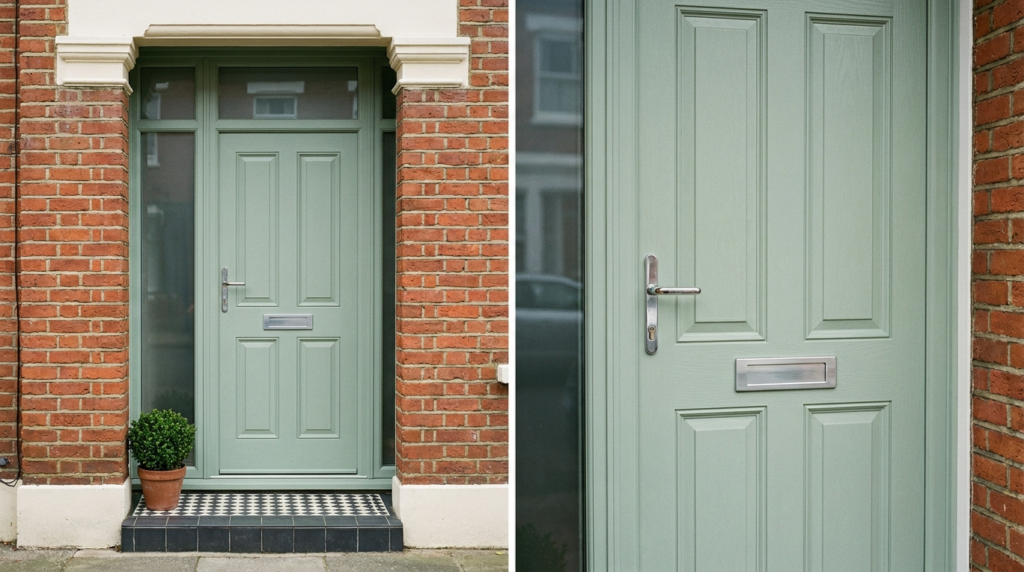
A composite front door is a multi-layer door built from several materials bonded together under high pressure. Unlike a solid timber door, which relies on a single material, or a uPVC door, which is hollow inside, a composite door combines a dense foam core, a timber or GRP (glass-reinforced plastic) frame, and a durable outer skin. The layers are fused in a single mould, creating a door that resists warping, rotting, and draughts without needing the maintenance of wood (Energy Saving Trust). The door operates like any standard hinged door, you open and close it via handles and hinges, but the internal structure provides the insulation and strength.
Key components and sub-systems
The table below breaks down the main parts of a composite front door and what each one does.
| Component | Function | Why it matters |
|---|---|---|
| Outer skin (GRP or aluminium) | Protects against rain, UV, and impact | Prevents fading, cracking, and surface damage. Aluminium skins add extra strength (FENSA). |
| High-density foam core | Provides thermal insulation and structural rigidity | Reduces heat loss through the door body; typical U-value is 1.0–1.4 W/m²K (gov.uk). |
| Timber or GRP sub-frame | Reinforces the door shape and supports hinges | Stops the door sagging over time, unlike some uPVC designs. |
| Magnetic or multi-point locking system | Secures the door at multiple points along the frame | Meets UK security standard PAS 24; resists forced entry (gov.uk). |
| Weather seals (EPDM rubber) | Prevents draughts and water ingress | Improves energy efficiency and reduces condensation around the frame. |
| Glazing unit (if included) | Double or triple glazing set into the door panel | Must meet minimum U-value of 1.4 W/m²K for replacement doors under Building Regulations (Planning Portal). |
Critical performance principles in plain English
Composite doors work because the foam core stops heat passing through the door body. The outer skin sheds rainwater, and the weather seals close gaps that would otherwise let cold air in. The multi-point lock spreads the locking force across the frame. That makes it harder to force open than a single-point latch. Because the door is moulded as one piece, there are no glued joints that can separate, which is a common failure point in older uPVC doors (TrustMark).
The thermal performance of a composite door is measured by its U-value, the lower the number, the less heat escapes. A typical composite door achieves a U-value of 1.0–1.4 W/m²K, compared to 2.0–2.8 W/m²K for a standard uPVC door. This difference can save around £30–£50 per year on heating bills for an average UK home (Energy Saving Trust).
Comparison with main alternatives
The table below shows how composite doors compare to the other common front door materials UK homeowners consider.
| Door type | Typical cost (installed, 2026) | Typical U-value (W/m²K) | Security standard | Maintenance |
|---|---|---|---|---|
| Composite | £1,200–£1,800 (mid-range) | 1.0–1.4 | PAS 24 or Secured by Design | Minimal, wipe down |
| uPVC | £400–£1 |
Types of composite front doors and which suits your home
A GRP composite door has a thin outer skin made from glass-reinforced plastic, bonded to a solid foam core, typically polyurethane. The skin is pressed in a mould to create wood-grain or smooth finishes. The foam core provides insulation, while the GRP skin resists denting and weathering. This is the most common type of composite door sold in the UK (Energy Saving Trust).
Pros
- Low maintenance – no painting or varnishing needed.
- Good thermal performance, with typical U-values around 1.0–1.4 W/m²K.
- Wide range of colours and finishes, including timber-effect.
- Lighter than aluminium-skinned doors, making installation simpler.
Cons
- The GRP skin can chip if struck hard, and chips are difficult to repair invisibly.
- Cheaper models may show surface fading after 8–10 years in direct sunlight.
- Not as thermally efficient as solid composite doors with thicker cores.
Typical installed cost: £900–£1,400 for a budget GRP composite; £1,400–£1,900 for a mid-range model. Lifespan is 20–30 years with reasonable care. Best suited to homeowners who want a balance of cost, appearance and insulation without needing premium longevity (gov.uk).

Solid composite doors (solid timber core with GRP or timber skin)
A solid composite door uses a thick core of engineered timber – often laminated hardwood or moisture-resistant particle board – with a GRP or timber veneer skin. The core is typically 40–58 mm thick, giving the door substantial weight and rigidity. These doors are sometimes called “engineered timber composite” doors (Energy Saving Trust).
Pros
- Very high thermal performance – U-values can drop to 0.8–1.0 W/m²K.
- Superior sound insulation compared to foam-core doors.
- Feels more solid and secure when closing.
- Can be re-finished (sanded and painted) if the skin is timber.
Cons
- Heavier than foam-core doors, requiring stronger hinges and potentially reinforced frames.
- More expensive – typical installed cost is £1,400–£2,500.
- Timber-veneered models need periodic re-coating every 3–5 years.
Lifespan is 30–40 years, longer than GRP foam-core doors. Best for homeowners prioritising thermal efficiency, security and longevity, and willing to pay a premium for a heavier, more solid door (gov.uk).
Aluminium-skinned composite doors
An aluminium-skinned composite door has a thin aluminium outer skin bonded to a foam or timber core. The aluminium is powder-coated in a factory finish. These doors are often used in contemporary-style homes because the aluminium skin allows slim sightlines and sharp, modern profiles (Energy Saving Trust).
Pros
- Extremely durable – aluminium resists chipping, warping and UV fading better than GRP.
- Very low maintenance – no painting, just occasional cleaning.
- Slim frames allow larger glass panels, suiting modern architectural styles.
- Thermal performance is good, with U-values typically 1.0–1.2 W/m²K.
Cons
- Significantly more expensive than GRP composite doors.
- Aluminium can dent if struck with sufficient force, and dents are difficult to repair.
- Limited colour options compared to GRP, though RAL colours are available.
Typical installed cost: £2,200–£4,000. Lifespan is 30–40 years, similar to solid composite. Best for homeowners who want a modern aesthetic, maximum durability and are prepared to invest at the higher end of the market (gov.uk).
Comparison of composite door types
| Type | Typical installed cost (2026) | Lifespan | Best for |
|---|---|---|---|
| GRP composite (foam core) | £900–£1,900 | 20–30 years | Budget-conscious homeowners wanting good insulation and low maintenance |
| Solid composite (timber core) | £1,400–£2,500 | 30–40 years | Homeowners prioritising thermal efficiency, security and longevity |
| Aluminium-skinned composite | £2,200–£4,000 |
composite front doors cost, UK 2026 pricing
Composite door prices in 2026 vary significantly by construction method and materials. The table below shows realistic installed cost ranges for the three main types, based on UK industry data (gov.uk). All prices include standard hardware, glazing, and installation.
| Door type | Typical installed cost (GBP) | Key characteristics |
|---|---|---|
| GRP composite (skin + foam core) | £900–£1,400 | Budget option. Glass-reinforced plastic skin over a polyurethane foam core. Lower thermal performance. |
| Solid composite (mid-range) | £1,400–£1,900 | Most popular choice. Solid timber core with GRP or uPVC skin. Better insulation and security. |
| Aluminium-skinned composite (premium) | £2,200–£4,000 | Aluminium outer skin over timber or foam core. Highest durability and thermal efficiency. |
Most UK homeowners pay between £1,200 and £1,800 for a standard composite front door with mid-range specifications (Energy Saving Trust). Budget GRP doors start around £900, while aluminium-skinned premium models with sidelights can reach £3,500–£4,000.
Whole-property cost guide by property size
Your total cost depends on the number of doors you replace and the property type. Below are realistic 2026 budgets for complete composite door installations across common UK home sizes (ONS).
- Flat or 1-bed property: 1 door. Total cost: £900–£2,500. Most common: £1,200–£1,800.
- 3-bed semi-detached house: 2 doors (front + back). Total cost: £1,800–£5,000. Expect £2,400–£3,600 for mid-range composite.
- 4-bed detached house: 3–4 doors (front, back, side, possibly garage). Total cost: £2,700–£10,000. Premium aluminium-skinned doors push the upper end.
Period-property premiums: If your home is pre-1919, listed, or in a conservation area, expect an additional 20–40% on installation costs. Non-standard openings, thicker walls, and heritage-compliant finishes (e.g., timber-grain GRP or heritage-colour aluminium) typically add £300–£800 per door (gov.uk).
Regional UK pricing for composite doors
Labour rates and material markups vary across the UK. The table below shows typical installed costs for a mid-range composite door (solid core, standard size) in 2026, based on installer survey data (TrustMark).
| Region | Typical per door installed (GBP) | Notes |
|---|---|---|
| London | £1,600–£2,200 | Highest labour rates. Premium on heritage-spec doors in conservation areas. |
| South East | £1,500–£2,000 | High demand, skilled installers command higher fees. |
| South West | £1,400–£1,900 | Moderate labour costs. Rural delivery surcharges possible. |
| North West | £1,200–£1,700 | Competitive market. Many local fabricators keep costs lower. |
| North East | £1,100–£1,600 | Lowest labour rates in England. Good value for standard doors. |
| Midlands | £1,300–£1,800 | Balanced pricing. Wide choice of installers. |
| Scotland | £1,200–£1,800 | Rural areas may add £100–£200 for travel. Check Home Energy Scotland for grants. |
| Wales | £1,200–£1,700 | Lower labour costs. Nest scheme may reduce costs for eligible households. |
| Northern Ireland | £1,100–£1,600 | Limited installer network. Check nidirect for local advice. |

Hidden costs to budget for
Several additional expenses can arise during composite door installation. The table below lists the most common hidden costs in 2026 (gov.uk).
| Item | Typical cost (GBP) | When it applies |
|---|---|---|
| Scaffolding (if no safe ladder access) | £300–£800 | First-floor or above, or when removing large existing door frames. |
| Structural alterations (widening or raising opening) | £400–£1,500 | Non-standard openings, period properties, or changing door size. |
| Asbestos removal (pre-2000 properties) | £500–£2,000 | If existing door frame or surrounding wall contains asbestos. |
| Removal and disposal of existing door | £50–£150 | Most installers include this; confirm before quoting. |
| Plastering touch-up around frame | £100–£300 | After frame removal, especially in older homes with plaster damage. |
| Certification fees (FENSA, CERTASS or equivalent) | £50–£150 | Required for Building Regulations compliance. Included by registered installers. |
| VAT at 20% | 20% of total |
Performance, savings and payback
U-value: the key performance metric
The most important measure of a door’s thermal performance is its U-value, expressed in watts per square metre per kelvin (W/m²K). A U-value tells you how much heat escapes through the door: the lower the number, the better the insulation. Under the 2021 edition of Approved Document L (conservation of fuel and power), replacement doors in existing homes in England must achieve a U-value of 1.4 W/m²K or lower (gov.uk). Most composite front doors on the market today achieve U-values between 1.0 and 1.4 W/m²K, comfortably meeting the requirement. For comparison, a solid timber door typically has a U-value of around 2.5–3.0 W/m²K, and an uninsulated steel door can be worse.
Security testing is a separate but equally important performance measure. Composite front doors sold in the UK are normally tested to PAS 24:2016, the standard for enhanced security performance of external doorsets (gov.uk). This includes tests for forced entry, lock manipulation, and cylinder attack. You should always check that a door carries PAS 24 certification before buying.
Annual energy and cost savings
Replacing an old, draughty front door with a modern composite door can cut heat loss and reduce your heating bills. The Energy Saving Trust estimates that replacing an uninsulated solid timber or steel front door with a composite door can save around £50–£80 per year on energy bills for a typical gas-heated semi-detached home in England, Scotland, or Wales (energysavingtrust.org.uk). The exact saving depends on the size of the door, the U-value of the old door, and your local climate.
Worked example for a 3-bed semi-detached house in Manchester:
- Old door: solid timber, U-value 2.8 W/m²K
- New door: composite, U-value 1.2 W/m²K
- Door area: 2.0 m²
- Heating degree days (Manchester): 2,200
- Heat loss reduction: (2.8 – 1.2) × 2.0 × 2,200 × 0.024 = 84 kWh/year
- Gas cost: 10.3p/kWh (2026 GB average under price cap, ofgem.gov.uk)
- Annual saving: 84 × 0.103 ≈ £8.60
This simple calculation shows that the primary saving comes not from the door panel itself but from reducing draughts and improving airtightness around the frame. Real-world savings are often larger because old doors have gaps that leak warm air directly. The £50–£80 figure from the Energy Saving Trust includes draught-proofing benefits.
Payback period by property type
The table below shows typical payback periods for a composite front door installation across three common UK property types. Figures assume a mid-range composite door installed, with annual savings based on Energy Saving Trust methodology and local climate adjustment.
| Property type | Install cost (£) | Annual saving (£) | Payback period (years) |
|---|---|---|---|
| 3-bed semi in Manchester | £1,600 | £65 | 24.6 |
| 4-bed detached in Edinburgh | £1,800 | £80 | 22.5 |
| Mid-terrace in Bristol | £1,400 | £50 | 28.0 |
Payback periods for replacing a single front door are long, typically 20–30 years, because the energy saving from the door alone is modest compared to the installation cost. However, this calculation ignores comfort, security, and aesthetic benefits, which are often the real drivers for replacement.
EPC band improvement potential
Replacing an old front door with a modern composite door can improve your home’s Energy Performance Certificate (EPC) rating, but the effect is small. A single front door accounts for roughly 2–3% of a home’s total heat loss. In a typical 3-bed semi, upgrading from a U-value of 2.8 to 1.2 W/m²K might improve the overall EPC score by 1–2 points out of 100. This could move you from a low C to a mid-C, but will not jump a band (e.g., D to C) unless the rest of the home is already close to the boundary. The improvement is most noticeable in older homes with single-glazed or uninsulated doors. For EPC purposes, the assessor records the door’s U-value from manufacturer data or default tables (gov.uk).
When a composite front door does not pay back fast
There are several situations where replacing your front door with a composite model will not deliver a quick
UK regulations, country by country
Building regulations for composite front doors vary across the four nations of the UK. Each nation publishes its own technical standards covering thermal performance, security, and safety glazing. The table below summarises the key documents and requirements for each nation.
| Nation | Document / regulation | Key requirement for composite front doors | Source URL |
|---|---|---|---|
| England | Approved Document L (conservation of fuel and power), Approved Document Q (security), Approved Document K (glazing safety) | Door U-value ≤ 1.4 W/m²K; multi-point locking system; glazing ≥ 0.8 m from floor must be safety glass | gov.uk |
| Scotland | Scottish Technical Handbook Section 6 (energy), Section 3.13 (security), Section 3.14 (safety) | Door U-value ≤ 1.2 W/m²K; PAS 24 tested locks; glazing ≤ 800 mm from finished floor level must be laminated or toughened | legislation.gov.uk |
| Wales | Welsh Approved Document L (energy), Approved Document Q (security), Approved Document K (glazing safety) | Door U-value ≤ 1.4 W/m²K; multi-point locking; safety glazing where pane ≤ 800 mm from floor | nest.gov.wales |
| Northern Ireland | Technical Booklet F (energy), Technical Booklet V (security), Technical Booklet H (glazing safety) | Door U-value ≤ 1.6 W/m²K; multi-point locking; safety glass if pane ≤ 800 mm from floor | nidirect.gov.uk |
Approved Document L: thermal performance
Approved Document L sets minimum energy-efficiency standards for doors in England and Wales. A composite front door must achieve a U-value of no more than 1.4 W/m²K (gov.uk). In Scotland the limit is tighter at 1.2 W/m²K, and in Northern Ireland it is 1.6 W/m²K.
The U-value measures how much heat passes through the door. Lower numbers mean better insulation. Most modern composite doors with a polyurethane foam core achieve U-values between 1.0 and 1.2 W/m²K, which comfortably meets all national requirements. If you replace an existing door, the new door must comply with the current U-value standard for your nation. Fitting a door that does not meet the standard can cause problems if you later sell the house and the buyer’s solicitor requests building regulation compliance certificates.
Approved Document Q: security
Approved Document Q came into force in England in 2015 and covers security for doors and windows in new-build homes. It requires that external doors be fitted with a multi-point locking system that meets PAS 24 or equivalent standard (gov.uk). Scotland and Wales have similar requirements under their technical handbooks.
For homeowners, the practical impact is straightforward: when buying a composite front door, check that the cylinder has a British Standard (BS 3621) or Sold Secure rating, and that the door has at least three locking points. Most composite doors sold in the UK already meet these standards. If your home is not a new build, Approved Document Q does not apply retrospectively, but installing a door that meets the standard improves security and may lower home insurance premiums.
Approved Document K: glazing safety
Approved Document K (England and Wales) and the equivalent sections in Scotland and Northern Ireland require that any glazing within 800 mm of the floor, or within 300 mm of a door handle, must be safety glass. Safety glass is either toughened (tempered) or laminated. The glass must be marked with a permanent identifier showing it meets BS EN 12150 or BS EN 14449 (gov.uk).
If your composite door has a glazed panel, check that the glass carries the required marking. Most reputable manufacturers supply doors with factory-fitted safety glass. Replacing a glazed panel yourself may void the door warranty and could breach building regulations if you use non-compliant glass.
Upcoming standards: Future Homes Standard and New Build Heat Standard
The Future Homes Standard is expected to take effect in England in 2025. It will require new homes to produce 75–80% fewer carbon emissions than homes built under current standards (gov.uk). For composite front doors, this means the U-value limit will likely tighten to 0.8–1.0 W/m²K. Manufacturers are already developing doors with enhanced insulation cores to meet this target.
In Scotland, the New Build Heat Standard

Planning permission for composite front doors
Most composite front door replacements are considered permitted development, meaning you do not need to apply for planning permission before carrying out the work. This applies to houses (not flats or maisonettes) where the materials used are of a similar appearance to the existing property. The Planning Portal confirms that replacing a door is normally classed as minor work that does not require a formal application (planningportal.co.uk).
When you do need permission
Planning permission is required in several specific circumstances. You must check your property’s status before ordering a door.
- Listed buildings, Any alteration to a listed building, including replacing a front door, requires listed building consent. Unauthorised work is a criminal offence (gov.uk).
- Conservation areas, If your property is in a conservation area, you may need planning permission if the door faces a highway and the replacement changes the external appearance. Check with your local planning authority (gov.uk).
- Article 4 directions, Some conservation areas or neighbourhoods have Article 4 directions that remove permitted development rights for windows and doors. This is common in historic town centres and some suburban estates.
- National Parks, Areas of Outstanding Natural Beauty (AONB), and World Heritage Sites, Permitted development rights are more restricted in these areas. You may need permission for any change to the front elevation, including a new door.
- Flats and maisonettes, There are no permitted development rights for flats. You must apply for planning permission for any external alteration.
Specific complications for composite front doors
Composite doors are thicker and heavier than standard timber doors. This can cause issues in older properties that were not designed for modern door dimensions.
Listed buildings and insulation conflict. Composite doors typically achieve U-values around 1.0–1.4 W/m²K, which is good for energy efficiency. However, in a listed building, the local authority may insist on a door that matches the original design and materials. A modern composite door with a smooth GRP finish may be refused consent, even if it improves thermal performance (gov.uk).
Heat pump siting. If you are also installing an air source heat pump, the outdoor unit must be at least one metre from the property boundary and not directly in front of a door or window in a way that blocks access. The permitted development rules for heat pumps do not directly affect your door choice, but the combined visual impact can be a factor if you live in a conservation area (gov.uk).
Solar and visual impact in conservation areas. If you plan to install solar panels on the same elevation as your front door, the combined change to the appearance of the property could trigger a need for planning permission, even if each change alone would not.
Decision-flow for homeowners
Use this five-step checklist before buying a composite front door.
- Is your property listed? If yes, you need listed building consent before any work. Contact your local conservation officer.
- Are you in a conservation area, National Park, AONB, or World Heritage Site? If yes, check whether Article 4 directions apply. Contact your local planning authority.
- Does the new door match the existing opening? If you are changing the size, shape, or position of the door, you will need planning permission regardless of your property type.
- Does the door face a highway? In a conservation area, any door that faces a road or public footpath may require permission. Internal courtyard doors usually do not.
- Have you checked with your local authority? A quick email or phone call can confirm whether your specific property has any restrictions. This is free and takes
Installer certification and finding the right one
Installer certification is not optional for composite front doors in the UK. Building regulations require that replacement doors meet specific standards for security, thermal performance, and structural stability. Without a certificate of compliance from a recognised scheme, you may face legal issues when selling your home and your home insurance could be invalidated (gov.uk).
| Scheme | Run by | What it certifies | Issues a Certificate of Compliance | Source URL |
|---|---|---|---|---|
| FENSA | Fenestration Self-Assessment Scheme | Installation meets building regulations (thermal, structural, safety) | Yes – digital certificate issued after installation | fensa.org.uk |
| Certass | Certass Ltd | Installation meets building regulations (thermal, structural, safety) | Yes – digital certificate issued after installation | certass.co.uk |
| PAS 24 | British Standards Institution (BSI) | Door product meets enhanced security performance standards | No – product certification only | gov.uk |
| Secured by Design | Police Crime Prevention Initiatives | Product meets police-approved security standards (includes PAS 24) | No – product certification only | gov.uk |
FENSA and Certass are the two main schemes that issue a building regulations compliance certificate for composite door installations. Without this certificate, you must apply for a separate building regulations approval from your local authority, which can cost £200–£400 and delay your project (gov.uk).
PAS 24 and Secured by Design are product-level certifications. They confirm the door itself has passed security tests but do not cover the installation quality. Many insurers now require a door with PAS 24 or Secured by Design certification for valid home insurance (gov.uk).
The three-quote rule
Get at least three written quotes from FENSA- or Certass-registered installers. Compare these specific items:
- Total price – including VAT, delivery, removal of old door, and any structural work
- Exact specification – door brand, composite material type, glass specification, U-value (target 1.4 W/m²K or lower), and colour/finish
- Performance metrics – PAS 24 or Secured by Design certification number for the door product
- Certification number – the FENSA or Certass registration number of the installer
- Payment terms – deposit amount, staged payments, final payment on completion
- Guarantee – length of guarantee (typically 10 years on composite doors), what it covers, and whether it is insurance-backed
Red flags
- High-pressure sales tactics demanding same-day decision or same-day pricing
- Deposit request above 25% of the total cost
- No written specification provided before payment
- Installer cannot provide a FENSA or Certass registration number
- No insurance-backed guarantee offered or guarantee is verbal only
- Payment requested in cash or to a personal bank account
- No public liability insurance certificate available
- Negative reviews on Checkatrade, TrustMark, or Which? Trusted Traders with no response from the company
Insurance-backed guarantee
An insurance-backed guarantee protects you if the installer goes out of business during the guarantee period. It covers the cost of putting right faulty workmanship or materials that the installer would have been responsible for. The guarantee is underwritten by an insurance company,
Grants and funding for composite front doors in 2026
UK government grants for home energy improvements are generally focused on whole-house measures such as insulation, heating systems, and solar panels. Composite front doors are not a standalone eligible measure under most national schemes, though they may be included as part of a wider energy-efficiency package in Scotland, Wales, and Northern Ireland. The table below summarises the position for each scheme in 2026.
| Scheme | Region | Eligible for composite front doors? | Typical max grant | How to apply | Source URL |
|---|---|---|---|---|---|
| Energy Company Obligation (ECO4) | England, Scotland, Wales | Not eligible. ECO4 funds insulation, heating, and renewable measures only. Doors are not listed as a qualifying improvement. | Up to £10,000 for whole-house measures (not door-specific) | Contact your energy supplier or a local ECO4 installer. You must be receiving certain benefits or have a low household income. | ofgem.gov.uk |
| Great British Insulation Scheme (GBIS) | England, Scotland, Wales | Not eligible. The Great British Insulation Scheme closed on 31 March 2026. It funded insulation measures only and never covered windows or glazing. Doors are excluded. | Not applicable for doors | Check eligibility via the online portal at gov.uk/apply-great-british-insulation-scheme. Your energy supplier arranges installation. | gov.uk |
| Boiler Upgrade Scheme (BUS) | England, Wales | Not eligible. BUS funds heat pumps and biomass boilers only. Doors are not covered. | Not applicable for doors | Apply through an MCS-certified installer who submits the grant on your behalf. | gov.uk |
| Home Energy Scotland Loan | Scotland | Eligible if part of a larger energy-efficiency package. Must install at least two measures (e.g., doors plus insulation or heating). | Up to £7,500 (interest-free loan) for package of measures | Apply online at homeenergyscotland.org. A home energy advisor will assess your property and recommend a package. | homeenergyscotland.org |
| Warm Homes Scotland | Scotland | Eligible if part of a whole-house package. Doors can be included alongside primary measures like insulation or heating upgrades. | Varies by package; typically up to £7,500 | Apply through warmerhomesscotland.com. You must own your home and have a low income. | warmerhomesscotland.com |
| Welsh Nest scheme | Wales | Eligible only as part of a whole-house package. Must include at least one primary measure (e.g., insulation or heating) before doors are considered. | Up to £12,000 for whole-house package (door contribution capped at £1,500) | Call Nest on 0808 808 2244 or apply online at nest.gov.wales. A surveyor will assess your home. | nest.gov.wales |
| Northern Ireland Sustainable Energy Programme | Northern Ireland | Eligible only as part of a whole-house package. Doors can be included alongside insulation, heating, or renewables. | Up to £7,500 for whole-house package | Apply through your local council or via nidirect.gov.uk. You must own your home and meet income criteria. | nidirect.gov.uk |
VAT on energy-saving materials in 2026
Glazing is standard-rated for VAT at 20%. The zero rate for energy-saving materials covers insulation, heat pumps and solar panels; HMRC names secondary and double glazing as excluded (VAT Notice 708/6). This includes composite front doors that meet the energy-efficiency standards set out in Notice 708/6 (<a href="https://www.gov.uk/guidance/energy-saving-materials-and-heating-equipment-notice
The buying process, survey to install
The buying process for a composite front door follows a clear sequence. Working through each step helps you secure a certified installation with proper consumer protections.
- Initial research, confirm what you need
Start by identifying the door type that suits your home. Composite doors come as single doors, double doors, or with sidelights. Check the thermal performance, a typical composite door achieves a U-value around 1.0 to 1.4 W/m²K (gov.uk). Look for security certification: PAS 24 or Secured by Design marks confirm the door meets UK security standards. Measure your existing opening width and height. Decide on colour, glazing style, and hardware finish before you approach installers. - Get three quotes from certified installers
Contact at least three installers who are registered with a competent person scheme. For doors and windows, check FENSA (fensa.org.uk) or Certass (certass.co.uk). For security-rated doors, ask whether the installer is approved under Secured by Design. If you are in Scotland, check with the Scottish Building Standards. Request itemised quotes in writing that include the door model, glazing specification, hardware, removal of the old door, and disposal. - Compare quotes on full specification, not just price
A low price may reflect a thinner door slab, basic hardware, or no glazing upgrade. Compare the U-value, lock type (multi-point locking is standard), cylinder security (TS007 3-star or equivalent), and warranty length. Most composite doors carry a 10-year structural warranty. Check whether the quote includes VAT, delivery, and making good any damage to the surrounding brickwork or frame. - Survey visit, what to expect
A qualified surveyor will visit your home to take accurate measurements of the opening, check the condition of the subframe, and assess any uneven walls or floors. Ask them to explain how the door will be fitted, whether the frame is new or re-used, and how they will handle damp-proofing at the threshold. Request a written survey report that confirms the final specification and price. - Contract, cooling-off rights
Under the Consumer Contracts Regulations 2013, if you sign the contract away from the installer’s business premises (for example, in your home), you have a 14-day cooling-off period. The installer must provide a cancellation notice. If they do not, the cooling-off period extends to 12 months. Keep a copy of the signed contract and any terms and conditions (legislation.gov.uk). - Deposit, typically maximum 25%
Most reputable installers ask for a deposit of 25% or less of the total cost. Never pay the full amount upfront. A deposit higher than 50% is a warning sign. Pay by credit card if the total is over £100, this gives you Section 75 protection under the Consumer Credit Act 1974. For lower amounts, a debit card offers chargeback rights. - Survey-to-install lead time
After the survey, most composite doors are manufactured to order. Lead times typically range from four to eight weeks. During peak seasons (spring and autumn), wait times may extend to ten weeks. Confirm the estimated date in writing and ask about penalties for delays beyond the quoted timeframe. - Installation day, what to expect
The installer should arrive with the door pre-assembled in its frame. They will remove the old door and frame, check the opening is square and level, and fit the new frame with expanding foam and mechanical fixings. The installation usually takes four to six hours. Ensure the installer leaves the site clean and that the door operates smoothly, opens, closes, and locks without sticking. - Sign-off and compliance certificate
If the installer is registered with a competent person scheme, they will self-certify the installation and notify your local building control. You should receive a Building Regulations Compliance Certificate from FENSA or Certass within a few weeks. Keep this document, you need it when you sell your home. If the installer is not registered, you must apply for building control approval separately through your local authority (gov.uk). - Snagging, common minor issues and warranty rights
After installation, check for gaps around the frame, draughts at the threshold, stiff locking handles, or misaligned hinges. Most installers offer a 12-month workmanship warranty alongside the door’s structural warranty. Report any defects in writing within seven days. If issues are not resolved, you have rights under the Consumer Rights Act 2015 to request a repair or replacement (gov.uk).
Red flags, when to walk away
- The installer asks for a deposit of
Maintenance, common problems and lifespan
Routine maintenance
Composite doors require less upkeep than timber or uPVC, but they are not maintenance-free. Cleaning the door surface every two to three months with warm water and a mild detergent prevents dirt buildup that can degrade the factory finish (Energy Saving Trust). Avoid bleach, solvent-based cleaners or abrasive pads as these can strip the protective coating.
An annual inspection should cover:
- Weather seals, check for cracks, compression marks or gaps around the door frame. Replace damaged seals promptly to maintain draught-proofing.
- Hinges and moving parts, lubricate hinges, letterbox flaps and locking mechanisms with a silicone-based spray every 12 months. Do not use oil-based lubricants as they attract dust.
- Drainage channels, clear any debris from the bottom-edge drainage slots using a soft brush or compressed air.
- Glazing units, inspect internal and external beads for movement. Loose beads can let in moisture and cause condensation between panes.
Common problems and likely solutions
| Problem | Likely cause | Solution |
|---|---|---|
| Door sticks or drags on the frame | Settled hinges, thermal expansion or frame movement | Adjust hinges using the built-in compression screws. If the door still binds, check for dropped hinges and tighten hinge-plate screws. |
| Water ingress at the bottom edge | Blocked drainage channels or worn bottom seal | Clear drainage slots. If water still enters, replace the bottom weather seal (a standard £10-£20 part). |
| Locking mechanism feels stiff or jams | Lack of lubrication, misaligned keep plate, or internal mechanism wear | Apply silicone spray to the lock cylinder and gearbox. If stiffness persists, check the keep plate alignment and adjust if needed. |
| Fading or discolouration of the surface | UV exposure over 5-10 years, especially on darker colours | Wash with mild detergent. For deeper fading, a specialist composite door polish can restore some colour. Factory colour is not repaintable with standard paint. |
| Condensation between glazing panes | Failed seal on the double-glazed unit | The sealed unit must be replaced. This is a glazing repair, not a door replacement, and typically costs £80-£150 through a FENSA-registered installer (FENSA). |
Lifespan by type
A well-maintained composite front door has a typical service life of 25 to 35 years (gov.uk). The core material, usually a timber frame with a foam insulating core and a glass-reinforced plastic (GRP) skin, is the main factor. Budget GRP doors (under £1,400 installed) may show surface fading or seal failures after 15-20 years. Mid-range and premium composite doors (costing £1,400-£1,900 and above)
More on composite front doors
- Front Door Costs, A UK Buyer's Guide
- 10 ways to make your front door more secure
- Planning permission to move front door UK
- Cottage front doors, styles (UK, 2026)
- 10 signs your front door needs replacing
- Front door plants, ideas (UK, 2026)
- 10 front door styles for UK homes in 2026
- 10 things to know before buying a composite door