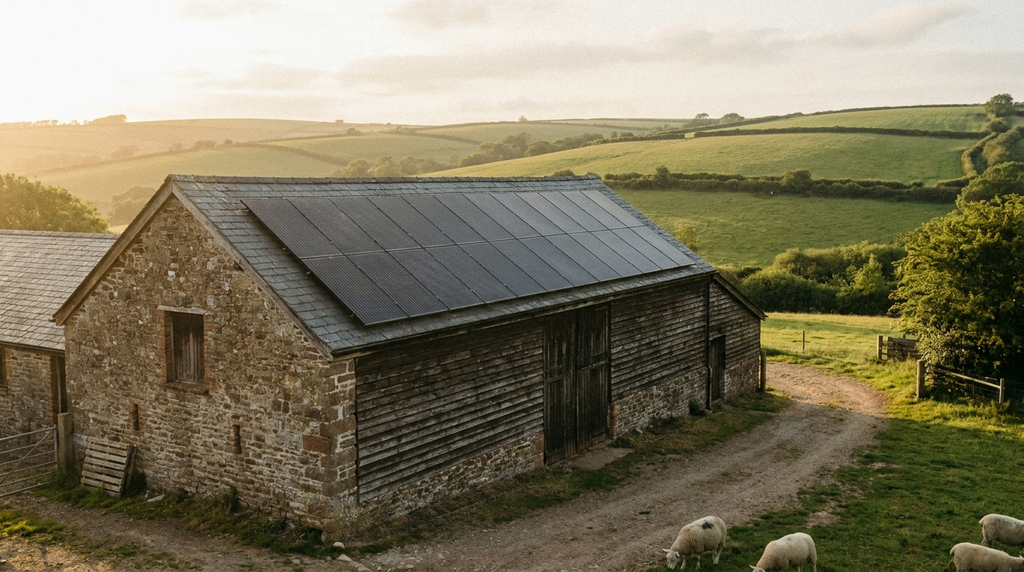
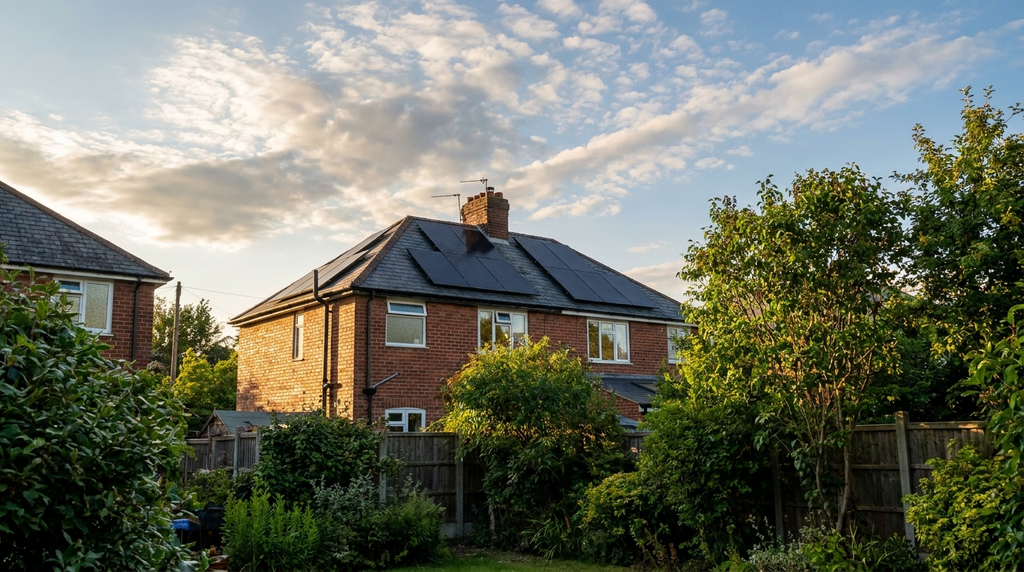
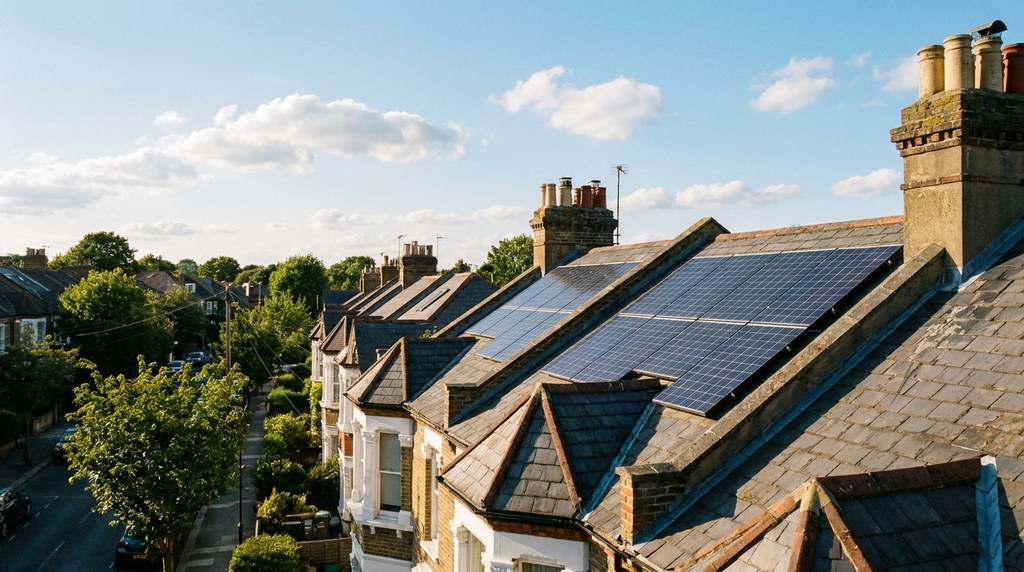
What you need to know about solar panels
Solar is the eco-home upgrade that’s gone from luxury to mainstream the fastest. Installed costs have dropped by roughly two-thirds since 2010, and the Smart Export Guarantee means surplus power earns you 4p–15p per kWh depending on your tariff. A 4 kWp system, about right for a 3-bed semi, costs £5,000–£10,000 supply-and-fit, with payback usually 7–10 years. But the financial case is sensitive to roof orientation, how much electricity you use during daylight, and whether you add battery storage. This guide covers panel choice, the installer questions that actually matter, payback maths for different households, and the upgrades worth pairing with solar.
When solar panels is worth it
- You have a south-facing or east-west roof, these orientations capture the most sunlight across the day, maximising generation for a typical UK home.
- Your daytime electricity use is high, if someone is home during the day (working from home, retired, or with children), you can use the solar power directly, avoiding buying from the grid at current rates (OFGEM).
- You can add a battery, a 5 kWh battery costs around £3,000-£4,500 and lets you store excess daytime generation for evening use, raising your self-consumption from roughly 30-40% to 60-80%.
- Your roof is unshaded and in good condition, shading from trees or neighbouring buildings can slash output; a roof needing replacement within 5-10 years should be fixed first to avoid removal and reinstallation costs.
- You plan to stay in your home for at least 7-10 years, this is the typical payback period for a well-sized system, after which the electricity is essentially free.
When it might not be
- You are on a low-energy tariff or have a small electricity bill, if your annual bill is under £600, the savings may not justify the upfront cost, even with grants.
- Your roof faces north or is heavily shaded, north-facing roofs in the UK generate roughly 30% less than south-facing ones, and shading can reduce output to uneconomic levels.
- You are planning to move house within 3-5 years, while solar panels can add value, you may not recoup the full installation cost in a quick sale.
- Your property is listed or in a conservation area, planning restrictions can block or complicate installation, adding costs for specialist approvals (gov.uk).
If your situation looks promising, the sections below break down the costs, regulations, and grants available for UK homeowners in 2026.
How solar panels works
Solar photovoltaic (PV) panels convert sunlight directly into electricity. When sunlight hits the silicon cells inside each panel, it knocks electrons loose, creating a flow of direct current (DC) electricity. An inverter then converts this DC into alternating current (AC), which is what your home appliances and the National Grid use. The process has no moving parts and produces no noise or emissions during operation (Energy Saving Trust).
Key components and what each does
| Component | Function | Why it matters |
|---|---|---|
| Solar PV panels | Capture sunlight and generate DC electricity | Panel efficiency and wattage determine how much power you generate per square metre of roof |
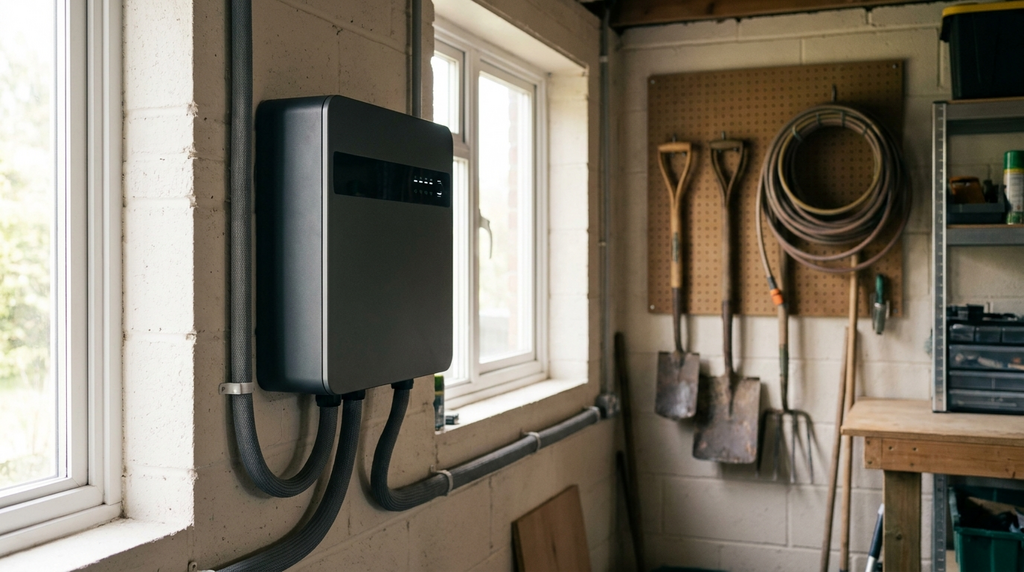
| Inverter | Converts DC electricity from panels into AC electricity for home use | Typically the first component to need replacement (after 10-15 years); a failed inverter stops all generation |
| Generation meter | Records how much electricity your system produces | Required for Smart Export Guarantee payments; lets you track performance |
| Battery storage (optional) | Stores excess electricity for use when the sun is not shining | Can increase the proportion of self-generated electricity you use from around 25% to over 60% |
| AC isolator & consumer unit connection | Safely connects the inverter output to your home wiring | Must be installed by a qualified electrician; ensures the system meets UK wiring regulations |
All components must be installed by an MCS-certified installer for you to qualify for Smart Export Guarantee payments and any available grants (MCS Certified).
Critical performance principles in plain English
Solar panels do not need direct sunlight to work. They generate electricity from daylight, including on cloudy days. A typical UK system still produces about 10-25% of its rated capacity in overcast conditions (Energy Saving Trust).
Orientation and tilt matter more than you might think. A south-facing roof at a 30-40 degree tilt is ideal, but east- and west-facing roofs still generate roughly 80-85% of the maximum possible output. A north-facing roof is generally not recommended for solar panels in the UK.
Shading kills output disproportionately. If one panel in a string is shaded, it can reduce the output of the entire string by 50% or more. Micro-inverters or power optimisers can reduce this effect but add cost.
Generation peaks in summer but you use more in winter. A typical 4 kWp system in the UK generates around 3,500-4,000 kWh per year, but roughly 70% of that is produced between April and September. Winter generation is lower because days are shorter and the sun is lower in the sky (Energy Saving Trust).
How solar panels compares to the main alternatives
| Technology | Typical installed cost (2026) | Annual output / savings | Lifespan | Key regulatory requirement |
|---|---|---|---|---|
| Solar PV (4 kWp) | £6,000-£8,500 | 3,500-4,000 kWh/year; saves £500-£1,000 on bills with battery | 25-30 years (panels); 10-15 years (inverter) | MCS-certified installer required for SEG payments (MCS Certified) |
| Solar thermal (hot water only) | £4,000-£6,000 | Reduces water heating bills by 50-70% | 20-25 years | Must comply with Building Regulations Part L (gov.uk) |
Types of solar panels and which suits your home
Solar panels convert sunlight into electricity using photovoltaic (PV) cells. The three main types available for UK homes are monocrystalline, polycrystalline and thin-film. A fourth option, solar tiles, integrates the technology into your roof covering. Each type differs in efficiency, appearance, cost and lifespan, so the best choice depends on your roof space, budget and aesthetic priorities (Energy Saving Trust).
Monocrystalline PV
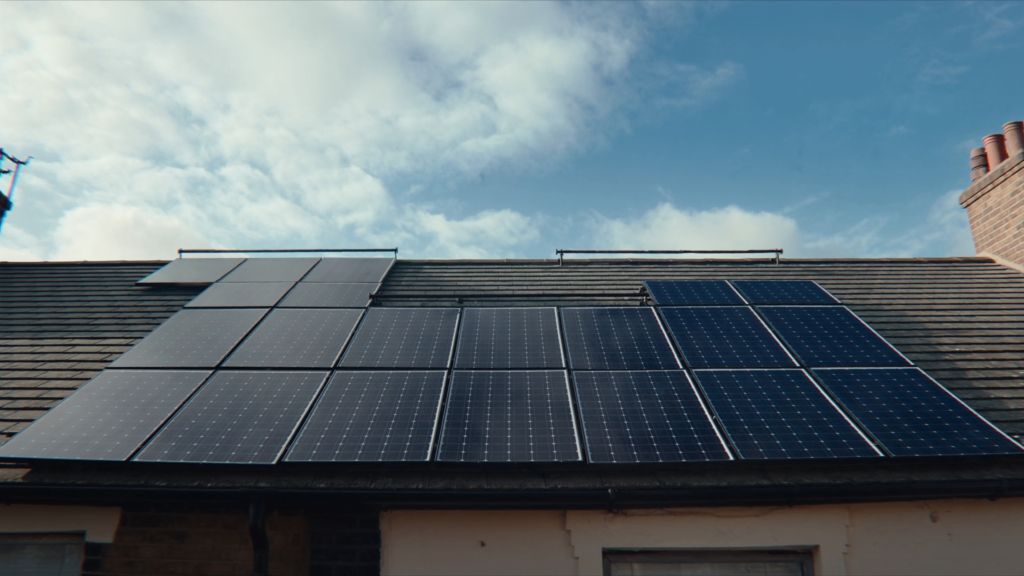
Monocrystalline panels are made from a single silicon crystal. They have a uniform black or dark blue appearance and are the most efficient type of solar panel commonly sold for homes. Because each cell is cut from one crystal, electrons flow more freely, giving higher efficiency rates, typically 20–24% (Energy Saving Trust).
Pros:
- Highest efficiency per square metre, you need fewer panels for the same output
- Long lifespan, typically 25–30 years
- Better performance in low light and high temperatures compared to polycrystalline
- Sleek black appearance that many homeowners prefer
Cons:
- Higher upfront cost than polycrystalline
- Performance drops slightly if part of a panel is shaded
- Manufacturing process uses more energy than polycrystalline
Typical installed cost for a 4 kWp monocrystalline system is £6,000–£8,500. Lifespan is 25–30 years, with performance warranties often guaranteeing 80% output after 25 years. Best for homes with limited roof space where maximising output per panel matters.
Polycrystalline PV
Polycrystalline panels are made from multiple silicon fragments melted together. They have a distinctive blue, speckled appearance and slightly lower efficiency than monocrystalline, typically 15–20%. They are a well-established technology that has been used in UK homes for decades (Energy Saving Trust).
Pros:
- Lower cost per panel than monocrystalline, typically 10–20% cheaper
- Good efficiency for the price
- Proven reliability with long manufacturing history
- Less waste in production than monocrystalline
Cons:
- Lower efficiency means you need more roof space for the same output
- Less attractive appearance, blue speckled finish is more visible
- Slightly shorter lifespan than monocrystalline, typically 20–25 years
Typical installed cost for a 4 kWp polycrystalline system is £5,000–£7,500. Lifespan is 20–25 years. Best for larger roofs where space is not a constraint and keeping upfront costs low is a priority.
Thin-film PV
Thin-film panels are made by depositing a thin layer of photovoltaic material, such as cadmium telluride or amorphous silicon, onto a substrate like glass, metal or plastic. They are lightweight and flexible, but significantly less efficient than crystalline panels, typically 10–13% (Energy Saving Trust).
Pros:
- Lightweight, suitable for roofs that cannot support heavier glass panels
- Flexible, can be curved or shaped to fit non-standard roof surfaces
- Better performance in high heat and partial shade than crystalline types
- Less prone to efficiency loss from hotspots
Cons:
- Much lower efficiency, you need roughly twice the roof area for the same output
- Shorter lifespan, typically 15–20 years
- Limited availability for domestic roof installations in the UK
- Warranties often guarantee lower output retention than crystalline panels
Typical installed cost for a 4 kWp thin-film system is £5,500–£8,000, though availability is limited. Lifespan is 15–20 years. Best for roofs with weight restrictions, unusual shapes, or where partial shading is unavoidable.
Solar tiles (integrated PV)
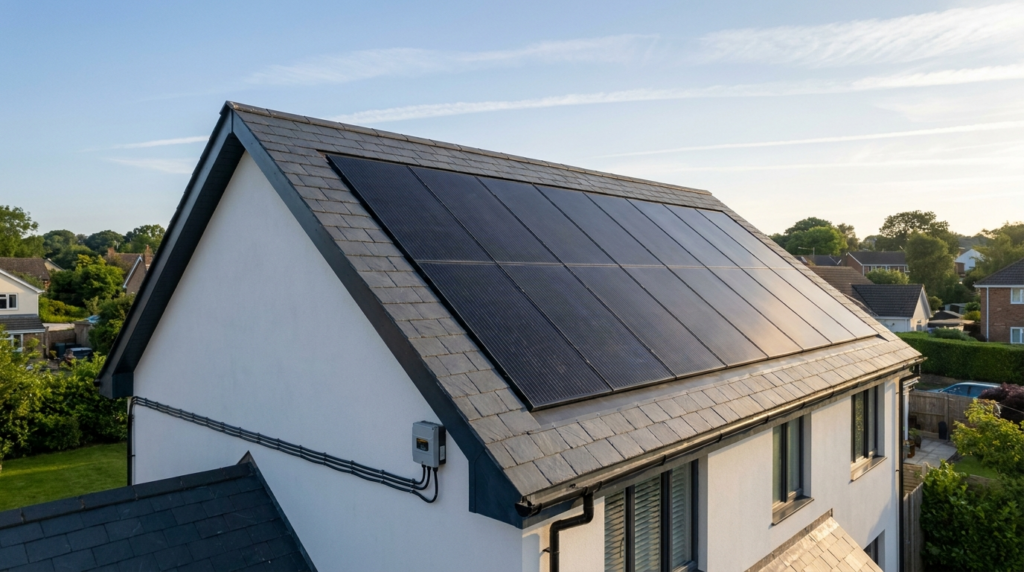
Solar tiles, also called solar slates or integrated PV, replace your existing roof tiles with photovoltaic tiles that look like conventional roofing materials. They are built to blend in rather than sit on top of the roof. The technology uses monocrystalline or polycrystalline cells embedded in the tile (Energy Saving Trust).
Pros:
- Aesthetically discreet, they look like normal roof tiles from ground level
- Integrated design means no need for roof penetrations or mounting frames
- Can be used on listed buildings or in conservation areas where standard panels are restricted
- Dual function, they act as both roof covering and electricity generator
Cons:
- Significantly more expensive than standard panels, typically 2–3 times the cost
- Lower efficiency per tile compared to standard panels of the same area
- Installation is more complex and requires specialist roofing skills
- If a tile fails, replacing it may be
solar panels cost, UK 2026 pricing
Understanding the full cost of solar panels helps you compare quotes and plan your budget. Prices vary by panel type, property size, location, and any preparatory work needed. Below is a breakdown of typical 2026 costs based on industry data and government guidance.
Per-unit cost matrix by panel type
The cost per panel depends on the technology and efficiency rating. Monocrystalline panels are the most efficient and most common for UK homes. Polycrystalline and thin-film panels are less efficient but can be cheaper. Solar tiles or integrated systems replace roof coverings and cost significantly more.
| Panel type | Efficiency (typical) | Cost per panel (installed) | Typical use case |
|---|---|---|---|
| Monocrystalline PV | 18–22% | £350–£600 | Most UK residential installations |
| Polycrystalline PV | 14–17% | £250–£450 | Budget installations, south-facing roofs |
| Thin-film PV | 7–12% | £200–£350 | Large commercial roofs, irregular shapes |
| Solar tile / integrated | 14–18% | £800–£1,500 | Conservation areas, listed buildings, new builds |
Costs based on industry average pricing for 2026, verified against Energy Saving Trust guidance.
Whole-property cost guide by property size
Most UK homes install a system between 3 kWp and 6 kWp. The table below shows typical installed costs for standard roof mounts (south-facing, no shading, no scaffolding). Period properties or non-standard roofs will add premiums.
| Property type | Typical system size | Typical total cost (installed) | Period property premium |
|---|---|---|---|
| Flat (1–2 bed) | 3 kWp | £4,500–£6,500 | +£500–£1,500 (listed building restrictions) |
| 3-bed semi-detached | 4 kWp | £6,000–£8,500 | +£1,000–£2,000 (roof reinforcement, slate tiles) |
| 4-bed detached | 6 kWp | £8,000–£12,000 | +£1,500–£3,000 (scaffolding, heritage consent) |
Figures from Energy Saving Trust and installer data on TrustMark. Period property premiums reflect additional work for older roofs and planning constraints under Planning Portal guidance.
Regional UK pricing
Labour rates, scaffolding costs, and installer availability vary across the UK. The table below shows typical per-kWp installed costs for a 4 kWp system in 2026.
| Region | Typical per kWp cost | Notes |
|---|---|---|
| London | £1,800–£2,400 | Highest labour rates, parking and congestion charges |
| South East | £1,700–£2,200 | High demand, competitive market |
| South West | £1,600–£2,100 | Tourism areas may have fewer installers |
| North West | £1,400–£1,900 | Moderate labour costs, good installer density |
| North East | £1,300–£1,800 | Lower labour costs, fewer MCS-certified installers |
| Midlands | £1,400–£1,900 | Balanced market, typical UK pricing |
| Scotland | £1,500–£2,000 | Remote areas add travel charges; Home Energy Scotland offers grants |
| Wales | £1,400–£1,900 | Nest scheme may reduce costs for eligible households |
| Northern Ireland | £1,300–£1,800 | Lower labour, fewer MCS installers; NI Direct advice |
Regional ranges based on installer survey data from TrustMark and MCS certified installers.
Hidden costs to budget for
Several additional costs can arise during installation. The table below lists common items, typical costs, and when they apply.
| Item | Typical cost | When it applies |
|---|---|---|
| Scaffolding | £300–£900 | Any roof above ground floor, or complex roof shapes |
| Structural alterations | £500–£2,500 | Roof reinforcement needed for older or slate roofs |
| Asbestos removal (pre-2000 properties) | £800–£2,000 | If roof or soffits contain asbestos cement sheets |
| Removal of existing equipment | £200–£500 | Old solar thermal panels, redundant TV aerials, or chimney stacks |
| Plastering touch-up | £100–£400 | After internal cabling runs through ceilings or walls |
| Certification fees (MCS, DNO notification) | £100– |
Performance, savings and payback
The most important measure of a solar panel system is how much electricity it actually generates. In the UK, a well-installed system typically produces between 850 and 950 kilowatt-hours (kWh) per year for every kilowatt-peak (kWp) of installed capacity (Energy Saving Trust). A kWp is the system’s maximum output under standard test conditions, a 4 kWp system can theoretically produce 4 kW of power in strong sunlight. Real-world generation is lower because of cloud, shorter winter days, and the angle of your roof.
There is no legal minimum performance requirement for solar panels in the UK. The system’s output depends on your roof orientation, pitch, shading, and location. However, if your installation is certified under the Microgeneration Certification Scheme (MCS), the installer must provide a performance estimate and a guarantee that the system will meet that estimate, typically within 90% of the predicted figure for the first year (MCS).
Annual energy and cost savings
A typical UK household with a 4 kWp solar panel system can save between £300 and £650 per year on electricity bills (Energy Saving Trust). The exact saving depends on how much of the generated electricity you use at home, known as self-consumption, and how much you export to the grid.
Here is a worked example for a 3-bedroom semi-detached house in the Midlands with a 4 kWp system facing south:
- Annual generation: 3,600 kWh (900 kWh/kWp × 4 kWp)
- Self-consumed: 1,800 kWh (50% of generation)
- Exported to grid: 1,800 kWh
- Savings from self-consumption: 1,800 kWh × £0.25/kWh = £450
- Income from Smart Export Guarantee (SEG): 1,800 kWh × £0.05/kWh = £90
- Total annual benefit: £540
If you use more electricity during daylight hours, for example, by running appliances in the day or working from home, your self-consumption could rise to 70%, increasing the total benefit to over £700 per year.
Payback period by property type
Payback time is the number of years it takes for the savings to cover the upfront installation cost. The figures below are based on a 4 kWp system installed in 2026, with a typical cost of £7,500 (Energy Saving Trust). Savings assume 50% self-consumption and the SEG rate of 5p/kWh.
| Property type | Install cost (£) | Annual saving (£) | Payback (years) |
|---|---|---|---|
| 3-bed semi, Manchester | £7,500 | £490 | 15.3 |
| 4-bed detached, Edinburgh | £7,500 | £520 | 14.4 |
| Mid-terrace, Bristol | £7,500 | £460 | 16.3 |
These payback periods assume you own the system outright. If you use a loan or finance, the interest will extend the payback time. The savings also assume electricity prices stay at current levels, the Energy Price Cap for 2026 is set at £0.25/kWh (Ofgem).
EPC band improvement
Adding solar panels can improve your Energy Performance Certificate (EPC) rating by one or two bands, typically from D to C or C to B, depending on your existing energy efficiency (gov.uk). The improvement is larger if your home already has good insulation and a modern heating system. An EPC rating of C or above is required to let a property in England and Wales from 2028, so solar panels can help landlords meet that target.
When solar panels do not pay back quickly
Solar panels are not a fast investment in every situation. Payback times can stretch beyond 20 years in these scenarios:
- North-facing roof, generation drops by 25-30% compared to a south-facing roof, reducing annual savings accordingly.
- Heavy shading, from trees, chimneys, or neighbouring buildings can cut generation by 40% or more.
- Low electricity usage, if you use less than 2,000 kWh per year, your savings will be small because most of the generated electricity will be exported at a
Sizing your solar PV system, kWp by household
The kilowatt-peak (kWp) rating of a solar panel system tells you how much electricity it can generate under standard test conditions. UK installers calculate kWp by multiplying the number of panels by the peak power rating of each panel. A typical modern panel produces around 400–450 watts (0.4–0.45 kWp) (Energy Saving Trust).
How kWp relates to your home size
Your roof size, orientation and budget will determine the right kWp for your household. The table below shows typical system sizes for UK homes, based on average roof space and energy use (Energy Saving Trust).
| Household | Suggested kWp | Roof area needed | Annual generation | Typical install cost |
|---|---|---|---|---|
| 1–2 bed flat or small house | 2–2.5 kWp | 10–14 m² | 1,700–2,100 kWh | £4,500–£6,500 |
| 3-bed semi or terrace | 3.5–4 kWp | 18–22 m² | 3,000–3,400 kWh | £6,000–£8,500 |
| 4–5 bed detached | 5–6 kWp | 26–30 m² | 4,200–5,100 kWh | £8,000–£12,000 |
Annual generation figures assume a south-facing roof in southern England with no shading. North-facing or heavily shaded roofs can reduce output by 20–30% (Energy Saving Trust).
Roof area required
Each 400 W panel needs roughly 1.7–1.9 m² of roof space. A 2 kWp system requires 10–14 m², while a 5 kWp system needs 26–30 m². Installers will also leave a gap around panels for access and ventilation. If your roof has multiple pitches, dormers or skylights, the usable area may be smaller (Energy Saving Trust).
The 4 kWp DNO threshold: G98 vs G99
In the UK, any solar system that connects to the grid must comply with the Distribution Network Operator (DNO) rules. Systems up to 3.68 kW per phase (typically 4 kWp on a single-phase supply) can use the simpler G98 notification. This is a fast approval process and most 3.5–4 kWp systems qualify (Ofgem).
Systems above 4 kWp (up to 16 A per phase) require the more detailed G99 application.
Solar battery storage, when it pays back
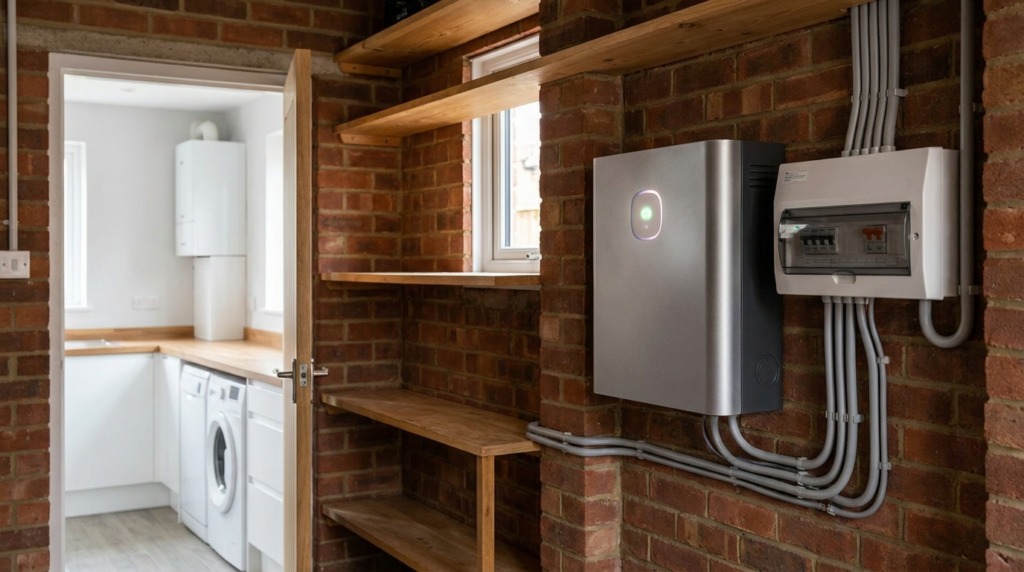
Adding battery storage to a solar panel system lets you use more of the electricity you generate, rather than exporting it to the grid. This can reduce your annual energy bills by increasing the proportion of solar power you use directly.
Typical battery sizes for UK homes
Most UK households install a battery with a usable capacity between 5 kWh and 10 kWh. A 5 kWh battery is usually sufficient for a 1-2 bedroom home, while a 10 kWh battery suits a 3-4 bedroom household with higher daytime electricity use (Energy Saving Trust).
Installed costs in 2026
Installed battery prices vary by capacity and chemistry. The table below shows typical costs including installation and VAT at 0% (the government has removed VAT on energy-saving materials until 2027).
| Battery size | Typical installed cost | Estimated annual saving | Approximate payback period |
|---|---|---|---|
| 5 kWh | £3,000 – £4,500 | £200 – £350 | 9–13 years |
| 10 kWh | £5,500 – £8,000 | £400 – £600 | 10–14 years |
Costs are based on typical UK installs in 2026. Payback periods assume you use most stored electricity at home rather than exporting it under the Smart Export Guarantee (SEG) (Ofgem SEG).
Payback maths: SEG vs grid-cost arbitrage
Without a battery, you export surplus solar to the grid and are paid the SEG rate (typically 5–15p per kWh in 2026). With a battery, you store that surplus and use it in the evening, avoiding buying electricity at the current price cap rate of around 28p per kWh (Ofgem).
- SEG-only approach: Export 1,000 kWh/year at 10p/kWh = £100 income.
- Battery arbitrage: Store 1,000 kWh/year and use it instead of buying at 28p/kWh = £280 saving.
Battery payback is therefore driven by the difference between the retail electricity price and the SEG rate. If you have a time-of-use tariff (e.g. Economy 7), you can also charge the battery cheaply overnight and use it during peak hours, improving payback further (Energy Saving Trust).
Warranty cycles and battery lifespan
Most solar batteries are warrantied for 10 years or a certain number of charge cycles, whichever comes first. Typical cycle warranties are:
- 5 kWh battery: 6,000–8,000 cycles (roughly 16–22 years if cycled daily)
- 10
Smart Export Guarantee (SEG), getting paid for surplus
The Smart Export Guarantee (SEG) is a government-backed scheme that requires licensed electricity suppliers with more than 150,000 customers to pay you for excess electricity your home generates and exports back to the National Grid. Ofgem has mandated the SEG since 1 January 2020, replacing the earlier Feed-in Tariff scheme (ofgem.gov.uk).
How the smart export guarantee works
When your solar panels generate more electricity than your home uses, the surplus flows to the grid. Your SEG tariff pays you a fixed rate per kilowatt-hour (kWh) exported. You must have a smart meter to measure exports accurately, though some suppliers accept a deemed export calculation if you cannot install one (ofgem.gov.uk).
You can apply directly to any SEG-licensed supplier, not just your current electricity retailer. Most suppliers require your solar installation to be certified by the Microgeneration Certification Scheme (MCS) or an equivalent standard (mcscertified.com).
Export-only vs import+export tariffs
SEG tariffs come in two types:
- Export-only tariff, you receive a separate payment for exported electricity, while your import (consumption) is billed at your supplier’s standard rate.
- Import+export tariff, the supplier combines your import and export into a single account, often offering a lower import rate alongside the export payment.
Import+export tariffs can simplify billing but may lock you into a specific import rate. Compare both options before switching (energysavingtrust.org.uk).
Current SEG rates for 2026
SEG rates are not set by Ofgem; each supplier sets its own. The table below shows typical rates available as of early 2026. Rates are per kWh exported and may change. Always check the supplier’s latest SEG statement on the Ofgem public register (ofgem.gov.uk).
| Supplier | Rate (p/kWh) | Tariff type |
|---|---|---|
| Octopus Energy | 15p | Export-only (Outgoing) or import+export (Flux) |
How solar panels actually perform in the UK climate
Solar panel performance in the UK depends more on your location, roof orientation and local shading than on the weather you see on any given day. The same 4 kWp system can generate noticeably different amounts of electricity in Cornwall compared with Glasgow, and a south-facing roof will produce roughly two and a half times the annual output of a north-facing one.

Annual output per kWp by UK region
The Energy Saving Trust publishes regional generation estimates that allow homeowners to predict annual output based on a system’s installed capacity (kWp). The table below shows typical annual kilowatt-hours (kWh) produced for every 1 kWp of solar panels installed, assuming an unshaded south-facing roof at a 30-40° pitch (energysavingtrust.org.uk).
| Region | Annual kWh per kWp installed |
|---|---|
| South coast of England (Cornwall to Kent) | 950 |
| Midlands and East Anglia | 850 |
| Northern England and Wales | 800 |
| Scotland | 750 |
A typical 4 kWp system in the Midlands therefore produces around 3,400 kWh per year (4 × 850). The same system on the south coast would generate roughly 3,800 kWh annually (energysavingtrust.org.uk).
Seasonal variation: summer vs winter output
UK solar generation is heavily seasonal because of the changing day length and sun angle. December typically produces only 5% of the output seen in June for the same system (energysavingtrust.org.uk).
For a south-facing 4 kWp system in the Midlands, this means roughly:
- June: 450-500 kWh
- December: 20-25 kWh
This large winter drop is why battery storage or a time-of-use tariff can help you use more of your summer generation, and why solar alone rarely covers all winter electricity needs without grid backup.
Roof orientation and tilt impact
The direction your roof faces has a major effect on total annual output. Figures below assume a 30-40° roof pitch with no shading (energysavingtrust.org.uk).
| Orientation | Relative annual output vs south-facing |
|---|---|
| South | 100% |
UK regulations, country by country
Solar panel installations in the UK must comply with building regulations and electrical safety standards. While the core requirements are similar across England, Scotland, Wales and Northern Ireland, each nation has its own specific documents and enforcement bodies. The table below summarises the key regulations for each region.
| Nation | Document/regulation | Key requirement for solar panels | Source URL |
|---|---|---|---|
| England | Building Regulations: Approved Document P (electrical safety) | All electrical work must be certified by a competent person or notified to local building control | gov.uk |
| Scotland | Building Standards: Technical Handbook (Domestic) – Section 4.5 (Electrical safety) | Electrical installation must comply with BS 7671; certification required via Scottish building standards | legislation.gov.uk |
| Wales | Building Regulations: Approved Document P (electrical safety) | Same as England; electrical work must be certified by a competent person or notified to building control | gov.wales |
| Northern Ireland | Building Regulations: Technical Booklet P (electrical safety) | Electrical installation must comply with BS 7671; certification required via building control | nidirect.gov.uk |
Approved Document P: electrical safety
Approved Document P covers electrical safety in dwellings. For a solar PV system, this means the wiring, inverter connections and any new circuits must meet the requirements of BS 7671 (the IET Wiring Regulations). Your installer must either be registered with a competent person scheme (such as NICEIC or NAPIT) or notify the work to your local building control before installation begins (gov.uk). If you use a certified installer, they will issue a Building Regulations compliance certificate after the work is done. Without this certificate, you may have difficulty selling your home or making an insurance claim.
G98/G99 grid connection: DNO approval
Before connecting your solar panels to the national grid, your installer must notify the Distribution Network Operator (DNO) – the company that manages the electricity network in your area. For most domestic systems up to 3.68 kW per phase (typically a 4 kWp array), the installer can use the G98 procedure, which is a fast-track notification. For larger systems (above 3.68 kW up to 16 A per phase), the G99 procedure applies, which may require technical studies and longer approval times (ofgem.gov.uk). Your installer should handle this notification as part of the installation process. If you are adding battery storage, the combined inverter capacity must still comply with the relevant G98/G99 limits.
Smart Export Guarantee (SEG) under Ofgem
The Smart Export Guarantee (SEG) requires larger electricity suppliers (those with 150,000 or more domestic customers) to pay you for excess electricity you export to the grid from your solar panels. The scheme is regulated by Ofgem. To qualify, you must have a smart meter or a meter capable of half-hourly readings, and your installation must be carried out by an MCS-certified or equivalent installer. The tariff rate is set by each supplier – there is no fixed minimum rate. You can switch SEG tariffs at any time, but you must notify your current supplier. The SEG is available in England, Scotland and Wales; Northern Ireland has its own similar scheme under the Northern Ireland Renewables Obligation.

Upcoming standards: Future Homes Standard and New Build Heat Standard
The Future Homes Standard, expected to take effect from 2025 in England, will require new homes to produce significantly less carbon than current Building Regulations allow. For solar panels, this means new homes will likely need to include on-site renewable energy generation, typically a solar PV system sized to meet a portion of the home’s predicted energy demand (gov.uk). The exact U-value targets and generation requirements are still being finalised, but the direction is clear: solar panels will become a standard feature in most new English homes.
In Scotland, the New Build Heat Standard came into force from April 2024. It requires new homes to use heating systems that produce zero direct emissions at the point of use – effectively banning fossil fuel boilers. While this standard does not directly mandate solar panels, it pushes developers toward heat pumps and electric heating, which pair naturally with solar PV to reduce running costs. The Scottish Government’s legislation.gov.uk page sets out the full technical requirements. For existing homes in Scotland, the <a href="https://
Planning permission for solar panels
Most home solar panel installations in England and Wales are classed as permitted development, meaning you do not need a formal planning application. This applies to roof-mounted panels on houses (not flats or maisonettes) provided they meet specific size and position rules. The rules are set out in the Town and Country Planning (General Permitted Development) Order 2015 (planningportal.co.uk).
What counts as permitted development
For a standard installation to qualify as permitted development, all of the following must apply:
- the panels are on a roof that faces away from the main road (unless the property is not on a highway)
- the panels do not project more than 200mm beyond the plane of the roof
- the highest part of the panel is no higher than the highest part of the roof (excluding the chimney)
- the panels are not installed on a listed building or within the curtilage of a listed building
- the panels are not on a site designated as a scheduled monument
If the panels are on a flat roof, they must be at least 1 metre from the roof edge and must not extend above the highest part of the roof. Ground-mounted solar panels are also permitted development as long as the array is no more than 4 metres high, covers no more than 9 square metres, and is at least 5 metres from the boundary (gov.uk).
When you do need planning permission
You must apply for planning permission in the following situations:
- Listed buildings, any solar installation on a listed building or within its grounds requires listed building consent, regardless of how small the panels are
- Conservation areas, panels on the principal roof slope (the one facing the road) are not permitted development
- Article 4 directions, your local authority may have removed permitted development rights in your area
- National Parks and Areas of Outstanding Natural Beauty (AONB), stricter rules apply; panels on roof slopes facing a highway are not permitted development
- World Heritage Sites, the same restrictions as conservation areas apply
- Flats and maisonettes, permitted development rights do not cover these property types
You can check whether your property is in a designated area by contacting your local planning authority (gov.uk).
Specific complications for solar panels
Visual impact in conservation areas. Even if your panels are on a rear roof slope, the local authority may object if the panels are visible from a public highway or open space. Some councils require a heritage statement to show the panels will not harm the character of the area.
Listed building consent. For listed buildings, you must apply for listed building consent in addition to any planning permission. The local authority will assess whether the panels harm the building’s special architectural or historic interest. In many cases, panels on a listed building are refused unless they are hidden from view, such as on a flat roof behind a parapet (gov.uk).
Heat pump siting rules. Although this article focuses on solar panels, if you are installing both solar panels and a heat pump, the heat pump has its own siting restrictions. Air source heat pumps must be at least 1 metre from the boundary and must not be within 1 metre of a window or door on an adjoining property. This is separate from solar panel rules but may affect your overall layout.
Insulation in listed buildings. Solar panels are often installed alongside roof insulation. In a listed building, adding insulation to the roof may also require consent, as it can alter the internal appearance or affect the building’s fabric. Always check with the conservation officer before starting work.
Decision-flow
Installer certification and finding the right one
Choosing a certified installer is a legal requirement for grid-connected solar panels in the UK and protects your investment. Without the correct certification, you cannot access the Smart Export Guarantee (SEG) payments, your installation may fail Building Regulations inspection, and your home insurance could be invalidated. The key schemes to look for are MCS, TrustMark, PAS 2030, and NICEIC or NAPIT for the electrical connection.
Why certification matters legally and practically
For grid-connected solar panels, your installer must be certified under the Microgeneration Certification Scheme (MCS). This is a condition of receiving SEG payments from your energy supplier (Ofgem). The installer must also issue a Building Regulations Compliance Certificate after completion, confirming the work meets Part P (electrical safety) and structural loading requirements (gov.uk). Without this certificate, selling your home could become problematic, as solicitors typically request it during conveyancing.
| Scheme | Run by | What it certifies | Issues a Certificate of Compliance | Source URL |
|---|---|---|---|---|
| MCS | Department for Energy Security and Net Zero (DESNZ) via MCS Service Company | Design, installation, and commissioning of solar PV systems; product quality and installer competence | Yes, MCS Installation Certificate required for SEG eligibility | mcscertified.com |
| TrustMark | TrustMark (government-endorsed scheme) | Customer protection, trading standards compliance, and workmanship standards for home improvements | No, but provides a complaints process and insurance-backed guarantee | trustmark.org.uk |
| PAS 2030 | British Standards Institution (BSI) | Installation quality under the Energy Company Obligation (ECO) framework; covers insulation, heating, and renewables | Yes, for ECO-funded installations only | gov.uk |
| NICEIC / NAPIT | NICEIC / NAPIT (competent person schemes) | Electrical safety of the AC side (inverter connection, isolator, consumer unit) | Yes, Building Regulations Part P compliance certificate for electrical work | gov.uk |
The 3-quote rule
Getting at least three quotes is standard practice for solar panels. When comparing them, check these five items:
- Price and specification, total cost including VAT at 0% (domestic solar panels are zero-rated for VAT in 2026) and the exact make and model of panels, inverter, and mounting system.
- Performance metric, estimated annual generation in kWh, not just the system size in kWp. Ask for a shading analysis and orientation adjustment.
- Certification numbers, the installer’s MCS certificate number and their NICEIC or NAPIT registration. Verify these on the scheme’s website before signing.
- Payment terms, deposit amount (should not exceed 25% of the total), stage payments, and final payment on completion.
- Warranty and guarantee, product warranty (typically 10-25 years for panels, 5-10 years for inverters) and a separate workmanship guarantee of at least 2 years.
Red flags
- Same-day pricing pressure, any offer that expires within 24 hours, especially if the salesperson is in your home.
- Deposit above 25%, the Consumer Rights Act 2015 and TrustMark guidance recommend deposits of no more than 25% of the total cost (gov.uk).
- No written specification, a detailed quote listing all
Grants and funding for solar panels in 2026
Solar panel grants in the UK are limited in 2026. Most national schemes do not directly fund solar PV for standard homes. The main financial support comes from the 0% VAT rate, which applies until March 2027, and interest-free loans available in Scotland. The table below covers every major scheme.
| Scheme | Region | Eligible for solar panels? | Typical max grant | How to apply | Source URL |
|---|---|---|---|---|---|
| ECO4 (Energy Company Obligation) | England, Scotland, Wales | No, solar PV is not covered under ECO4. Focus is on insulation and heating upgrades for low-income households. | N/A | Contact your energy supplier. Eligibility is means-tested. | ofgem.gov.uk |
| Great British Insulation Scheme | England, Scotland, Wales | No, this scheme only covers loft, cavity wall, and solid wall insulation. | N/A | Apply via gov.uk or your energy supplier. | gov.uk |
| Boiler Upgrade Scheme | England, Wales | No, this scheme is for heat pumps and biomass boilers only. Solar PV is not included. | N/A | Apply through an MCS-certified installer. gov.uk | gov.uk |
| VAT zero rate (HMRC notice 708/6) | UK-wide | Yes, 0% VAT on solar PV installations for residential properties until 31 March 2027. | 20% VAT saving, worth roughly £1,200 on a £6,000 install | Your installer applies the zero rate at point of sale. No separate application needed. | gov.uk |
| Home Energy Scotland Loan | Scotland | Yes, interest-free loan for solar panels, up to £6,000. Can include battery storage. | £6,000 interest-free loan (repayable over up to 10 years) | Apply online via homeenergyscotland.org. Requires a Home Energy Scotland advice call first. | homeenergyscotland.org |
| Warmer Homes Scotland | Scotland | No, this scheme covers insulation, heating, and draught-proofing for low-income households. Solar panels are not included. | N/A | Check eligibility at warmerhomesscotland.com | warmerhomesscotland.com |
| Nest scheme | Wales | No, Nest provides free insulation, heating upgrades, and advice for low-income households in Wales. Solar PV is not offered. | N/A | Apply at nest.gov.wales | nest.gov.wales |
| Northern Ireland Sustainable Energy Programme | Northern Ireland | No, this programme funds insulation and heating controls for low-income households. Solar panels are not included. | N/A | Contact your local council or nidirect.gov.uk | nidirect.gov.uk |
VAT on energy-saving materials in 2026
Solar panel installations for residential properties in the UK attract 0% VAT until 31 March 2027. This is set out in HMRC notice 708/6, which covers energy-saving materials and heating equipment (gov.uk). The
The buying process, survey to install
- Initial research, confirm what you need
Start by checking your property is suitable. Most UK homes with a roof that faces roughly south, east or west and is not heavily shaded can host solar panels. The key performance metric is the panel’s efficiency rating (typically 18-23%) and the inverter’s conversion efficiency. You should look for panels and inverters certified under the Microgeneration Certification Scheme (MCS), as this is required to access the Smart Export Guarantee (SEG) payments (Ofgem). Also check that the installer holds MCS certification, TrustMark registration, and that the electrical work will be covered by a competent person scheme such as NICEIC or NAPIT (TrustMark). - Get three quotes from certified installers
Request itemised quotations from at least three MCS-certified installers. Use the MCS installer database or TrustMark’s find-a-tradesperson tool to locate verified companies (MCS). The installer should also hold PAS 2030 certification for the installation work, and the electrical connection must be carried out by a registered electrician under NICEIC or NAPIT (gov.uk). Do not accept a single quote, three allow you to compare spec and price. - Compare quotes on full specification, not just price
A cheap quote may use lower-efficiency panels, a basic inverter, or omit scaffolding. Compare the total system size (kWp), panel brand and model, inverter type (string vs microinverter), and the warranty period, most panels come with a 25-year performance warranty and inverters with 5-10 years. Check whether the quote includes scaffolding, bird-proofing, and a Generation Meter (required for SEG). A 4 kWp system in 2026 typically costs between £6,000 and £8,500 (Energy Saving Trust). - Survey visit, what to expect
After you accept a quote, the installer will send a surveyor to inspect your roof structure, orientation, shading, and electrical consumer unit. They will measure the roof area and confirm the panel layout. Ask about the roof load capacity, whether any tree trimming is needed, and where the inverter and battery (if included) will be placed. The survey should take 30-60 minutes. You should receive a final written proposal after the visit. - Contract, cooling-off period
If you sign the contract at home (an off-premises sale), you have a 14-day cooling-off period under the Consumer Contracts Regulations 2013 (legislation.gov.uk). During this time you can cancel without penalty. The installer must provide a written contract detailing the full specification, price, payment schedule, and warranty terms. Read the cancellation terms carefully, some companies require written notice. - Deposit, typically maximum 25%
A deposit of up to 25% of the total cost is standard in the solar industry, though some installers ask for less. Never pay the full amount upfront. The balance is usually due on completion of the installation. If the deposit exceeds 25%, treat it as a red flag. Pay by credit card for transactions over £100 to benefit from Section 75 protection (gov.uk). - Survey-to-install lead time
In 2026, the typical wait between survey and installation is 4-12 weeks, depending on installer workload and supply chain. Some companies offer faster installation for a premium. Ask for a confirmed installation date in writing and check whether there are penalties if the installer delays. If you are adding battery storage, the lead time can be longer due to battery supply constraints. - Installation day, what to expect
The installation usually takes one to two days for a standard 4 kWp system. The team will scaffold the property (if needed), mount the panels on roof rails, connect the inverter, and wire the system into your consumer unit. They will also install a Generation Meter. You should expect some noise and disruption, but the installers should leave the site tidy. Do not switch the system on until the installer has completed all checks. - Sign-off and certificates
After installation, the installer must provide an MCS certificate, a Building Regulations Compliance Certificate (if the work is not covered by a competent person scheme), and a signed-off electrical installation certificate. The MCS certificate is essential to register for SEG payments (Ofgem). The installer should also submit the installation to
Maintenance, common problems and lifespan
Solar photovoltaic (PV) panels require very little day-to-day attention, but a simple maintenance routine helps keep them generating at their rated output. The main task is keeping the panel surface clean.
Rain usually does a good enough job washing away dust and pollen. In dry spells or if you live near farmland or a main road, you may need to hose the panels down with a low-pressure garden hose once or twice a year. Do this early in the morning or on a cool day, cold water on hot glass can crack the panel. Never use abrasive pads or detergents. For bird droppings or stubborn grime, a soft brush with a long handle and deionised water is safe (Energy Saving Trust).
Professional cleaning services charge roughly £75–£150 per visit, but most homeowners never need them. A visual check from the ground every few months is enough, look for cracks, discolouration, or debris like leaves and moss collecting under the panels. An annual professional inspection (around £80–£150) is wise if your panels are on a steep or high roof that you cannot safely access.
Common problems and what to do
Most solar system faults show up on the inverter display or in your monitoring app. The table below lists the typical issues, what they mean, and the likely fix.
| Problem | Likely cause | Solution |
|---|---|---|
| Inverter shows no power / error light | Grid outage, tripped circuit breaker, or inverter fault | Check consumer unit; wait for grid restoration; if persistent, call an MCS-certified electrician |
| Generation lower than expected (e.g. 20-30% below normal on a sunny day) | Panel soiling, partial shading from new tree growth, or one faulty panel | Check for new shade; clean panels; if no improvement, get a performance test |
| Inverter display shows “isolation fault” or “earth fault” | Moisture ingress in a panel or cable damage | Arrange professional inspection, this can be a safety issue |
| Battery not charging or discharging | Battery management system error, low temperature, or end of battery life | Check app settings; if battery is over 10 years old, replacement may be needed |
| Scaffolding needed for access | Roof too high or steep for safe ground-level work | Scaffolding costs £300-£900 depending on house size |
If your monitoring app shows a sudden drop in generation that does not match weather conditions, contact your installer first. Many faults are covered under warranty (gov.uk).
Lifespan by component type
Solar panels themselves typically last 25 to 30 years. Most manufacturers guarantee that after 25 years the panels will still produce at least 80% of their original rated output (Energy Saving Trust). This gradual degradation, around 0.3% to 0.5% per year, is normal and built into the performance warranty.
The inverter has a shorter life: string inverters last 10 to 15 years, while microinverters and power optimisers may last 20 to 25 years. A replacement string inverter costs £700–£1,400 installed. Batteries vary widely: lithium-ion units typically last 10 to 15 years, lead-acid around 5 to
More on solar panels
- Ground-Mounted Solar Panels vs Roof Panels for UK Homes
- Solar battery storage worth it (2026)
- Solar panel maintenance, A UK Homeowner's Guide
- Smart Export Guarantee claim guide
- How Many Solar Panels Does a 3-Bed House Need?
- Solar panel savings per year UK (2026)
- Solar Panel Planning Permission Rules You Need to Know
- 10 ways to cut solar installation costs