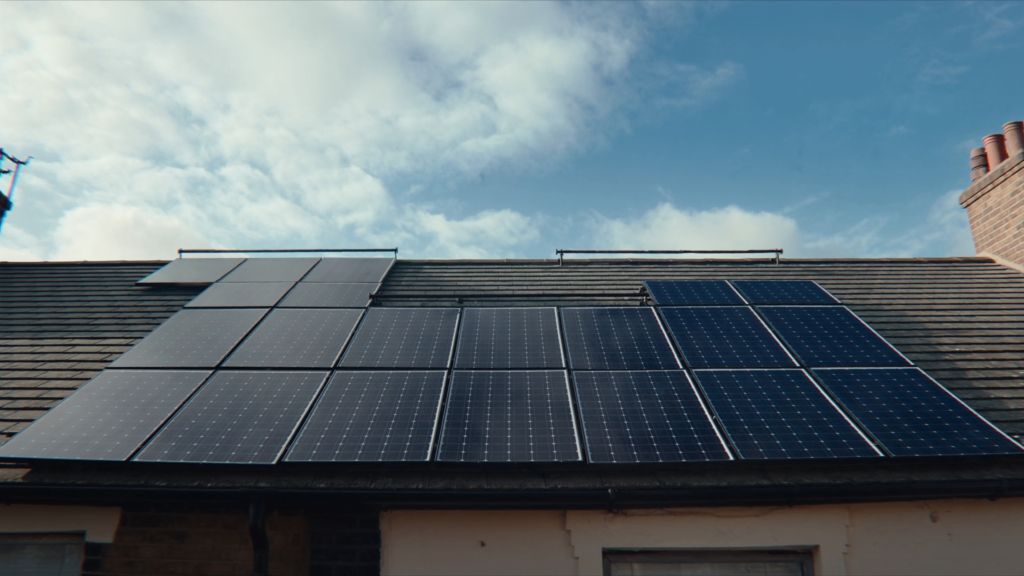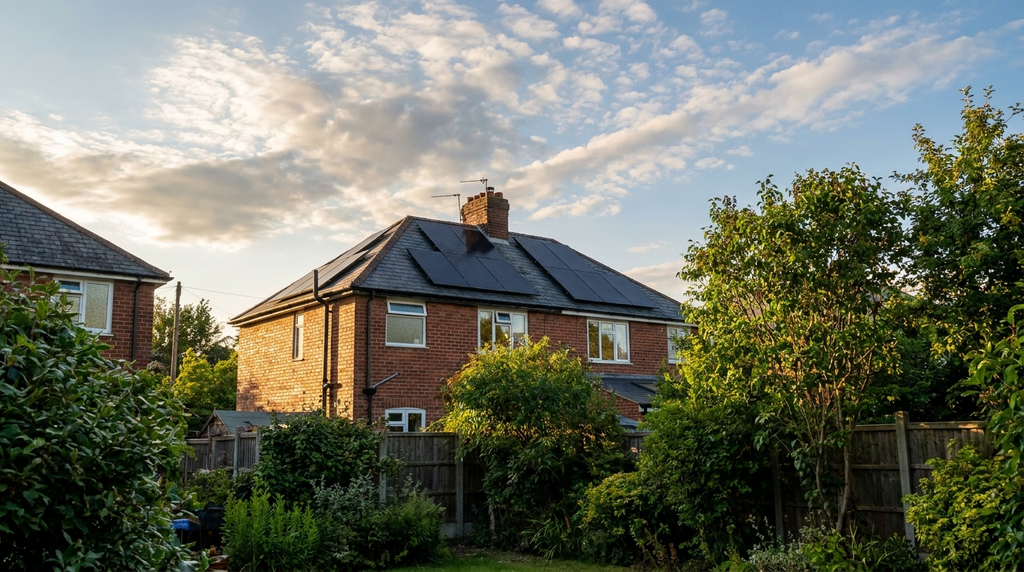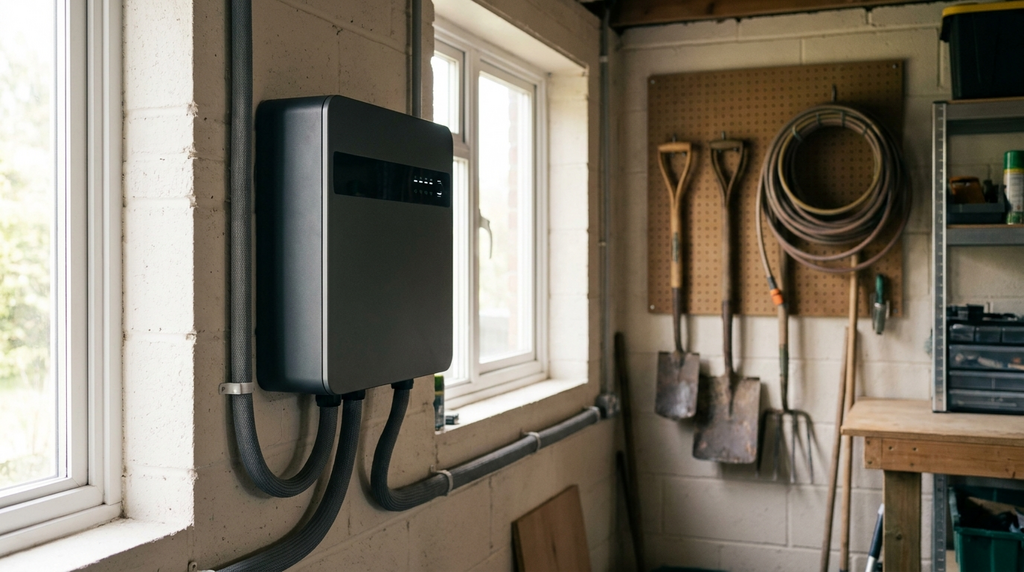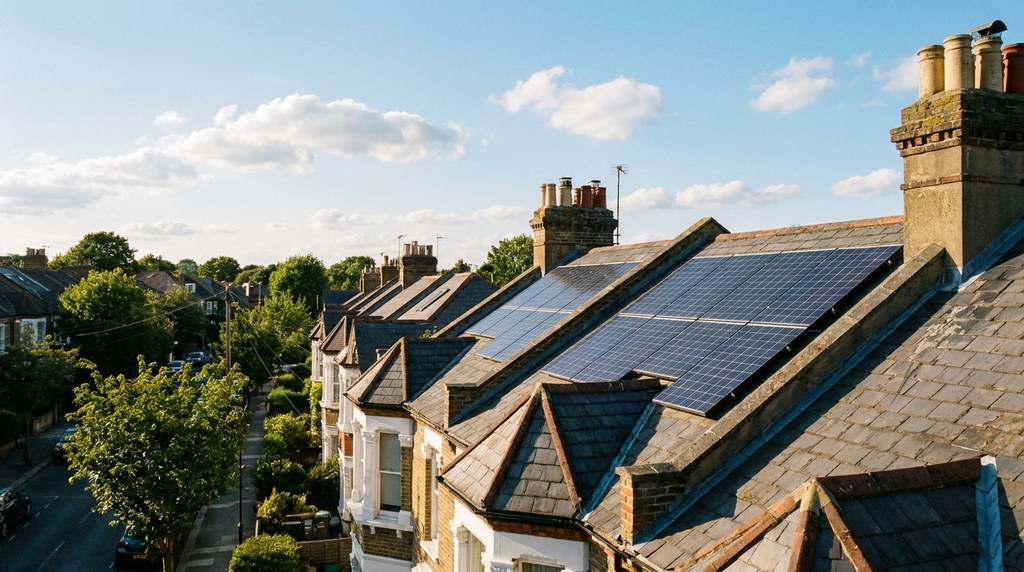
North-facing panels produce roughly 15–20 % less than south-facing ones, but they can still be worth installing
If your roof faces north, you may have been told solar panels are not worth it. That is not quite true. According to the Energy Saving Trust, a north-facing roof at a typical UK pitch of 30–40° will produce around 15–20 % less electricity than an equivalent south-facing system (Energy Saving Trust, 2026).
The direct answer is that north-facing panels do generate a meaningful amount of electricity, especially during the summer months when the sun is high in the sky. The exact loss depends on your roof pitch, local shading, and latitude, the 15–20 % figure is a UK average, not a guarantee for every home. A shallow north-facing roof (20°) will perform better than a steep one (45°+), because the low winter sun barely reaches the panels at a steep angle. How roof pitch affects solar panel output
East-west split arrays can produce more total energy across the day than a single south-facing array
An east-west array splits the panels across two roof faces, one facing east and one west. This configuration captures morning sun on the east side and afternoon sun on the west, flattening the generation curve and reducing the peak of electricity you export to the grid. The Energy Saving Trust and the Microgeneration Certification Scheme (MCS) both note that total annual kWh from an east-west array is typically 10–15 % less than a south-facing system of the same capacity (Energy Saving Trust, 2026).
However, because the generation is spread across the day, you are likely to use more of the electricity you generate yourself, often called self-consumption. This higher self-consumption rate can make the financial return better than a south-facing system, even though the total output is lower. MCS register data shows that east-west is now the most common orientation for new UK rooftop installs, largely because many homes have east-west roof lines and the economics work well (MCS, 2026).
Quick numbers generation, cost, and payback for north and east-west roofs
The table below compares a typical 4 kWp system on different roof orientations. All figures are based on the Energy Saving Trust’s solar panel payback calculator and MCS register data for 2026 (Energy Saving Trust, 2026). The payback period assumes 50 % self-consumption and the April 2026 average Smart Export Guarantee (SEG) rate of 6.5 p/kWh (Ofgem, 2026).
| Orientation | Annual generation per kWp (kWh) | Typical 4 kWp system cost (GBP) | Estimated annual bill saving (GBP) | Typical payback period (years) |
|---|---|---|---|---|
| North-facing | 2,100–2,400 | £6,000–£7,500 | £250–£320 | 14–18 |
| East-west split | 2,500–2,800 | £6,500–£8,000 | £350–£450 | 11–14 |
| South-facing (baseline) | 2,800–3,200 | £6,000–£7,500 | £400–£520 | 10–12 |
The direct answer north-facing solar panels do work, but expect a longer payback
Yes, north-facing panels generate electricity, but at roughly 80 % of a south-facing system’s output. The Energy Saving Trust figure of 15–20 % less is confirmed by DESNZ data on solar PV performance by orientation (DESNZ, 2026). The payback period for a north-facing system is typically 14–18 years, compared to 10–12 years for south-facing, based on a 4 kWp system at 2026 prices.
If your roof is north-facing only, the system is still viable if electricity prices remain high or you have high daytime usage. The longer payback means you need to be confident you will stay in the house for at least 15 years. For a shorter stay, the financial case weakens, though the environmental benefit remains the same per kWh generated. Solar panel payback periods explained
How to verify your installer is certified for north or east-west roof installations
All roof-mounted solar PV installations must be done by an MCS-certified installer to qualify for Smart Export Guarantee payments and the 0 % VAT scheme. You can check an installer’s certification on the MCS website (MCS, 2026). The GOV.UK page on solar PV installers and certification confirms that MCS covers the design and orientation calculation, your installer must model your specific roof pitch and azimuth (GOV.UK, 2026).
TrustMark is the consumer-protection scheme for MCS-certified firms. After installation, the installer must provide a certificate of compliance. Without this, you cannot register for SEG payments. For north or east-west roofs, the installer’s ability to accurately model generation is critical, so ask to see the design calculations before you sign a contract.
Roof pitch and shading matter more for north-facing panels than for east-west
North-facing panels are much more sensitive to roof pitch than east-west arrays. The Energy Saving Trust’s guide on solar panel orientation and pitch explains that north-facing panels at a steep pitch (45°+) lose more output than at a shallow pitch (20–30°), because the sun is lower in the sky and hits the panels at a less favourable angle (Energy Saving Trust, 2026).
East-west arrays are more tolerant of moderate shading, because the two roof faces capture sun from different directions. But north-facing arrays are highly sensitive to nearby trees or buildings. The MCS design standard MIS 3002 requires a full shading analysis for any installation, and for north-facing roofs this analysis is essential to avoid a system that barely generates in winter (MCS, 2026).
Smart Export Guarantee rates in 2026 affect the payback for north and east-west systems
The average Smart Export Guarantee rate in 2026 is 5–8 p/kWh, according to Ofgem’s annual SEG report (Ofgem, 2026). North-facing systems export more electricity than south-facing ones because they generate less during peak daylight hours, so a lower SEG rate hurts their payback more. East-west arrays typically export less total electricity because the flatter generation curve means you use more of what you generate, making them less sensitive to SEG rate changes.
Before installing, check the SEG tariff offered by your supplier. Some suppliers pay a fixed rate, others pay a time-of-use rate that can benefit east-west systems that generate across the day. A north-facing system with a low SEG rate may see its payback stretch beyond 18 years, so factor this into your decision. Smart Export Guarantee rates and suppliers
The Energy Saving Trust recommends a professional orientation survey for non-south roofs
The Energy Saving Trust advises that a professional survey is essential for any roof that does not face south (Energy Saving Trust, 2026). A survey will measure your roof’s true azimuth (the exact compass direction), pitch, and shading to calculate an accurate generation estimate. The EST’s online tool at solar-estimator.energytrust.org.uk provides a first-pass estimate for north and east-west roofs, but it cannot account for local shading or complex roof shapes.
A professional survey is the only way to get a reliable payback figure for a non-south array. Without it, the 15–20 % loss figure for north-facing panels is just a starting point, not a guarantee. For east-west roofs, the survey will confirm whether the split is even or whether one side dominates, which changes the generation profile and financial return.