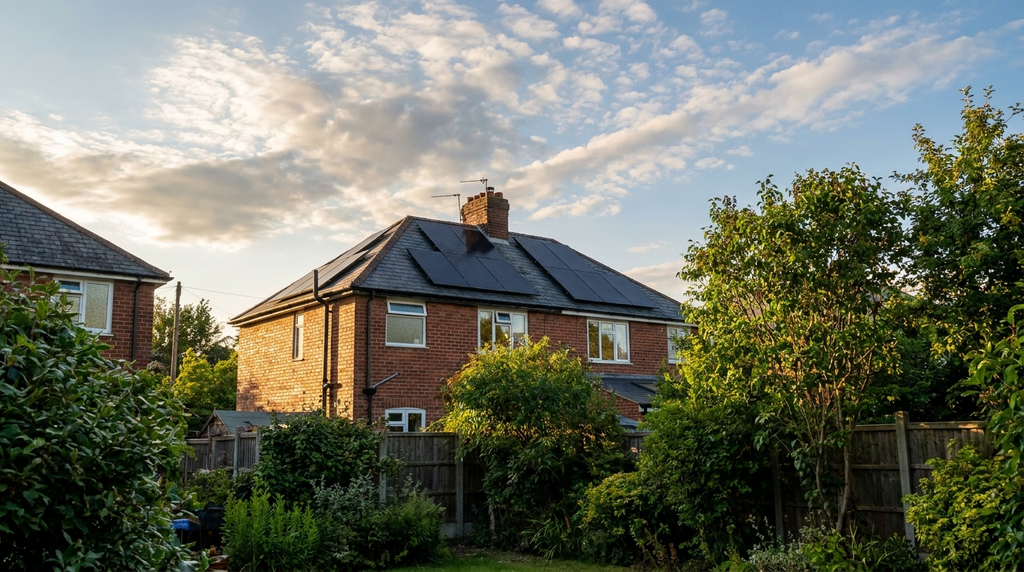
The number of solar panels your home needs depends on your annual electricity usage and roof space, but a typical 3-bedroom household requires a system rated around 3.5–4.0 kWp, which means roughly 8 to 10 panels. According to the Energy Saving Trust, the average UK household uses 2,700 kWh of electricity per year, and a 3.5 kWp system will generate about 3,000 kWh annually (Energy Saving Trust, 2026). This is the most-common starting point for homeowners.
- Typical 3-bedroom UK home needs 8–10 panels for a 3.5 kWp system.
- Average household uses 2,700 kWh per year (Energy Saving Trust 2026).
- Divide your annual kWh by 0.8 then by local generation per kWp.
The exact number of panels you need is decided by two variables: your actual electricity consumption and the usable area of your roof. A panel is typically 1.9 m by 1.0 m and has a power rating of 350–400 W. If you use more than 3,000 kWh a year, for example, if you run an electric car or heat pump, you will need a larger array. For homes with limited roof space, higher-efficiency panels can reduce the number needed. Conversely, if your roof is shaded or faces east or west, you may need extra panels to compensate for lower generation.
Calculate your annual electricity usage first
Your starting point is your annual kWh consumption, found on your electricity bill or via your smart meter. The average UK household uses 2,700 kWh per year, but a large detached home with electric heating can use over 4,000 kWh (Ofgem, 2026). To cover 100% of your usage, your system must generate roughly the same kWh annually. Divide your yearly kWh by 0.8 (to account for system losses) and then by the average generation per kWp for your location, typically around 850–950 kWh per kWp in southern England. For example, 3,000 kWh ÷ 0.8 ÷ 900 = 4.2 kWp, which equates to 10 to 12 panels.
Match panel count to available roof space
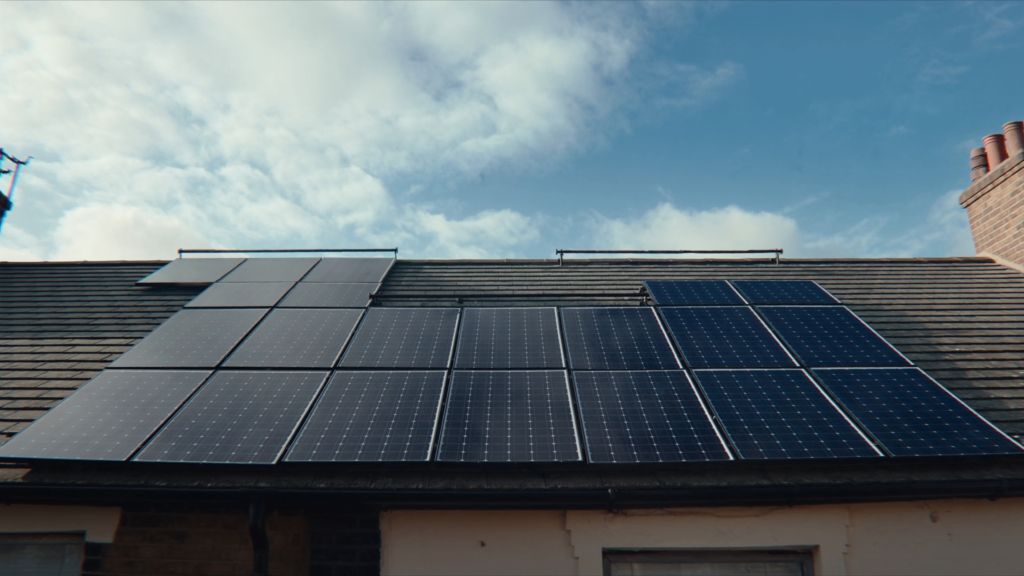
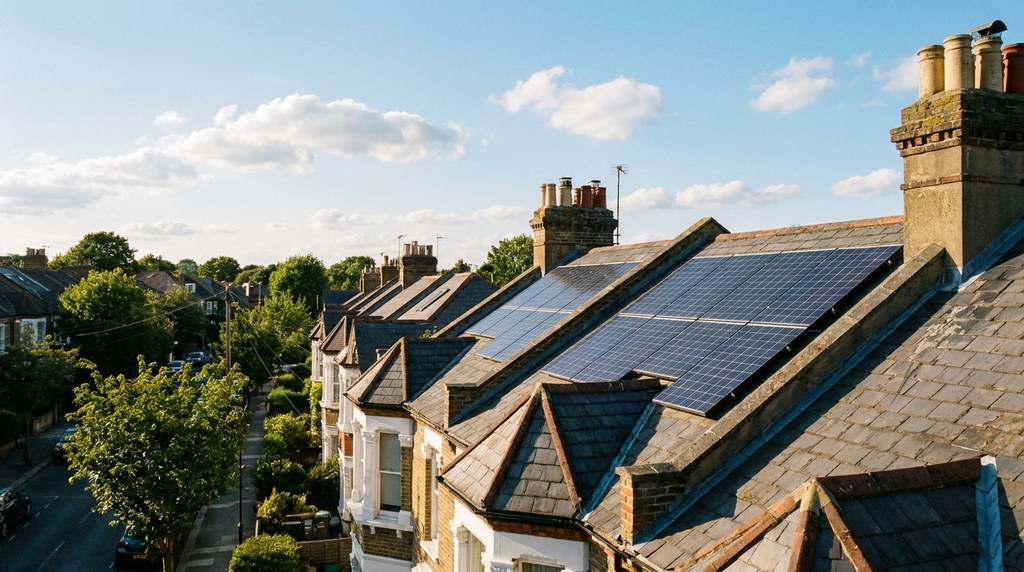
Each standard solar panel covers about 1.9 m² of roof. A 4.0 kWp system using 400 W panels needs 10 panels, requiring roughly 19 m² of unshaded south-facing roof. If your roof faces east or west, you will need 15–20% more panels to achieve the same annual output (Energy Saving Trust, 2026). For a typical semi-detached home with a 30 m² south-facing roof, 10 panels fit comfortably. If your roof is smaller or has chimneys, dormers, or skylights, you may need fewer or smaller panels. High-efficiency panels (e.g., 420 W) can reduce the panel count by one or two.
Consider battery storage and future usage
Adding a battery to your solar system changes the panel count you need. A battery allows you to store surplus daytime generation for evening use, so you can install a slightly larger array to charge the battery fully. For a 5 kWh battery, add 1–2 panels to your base system. Also factor in future changes: if you plan to buy an electric car or install a heat pump, increase your panel count by 40–60% (GOV.UK Solar PV Strategy, 2026). A typical future-proof system for a 3-bedroom home with a car is 5.0–6.0 kWp, or 12–15 panels. Always get a site survey from an MCS-certified installer to confirm the exact number for your roof.
A worked example
For a typical 1930s semi-detached home in Manchester using 3,200 kWh per year, a 4.0 kWp system of 10 panels (400 W each) costs roughly £7,000 after the 0% VAT saving that runs until March 2027. If you qualify for the ECO4 scheme your upfront cost could drop further, though the main solar grant is the Smart Export Guarantee which pays you for surplus electricity exported to the grid. According to the Energy Saving Trust, this system would generate around 3,400 kWh per year, covering nearly all your usage. With export payments at roughly 15p per kWh and a typical 50% export rate, your total yearly saving including the avoided electricity cost is about £540.
| Item | Figure |
|---|---|
| Upfront cost after grants | £7,000 |
| Yearly savings | £540 |
| Payback period | 13 years |
| 25-year lifetime savings | £6,500 |
What homeowners often get wrong
The most common mistake is assuming you need enough panels to cover 100% of your electricity usage every month of the year. This leads to three frequent errors that cost homeowners money and miss out on grant opportunities.
- Over-sizing the system for winter months Many homeowners size their array based on December generation, which is roughly one-fifth of summer output. The right approach is to size for your annual total and accept that you will import some grid electricity in winter while exporting a surplus in summer, which still saves you money overall.
- Ignoring roof orientation and shading People assume south-facing is the only viable option and dismiss east or west-facing roofs entirely. An east-west split array can still generate 80-85% of a south-facing system, and missing that option could mean missing out on a £7,500 BUS grant if you are also installing a heat pump.
- Forgetting to check the MCS certification requirement Homeowners often buy cheap panels from an uncertified installer to save money upfront. Without MCS certification you cannot access the Smart Export Guarantee, which means you lose roughly £100-£150 per year in export payments and may void your roof warranty.
Quick reference
- A typical 3-bedroom UK home needs 8 to 10 panels for a 3.5-4.0 kWp system that generates about 3,000 kWh per year.
- You calculate your panel count by dividing your annual kWh usage by 0.8 and then by 350 (the wattage of a standard panel).
- To qualify for the Smart Export Guarantee your system must be installed by an MCS-certified installer and be under 5 MW capacity.
- Most 3.5 kWp systems pay back their upfront cost within 12 to 15 years based on current electricity prices and export rates.
- Installing more than 4.0 kWp on a single-phase home may require a grid connection application to Ofgem, which adds cost and delay.
Frequently Asked Questions
A 3-bedroom house typically needs 8 to 10 panels rated at 350–400 W each, forming a 3.5–4.0 kWp system. This matches the average UK electricity usage of 2,700 kWh per year (Energy Saving Trust, 2026).
To generate 3,000 kWh per year, you need a system rated around 3.5–4.0 kWp, which means roughly 8 to 10 panels. The exact number depends on panel wattage and your roof orientation (Ofgem, 2026).
Divide your annual kWh usage by 0.8 to account for system losses, then divide by the average generation per kWp in your region (e.g., 850 kWh per kWp in southern England). Use the Energy Saving Trust's online solar calculator for a precise result.