Most homeowners across the UK are surprised to discover that fitting solar panels to their roof does not automatically require a trip to the planning department. For decades, planning rules around home improvements created unnecessary hurdles, but reforms to permitted development rights have made the path to solar energy significantly more straightforward for the majority of properties.
The majority of UK homeowners do not need solar panel planning permission, as rooftop installations on standard residential properties are covered by permitted development rights. However, if your home is a listed building, in a conservation area with an Article 4 Direction, or in certain parts of Scotland, Wales, or Northern Ireland, you will need formal consent before work begins. A householder planning application costs around £258 in England and can take up to 8 weeks to be decided. The most important step is to confirm your property's status with your local planning authority in writing before booking an MCS-certified installer.
- Most UK homeowners do not need planning permission for rooftop solar panels, as standard residential installations fall under permitted development rights
- Check whether your property is a listed building, in a conservation area, or subject to an Article 4 Direction before proceeding — all three require formal planning consent
- Planning rules differ across England, Scotland, Wales, and Northern Ireland, so confirm the specific rules for your nation before booking an installer
- Contact your local planning authority in writing to get confirmation of your permitted development status before installation begins, creating a paper trail
- Use only MCS-certified solar installers, as this is required to access the Smart Export Guarantee and most energy grants available in 2026
- If planning permission is required, budget an additional £200 to £300 for a householder planning application fee in England, and allow up to 8 weeks for a decision
- Even under permitted development, solar panels must not protrude more than 200mm from the roof slope and must be removed when no longer needed
- Understanding Solar Panel Planning Permission in the UK
- Do You Need Planning Permission for Solar Panels
- Permitted Development Rules for Solar Panels in England
- How Planning Rules Differ in Scotland, Wales and Northern Ireland
- When You Will Always Need Planning Permission
- What to Look For When Checking Your Own Property
- The Cost of Planning Applications in 2026
- How Solar Panel Grants Interact With Planning Rules in 2026
- Verifying Your Solar Installer's Credentials
Most UK homeowners do not need planning permission for solar panels, because rooftop installations on standard residential properties are covered by permitted development rights, a legal framework that allows certain home improvements without a formal planning application. However, this rule has important exceptions. If your home is a listed building, sits within certain conservation areas, or is subject to an Article 4 Direction, you will need to go through a planning process before installation can begin. The rules also differ between England, Scotland, Wales, and Northern Ireland, so your location matters as much as your property type.
Understanding Solar Panel Planning Permission in the UK
Planning permission, in the context of home improvements, is the formal consent granted by your local planning authority to carry out a specific change to a property. It exists to ensure that development, including changes to buildings, does not harm the local environment, streetscape, or neighbouring properties. Solar panels sit in an interesting position within this framework, because most rooftop installations are not treated as conventional structural changes at all.
Permitted development rights are the legal permissions that allow homeowners to carry out certain improvements without submitting a planning application. Rather than granting permission on a case-by-case basis, Parliament has pre-approved a defined category of works as acceptable in principle, provided they fall within specific size, placement, and location limits. For solar panels, this means millions of UK homeowners can install roof-mounted systems without any interaction with their local council whatsoever.
It is important to understand that planning rules in the UK are devolved. England, Scotland, Wales, and Northern Ireland each operate under their own planning legislation and permitted development frameworks. This means that advice given for one nation may not be accurate for another. If you are researching solar panel planning rules online, always confirm that the guidance you are reading applies to your specific nation.
Several mechanisms can restrict or remove permitted development rights even where they would otherwise apply. Article 4 Directions are instructions issued by local planning authorities that withdraw permitted development rights in a specific area, often historic town centres or sensitive streetscapes. Conservation area designations impose additional restrictions, particularly for installations visible from public roads. Listed building status removes permitted development rights entirely for certain works. Understanding these terms before you proceed is essential, because installing panels without the correct permissions is a breach of planning law that can have serious consequences when you come to sell your home.
Practical tip, Before speaking to any installer, look up your property on your local council’s planning map to check for conservation area designations and Article 4 Directions. This five-minute check could save you significant time and cost later.
Do You Need Planning Permission for Solar Panels
The straightforward answer for most UK homeowners is no, you do not need to apply for planning permission to install solar panels on your home. However, this only holds true if your installation falls within the conditions set out by your nation’s permitted development framework, and if your property does not carry any of the restrictions described below.
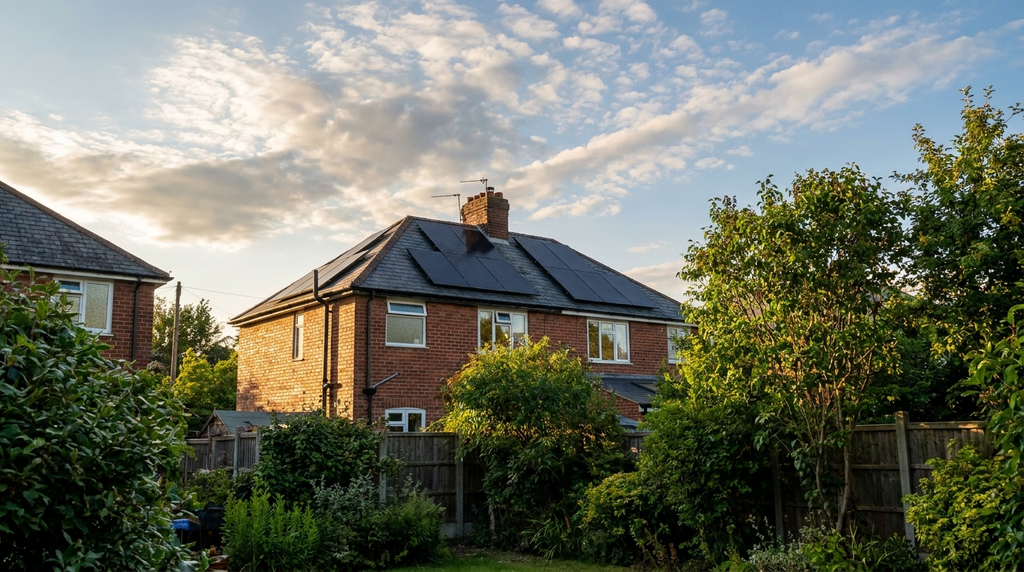
In England, permitted development rights for solar panels apply where the installation is on the roof of a dwellinghouse, panels do not project more than 200 millimetres beyond the roof surface, panels are not higher than the highest part of the roof (not counting the chimney), and the property is not a listed building. These are the core conditions, and the vast majority of standard semi-detached, terraced, and detached homes across England will meet them without difficulty.
Planning permission is always required in the following situations, regardless of how straightforward the installation might appear:
- The property is a listed building, planning permission and separate listed building consent are both required
- The property is a flat or maisonette, permitted development rights generally do not apply to flats, and a full planning application is usually needed
- The property sits within a conservation area and panels would be visible from a public highway
- The property is covered by an Article 4 Direction removing permitted development rights
- The property is on a new-build estate where the developer has attached planning conditions that restrict or remove permitted development rights
If any of these circumstances apply to you, do not assume that a planning application will be refused, many councils do grant permission for solar panels in sensitive areas, particularly when the installation is carefully positioned and not highly visible. The key is to apply before installation, not after.
guide to listed building solar panels
Practical tip, If you are unsure whether your permitted development rights are intact, applying for a Certificate of Lawful Development gives you a formal legal document confirming your installation is permitted. This is invaluable when selling your home.
Permitted Development Rules for Solar Panels in England
In England, the specific rules governing solar panel installations under permitted development are set out in the Town and Country Planning (General Permitted Development) (England) Order 2015. For domestic rooftop installations, this order establishes a clear set of conditions that, if met, mean no planning application is needed.
The key conditions for roof-mounted solar panels on a dwellinghouse in England are as follows:
- Panels must not protrude more than 200 millimetres beyond the plane of the roof or wall surface on which they are mounted
- Panels must not be installed at a height exceeding the highest part of the roof, excluding any chimney
- Panels must be removed when they are no longer needed
- The installation must not be on a listed building or within the curtilage of a listed building
- In conservation areas and Areas of Outstanding Natural Beauty (AONBs), panels are not permitted development if they are installed on a wall or roof slope that faces, and is visible from, a highway
Ground-mounted solar panels are also covered by permitted development rights in England, but under different conditions. A ground-mounted array must cover no more than 9 square metres, or must not be larger than the largest existing outbuilding on the property, whichever is smaller. The array must not be positioned forward of the principal elevation of the house (in other words, it must not be in front of the main front wall), and it must sit at least 5 metres from the boundary of the property.
For homes in conservation areas or AONBs, the restrictions are more significant. If any part of your roof slope or wall that faces a road is visible from that road, solar panels installed there are not covered by permitted development. You would need to submit a full householder planning application for that specific position, though panels on rear or side slopes that are not visible from the road may still be permitted development.
ground-mounted solar panels guide
Practical tip, For conservation areas, position panels on rear-facing roof slopes wherever possible. This often keeps your installation within permitted development and avoids a lengthy planning process.
How Planning Rules Differ in Scotland, Wales and Northern Ireland
Because planning is a devolved matter, the rules governing solar panels differ meaningfully across the four nations, and you should always verify the specific regulations for your home’s location rather than relying on guidance written for a different part of the UK.
Scotland
In Scotland, permitted development rights for solar panels are governed primarily by the Town and Country Planning (General Permitted Development) (Scotland) Amendment Order 2012 and its subsequent amendments. The conditions are broadly similar to those in England, panels must not protrude excessively beyond the roof plane, must not be higher than the ridge, and must be removed when no longer needed. However, there are some differences around flat roofs and protrusion limits, and homeowners in Scottish conservation areas or National Scenic Areas face equivalent restrictions to those in English conservation areas. The Scottish Government’s planning website and NatureScot are useful starting points for checking designations.
Wales
Wales updated its permitted development framework in recent years, and the rules are broadly comparable to those in England, with some local differences. Homeowners in Wales should consult the Planning Portal Wales to check their specific circumstances. Properties within Welsh National Parks, including Snowdonia, the Brecon Beacons, and the Pembrokeshire Coast, or within AONBs face additional restrictions, and it is always worth contacting the relevant national park authority directly if your property falls within one of these areas.
Northern Ireland
Northern Ireland operates its own planning system, governed by the Planning (General Development) (Northern Ireland) Order 1993 and its subsequent amendments. The Planning Portal NI is the most reliable starting point for homeowners in Northern Ireland, and contacting your local council’s planning department directly is strongly recommended if there is any uncertainty about your property’s status or permitted development entitlements.
Across all four nations, the consistent advice is this, regardless of what permitted development rights appear to allow on paper, always verify your specific property’s situation with your local planning authority before committing to an installation. A brief pre-application enquiry can prevent costly mistakes.
Practical tip, Never rely solely on online guidance from another nation. Planning in the UK is devolved, and the rules in Edinburgh, Cardiff, Belfast, and London are not identical.
When You Will Always Need Planning Permission
There are several categories of property and circumstance where planning permission, and in some cases additional consents, will always be required, regardless of how standard the proposed installation might appear.
Listed Buildings
If your home is a listed building, permitted development rights do not apply to solar panels. You will need to apply for both planning permission and listed building consent before any installation can take place. Listed building consent exists to protect the character and appearance of historically significant structures, and local planning authorities assess solar applications on listed buildings carefully. This does not mean permission will be refused, many councils have approved sensitively designed solar installations on listed buildings, but the bar is higher, and specialist advice is strongly recommended. According to Historic England, there are around 400,000 listed buildings in England alone, so this affects a significant number of homeowners.
Flats and Maisonettes
Permitted development rights for solar panels generally do not extend to flats or maisonettes. Residents of flats who wish to install solar panels would typically need to apply for full planning permission, and would also need to obtain consent from their freeholder or managing agent, since the roof of a block of flats is almost always part of the common structure rather than the individual flat. This can make solar installations significantly more complex in leasehold properties.
Article 4 Directions
Some local authorities have withdrawn permitted development rights in specific areas by issuing an Article 4 Direction. These directions are typically applied in historic town centres, sensitive streetscapes, or areas where the council wishes to exercise greater control over the character of development. If your property is subject to an Article 4 Direction, a planning application will be required even for a rooftop solar installation that would otherwise be fully permitted development. You can check for Article 4 Directions through your local council’s planning department or the council’s online planning map.
New-Build Estates With Restrictive Planning Conditions
Some housebuilders attach planning conditions to new-build estate developments that restrict or remove permitted development rights. These conditions are sometimes imposed by local planning authorities as part of granting planning permission for the development itself. If you live on a newer estate and are unsure about your permitted development entitlements, your solicitor’s pack from your property purchase should contain your title deeds and any planning conditions attached to your property. If you cannot locate these documents, your local planning authority can advise.
Practical tip, If you bought your home in the last ten years, ask your solicitor to check the original planning conditions for the development before you proceed with any solar installation.
What to Look For When Checking Your Own Property
Checking whether your home is subject to any planning restrictions is something most homeowners can do themselves, using freely available tools. Follow these steps to build a clear picture of your situation before approaching an installer or planning authority.
- Check your property’s listing status. Search the Historic England register (for England), Historic Environment Scotland, Cadw (for Wales), or the Northern Ireland Historic Environment (NIHE) database to confirm whether your home is a listed building and, if so, at what grade. These are all freely searchable online databases.
- Identify your local designations. Use your local council’s interactive planning map or the Magic Map application (for England, available through the government’s Planning Portal) to check whether your property falls within a conservation area, Area of Outstanding Natural Beauty, National Park, or World Heritage Site.
- Review your title deeds and original planning permission. Look for any conditions attached to your property’s planning history. Your solicitor’s pack from when you purchased the property should contain these documents. Pay particular attention to any conditions that reference permitted development rights or restrict alterations to the exterior.
- Contact your local planning authority. If you are still uncertain after completing the steps above, contact your council’s planning department. Most offer a pre-application enquiry service, and some will provide written informal advice at no charge. This is not a formal approval, but it gives you a clear steer before you commit to a purchase.
- Consult your solar installer. A reputable installer who holds MCS accreditation (Microgeneration Certification Scheme, the quality standard required for domestic renewable energy installations) will be familiar with local planning requirements and should flag potential concerns before work begins. However, the legal responsibility for planning compliance rests with you as the homeowner, not the installer.
- Apply for a Certificate of Lawful Development if in doubt. A Certificate of Lawful Development is a formal document, issued by your local planning authority, confirming that your proposed installation is lawful under permitted development. It is not planning permission itself, but it provides legal certainty and is particularly valuable when you come to sell your home, since buyers and their solicitors will sometimes query solar installations that lack formal documentation.
how to choose a solar panel installer
Practical tip, A Certificate of Lawful Development typically costs around £258 in England and takes approximately eight weeks to process. Given that it provides legal certainty for the lifetime of your ownership, it represents good value for any homeowner with even a slight uncertainty about their permitted development rights.
The Cost of Planning Applications in 2026
Understanding the costs associated with different types of planning application helps you make an informed decision about which route is right for your circumstances. The table below compares the main application types relevant to solar panel installations.
| Application Type | Who Needs It | Approximate Cost in England (2026) | Typical Decision Time | Key Benefit |
|---|---|---|---|---|
| Permitted development, no application needed | Most homeowners with standard properties | £0 | Not applicable | Fastest and simplest route to installation |
| Certificate of Lawful Development | Anyone wanting formal written confirmation of permitted development status | Approximately £258 | Around 8 weeks | Provides legal certainty, especially useful when selling the property |
| Householder Planning Application | Properties in Article 4 areas, some conservation areas, flats | Approximately £258 | Around 8 weeks | Required where permitted development does not apply |
| Listed Building Consent | All listed buildings, regardless of location | No fee charged | Around 8 weeks | Required separately from, and in addition to, any planning permission |
Fee schedules differ between the four nations, and fees are subject to periodic review by government. Always verify the current fee with your local planning authority or through the relevant Planning Portal before submitting any application. Pre-application advice services also vary considerably, some councils offer a free written response to simple pre-application enquiries, while others charge between £50 and £200 for a formal written opinion.
In Scotland, Wales, and Northern Ireland, the equivalent fees for planning applications and lawful development certificates are set independently by the respective governments, and may differ from the English figures shown above.
Practical tip, If you need to submit both a householder planning application and a listed building consent application, check with your council whether you can submit them simultaneously to run the 8-week decision periods in parallel, rather than sequentially.
How Solar Panel Grants Interact With Planning Rules in 2026
The main UK grant schemes for solar panels in 2026 do not require planning permission to be formally in place before you apply, but any installation funded through a grant must still comply with all applicable planning rules, or hold valid planning permission where permitted development does not apply.
ECO4 (Energy Company Obligation 4) is the government scheme under which energy companies fund insulation and renewable energy measures, including solar panels, for eligible lower-income and fuel-poor households. MCS-accredited installers working under ECO4 are generally well-versed in planning requirements, but homeowners in conservation areas, listed buildings, or Article 4 areas should raise their situation explicitly with the installer before any work is agreed. The installer’s knowledge of local planning rules is useful, but the legal responsibility for compliance rests with you.
The Great British Insulation Scheme (GBIS) is focused primarily on insulation rather than solar panels, but it is sometimes combined with wider whole-home improvement packages. Where solar is included, the same planning compliance requirement applies.
For homeowners looking to export surplus electricity back to the grid and earn payments for doing so, the Smart Export Guarantee (SEG) is the mechanism through which energy suppliers pay for exported electricity. To qualify for SEG payments, your installation must have been carried out by an MCS-accredited installer, and the installation must be lawful, meaning it either falls within permitted development or holds the relevant planning permission. A planning breach puts your SEG eligibility at risk and could also result in enforcement action from your council.
Smart Export Guarantee explained
According to the Energy Saving Trust, homeowners with a typical 3.5 kilowatt-peak solar panel system can export a meaningful proportion of their generated electricity back to the grid, making SEG eligibility a financially significant consideration. Always check the Energy Saving Trust website and your local council for any additional regional grant schemes or home improvement funds, as availability varies considerably by area.
Practical tip, Before accepting any grant-funded solar installation, ask the installer to confirm in writing how they have assessed your property’s planning position. If you are in a conservation area or have any other designations, do not proceed until this is resolved.
Verifying Your Solar Installer’s Credentials
Choosing a qualified and properly accredited installer is one of the most important decisions you will make in the solar panel process, and it has a direct bearing on your planning compliance, grant eligibility, and long-term peace of mind.
For solar panel installations in the UK, the relevant accreditation is MCS, the Microgeneration Certification Scheme. MCS is the quality standard and certification scheme for small-scale renewable and low carbon energy installations in the UK. An MCS-accredited installer has been assessed against defined quality standards for both the products they use and the work they carry out. MCS accreditation is a requirement for eligibility under ECO4, the Smart Export Guarantee, and other government-backed schemes. You can verify any installer’s MCS accreditation by searching the official MCS register at mcscertified.com.
In addition to MCS, look for installers who are registered with TrustMark, the government-endorsed quality scheme for tradespeople carrying out work in or around the home. TrustMark registration provides an additional layer of consumer protection, and it is a requirement for many government-backed green home improvement schemes. You can verify TrustMark registration at trustmark.org.uk.
Electrical work associated with a solar installation must also be carried out by a qualified electrician registered with a competent persons scheme. Look for registration with NICEIC or NAPIT, both of which are government-approved schemes for electrical installation work. You can verify registration on the respective NICEIC and NAPIT websites.
When obtaining quotes, always seek at least three from different MCS-accredited installers. Costs for a typical 3-bedroom semi-detached home in England in 2026 range from approximately £5,000 to £9,000 for a standard 3 to 4 kilowatt-peak system, depending on panel brand, battery storage inclusion, and regional labour rates. Be wary of quotes that seem significantly below this range, as they may indicate substandard equipment or unaccredited installation work.
| Credential | What It Covers | Where to Verify | Why It Matters |
|---|---|---|---|
| MCS Certification | Solar panel design and installation quality | mcscertified.com | Required for SEG payments and most grant funding |
| TrustMark Registration | Overall quality and consumer protection for home improvement work | trustmark.org.uk | Government-endorsed scheme, required for many grant schemes |
| NICEIC or NAPIT Registration | Electrical installation and connection work | niceic.com or napit.org.uk | Ensures electrical work is safe, legal, and certificated |
A reputable installer will not pressure you to proceed quickly, will be transparent about costs and timescales, and will raise any planning concerns with you before work begins. If an installer dismisses your questions about planning or accreditation, treat that as a significant warning sign and look elsewhere.
Practical tip, Always verify an installer’s MCS number on the official MCS register before signing any contract. Do not rely solely on their own marketing materials or website badges.
Understanding the planning rules around solar panels in the UK is genuinely not as daunting as it first appears. For the majority of homeowners with standard properties, permitted development rights provide a clear and cost-free route to installation. The situations where planning permission is genuinely required, listed buildings, flats, Article 4 areas, and certain conservation area positions, are well-defined and manageable once you know where to look. Taking the time to check your property’s designations, seeking a Certificate of Lawful Development where there is any uncertainty, and choosing a properly accredited MCS and TrustMark-registered installer will protect you, your investment, and your home’s future saleability.
Frequently Asked Questions
Most UK homeowners do not need planning permission for rooftop solar panels, as installations on standard residential properties are covered by permitted development rights. Exceptions apply to listed buildings, properties in conservation areas, and homes subject to an Article 4 Direction. If any of these apply to you, a householder planning application is required, which costs around £200 to £300 in England.
Solar panels on a listed building require both listed building consent and, in most cases, full planning permission from your local planning authority. Permitted development rights do not apply to listed buildings anywhere in the UK. You will need to demonstrate that the installation does not harm the historic character or fabric of the building, and decisions can take up to 8 weeks or longer.
Solar panels in conservation areas may still be covered by permitted development rights in England, provided the panels are not visible from a highway and meet the standard size conditions. However, some conservation areas are subject to Article 4 Directions that remove this automatic permission. Always check with your local planning authority before proceeding, as rules vary by area and nation.
Under permitted development in England, solar panels must not protrude more than 200mm from the roof slope or wall surface, must not be installed on a listed building, and must be removed when no longer needed. On a pitched roof, panels should not be higher than the highest point of the roof. These rules are set out in the Town and Country Planning (General Permitted Development) (England) Order and apply to standard residential dwellings.
A householder planning application in England costs approximately £258 as of 2026, following recent fee increases. In Wales the fee is broadly similar, while Scotland and Northern Ireland have their own fee structures set by their respective governments. If your installation falls under permitted development, there is no planning fee to pay, though you may choose to pay around £103 for a Lawful Development Certificate to formally confirm your permitted development status.