The Boiler Upgrade Scheme is one of the most significant financial incentives available to UK homeowners wanting to swap their fossil fuel boiler for a low-carbon heating system, offering grants of up to £7,500 towards the cost of installation in 2026.
The Boiler Upgrade Scheme is a UK Government grant programme administered by Ofgem that provides upfront discounts of up to £7,500 off the cost of installing a low-carbon heating system in homes across England and Wales. To apply, you find an MCS-certified installer via mcscertified.com, ensure your EPC has no outstanding insulation recommendations, and allow your installer to submit the voucher application to Ofgem before any work begins. The most important thing to know is that the grant goes directly to your installer as a discount off your bill, you never apply or handle the funds yourself. For a typical air source heat pump costing between £8,000 and £15,000, the £7,500 grant significantly reduces what you pay, but getting multiple quotes from certified installers is essential to ensure competitive pricing on the remaining balance.
- The Boiler Upgrade Scheme offers £7,500 for air source heat pumps, £7,500 for ground source heat pumps, and £5,000 for biomass boilers in England and Wales.
- Your MCS-certified installer applies for the Ofgem voucher on your behalf — you pay only the reduced balance after the grant is deducted.
- Check your EPC before approaching installers — your property must have no outstanding loft or cavity wall insulation recommendations to qualify.
- Get at least three quotes from MCS-certified installers, as the grant amount is fixed but installation costs vary significantly between companies.
- The voucher must be applied for before installation begins — work started without an approved voucher will not qualify for the grant.
- Use the MCS installer database at mcscertified.com to find eligible contractors in your area who can submit BUS applications.
- Scotland and Northern Ireland are not covered by BUS — homeowners there should check the Home Energy Scotland and Affordable Warmth schemes instead.
- Understanding the Boiler Upgrade Scheme
- How Much Money You Could Receive in 2026
- Who Is Eligible to Apply for the Boiler Upgrade Scheme
- What You Need to Sort Out Before Applying
- How to Apply, A Step by Step Guide
- How to Find and Verify a Trustworthy Installer
- The Boiler Upgrade Scheme Versus Other Available Grants
- Realistic Costs and Savings to Expect
- Common Mistakes to Avoid When Applying
The Boiler Upgrade Scheme (BUS) is a UK Government grant programme administered by Ofgem that provides upfront vouchers worth £7,500 for air source heat pumps, £7,500 for ground source heat pumps, and £5,000 for biomass boilers in eligible properties across England and Wales. The grant is claimed directly by your MCS-certified installer and applied as a discount off your total installation bill, meaning you never handle the money yourself. To apply, you find an MCS-certified installer, confirm your property eligibility including a valid EPC with no outstanding insulation recommendations, and allow your installer to submit the voucher application to Ofgem before installation begins.
Understanding the Boiler Upgrade Scheme
The Boiler Upgrade Scheme is a government-backed programme that pays a fixed grant towards replacing a fossil fuel heating system with a qualifying low-carbon alternative in an existing home in England or Wales. The scheme has remained open and active since its launch and continues into 2026 as part of the UK Government’s broader strategy to decarbonise home heating, overseen by DESNZ, the Department for Energy Security and Net Zero.
What makes BUS different from many grant programmes is how the money flows. Rather than applying for a payment yourself, your installer, who must hold a current MCS certification, submits the voucher application to Ofgem on your behalf. Once the voucher is issued and the work is completed, the installer redeems it directly. You simply pay the remaining balance. This design was intentional: it removes the paperwork burden from homeowners and reduces the risk of fraud.
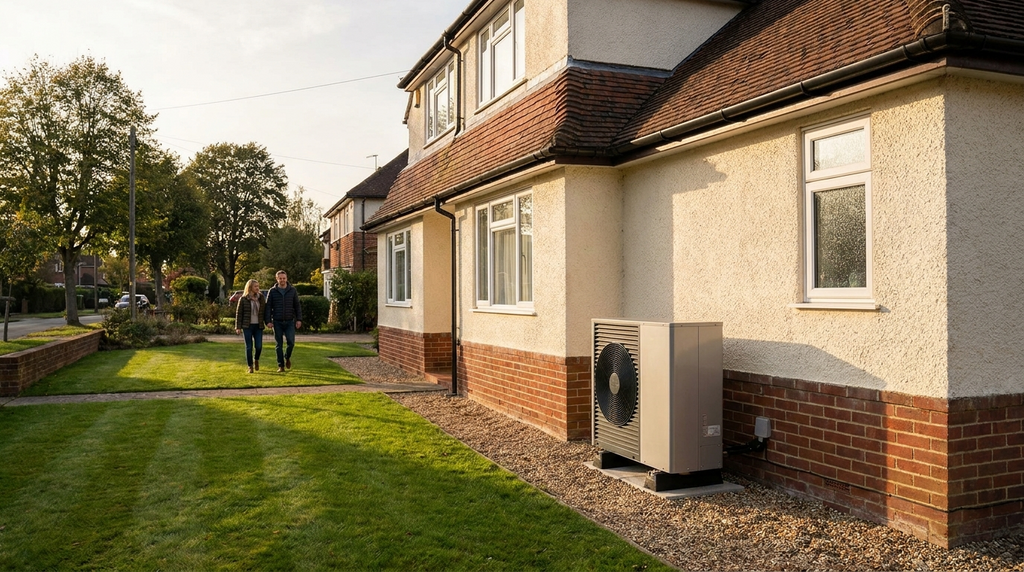
Three heating technologies currently qualify under the scheme. Air source heat pumps are devices that extract heat from outdoor air and transfer it into your home using a refrigerant cycle, powered by electricity rather than combustion. Ground source heat pumps work on the same principle but draw heat from the ground via buried pipework. Biomass boilers burn sustainably sourced wood pellets or chips to generate heat, though these are now generally restricted to rural, off-gas-grid properties under the current rules.
It is worth being clear about what BUS is not. The Great British Insulation Scheme closed on 31 March 2026. It funded insulation measures only and never covered windows or glazing. BUS sits specifically within the clean heating technology space and is not means-tested in any way.
Practical tip, If you are unsure whether your home is in a gas grid area, check the National Grid’s postcode checker before spending time on quotes. This one step will tell you whether biomass is even a possibility for your property.
guide to air source heat pumps for homeowners
How Much Money You Could Receive in 2026
The current BUS grant amounts in 2026 are £7,500 for air source heat pumps, £7,500 for ground source heat pumps (including water source heat pumps), and £5,000 for biomass boilers, always verify these figures against the latest Ofgem and DESNZ guidance, as amounts can be revised by the government.
These sums are meaningful, but it is equally important to understand the full cost picture so you are not caught off guard. Heat pump installations are not cheap, and the grant does not cover the whole bill for most homeowners. Below is a realistic breakdown of what you might expect to pay in 2026.
| Technology | Typical Total Installation Cost Before Grant | BUS Grant Amount | Typical Homeowner Contribution After Grant |
|---|---|---|---|
| Air Source Heat Pump | £10,000 to £15,000 | £7,500 | £2,500 to £7,500 |
| Ground Source Heat Pump | £15,000 to £25,000 | £7,500 | £7,500 to £17,500 |
| Biomass Boiler | £10,000 to £20,000 | £5,000 | £5,000 to £15,000 |
These are broad ranges, your actual cost will vary significantly based on your property size, the complexity of the installation, whether your existing radiators need upgrading, and the installer you choose. A well-insulated three-bedroom semi-detached house with a straightforward existing system will typically sit towards the lower end of these ranges for an air source heat pump. A larger, older detached property with gravity-fed pipework and undersized radiators could sit towards the higher end.
One frequently misunderstood point is that the grant is not means-tested. Your household income, savings, or benefit status have no bearing on whether you qualify. Eligibility is determined by the property and the proposed system, not the people living there. This is fundamentally different from ECO4, which specifically targets households in fuel poverty or on certain benefits.
Practical tip, When you receive quotes, ask each installer to clearly show the total cost, the BUS grant deduction, and your net payment as separate line items. If a quote only shows you the net figure without explaining how the grant is applied, ask them to break it down before you agree to anything.
Who Is Eligible to Apply for the Boiler Upgrade Scheme
Eligibility for the Boiler Upgrade Scheme is based on a set of property and system criteria rather than personal circumstances, and understanding these upfront will save you time and potential frustration.
Starting with geography, the scheme covers England and Wales only. If you live in Scotland, you should look at the Home Energy Scotland Grant and Loan scheme instead, which is administered separately. Northern Ireland has its own support arrangements.
On property type, the home must be an existing residential building, new builds are explicitly excluded because they are expected to meet modern heating standards from the outset. The property can be owner-occupied, privately rented, or a second home. Notably, private landlords can apply, but social housing landlords are excluded. The key requirement is that it is a domestic dwelling and has not previously received a BUS grant for the same property.
One of the most commonly misunderstood requirements involves the Energy Performance Certificate (EPC). An EPC is a report, typically valid for ten years, that rates a property’s energy efficiency from A to G. For BUS eligibility, you do not need to achieve a particular rating, but your EPC must not have any outstanding recommendations for loft insulation or cavity wall insulation. If it does, those measures must either be installed before the voucher is issued, or you must obtain a written technical assessment confirming they are not suitable for your property (for example, because you have solid walls, or an already-insulated loft).
On fuel type, homeowners currently heating with oil, LPG, direct electric storage heaters, or coal are all eligible. Homes on the mains gas grid can apply for an air source or ground source heat pump, but biomass boilers under BUS are generally restricted to properties that are off the gas grid, the intention being to prioritise genuine fossil fuel replacement in areas with no viable alternative.
Practical tip, Pull up your EPC on the GOV.UK EPC register before you contact any installers. This takes about two minutes and immediately tells you whether there are any outstanding insulation recommendations that could delay your application.
what is an EPC and how does it affect your energy grants
What You Need to Sort Out Before Applying
A little preparation before you start speaking to installers can make the entire process significantly smoother and help you avoid the most common causes of BUS applications being delayed or rejected.
Your first priority is confirming that your EPC is current and clean. If your certificate is more than ten years old, or if your property does not have one at all (which is common for homes that have never been sold or rented), you will need a new assessment from an accredited energy assessor. You can find accredited assessors through the GOV.UK EPC register. A new EPC typically costs between £60 and £120 and takes an hour or two to complete.
If your EPC does flag insulation improvements as recommended, do not panic. You have two practical routes. The Great British Insulation Scheme closed on 31 March 2026. It funded insulation measures only and never covered windows or glazing. The second route is to obtain a surveyor’s written report confirming the measures are technically unsuitable for your specific property. This is a legitimate and commonly used pathway, particularly for solid-walled older homes.
Beyond the EPC, it is worth getting an independent technical survey of your home’s heating compatibility before you commit to a heat pump. Heat pumps are highly efficient technology but they work differently from gas boilers, they produce heat at lower temperatures over longer periods, which means they work best in well-insulated homes with adequately sized radiators or underfloor heating. If your current radiators are small or the house loses heat quickly, you may need to budget for upgrades that are not covered by the BUS grant.
Gather your paperwork in advance. You will need proof of property ownership (such as a mortgage statement or land registry document), your EPC reference number, and details of your existing heating system including fuel type.
Practical tip, Ask any prospective installer whether they carry out a full heat loss calculation for your property before specifying the heat pump size. A proper heat loss survey is a professional standard practice and any installer who skips this step should be treated with caution.
how to improve your home's EPC rating before installing a heat pump
How to Apply, A Step by Step Guide
The application process for the Boiler Upgrade Scheme is managed almost entirely by your installer, but understanding each step helps you stay in control and avoid costly mistakes.
- Check your eligibility using the Ofgem BUS eligibility checker available on GOV.UK. This confirms your property type, location, existing heating fuel, and EPC status before you invest time in getting quotes.
- Find an MCS-certified installer using the official MCS certified installer database at mcscertified.com. Only installers with a current, valid MCS certification for the relevant technology are legally permitted to apply for BUS vouchers. Do not rely on an installer’s word alone, check the database yourself.
- Get at least two or three quotes from different MCS-certified installers. Each quote should clearly show the total installation cost, the BUS grant deduction, and the net amount you will pay. Prices can vary substantially between installers for what is technically the same job, so comparing quotes is always worthwhile.
- Your chosen installer submits the voucher application to Ofgem on your behalf before any work begins. This is a critical point, the voucher must be applied for and issued prior to installation. If work starts before the voucher is in place, the grant cannot be claimed retrospectively.
- The voucher is issued by Ofgem, typically within a few working days of a valid application. Once issued, the voucher is valid for three months. Installation must be fully completed within this window or the voucher expires and a new application must be submitted.
- Installation is completed by your MCS-certified installer to the standard required by the scheme. The installer then redeems the voucher directly with Ofgem. You pay only the remaining balance owed to the installer, the grant amount is settled between the installer and Ofgem without any involvement from you.
- Your MCS installation certificate is issued to you by your installer upon completion. Keep this document safe. It confirms the system was installed to the required standard and will be needed for any future property sale, additional energy-related claims, or warranty purposes.
Practical tip, Put the voucher expiry date in your diary the moment your installer confirms it has been issued. Three months sounds comfortable, but delivery delays on heat pump units do happen, and you do not want to be caught out.
How to Find and Verify a Trustworthy Installer
Choosing the right installer is arguably the single most important decision you will make throughout this process, and it deserves more care than many homeowners give it.
The starting point is the MCS certification. MCS, the Microgeneration Certification Scheme, is an independent certification body that accredits both the installers and the products they fit for low-carbon technologies including heat pumps and biomass boilers. Without a current MCS certificate, an installer cannot apply for BUS vouchers, full stop. Verify certification at mcscertified.com by searching for the installer’s company name. If they are not listed, or their certificate has lapsed, do not proceed.
TrustMark is a Government-endorsed quality scheme that covers a wide range of home improvement trades, including heat pump installers. Many reputable installers carry both MCS and TrustMark accreditation, which provides an additional layer of consumer protection. You can verify TrustMark membership at trustmark.org.uk.
There are several red flags that should prompt you to walk away from an installer. Be cautious of anyone who asks you to apply for the voucher yourself (this is not how the scheme works and is usually a sign of a non-certified trader trying to circumvent the system), anyone who requests a large cash payment before the voucher has been confirmed, or anyone who cannot or will not provide their MCS certificate number when asked directly.
Beyond accreditation, check independent reviews. Trustpilot and Which? Trusted Traders both carry reviews for heat pump installers, and these can give you a realistic picture of how a company handles problems as well as straightforward jobs. Ask the installer directly for references from customers in similar properties, a good installer will be proud to provide them and a reluctant response is itself informative.
Practical tip, When you call the MCS database to verify an installer, also check whether the specific heat pump model they are proposing to install is MCS-listed as an approved product. Both the installer and the product must be certified for the installation to qualify for the grant.
questions to ask before hiring a heat pump installer
The Boiler Upgrade Scheme Versus Other Available Grants
Understanding where BUS fits within the wider landscape of UK home energy grants will help you make the most of what is available to you, and avoid the common mistake of assuming you must choose just one scheme.
The four main schemes operating in 2026 serve quite different purposes and different audiences. ECO4 (the Energy Company Obligation) is delivered by energy suppliers and targets households in fuel poverty or on qualifying means-tested benefits, covering insulation and some heating improvements. The Great British Insulation Scheme (GBIS) is focused specifically on insulation for homes with an EPC rating of D or below, delivered through local authorities and energy suppliers. The Boiler Upgrade Scheme is the only mainstream grant specifically funding the installation of low-carbon heating technology for households regardless of income. Home Energy Scotland, administered by the Scottish Government, operates entirely separately and covers a range of measures for Scottish homeowners.
The Great British Insulation Scheme closed on 31 March 2026. It funded insulation measures only and never covered windows or glazing. These schemes are not built to conflict, and this sequencing is actually the approach recommended by many energy advisers for homes that currently have both insulation gaps and inefficient heating.
| Scheme | What It Funds | Grant Amount | Means-Tested | Who Administers | Coverage | Who Applies |
|---|---|---|---|---|---|---|
| Boiler Upgrade Scheme | Low-carbon heating (heat pumps, biomass boilers) | £5,000 to £7,500 | No | Ofgem | England and Wales | MCS-certified installer applies on homeowner’s behalf |
| ECO4 | Insulation, heating upgrades for eligible households | Varies (can cover full cost) | Yes | Energy suppliers (overseen by Ofgem) | Great Britain | Homeowner applies via energy supplier or local authority |
| Great British Insulation Scheme | Single insulation measure per household | Varies | Partially (EPC rating and council tax band criteria) | Ofgem | England | Homeowner applies via energy supplier or local authority |
| Home Energy Scotland | Insulation, heating, renewables | Up to £15,000 grant plus interest-free loan | No (additional funding for lower incomes) | Energy Saving Trust on behalf of Scottish Government | Scotland only | Homeowner applies directly |
One scheme worth mentioning to prevent confusion is the Warm Home Discount. This is an annual rebate applied to energy bills for eligible low-income households, it has nothing to do with installing new heating equipment and cannot be used to fund a heat pump or boiler replacement. If you have seen it mentioned alongside BUS in any context, they are entirely separate things.
The Great British Insulation Scheme closed on 31 March 2026. It funded insulation measures only and never covered windows or glazing. Eligibility criteria are reviewed periodically and some homeowners who did not qualify previously may qualify under updated rules.
Realistic Costs and Savings to Expect
Honest expectations matter more here than optimistic projections, the costs are real and upfront, while the savings accumulate gradually over time, and the picture varies considerably depending on your home and circumstances.
After the BUS grant is applied, a typical air source heat pump installation in a three-bedroom semi-detached property might cost the homeowner between £3,000 and £8,000, depending on the complexity of the job, the existing pipework and radiator setup, and the installer. Ground source heat pump installations remain substantially more expensive even after the grant, homeowners should budget for a net contribution of £7,500 to £17,500 in most cases. This reflects the additional cost of drilling boreholes or laying ground loops.
Running costs are where the picture becomes more specific. Heat pumps run on electricity, which per unit of energy costs more than gas in 2026. However, heat pumps are significantly more efficient than gas boilers, a well-installed air source heat pump can deliver between 250 and 350 units of heat for every 100 units of electricity it consumes, expressed as a Coefficient of Performance (COP) of 2.5 to 3.5. This efficiency advantage offsets the higher electricity unit cost to a meaningful degree, though the financial savings compared to a modern gas boiler are modest for many households and should not be the primary reason for switching.
According to the Energy Saving Trust, switching from oil central heating to a heat pump offers more compelling running cost savings than switching from gas, simply because oil prices are higher and less predictable. For homeowners currently on oil or LPG, the financial case for a heat pump is generally stronger.
It is also worth factoring in maintenance. Heat pumps have fewer moving parts than gas boilers and do not require an annual Gas Safe service, but they do benefit from annual maintenance checks by a qualified engineer to maintain efficiency and warranty validity. Budget approximately £100 to £200 per year for this.
| Existing Heating Fuel | Likely Running Cost Change After ASHP Installation | Notes |
|---|---|---|
| Mains gas | Broadly similar or slightly higher in some cases | Depends heavily on electricity tariff, heat pump COP, and insulation level |
| Oil | Likely reduction for most households | Oil price volatility means savings can be significant but variable |
| LPG | Likely reduction for most households | LPG is expensive per unit; heat pump efficiency advantage is clear |
| Direct electric (storage heaters) | Reduction expected for most households | Heat pumps use electricity more efficiently than direct resistance heating |
This will vary based on your home’s insulation level, the size of the heat pump, the electricity tariff you are on, and how you use heating. Specialist heat pump electricity tariffs, offered by several suppliers in 2026, can improve the running cost calculation considerably by offering cheaper overnight electricity rates. Always ask your installer to model running costs for your specific property using actual heat loss figures rather than industry averages.
Practical tip, If you are switching from gas, investigate whether your electricity supplier offers a dedicated heat pump tariff before your installation is completed. Some tariffs require the heat pump to be registered with the supplier, so planning this in advance saves time and may reduce your bills from day one.
heat pump running costs explained for UK homeowners
Common Mistakes to Avoid When Applying
A number of entirely avoidable errors regularly derail BUS applications or leave homeowners out of pocket. Being aware of them in advance costs nothing.
The most expensive mistake is allowing installation to begin before the voucher has been issued. This happens more than it should, often because eager installers want to move quickly, or because homeowners assume the paperwork can follow the work. It cannot. The rules are explicit, the voucher must be issued before installation commences. If work starts without a confirmed voucher, the grant is lost entirely.
A second common issue is failing to resolve EPC insulation recommendations before the application is submitted. Installers who do not check your EPC thoroughly at the quoting stage may submit an application that Ofgem rejects, causing delays and potentially causing the voucher window to be missed.
Choosing an installer based on price alone, particularly if the cheapest quote comes from a trader who is not MCS-certified, is a serious risk. You lose the ability to claim the BUS grant, and a poorly installed heat pump will underperform, cost more to run, and may void any manufacturer warranty on the equipment.
Finally, do not overlook the broader works that may be needed to make a heat pump perform properly. A heat pump installed into a poorly insulated home with undersized radiators will struggle to heat the space efficiently and your running costs will be higher than they should be. The grant is for the technology itself, associated works such as radiator upgrades or additional insulation are your responsibility to budget for separately.
Practical tip, Always ask each installer to confirm in writing that they have checked your EPC, verified your property’s eligibility, and confirmed the proposed system qualifies under current BUS rules before you sign any contract or pay any deposit.
The Boiler Upgrade Scheme is a genuine and substantial financial contribution towards the significant cost of decarbonising your home’s heating, and for many homeowners, particularly those on oil or LPG, it makes a heat pump installation financially viable in a way it simply would not be without the grant. Going in with clear expectations about the costs that remain your responsibility, choosing a verified MCS-certified installer, and sorting your EPC in advance are the three steps most likely to result in a smooth, successful application.
Frequently Asked Questions
The Boiler Upgrade Scheme currently offers £7,500 for air source heat pumps and ground source heat pumps, and £5,000 for biomass boilers. These grant levels apply to eligible properties in England and Wales and are applied as an upfront discount off your installation bill rather than a cashback payment.
Homeowners and some small non-domestic buildings in England and Wales can apply through a qualifying MCS-certified installer. Your property must have a valid EPC with no outstanding recommendations for loft or cavity wall insulation — if it does, you must address those first before your installer can submit a voucher application to Ofgem.
You do not apply directly — your MCS-certified installer submits the voucher application to Ofgem on your behalf before installation begins. You find an eligible installer via the MCS database at mcscertified.com, confirm your EPC meets requirements, agree a quote, and the installer handles the Ofgem submission. You then pay the remaining cost after the grant is deducted.
Ofgem typically processes BUS voucher applications within a few working days once submitted by your installer, though this can vary during busy periods. Vouchers are valid for three months from the date of issue, giving you a clear window within which installation must be completed and the voucher redeemed.
No — the grant covers a fixed portion of the cost, but a typical air source heat pump installation in the UK ranges from around £8,000 to £15,000 depending on property size and system complexity. After the £7,500 BUS grant, most homeowners pay between £1,500 and £7,500 out of pocket, though quotes vary widely so comparing multiple MCS-certified installers is strongly recommended.