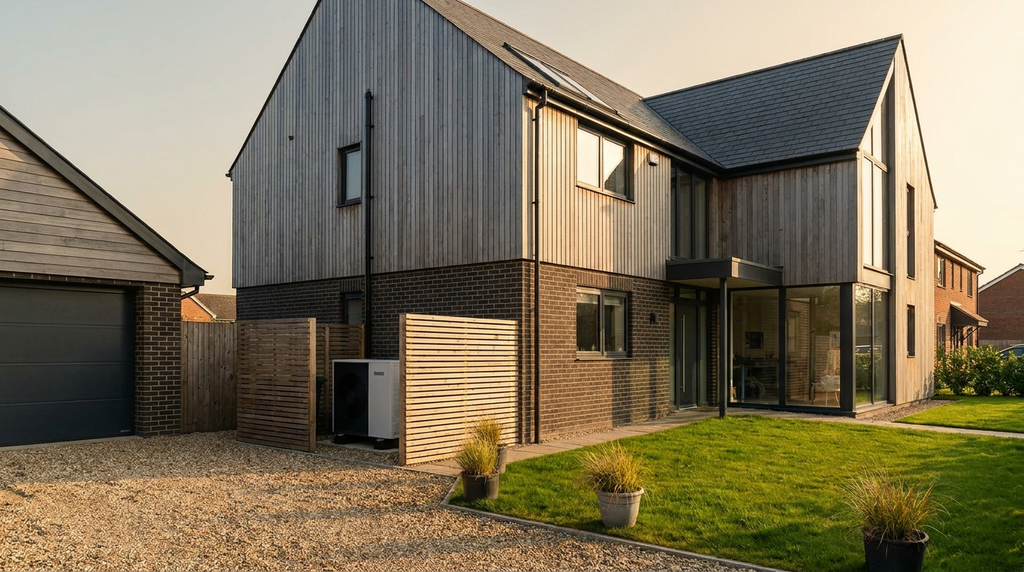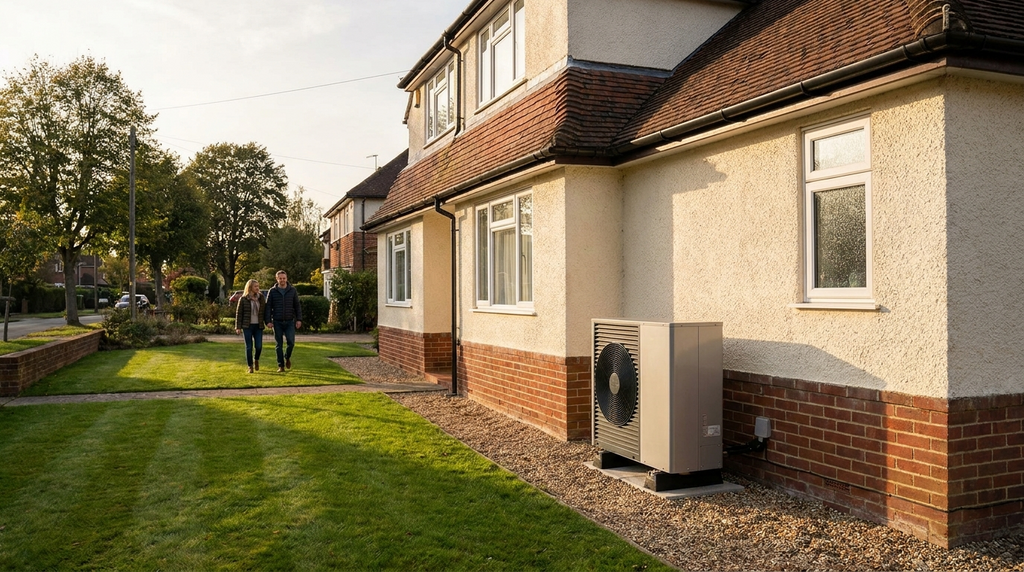
Hydrogen-ready boilers heat a home the same way as a standard gas boiler, while a heat pump uses electricity to extract warmth from outside air or ground, the annual running-cost difference between the two can exceed £400.
A hydrogen-ready boiler burns natural gas to heat water, which is then circulated through radiators. A heat pump uses electricity to compress refrigerant, extracting heat from outside air or the ground and transferring it indoors. For a typical 3-bed semi-detached home, the installed cost of a hydrogen-ready boiler ranges from roughly £2,500 to £4,000, while an air-source heat pump costs between £10,000 and £16,000 before grants (Energy Saving Trust, 2026). Annual running costs for a home with 12,000 kWh of heat demand are approximately £600 for a hydrogen-ready boiler using natural gas at 2026 prices, versus around £1,000 for an air-source heat pump with a Seasonal Coefficient of Performance (SCOP) of 3.0, a difference of roughly £400 per year. Hydrogen-ready boilers are built to burn a hydrogen-gas blend once the supply network allows it, but in 2026 they still burn 100% natural gas, offering no immediate carbon benefit.
The direct answer: for a typical 3-bed semi, a hydrogen-ready boiler costs about £400 less per year to run than a heat pump in 2026, but a heat pump produces around 70% less CO₂ per year.
How heat pump and hydrogen-ready boiler running costs compare in 2026
As of early 2026, the UK energy price cap sets gas at roughly 6.5 pence per kilowatt-hour (p/kWh) and electricity at approximately 26 p/kWh (Ofgem, 2026). This four-to-one ratio is the key variable. A hydrogen-ready boiler operates at 90–94% efficiency, meaning it converts 90–94% of the gas energy into heat. A heat pump’s SCOP of 3.0–3.5 means it produces 3.0 to 3.5 kWh of heat for every 1 kWh of electricity consumed (MCS, 2026).
A worked example: a home with 12,000 kWh of annual heat demand. With a hydrogen-ready boiler at 92% efficiency, the gas input needed is roughly 13,043 kWh (12,000 ÷ 0.92). At 6.5 p/kWh, that costs £848 per year. With a heat pump at SCOP 3.0, the electricity input is 4,000 kWh (12,000 ÷ 3.0). At 26 p/kWh, that costs £1,040 per year. The heat pump runs £192 more per year at these averages. However, the Boiler Upgrade Scheme (BUS) grant of £7,500 does not directly reduce running costs but lowers the upfront barrier. Homeowners on time-of-use tariffs like Economy 7 can shift heat pump operation to cheaper night rates, narrowing the gap.
Quick numbers, cost, efficiency and carbon for 2026
| Metric | Hydrogen-ready boiler (natural gas) | Air-source heat pump |
|---|---|---|
| Typical installed cost (3-bed semi) | £2,500 – £4,000 | £10,000 – £16,000 |
| Annual running cost (12,000 kWh heat demand) | ~£850 | ~£1,040 |
| Efficiency / SCOP | 90–94% | 3.0–3.5 SCOP |
| Annual CO₂ emissions (kg) | ~2,400 kg | ~700 kg |
| Lifespan (years) | 10–15 | 15–20 |
| Boiler Upgrade Scheme grant available? | No | Yes, £7,500 |
Sources: Energy Saving Trust, 2026 for costs; MCS, 2026 for SCOP data; GOV.UK, 2026 for BUS grant; DESNZ, 2026 for carbon intensity figures.
The heat pump is the lower-carbon option in 2026 because the UK electricity grid is now cleaner than burning natural gas in a boiler
The 2026 grid carbon intensity averages around 120 grams of CO₂ per kilowatt-hour (gCO₂/kWh) (DESNZ, 2026). Burning natural gas in a 94% efficient boiler produces approximately 200 gCO₂ per kWh of heat output. Even a heat pump with a low SCOP of 2.5 produces just 48 gCO₂ per kWh of heat (120 ÷ 2.5), which is 76% less than the boiler. At SCOP 3.5, emissions drop to 34 gCO₂/kWh of heat. A hydrogen-ready boiler burning natural gas in 2026 offers zero carbon benefit until hydrogen supply arrives, and that remains uncertain. The government’s 2026 hydrogen heating trials may or may not lead to widespread rollout (GOV.UK, 2026). A heat pump gets cleaner as the grid decarbonises further; a hydrogen-ready boiler stays the same until hydrogen supply materialises.
Eligibility and installer certification
For a heat pump, MCS certification is required to qualify for the £7,500 Boiler Upgrade Scheme grant (GOV.UK, 2026). TrustMark registration provides additional consumer protection. The property must have adequate outdoor space for the external unit and space for a hot water cylinder indoors. A 3-bed semi typically meets these requirements if it has a side or rear garden area of at least 1 square metre for the unit and a cupboard or utility room for the cylinder. For a hydrogen-ready boiler, installation must be carried out by a Gas Safe registered engineer (Gas Safe Register, 2026). No specific hydrogen certification exists yet in 2026. The boiler fits in the same space as a standard gas boiler, and no hot water cylinder is required unless the property has a system boiler setup. No outdoor space or additional insulation is needed beyond the existing gas connection.
Hydrogen-ready boiler, the “do nothing” option that delays the decision until the gas network changes
A hydrogen-ready boiler requires no home modifications beyond a standard boiler swap. It connects to the existing gas pipe and radiators. Current natural gas cost is roughly half the electricity cost per kWh, making running costs lower than a heat pump in 2026, approximately £850 versus £1,040 for a typical home. The government’s 2026 hydrogen heating trials are testing hydrogen blending in the gas network, but widespread rollout is not guaranteed (GOV.UK, 2026). The homeowner risk is clear: if hydrogen never reaches your street, the boiler remains a standard gas boiler with no carbon benefit. You pay the same gas bills and emit the same CO₂ as a standard boiler. The “hydrogen-ready” label adds a small premium to the purchase price, typically £100–£200, but delivers no immediate advantage.
Heat pump, higher upfront cost but lower carbon and future-proof running costs
After the £7,500 Boiler Upgrade Scheme grant, a typical air-source heat pump installation costs between £7,000 and £13,000 for a 3-bed semi (Energy Saving Trust, 2026). Running costs can be higher or lower than gas depending on the heat pump’s SCOP and the electricity tariff. On a standard tariff, the heat pump costs roughly £190 more per year. On a heat-pump-specific tariff (such as Octopus Cosy or EDF’s heat pump tariff), the annual cost drops to around £850–£900, closing the gap to within £50 of the gas boiler. The property must be well insulated, cavity wall and loft insulation to at least the 2026 Building Regulations standard, and have space for a hot water cylinder and outdoor unit. No reliance on future hydrogen infrastructure is needed; the system works on today’s electricity and gets cleaner as the grid decarbonises. Heat pump installation checklist for UK homes
The direct answer to “heat pump vs hydrogen boiler UK” in 2026
For a homeowner who can afford the upfront cost and has a suitable property, a heat pump is the lower-carbon and more future-proof choice. The £7,500 BUS grant reduces the upfront gap, and the running-cost difference can be minimised with a heat-pump-specific tariff. For a homeowner who wants the lowest possible upfront cost and is comfortable with natural gas for the next decade, a hydrogen-ready boiler is cheaper to install and run today. Neither option is “wrong”, the choice depends on budget, property suitability, and carbon priorities. No government mandate to replace gas boilers before 2035 exists, so there is time to decide (GOV.UK, 2026). Gas boiler replacement timeline UK 2026
Frequently Asked Questions
Around £600 per year for a typical 3-bed semi with 12,000 kWh heat demand, based on gas at 6.5p/kWh and 92% boiler efficiency (Ofgem, 2026).
Approximately £1,000 per year for the same home, assuming a SCOP of 3.0 and electricity at 26p/kWh (Energy Saving Trust, 2026).
No, a hydrogen-ready boiler is roughly £400 per year cheaper to run than a heat pump in 2026, due to the four-to-one gas-to-electricity price ratio (Ofgem, 2026).
A heat pump produces around 70% less CO₂ per year than a hydrogen-ready boiler burning natural gas, according to the Energy Saving Trust (2026).
No, in 2026 hydrogen-ready boilers still burn 100% natural gas because the hydrogen supply network is not yet available (GOV.UK, 2026).