The University of Salford‘s Energy House put a gas combi boiler in an environmental chamber and measured what different heating controls actually saved. The best-performing thermostat cut heating gas by 15% in a winter test. The change that costs nothing, turning the boiler’s flow temperature down to 60°C, cuts about 9% of a household’s total gas use on its own. According to Ofgem’s price cap for 1 July to 30 September 2026, gas costs 7.33p per kWh, so that free adjustment is worth roughly £76 a year to a home burning 11,500 kWh of gas. The £134.99 smart thermostat sitting next to it on the shelf needs somewhere between three and fifteen years to pay for itself.
That gap is the whole point of this guide. Almost every article about heating controls ranks them by how clever they are. Ranked instead by pounds spent per percent of gas saved, the order inverts completely. Below is that ranking, built only on measured UK trial data: the BEAMA and University of Salford Energy House control tests of October 2021, the DESNZ smart thermostat randomised controlled trial, and Nesta’s flow temperature work at the same Salford facility.
One disclosure before the numbers. I spent about 15 years in the UK windows and doors trade and now work in marketing. I am not a heating engineer or a Gas Safe registered installer. Everything below is sourced from published trials and regulations rather than from my own site experience, and anything involving gas work or wiring belongs to a registered engineer.
The league table, ranked by cost per percent of gas saved
Savings percentages below are not all measured against the same denominator, which matters. Nesta’s flow temperature figure is a share of total gas use. The BEAMA control-class figures are a share of gas used for space heating during seven-hour test runs. The DESNZ smart thermostat figure is a share of total daily gas consumption. I have kept them separate rather than blending them into a single fake number.
| Rank | Move | Measured saving | Hardware cost | Cost per 1% saved |
|---|---|---|---|---|
| 1 | Drop combi flow temperature from 80°C to 60°C | 9% of total gas (Nesta, Salford) | £0 | £0 |
| 2 | Commission and balance the system properly | Not quantified alone. It cut the measurable annual gain from a Class IV control from 10% to 4% (BEAMA) | £0 for the TRV and thermostat settings you can correct yourself. Engineer time for commissioning and balancing is unpriced here because I have no verified UK labour figure | Not calculable |
| 3 | Class IV proportional on/off thermostat. Warning: this is the TPI class that Boiler Plus excludes on a new combi installation in England | 10% retrofit, 4% on an optimised system | £30.99 to £56.40 | £3.10 to £5.64 |
| 4 | Class V or Class VI directly modulating thermostat over OpenTherm | 12% retrofit (Class V), 5% on an optimised system (BEAMA’s deliberately conservative figure covering both classes) | £78.99 | £6.58 |
| 5 | TRVs fitted to radiators that have none | No separate saving measured in any trial cited here. Used throughout the Salford tests to hold non-living rooms at 18°C | £26.29 per radiator | No figure exists. See the TRV section below |
| 6 | Weather compensation outdoor sensor added to a modulating control | No measured advantage over load compensation at Salford. BEAMA concluded the two produce similar savings | £48.67 plus engineer time | Not calculable. There is no separate saving to divide by |
| 7 | Smart thermostat bought for app scheduling alone. Note: the £78.99 entry price is the same Hive Hubless Mini V4 counted in row 4, so this row and row 4 overlap | 5.0% ± 3.9% of total gas (DESNZ SENS trial) | £78.99 to £164.99 | £15.80 to £33.00 at the central estimate |
| 8 | Smart TRV multi-room zoning kit | No UK trial cited here measured zoning | £170.99 for hub, room thermostat and two heads. £52.99 per extra head | No figure exists |
Hardware prices are Screwfix and City Plumbing listings checked on 21 July 2026, inclusive of VAT, excluding fitting. Fitting is the variable I cannot price honestly, because I have no verified UK labour figure, and it swings the bottom half of this table more than the hardware does.
Why the free change ranks first
A condensing boiler earns its name by pulling latent heat out of its own flue gases. That only happens when the water coming back from the radiators is cold enough to condense the water vapour in the exhaust. BEAMA puts the threshold at 55°C: “the increase in efficiency is pronounced once the return temperature goes below 55oC and the boiler goes into ‘condensing mode’.” Nesta puts it a degree lower, at “around 54°C”. Either figure leaves most UK systems well short.
Nesta states that “most condensing boilers in use across the UK are set with flow temperatures of 70-80°C, which is too high for them to operate at their maximum efficiency.” BEAMA describes the traditional UK radiator design as roughly 75°C flow and 65°C return, and adds that with a plain on/off thermostat “the return temperature will rarely be below 55°C so the boiler will spend little time in its more efficient condensing mode.” A boiler advertised at 92% efficiency spends most of its life below that figure, because it is being run outside the conditions the 92% was measured in.
Turning the flow temperature down to 60°C forces the return below the condensing threshold for most of the heating season. Nesta’s testing at the University of Salford Energy House, a two-bedroom early twentieth-century terrace inside an environmental chamber, measured about 9% of total gas use saved, which they put at 1,092 kWh a year for a home using 12,000 kWh.
The knock-on effect is that the house heats more slowly. Radiators run cooler, so they emit less heat per hour. In a well insulated home you will not notice. In a draughty solid-wall property you may need to start the heating earlier rather than turn the flow temperature back up.
Who should not touch the flow temperature
This is where the advice gets repeated carelessly. Nesta is explicit that it will not recommend the change where a hot water cylinder is present: “unfortunately we’re unable to suggest that you reduce your boiler flow temperature if you have a water tank.” That still leaves most of the country in scope, because Nesta counts more than 15 million UK homes with a combi boiler. According to Citizens Advice, the safe settings by system type run as follows.
- Combi with radiators. Try 60°C flow.
- Combi with underfloor heating. Try 50°C.
- System or regular boiler with a cylinder. Citizens Advice puts the safe floor at 65°C flow, no lower.
- Cylinder hot water temperature. Minimum 60°C. That is a Legionella control, not a comfort setting, and it is the one number in this guide you should never reduce.
- Combi hot water temperature. A separate dial from the flow temperature. Citizens Advice suggests trying 50°C.
The most common fear here is unfounded. On a combi, radiator flow temperature and tap water temperature are two different settings. Nesta states plainly that “changing the flow temperature on a combi boiler will not affect the temperature of the hot water from your taps and showers.”
One caveat on the money. Nesta’s headline saving is around £65 a year, and the site labels it “based on energy prices as at September 2023,” so it does not describe today’s cap. The durable figure is the physical one, roughly 9% of your gas, which you can convert at whatever the cap rate is when you read this.
What the Salford control tests actually measured
BEAMA commissioned the University of Salford to run gas-fired radiator heating for seven-hour periods, consistent with the typical UK afternoon and evening heating pattern used in SAP. The living room was held at 21°C, other rooms at 18°C by TRVs, both per SAP. The winter test ran at 4.2°C outside, the UK’s average December temperature. The spring test ran at 8.9°C, the average for April. The test house is a Victorian solid-wall two-up two-down, a type BEAMA says numbers around 6.6 million in the UK.
Data from the Energy House came in two phases, and the difference between them is the most useful finding in the entire report.
| Control class | What it does | Phase 1 winter | Phase 1 spring | Phase 2 winter | Phase 2 spring |
|---|---|---|---|---|---|
| Class I | Standard on/off room thermostat (the baseline) | 0% | 0% | 0% | 0% |
| Class IV | Proportional on/off, load compensation | 11% | 9% | 2% | 6% |
| Class V | Directly modulating, load compensation | 15% | 9% | 8% | 7% |
| Class VI | Directly modulating, weather compensation | Set-up failure, not comparable | Set-up failure, not comparable | 2% | 7% |
Phase 1 is a straight retrofit. An installer swapped the thermostat with no extra guidance and no specified commissioning or balancing. Phase 2 fitted a new boiler with detailed sizing, proper commissioning and a balanced system, then tested the same controls against that improved baseline.
Class IV fell from 11% to 2% in the winter test. BEAMA’s own estimate of the annual saving dropped from 10% to 4%. The controls did not get worse. The system they were compensating for got better. BEAMA’s conclusion is that “thorough boiler commissioning and system balancing was observed to have a significant beneficial impact on the operation of a heating system.”
Read that as a buying rule. A large slice of the headline saving attributed to advanced controls in a typical UK home is the control quietly papering over a badly set up system. Fix the setup and you bank most of it without buying anything. Buy the control instead and you are paying for a saving you could have had free.
Load compensation versus weather compensation
Both aim at the same thing, which is running the boiler at the lowest flow temperature that will still heat the house. They get there differently.
- Load compensation (Class V) reads the gap between room temperature and setpoint, then tells the boiler to modulate its flow temperature to deliver exactly that much heat. It responds to what the building is actually doing.
- Weather compensation (Class VI) adds an outdoor sensor or an internet forecast and infers the required flow temperature from the outside temperature, using a heating curve the installer sets.
Weather compensation is usually sold as the higher tier. The phase 2 winter numbers look at first glance as though it is the weaker one, with Class V at 8% against 2% for Class VI. BEAMA does not read them that way, and neither should anyone quoting the report.
Both classes ran on the same physical thermostat, in the same position, with the same sensor and the same setpoint. The only difference was whether the outdoor sensor fed the algorithm. In the spring tests the two landed at 7% each. BEAMA’s conclusion in section 4.2 is direct: “Given the flow and return characteristics of the system are similar we are confident that either form of Directly Modulating room thermostat (i.e. load compensation or weather compensation) will produce similar savings.”
The winter gap has a mundane explanation. These controls contain an element of self-learning about how the building responds thermally, and the running order in BEAMA’s Table 4 puts the Class VI winter run first in the entire sequence. BEAMA: “the device will have been learning about the thermal characteristics of the building in the first test period, which as seen in Table 4 was the Class VI Winter test. Had there been the opportunity to run this test again it is expected that the room temperature maintained would also have been close to 21oC.” The Class VI run also drifted to a mean 22.2°C once setpoint was reached, against 21.0°C for Class V, so it was heating a warmer house on the way to that 2%.
BEAMA then picked the lower number deliberately: “we will take the lower (Class VI) energy savings as the figure for Directly Modulating room thermostats added to an optimised system. This is both to favour a conservative figure, but also to fit into the test approach which was to make comparisons with the living room maintained at the same average temperature.” Its footnote 8 adds that the European control accuracy standard EN15500 takes the lowest room temperature in the control cycle rather than the average, and that under that standard “the 8% saving in the Winter tests would be the valid measurement.”
So the 5% in row 4 of the league table is not a weather compensation number and never was. It is BEAMA’s conservative figure for any directly modulating room thermostat on a properly commissioned system, load or weather compensating. On the measured evidence the two are equivalent. Choose between them on installation risk instead, and that is where they genuinely differ.
Phase 1 shows why. Weather compensation could not be measured at all in the retrofit phase, because the installer set a heating curve holding 74°C flow at the system design temperature of -3°C, and the living room did not reach 21°C until near the end of the seven-hour test. The control was made by the boiler manufacturer, so compatibility was not the issue. The Salford team reported that they could not find clear guidance on selecting an appropriate heating curve. BEAMA calls this “a problem that is known to exist for UK installers” and adds, with a hedge worth preserving, that “anecdotally, it is believed that this problem has been resolved in real homes by simply disconnecting the weather compensation.” BEAMA flags that as a belief rather than an observed rate, and I am repeating it on the same terms.
If you are being sold weather compensation, the sensor is the cheap part. The commissioning is the product. Ask the installer what heating curve they will set and how they will verify the house reaches setpoint on a cold morning. If they cannot answer, a load-compensating control gets you the same measured saving without that dependency.
The cheapest good control is the one Boiler Plus will not accept
Row 3 of the league table is the best cost per percent of anything you can buy. The Honeywell Home DT4 is £30.99 at Screwfix and its specification table lists the ERP Control Class as Class IV, against a 10% estimated annual saving on a retrofit. That is £3.10 per 1% saved, roughly half the rate of the modulating controls above it.
There is a catch, and it bites in exactly one situation. BEAMA’s footnote 13 records that “Class IV is currently described in the regulation as a ‘TPI room thermostat, for use with on/off output heaters.'” BEIS excludes TPI controls from the Boiler Plus list of additional efficiency measures: “TPI controls are not included.” So if you are having a new gas combi installed in England, a Class IV thermostat will not satisfy the extra measure the regulation demands, however well it performed at Salford. Buy one for that job and your installation fails Boiler Plus.
Two qualifiers keep this fair. BEAMA notes the 2017 policy decision excluded TPI controls “though not the broader category of on/off load compensation,” so the class label and the excluded technology are not identical, and the European Commission review is proposing to redraw Class IV as “a generic load compensating control using proportional on/off control.” Second, the exclusion only applies when a new combi is being installed. If you are simply replacing a tired thermostat on an existing boiler, Boiler Plus is not triggered and a Class IV control remains the best value on this evidence.
The honest smart thermostat number
Marketing claims of 20% to 30% savings are common. The only UK government-funded randomised controlled trial of a smart thermostat found considerably less.
The DESNZ Smart Energy Savings competition trial ran from December 2020 to the end of March 2022, in homes all heated by gas boilers. Its primary Intention to Treat analysis found “a statistically significant reduction in daily gas consumption between the intervention and control group with an effect size of 5.0% ± 3.9% (95% Confidence Interval, p<0.05).” In absolute terms that is 1.92 ± 1.50 kWh a day, calculated against an average annual gas consumption of 13,923 kWh across the trial.
The often-quoted 14% figure from the same report is the Treatment on Treated analysis. That covers only the households which actually received and used the device. It carries a margin of ±10.9%, and it rests on 93 properties out of 261 in the dataset. The trial’s effective sample size reached 25% of its original recruitment target.
Two further details from the report are worth more than the headline. First, the trial found “no change in electricity use between the intervention and control groups,” so the gas saving was real rather than displaced onto the electricity bill. Second, the mechanism was behavioural. The report attributes the reduction to the fact that “the thermostat allowed trialists to reduce heating hours or lower heating temperatures while retaining similar levels of thermal comfort.” The hardware enabled the saving. The householder made it. Fit a smart thermostat, never open the app and never change the schedule, and you have bought a better looking on/off thermostat.
The trial’s baseline matters too. The DESNZ report cites an earlier BEIS finding that smart meters on their own produce average reductions of 3% for electricity customers, 2.2% for gas credit customers and 0.5% for gas prepayment customers. The 5.0% thermostat effect sits on top of that, and the figures originate with BEIS rather than with this trial.
Why the smart thermostat row ranks last but a smart thermostat might not
Rows 4 and 7 of the league table are, at the cheap end, the same product. Many smart thermostats sold today are also Class V load-compensating controls when connected to a compatible boiler over OpenTherm, and the £78.99 Hive Hubless Mini V4 is listed as an OpenTherm model. It appears twice because it can do two separate jobs, measured in two separate trials, and the price you pay buys whichever ones you actually switch on.
The saving measured by DESNZ is the app and scheduling saving. The saving measured by BEAMA is the boiler modulation saving. If one box delivers both, you get both, and the honest cost per percent then sits somewhere better than row 7 suggests. Before you buy, check two things: whether your boiler supports OpenTherm, and whether the installer will wire and enable it rather than running the thermostat as a plain on/off switch. Plenty are fitted the lazy way, and a smart thermostat wired as an on/off switch is worth only the row 7 number.
TRVs, and the radiator nearest your thermostat
A thermostatic radiator valve costs about £26.29 for a Drayton TRV4 at Screwfix. In the Salford tests, TRVs did the work of holding non-living rooms at 18°C while the room thermostat governed the living room at 21°C. Neither BEAMA nor DESNZ measured a saving for TRVs on their own, which is why row 5 of the league table carries a price and no percentage. If someone quotes you a TRV saving figure, ask which trial it came from.
Two mistakes are common, and two different charities address them.
- Do not let a TRV fight your room thermostat. Citizens Advice puts it as a setting rather than a ban: “if your room thermostat is in the same room as a TRV, make sure the TRV is set higher than the temperature on the room thermostat.” The Centre for Sustainable Energy approaches the same problem from the other side and tells you to “keep the radiators higher in the rooms you are using and especially the one nearest the thermostat.” The failure mode is the same either way. If that valve throttles the radiator, the room cools, the thermostat calls for heat the radiator cannot deliver, and the boiler runs on.
- Turning every TRV down only saves money if the thermostat comes down too. The Centre for Sustainable Energy answers this one as a qualified yes rather than a myth: “True. But only if you also turn your thermostat down at the same time.” Leave the thermostat at 21°C and “your boiler will keep running until the room temperature reaches 21C”, which CSE notes “will take a long time with the radiators on low.” You get a colder, slower house for a saving you could have taken directly at the thermostat. The room thermostat is the master. TRVs only trim individual rooms below whatever it is calling for.
The dial numbers are not degrees, which trips people constantly. Citizens Advice gives the approximate equivalents as 1 = 10°C, 2 = 15°C, 3 = 20°C, 4 = 25°C, and 5 or maximum = 30°C. Setting a bedroom to 5 and expecting it to be warmer sooner does nothing except let it overheat.
The Centre for Sustainable Energy kills the related myth about the thermostat itself: “your boiler works at the same constant speed regardless of whether you set your thermostat to 20C or 30C.” The setpoint decides when the boiler stops, not how hard it works.
Smart TRVs and multi-room zoning kits
For a lot of households the live decision is not which thermostat, it is one smart thermostat against a kit that puts a motorised head on every radiator. Screwfix lists the Drayton Wiser Wireless Heating and Hot Water 2-Channel Smart Radiator Thermostat Control Kit at £170.99, which includes a hub, a room thermostat, two smart radiator heads and an OpenTherm module. Extra heads are £52.99 each. A house wanting heads on eight radiators is therefore looking at about £489 of hardware before fitting, against £210 for eight plain TRVs. The zoning route costs roughly £279 more.
Here is the honest position on that £279. Neither trial in this guide measured multi-room zoning. BEAMA tested single room thermostats with ordinary TRVs elsewhere in the house. The DESNZ SENS trial tested a smart thermostat, not a zoning kit. I have no measured UK saving to divide the cost by, and I am not going to build one out of manufacturer claims.
What the evidence does point at is the mechanism. The DESNZ finding that the saving came from households reducing “heating hours or lower[ing] heating temperatures” says the money is in scheduling flexibility. A plain £26.29 TRV already sets a per-room temperature. A smart head adds a per-room schedule and remote control on top. That extra is plausibly worth paying for in a house with genuinely unused rooms and irregular occupancy, and close to worthless in a house where everybody is in and out at the same time. Buy it as a comfort and convenience product with a possible saving attached, not as an investment with a payback you can calculate, because on the published UK evidence you cannot calculate one.
If you have no room thermostat at all
Every percentage in this guide is measured against a baseline that already has one. BEAMA’s baseline is a standard Class I on/off room thermostat and every saving in the Salford tests is relative to that. A house running on the boiler dial and a time clock alone sits below the baseline, so none of these figures describe your upgrade. They understate it.
The regulation treats this as settled. BEIS lists timers and room thermostats as “an explicit requirement for all gas and oil systems” under Boiler Plus. If your home has no room thermostat, that is the purchase to make before any comparison above becomes relevant to you. The cheapest on the Screwfix list is the Drayton RTS1 wired room thermostat at £17.99, and wiring it into the boiler is engineer work.
Schedule and setback, which beat most hardware
Citizens Advice gives 18°C to 21°C as a usually comfortable room temperature and recommends a setback 2°C or 3°C below your comfort temperature during unoccupied periods, with a hard floor: “don’t set it lower than 16 degrees Celsius,” because below that “there’s a risk of your home becoming damp and you getting ill.”
For a gas boiler, running the heating low all day costs more than a timed schedule, because you pay for heat leaking out of the building during every hour nobody is in. Heat pumps behave differently and are a separate discussion. Note that the Salford tests used a 15°C setback between runs purely to standardise the starting conditions, not as a recommendation for occupied homes.
How to tell if your system needs balancing, and what it costs
Phase 2 of the Salford tests puts balancing second in the league table, so it deserves more than a row. The test is the one BEIS describes: a competent engineer should not sign off an installation without “checking that all radiators are heating up at a similar rate.” Run the heating from stone cold and feel every radiator after ten minutes and again after twenty. If the ones nearest the boiler are hot while the far ones are lukewarm, flow is taking the short route, and the cold rooms are only reaching temperature because the thermostat keeps the boiler running longer than it should.
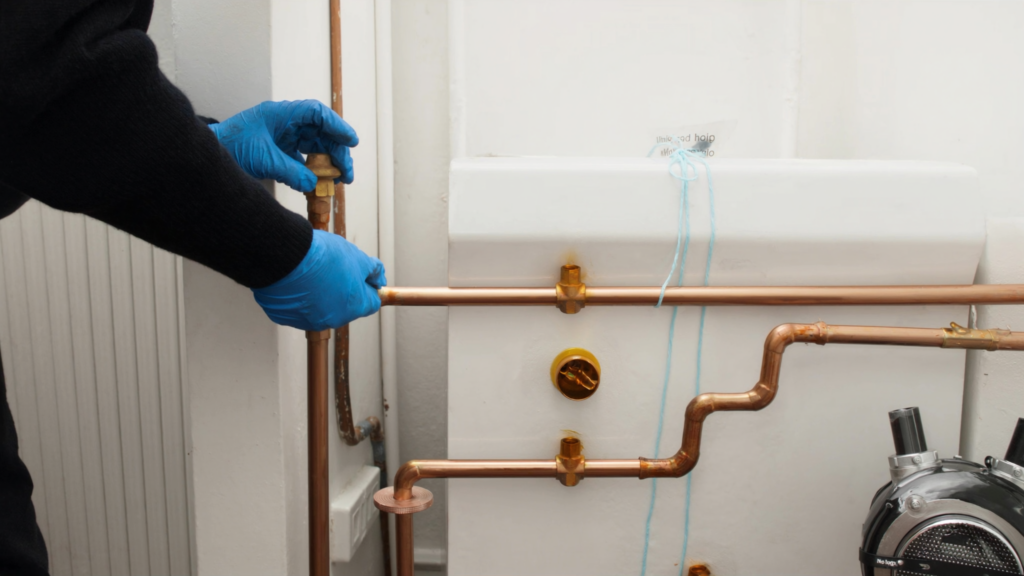
The adjustment is made at the lockshield valve, the plain capped valve at the opposite end of the radiator from the TRV. Closing it slightly on the fast radiators pushes flow towards the slow ones. Done properly it is a measured job, with a thermometer reading the temperature drop across each radiator and the whole system worked through in order rather than one valve tweaked by feel.
On price I have to be straight with you. I have no verified UK figure for what an engineer charges to balance a system or commission a boiler, so I am not publishing one. That is why row 2 of the league table shows £0 only for the settings you can correct yourself and leaves the labour unpriced. Get two written quotes. Ask specifically whether balancing is included in any boiler service or new installation you are already paying for, because on the wording BEIS quotes it arguably already should be.
Boiler Plus, and why it may not apply where you live
Boiler Plus came into force in April 2018 and applies, per the BEIS factsheet, “whenever a boiler is installed in an existing heating system anywhere in England.” Three requirements matter to a homeowner.
- Domestic gas boilers must meet a minimum of 92% ErP. This applies to the boiler as a product. BEIS is unambiguous: “a boiler below 92% ErP does not comply, even if the system label is brought up to 92% by other components.” You cannot bolt weather compensation onto a 90% boiler and call it compliant.
- Timers and room thermostats are an explicit requirement for all gas and oil systems.
- When a gas combi is installed, one additional energy efficiency measure is required, chosen from flue gas heat recovery, weather compensation, load compensation, or smart controls with automation and optimisation. BEIS says this “can be met with a one-off payment of as little as £50.”
Three exclusions catch people out. TPI controls do not count: BEIS states that the load compensation description “should not be misinterpreted as including TPI controls” and that “TPI controls are not included.” That is the trap described earlier, because Class IV is the regulation’s own label for a TPI thermostat. The additional-measure rule was applied to combi boilers only, with heat-only and system boilers excluded partly over Legionella risk. Oil boilers were not given an efficiency standard under Boiler Plus at all.
On nation: the BEIS wording is England. Scotland, Wales and Northern Ireland set building standards separately, and I have not verified their current requirements against a primary source, so I am not going to state them. If you are outside England and getting a combi fitted, ask your installer in writing which standard applies and what it requires, before you accept a quote that omits an efficiency measure.
An illustrative payback calculation
This is a worked illustration, not a real household. Assumptions, stated so you can vary them: a 3-bed semi using 11,500 kWh of gas a year, of which I have assumed 9,000 kWh goes on space heating and the balance on hot water. Gas at 7.33p per kWh, Ofgem’s cap rate for 1 July to 30 September 2026. Percentages applied to the base each trial actually measured against. Nothing here accounts for fitting labour.
| Measure | Applied to | kWh saved | Annual saving | Hardware | Simple payback |
|---|---|---|---|---|---|
| Flow temperature to 60°C | 9% of 11,500 kWh total gas | 1,035 | £75.87 | £0 | Immediate |
| Class IV thermostat, unoptimised system | 10% of 9,000 kWh heating gas | 900 | £65.97 | £30.99 | About 6 months |
| Class V OpenTherm thermostat, unoptimised system | 12% of 9,000 kWh heating gas | 1,080 | £79.16 | £78.99 | About 1 year |
| Directly modulating thermostat, already optimised system | 5% of 9,000 kWh heating gas, BEAMA’s conservative figure for load or weather compensation | 450 | £32.99 | £78.99 | About 2.4 years |
| Smart thermostat scheduling, central estimate | 5.0% of 11,500 kWh total gas | 575 | £42.15 | £134.99 | About 3.2 years |
| Smart thermostat scheduling, bottom of confidence interval | 1.1% of 11,500 kWh total gas | 127 | £9.27 | £134.99 | About 14.6 years |
That last row is the one to sit with. The DESNZ confidence interval of ±3.9% is wide enough that a real household could land anywhere between £9 and £75 a year. At the bottom of the range the payback runs past the likely working life of the device. Anyone quoting you a single confident smart thermostat saving figure is quoting the midpoint and hiding the spread.
The flow temperature row, by contrast, has a payback of zero because the change costs nothing. That is why it ranks first, and why it should be done tonight regardless of what else you buy.
When better controls do not pay
Four situations where the honest answer is to leave your money in your pocket.
- Your system was recently and properly commissioned. Phase 2 of the Salford tests is the evidence. On a correctly sized, commissioned and balanced system, Class IV controls delivered 4% a year rather than 10%. The better your baseline, the worse the payback on the upgrade.
- Your boiler does not support OpenTherm or equivalent modulation. Without that link, a smart thermostat cannot load compensate. You are buying app scheduling, which is the 5.0% ± 3.9% number, at a price that ranks near the bottom of the league table.
- Nobody in the household will change the schedule. The DESNZ trial attributed the saving to people reducing heating hours and temperatures. If the schedule is set once at installation and never revisited, the measured mechanism for the saving is absent.
- Weather compensation with an installer who cannot describe the heating curve. Salford’s own installer, using the boiler manufacturer’s own control, produced a result that could not be compared to the baseline because the house never got warm enough. BEAMA reports it as an anecdotal belief that badly commissioned weather compensation ends up disconnected in real homes, and no measured UK figure for how often that happens exists.
What to do, and by when
In order, cheapest and best-evidenced first.
- Tonight. If you have a condensing combi with radiators and no hot water cylinder, turn the central heating flow temperature to 60°C. Leave the hot water dial alone. Cost £0, worth about 9% of your gas.
- This week. Check any TRV on the radiator in the room with your thermostat is set higher than the thermostat, per Citizens Advice, so the two are not fighting. Set bedroom TRVs to about 3 for 20°C using the Citizens Advice scale. Set the thermostat between 18°C and 21°C, with a setback 2°C to 3°C lower and never below 16°C.
- Before next winter. Run the heating from cold and feel every radiator. If some reach temperature far ahead of others, the system needs balancing. Get that done before you buy any control, because it will shrink the payback on everything you were considering.
- Only after the above. If you are replacing a plain on/off thermostat on an existing boiler, a Class IV control at £30.99 has the best cost per percent in the table, and a Class V load-compensating control over OpenTherm has the strongest measured saving per pound at 12% on a retrofit. Confirm your boiler supports OpenTherm before paying for the second one.
- If you are having a new gas combi fitted in England. Boiler Plus requires an additional efficiency measure. Ask which one is in the quote, confirm the boiler itself is at least 92% ErP, and rule out a Class IV thermostat for that job, because Class IV is the regulation’s TPI class and BEIS excludes it.
Sources for every figure above: Ofgem price cap unit rates, BEAMA and University of Salford Energy House tests, DESNZ SENS smart thermostat trial, Nesta Money Saving Boiler Challenge evidence, Nesta on lowering boiler flow temperature, BEIS Boiler Plus factsheet, Citizens Advice, the Centre for Sustainable Energy, and Screwfix room thermostat pricing.
Frequently Asked Questions
The DESNZ SENS randomised controlled trial measured a 5.0% plus or minus 3.9% reduction in daily gas use against a control group. On 11,500 kWh of gas at July 2026 cap rates that is between £9 and £75 a year. The trial credited the saving to people cutting heating hours, not to the device alone.
For a condensing combi with radiators and no hot water cylinder, Citizens Advice suggests 60C. With underfloor heating try 50C. If you have a system or regular boiler with a cylinder, do not go below 65C flow, and never set cylinder hot water below 60C because of Legionella risk.
No, not on a combi boiler. The central heating flow temperature and the hot water temperature are two separate settings on the boiler. Nesta states that changing the flow temperature on a combi will not affect the temperature of water from your taps and showers. Adjust the heating dial only.
BEAMA's report on the Salford tests says the two are equivalent. Section 4.2 concludes it is confident that either form of directly modulating room thermostat, load or weather compensating, will produce similar savings. The lower Class VI winter result came from that run being first in the test sequence while the self-learning control was still learning the building. Choose on installation risk instead, because weather compensation depends on the installer setting the heating curve correctly.
You can, but set the one nearest your thermostat carefully. Citizens Advice says that if your room thermostat is in the same room as a TRV, make sure the TRV is set higher than the temperature on the thermostat, so the two controls do not work against each other. The Centre for Sustainable Energy separately advises keeping the radiator nearest the thermostat turned up.