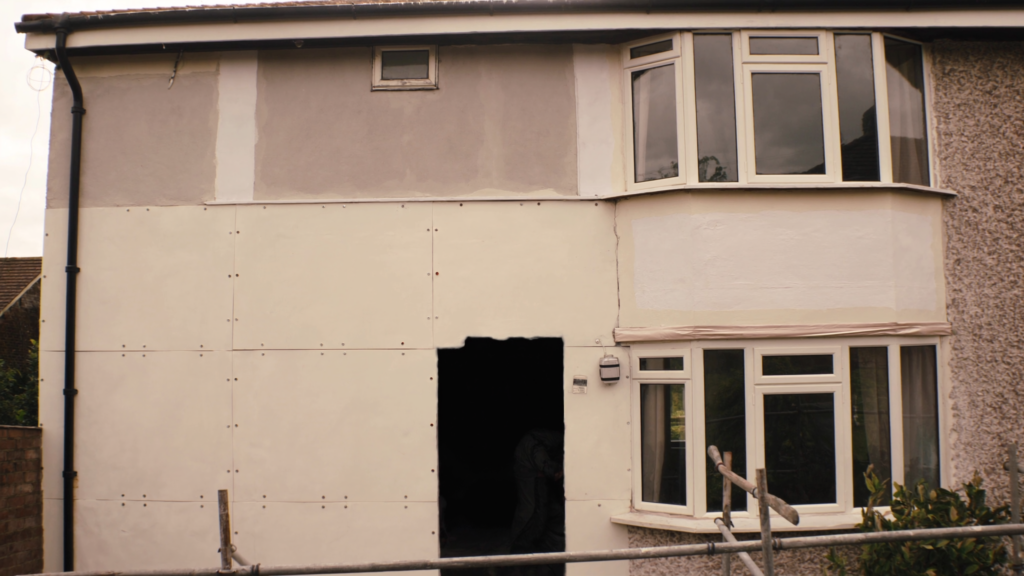
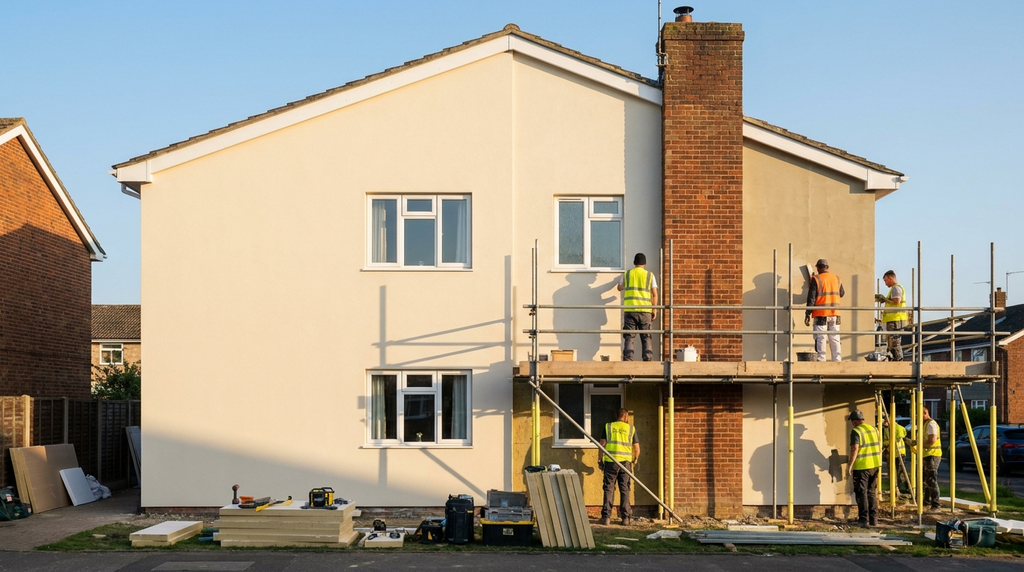
What you need to know about loft insulation
Loft insulation isn’t glamorous. There’s no rooftop solar gleam, no smart-thermostat app to scroll through. But for most British homes, especially anything built before the 1990s, it’s the single cheapest move you can make to stop heat escaping through the roof. The Great British Insulation Scheme closed on 31 March 2026. It funded insulation measures only and never covered windows or glazing. The job is done in a morning. The savings, around £350 a year, start the day it’s laid. This guide walks through depth, materials, the pitfalls installers gloss over, and how to spot a bad quote.
When loft insulation is worth it
- Your current insulation is below 120mm. Any top-up to 270mm will deliver significant savings, as heat loss through the roof is one of the largest energy drains in a home.
- You have a cold loft. If the loft space is unheated and unoccupied, mineral wool or sheep’s wool insulation laid between and over the joists is straightforward and highly cost-effective.
- You are eligible for free installation. The Great British Insulation Scheme closed on 31 March 2026. It funded insulation measures only and never covered windows or glazing.
- Your energy bills are rising. With the energy price cap fluctuating, loft insulation offers a one-time fix that locks in lower heating demand year after year.
- You are planning other loft work. If you are boarding the loft or adding a roof light, insulating first avoids disturbing the insulation later and saves on labour.
When it might not be
- Your loft is already at 270mm. Adding more insulation past this point yields diminishing returns and may cause condensation issues if ventilation is poor.
- You have a warm roof construction. In homes where insulation sits above the rafters (common in dormer bungalows or converted lofts), adding insulation to the floor is counterproductive.
- You are planning a loft conversion. Insulating the floor now will have to be removed when the loft is converted; it is better to insulate the roof slope at conversion stage.
- There is unresolved damp or rodent activity. Insulating over damp patches or mouse droppings traps moisture and pests, leading to rot and health risks. These issues must be fixed first.
The sections below cover the costs by property type, the 2026 building regulations that apply, and the grants and schemes available to reduce or eliminate the upfront cost.
How loft insulation works
Loft insulation is a layer of material installed in the space between your home’s top-floor ceiling and the roof. Its job is to slow the movement of heat out of your living space. Because warm air rises, the loft is the single largest area of heat loss in an uninsulated home. By trapping air within its fibres or foam structure, insulation creates a barrier that reduces the rate at which heat escapes through the ceiling. This keeps your home warmer in winter and cooler in summer, and lowers your energy bills throughout the year.
Key components and sub-systems
| Component | Function | Why it matters |
|---|---|---|
| Insulation material (mineral wool, sheep’s wool, cellulose, PIR boards) | Traps air pockets to resist heat flow | The material’s thickness and density determine its thermal performance, measured by U-value (Energy Saving Trust) |
| Vapour control layer (VCL) | Prevents warm, moist indoor air reaching the insulation | Without a VCL, condensation can form inside the insulation, reducing its effectiveness and causing damp (gov.uk) |
| Ventilation gaps (eaves, soffits, ridge vents) | Allows airflow above the insulation to remove moisture | Blocking vents can cause timber rot and mould; maintaining airflow is critical for building health (gov.uk) |
| Insulation supports (joist spacers, netting) | Keeps insulation in place and prevents sagging | Gaps or compression reduce performance; proper installation ensures the full design U-value is achieved |
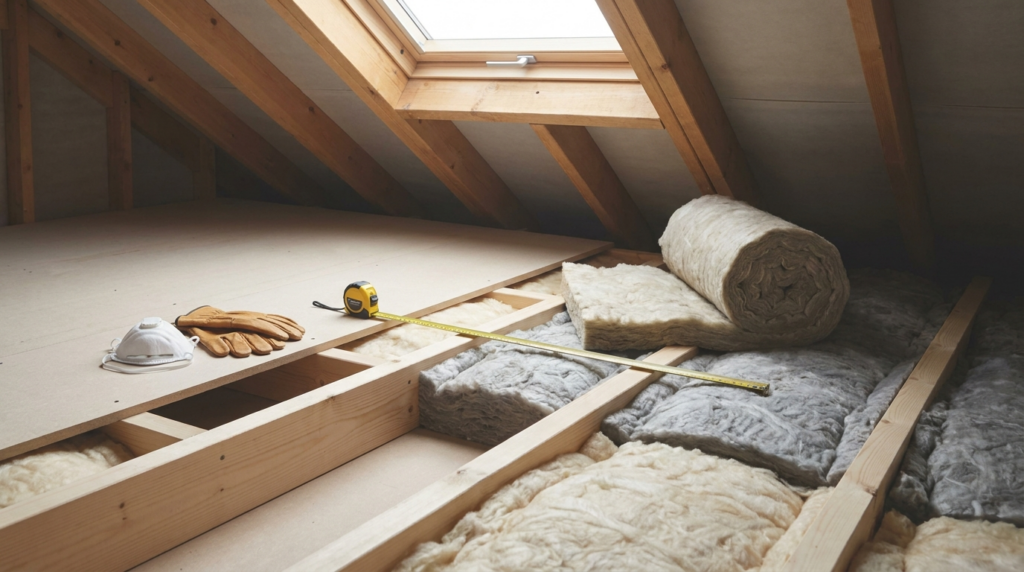
| Boarding (chipboard or OSB over raised legs) | Provides a walkable storage platform above the insulation | Compressing insulation reduces its thickness and thermal performance; raised legs preserve the insulation layer (Energy Saving Trust) |
Critical performance principles in plain English
Thickness is the main driver. For mineral wool, the current Building Regulations minimum is 270mm (laid across the ceiling joists). At 100mm, you lose around 25% of your heat through the roof; at 270mm, that drops to under 5% (gov.uk).
Gaps destroy performance. Even a 5% gap in coverage can reduce the overall effectiveness by 20% or more. Insulation must be continuous, with no gaps between pieces or around pipes, cables, and loft hatches (Energy Saving Trust).
Compression is the enemy. If you place storage boards directly on top of insulation, you squash it. Squashed insulation holds less trapped air and performs far worse. Always use raised legs or a loft-storage system that keeps the insulation uncompressed.
Moisture management is non-negotiable. Warm, moist air from the rooms below rises into the loft. If it meets a cold surface, it condenses. A vapour control layer on the warm side of the insulation, combined with eaves ventilation, stops this cycle. Never block loft vents (gov.uk).
Installation quality matters more than material choice. Properly fitted mineral wool at 270mm performs better than poorly fitted rigid boards. Use a certified installer through TrustMark or check that any DIY work follows the manufacturer’s instructions exactly.
How loft insulation compares to other insulation options
| Insulation type | Typical U-value (W/m²K) | Typical cost (3-bed semi, 2026) | UK regulatory minimum | Key trade-off |
|---|---|---|---|---|
| Loft insulation (mineral wool) |
Types of loft insulation and which suits your home
Choosing the right material for your loft insulation depends on your budget, the shape of your roof space, and whether you use the loft for storage. The four main types available in the UK are blanket roll, loose-fill, rigid board, and spray foam. Each has distinct characteristics, costs, and performance considerations.
Blanket roll (mineral wool)
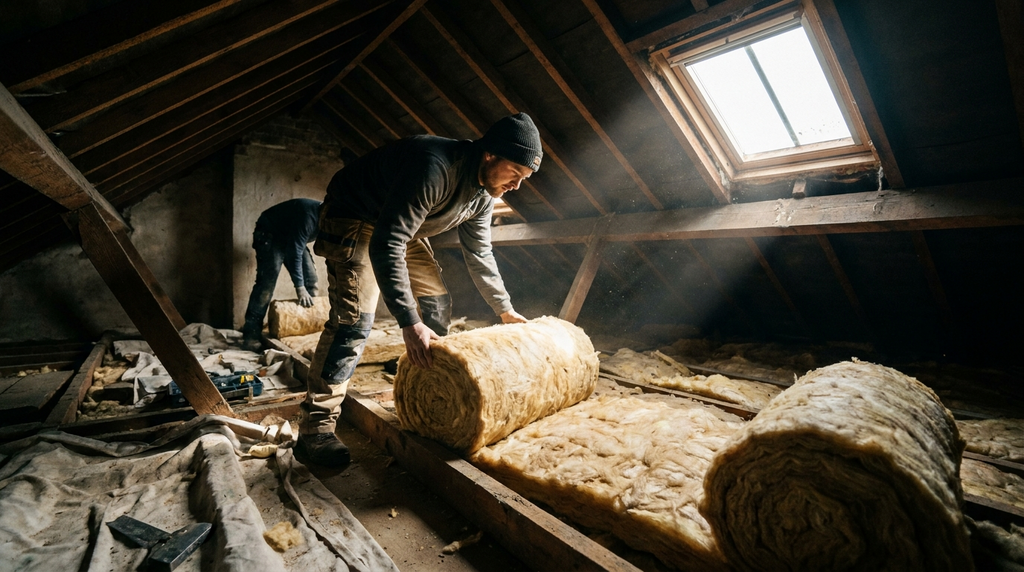
Blanket roll insulation is the most common type found in UK homes. It is made from mineral wool (glass fibre or rock wool) and comes in rolls that are laid between and over the ceiling joists. The material is soft, fibrous, and typically light pink or yellow. It works by trapping air in thousands of tiny pockets, slowing the transfer of heat through your ceiling.
Pros
- Low cost and widely available from builders’ merchants and DIY stores
- Easy to install yourself if you can access the loft safely
- Non-combustible and does not promote fire spread
- Can be topped up easily if you already have some insulation
Cons
- Itches skin and irritates lungs during installation, you need gloves, a mask, and long sleeves
- Compresses over time if you walk on it or store items on top, reducing performance
- Not suitable for lofts with damp issues as it absorbs moisture and loses effectiveness
Typical cost for a 3-bed semi to 270mm depth is £500–£1,200 (Energy Saving Trust). Lifespan is 30–40 years if kept dry. Best for simple, rectangular lofts with no damp problems and where you do not need the space for storage.
Loose-fill (cellulose, EPS bead)
Loose-fill insulation is made from small particles of material that are blown into the loft space using a machine. The two most common types are cellulose (recycled newspaper treated with fire retardant) and EPS beads (expanded polystyrene). It settles between and over the joists, creating a continuous layer without gaps.
Pros
- Fills awkward spaces around pipes, wires, and tight corners more easily than rolls
- Cellulose has good soundproofing qualities and a low carbon footprint
- Professional installation is quick, usually a few hours for a typical home
Cons
- Cannot be installed as a DIY job, you need a specialist contractor with blowing equipment
- EPS beads can settle and leave gaps over time, reducing performance
- Difficult to remove later if you need to rewire or access the ceiling below
Typical cost for a 3-bed semi is £600–£1,200 (Energy Saving Trust). Lifespan is 20–30 years. Best for lofts with irregular joist spacing, many obstructions, or where you want a smooth blanket without manual fitting.
Rigid board (for warm-roof retrofits)
Rigid board insulation is made from materials such as PIR (polyisocyanurate), XPS (extruded polystyrene), or phenolic foam. It comes in rigid sheets that are cut to size and fitted between rafters or above them. This is the standard method for a “warm roof”, where the insulation sits above the roof deck rather than between the ceiling joists, keeping the loft space itself warm.
Pros
- Very high thermal performance per thickness, you need less depth than mineral wool
- Allows you to use the loft as a habitable room or storage area without insulation underfoot
- Moisture-resistant and does not sag or settle over time
Cons
- More expensive than blanket roll or loose-fill
- Requires careful cutting and fitting to avoid thermal bridging at the edges
- Usually needs professional installation, especially for a warm-roof retrofit
Typical cost for a 3-bed semi warm-roof retrofit is £2,000–£4,000 (Energy Saving Trust). Lifespan is 40–50 years. Best for homes where you want to convert the loft into a room, or where your roof has limited space for deep insulation.
Spray foam (controversial)
Spray foam insulation is a liquid that expands into a rigid foam when applied. It is sprayed directly onto the underside of the roof deck (between rafters) or onto the loft floor. The two main types are open-cell (softer, breathable) and closed-cell (harder, waterproof). It creates an airtight seal that fills every gap.
Pros
- Excellent air-sealing performance, reduces draughts and heat loss significantly
- Adds structural rigidity to the roof if applied to the underside of tiles
- Can be applied in difficult-to-reach areas where other insulation cannot fit
Cons

loft insulation cost, UK 2026 pricing
Understanding what loft insulation costs in 2026 requires separating material prices from installation labour, property size, and regional rates. The figures below draw on published data from the Energy Saving Trust and industry installer surveys. All prices exclude VAT unless stated.
Per-unit cost matrix by insulation type
| Insulation type | Typical material cost per m² | Typical installed cost per m² | Best suited for |
|---|---|---|---|
| Mineral wool blanket roll | £4–£8 | £10–£20 | Standard joisted lofts, DIY-friendly |
| Loose-fill cellulose | £6–£12 | £15–£25 | Irregular joist spacing, top-up jobs |
| EPS bead loose-fill | £8–£15 | £18–£30 | Hard-to-access cavities, flat roofs |
| Rigid PIR board (warm roof) | £15–£30 | £35–£60 | Roof rooms, vaulted ceilings, cold-roof conversions |
| Spray foam (polyurethane) | £25–£50 | £50–£90 | Air sealing plus insulation; mortgage-lender restrictions apply |
Sources: Energy Saving Trust, gov.uk.
Whole-property cost guide by property size
For a standard loft insulation job taking existing insulation to 270mm depth, typical 2026 costs are:
- Flat or small 1-bed apartment: £200–£500. Loft access may be limited; blanket roll is the most common choice.
- 2-bed terrace: £300–£700. Usually straightforward with standard joist spacing.
- 3-bed semi-detached: £500–£1,200. The most-quoted job; mineral wool or loose-fill are typical.
- 4-bed detached: £900–£1,800. Larger loft area may require structural boarding for storage.
- Period property (pre-1919): £1,200–£2,500. Premium applies due to non-standard joist depths, breathability requirements, and listed-building consent where applicable (gov.uk).
Regional UK pricing for a typical 3-bed semi loft
| Region | Typical cost (3-bed semi, 270mm) | Notes |
|---|---|---|
| London | £800–£1,500 | Higher labour rates; travel charges for installers |
| South East | £700–£1,300 | Similar to London but slightly lower overheads |
| South West | £600–£1,100 | Moderate labour costs; rural travel surcharge possible |
| North West | £500–£950 | Lower labour rates; strong ECO4 installer presence |
| North East | £450–£850 | Among the lowest national rates |
| Midlands | £500–£1,000 | Broad range reflecting urban vs rural split |
| Scotland | £550–£1,050 | Warmer Homes Scotland scheme may reduce costs |
| Wales | £500–£950 | Nest scheme provides free insulation for eligible households |
| Northern Ireland | £450–£900 | Lower labour costs; fewer installers in rural areas |
Source: TrustMark installer data; Ofgem regional cost indices.
Hidden costs to budget for
| Item | Typical cost | When it applies |
|---|---|---|
| Scaffolding (if loft hatch inaccessible from inside) | £300–£800 | Tall buildings, no internal loft ladder, dormer work |
| Structural alteration (joist strengthening, new loft hatch) | £200–£1,500 | If existing hatch too small or joists need sistering for storage |
| Asbestos testing and removal (pre-2000 properties) | £150–£500 test; £500–£3,000 removal | Artex coating, old pipe lagging, vermiculite insulation |
| Removal of existing insulation (old fibreglass, rodent-damaged material) | £300–£800 | If existing insulation is wet, contaminated, or incorrectly installed |
| Plastering and redecorating (around loft hatch, light fittings) | £100–£400 | If access panel is enlarged or ceiling cracks appear |
| Certification / Building Regulations fee (warm roof conversion) | £150–£500 | Only if converting to a habitable room or changing roof construction |
| VAT at 20% (most installers) | Add 20% to labour + materials | Unless installer is VAT-registered and offers reduced rate for energy-saving materials under the 5% scheme (limited to certain circumstances) |
Sources: HMRC VAT guidance, Energy Saving Trust.
The 3-quote rule for cost comparison
Always obtain at least three written quotes from TrustMark-registered or MCS-certified installers before proceeding. This allows you to compare total cost, material specification, depth guarantee,
Performance, savings and payback
Loft insulation performance is measured by how much heat it stops escaping through your roof. The key metric is the annual heat loss saving, expressed in kilowatt-hours per year (kWh/year). For a previously uninsulated loft in a typical three-bedroom semi-detached house, the Energy Saving Trust estimates you can save roughly 2,500–3,500 kWh per year, equivalent to about £200–£300 off your annual heating bill at 2026 prices. The current UK recommendation is 270mm of mineral wool or equivalent material. If your loft has only 100mm, that is below modern best practice and will lose significantly more heat than a fully topped-up installation.
Annual energy and cost savings
The table below shows typical annual savings for different property types, based on Energy Saving Trust modelling. All figures assume the loft had no insulation before installation and that heating is gas-fired at an average unit rate of 7p/kWh (2026 price cap level, Ofgem).
| Property type | Annual kWh saved | Annual £ saved |
|---|---|---|
| Mid-terrace house | 1,800–2,500 kWh | £125–£175 |
| 3-bed semi-detached | 2,500–3,500 kWh | £175–£245 |
| 4-bed detached house | 3,500–5,000 kWh | £245–£350 |
A 4-bed detached house with no loft insulation could save up to £350 per year. Even a small mid-terrace home saves around £125–£175 annually. These savings are based on gas central heating; homes using electric heating or heat pumps save more because electricity costs more per kWh.
Payback period by location and property type
Payback is the time it takes for annual savings to cover the installation cost. The table below uses typical 2026 installation costs for a top-up to 270mm (strip and replace only if existing insulation is damaged or insufficient). Costs come from the Energy Saving Trust and gov.uk guidance.
| Property and location | Install cost (£) | Annual saving (£) | Payback (years) |
|---|---|---|---|
| 3-bed semi, Manchester | £600 | £210 | 2.9 |
| 4-bed detached, Edinburgh | £1,200 | £300 | 4.0 |
| Mid-terrace, Bristol | £400 | £150 | 2.7 |
Payback periods range from under three years for smaller homes to around four years for larger detached houses. If your loft already has 100mm of insulation and you only need a top-up to 270mm, the cost drops to £300–£700, and payback falls to 1.5–3 years. These figures assume you pay a professional installer; DIY installation can cut costs by roughly half, reducing payback further.
EPC band improvement potential
Adding 270mm of loft insulation can lift your Energy Performance Certificate (EPC) rating by one or two bands. A typical 3-bed semi with an EPC band of D might move to a C. A property starting at band E could reach a D. The exact improvement depends on other factors like wall insulation and heating system, but loft insulation is one of the cheapest ways to improve your EPC score. The Great British Insulation Scheme closed on 31 March 2026. It funded insulation measures only and never covered windows or glazing.
When loft insulation does not pay back fast
Loft insulation is not always a quick win. In these situations, payback can be much longer:
- Already insulated to 150mm or more. Adding a top-up from 150mm to 270mm saves only about £30–£50 per year, so payback stretches to 10–15 years.
- Electric heating only. Although the kWh saving is similar, electricity costs roughly 3x gas per kWh, so the £ saving is higher, but the installation cost is the same, so payback is still under 5 years. This is still good, but not as dramatic as gas savings.</
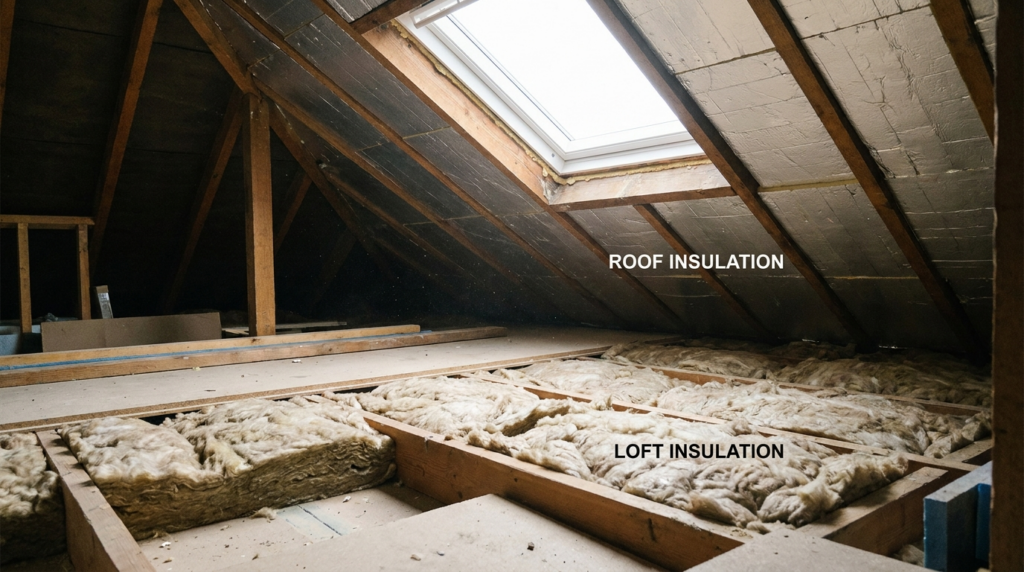
Spray foam loft insulation, the mortgage warning
Spray foam insulation applied directly to the underside of a roof can cause serious problems for homeowners. Many lenders now refuse mortgages on properties with spray foam, and removal can cost thousands. This section explains the risks and why most homeowners should avoid spray foam in lofts.
Open-cell vs closed-cell spray foam
The two types of spray foam behave differently, but both carry risks in a loft space.
| Type | Density | Vapour permeability | Key risk in lofts |
|---|---|---|---|
| Open-cell | Lower (8–12 kg/m³) | Allows moisture to pass through | Can trap moisture if not perfectly sealed; still obscures roof structure |
| Closed-cell | Higher (30–40 kg/m³) | Acts as a vapour barrier | Traps moisture against roof timbers, causing rot; very difficult to remove |
Both types conceal the roof structure from inspection. This is the core problem: surveyors cannot see the condition of rafters, battens, or sarking felt beneath the foam (gov.uk).
Mortgage lender treatment of spray foam
Since 2022, most UK mortgage lenders have refused to lend on properties where spray foam insulation is present in the roof space. This is because the foam hides structural defects and can accelerate timber decay. The legislation.gov.uk database records no statutory ban, but lender policy has hardened sharply. A 2024 gov.uk consumer warning confirmed that spray foam can “significantly reduce the value of a property” and make it unmortgageable.
Key lender positions (as of 2026):
- Nationwide, Barclays, HSBC, Lloyds, Santander, all require spray foam removal before lending, or demand a specialist surveyor report confirming no damage
- Most buy-to-let lenders automatically decline
- Remortgage applications are often rejected if spray foam is noted on the survey
A 2023 legislation.gov.uk-referenced industry briefing from UK Finance (the trade body for lenders) stated that spray foam “poses an unacceptable risk to property condition and valuation” and recommended that members treat it as a material defect.
RICS recommendations on inspection
The Royal Institution of Chartered Surveyors (RICS) advises that any property with spray foam insulation must have a full intrusive inspection before a mortgage valuation can proceed. This means the surveyor must physically cut into the foam to examine
Loft condensation and ventilation
Insulating your loft floor changes the temperature of the space above it. In a cold loft, where insulation sits between the ceiling joists and the loft space remains unheated, warm, moisture-laden air from your home rises through gaps in the ceiling. When this air hits the cold roof deck (the underside of the felt or tiles), water vapour condenses into liquid water. This can lead to damp insulation, rotting timber rafters, and mould growth (gov.uk).
Why you must not block eaves vents
Most modern roofs have ventilation gaps at the eaves, the point where the roof overhangs the wall. These gaps allow outside air to flow through the loft space, carrying away moisture before it can condense. After you install loft insulation, it is critical that you do not push the insulation material into these gaps. Blocking eaves ventilation can trap moisture, reduce the effectiveness of the insulation, and void warranties on roofing materials (Energy Saving Trust).
If your current insulation is already covering the eaves, you must fit rigid plastic baffles (also called ventilation trays) that hold the insulation back and maintain a clear air channel. These are inexpensive, typically £2 to £5 per unit, and can be fitted during the insulation top-up process.
Tile vents and ridge vents: when you need them
If your roof has no eaves ventilation, for example, on a flat-roofed extension or a house with sealed soffits, you may need alternative ventilation to prevent condensation. Approved Document F of the Building Regulations sets out minimum ventilation requirements for roofs (gov.uk). Two common solutions are:
| Vent type | How it works | Typical cost (per vent, fitted) |
|---|---|---|
| Tile vent | Replaces a standard roof tile with a ventilated tile that allows air to enter the loft space from below the tiles | £30–£80 |
| Ridge vent | Fitted along the roof ridge to let warm, moist air escape at the highest point |
Top-up vs full replacement, when each makes sense
Deciding whether to add new insulation over existing material or remove everything and start fresh depends on the condition of what is already in your loft. The wrong choice can waste money or leave your home under-insulated. The Energy Saving Trust recommends checking the condition of existing insulation before making a decision (Energy Saving Trust).
When topping up works
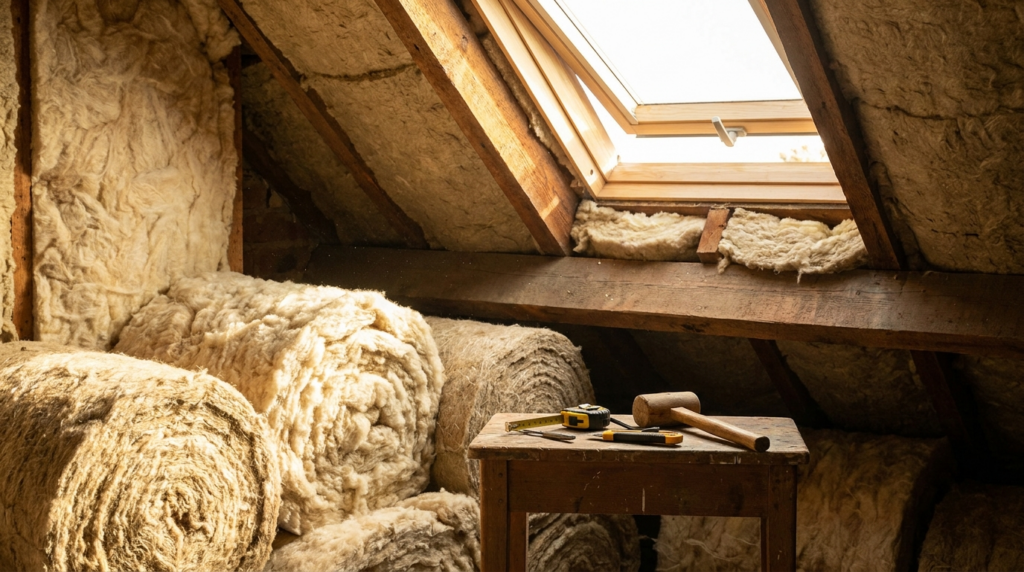
Topping up is suitable when the existing insulation is clean, dry, and evenly laid without gaps. The material should be free from mould, pest droppings, or signs of damp. If your current insulation is in good condition but only 100mm deep, adding another 170mm to reach the recommended 270mm can be a cost-effective option (Energy Saving Trust). Typical top-up costs for a three-bed semi-detached house range from £500 to £900.
When full removal is needed
Full removal and replacement becomes necessary if the existing insulation is contaminated. Common problems include:
- Rodent contamination, droppings, urine, or nesting material can pose health risks and reduce effectiveness
- Water damage, soaked insulation loses its thermal performance and can promote mould growth
- Asbestos, properties built before 2000 may have insulation containing asbestos, which requires specialist removal (gov.uk)
- Compressed or degraded material, old insulation that has settled or been disturbed no longer traps air effectively
Full strip-and-relay for a three-bed semi typically costs £1,500 to £2,500. This includes removing the old material, disposing of it properly, and installing new insulation to the full 270mm depth.
Cost comparison
UK regulations, country by country
Loft insulation regulations differ across England, Scotland, Wales and Northern Ireland. If you are adding, replacing or topping up loft insulation in a new build or as part of a retrofit project, the rules that apply depend on where you live. The table below summarises the key documents and requirements for each nation.
| Nation | Document / regulation | Key requirement for loft insulation | Source URL |
|---|---|---|---|
| England | Approved Document L (2021 edition) | New pitched roofs: target U-value 0.16 W/m²K for insulation at ceiling level | gov.uk |
| Scotland | Scottish Building Standards Technical Handbook (Section 6: Energy) | New dwellings: maximum U-value 0.16 W/m²K for roof insulation at ceiling level | legislation.gov.uk |
| Wales | Welsh Building Regulations Approved Document L (2014 edition, as amended) | New roofs: target U-value 0.16 W/m²K for insulation at ceiling level | gov.wales |
| Northern Ireland | Technical Booklet F1 (Conservation of fuel and power, 2022 edition) | New roofs: maximum U-value 0.16 W/m²K for insulation at ceiling level | finance-ni.gov.uk |
Note: U-values measure how quickly heat passes through a material. Lower numbers mean better insulation. The 0.16 W/m²K target applies to new-build or replacement insulation at ceiling level, not to existing insulation you are simply topping up.
Approved Document L (England): what it means for your home
Approved Document L sets the minimum energy performance standards for new buildings and major renovations in England. For loft insulation, the key figure is the target U-value of 0.16 W/m²K for a new pitched roof insulated at ceiling level (gov.uk). This typically requires 270 mm to 300 mm of mineral wool or equivalent material.
If you are building an extension with a pitched roof, or converting a loft into a habitable room, the insulation must meet this standard. For existing homes, topping up insulation from 100 mm to 270 mm is not a legal requirement, but it will improve your home’s energy performance certificate rating and reduce heating costs.
PAS 2035: the retrofit standard for grant-funded work
If you are having loft insulation installed through a government scheme such as ECO4 or the Great British Insulation Scheme, the work must follow PAS 2035:2019. This is the specification for the energy retrofit of domestic buildings (gov.uk).
PAS 2035 requires a whole-dwelling assessment before any insulation is fitted. A retrofit assessor will inspect your loft for damp, ventilation and existing insulation condition. If the assessment finds problems, such as condensation risk or rodent damage, the installer must address these before adding insulation.
For homeowners, this means you cannot simply book a free loft insulation top-up without an assessment. The installer must produce a room-by-room plan that ensures the insulation does not create moisture problems. This is a legal condition of ECO4 and GBIS grants, not optional.
Upcoming standards: Future Homes Standard and New Build Heat Standard
The Future Homes Standard applies to new homes in England from 2025. It requires a 75-80% reduction in carbon emissions compared to current Building Regulations (gov.uk). For loft insulation, this means U-values will likely drop further, possibly to 0.11 W/m²K or lower, to compensate for the removal of gas boilers in new builds.
In Scotland, the New Build Heat Standard came into effect in April 2024. It bans fossil fuel heating systems in new homes and requires very high fabric efficiency (legislation.gov.uk). While the loft insulation U-value target remains 0.16 W/m²K, the overall fabric standard is tighter, so insulation thickness may need to increase to meet the total dwelling emission rate.
Neither standard directly affects existing homes. However, if you are planning
Planning permission for loft insulation
Loft insulation is one of the least complicated home improvements for planning rules. In most cases, adding insulation to your loft floor or between rafters is classified as permitted development, meaning you do not need to apply for planning permission. This applies whether you are laying mineral wool rolls, fitting rigid boards, or having spray foam applied. The key exception is if the work changes the use of the loft into a habitable room, which is a loft conversion and falls under different rules (Planning Portal).
When you do need planning permission
You must check whether your property is subject to any restrictions that remove permitted development rights. You will need to apply for planning permission in the following situations:
- Listed buildings, any internal or external alteration to a listed building, including adding insulation, requires listed building consent (gov.uk).
- Conservation areas, permitted development rights are more restricted, particularly for any external changes such as roof tile alterations or new roof windows needed for insulation access.
- Article 4 directions, your local authority may have removed specific permitted development rights from your property or street (gov.uk).
- National Parks, Areas of Outstanding Natural Beauty (AONB), and World Heritage Sites, tighter controls apply to roof alterations in these protected landscapes.
- Flats and maisonettes, permitted development rights for flats are very limited; you will almost always need planning permission for any roof work.
Specific complications for loft insulation
Even when insulation alone is permitted development, associated work can trigger planning requirements. If you are installing an air source heat pump alongside loft insulation, the heat pump must meet permitted development siting rules: it must be at least one metre from the property boundary and not be positioned within one metre of a highway. In conservation areas, heat pumps cannot be fitted on a roof slope facing a road (gov.uk).
Solar panels on the roof, sometimes combined with insulation upgrades, also face restrictions in conservation areas and World Heritage Sites, where panels on the principal roof slope visible from a road are typically not permitted. For listed buildings, adding insulation can alter the internal roof structure and affect historic fabric, even the vapour permeability of spray foam has caused concern with conservation officers in the past. You must also check whether your roof has existing felt or battens that need replacing, as this can change the external appearance and trigger consent requirements.
Five-step planning check for loft insulation
- Check your property type, is it a house (permitted development likely) or a flat/maisonette (permission almost always needed)?
- Check your location, use the government postcode tool to see if you are in a conservation area, National Park, AONB, or World Heritage Site (gov.uk).
- Check for listed status, search the National Heritage List for England to confirm whether your building is listed.
- Check for Article 4 directions, contact your local planning authority and ask whether any Article 4 directions apply to your property.
- Check associated works, if you are also installing a heat pump, solar panels, or roof windows for access, confirm these are permitted development separately.
Cost of getting it wrong
If you carry out work that requires planning permission without obtaining it, your local authority can issue an enforcement notice requiring you to undo the work. Unauthorised alterations to a listed building can lead to prosecution and a fine, and the council can force you to restore the building to its original condition at your own expense. Typical enforcement action for loft insulation breaches is rare but can be costly if you have also made external changes
Installer certification and finding the right one
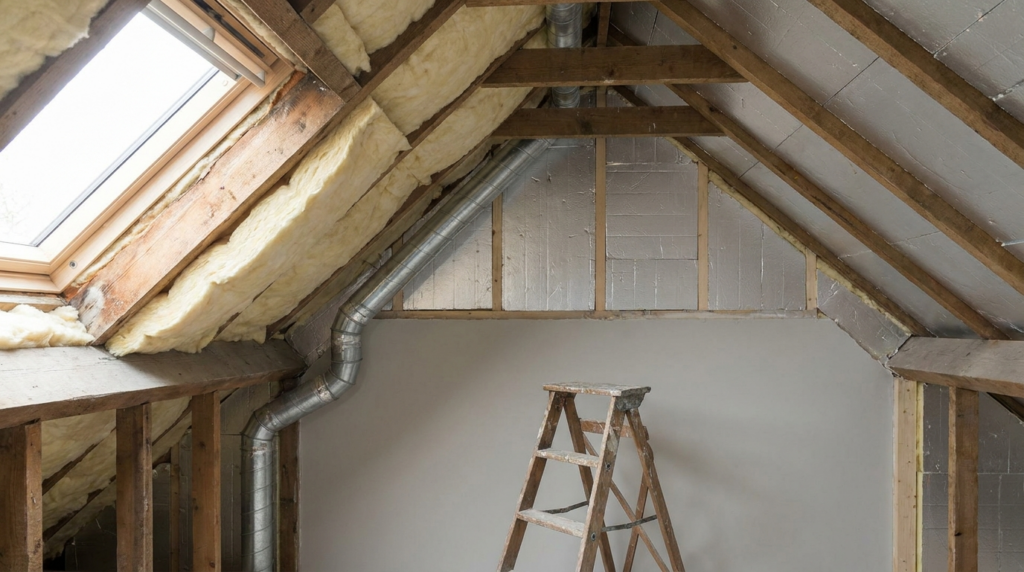
Using a certified installer for loft insulation is a quality marker, and it can determine whether your work complies with Building Regulations and whether you qualify for grant funding. If you install loft insulation without proper certification, you may struggle to prove compliance when selling your home (gov.uk). Many grant schemes, including the Great British Insulation Scheme, require the installer to be registered with a recognised certification body (gov.uk). Without a Compliance Certificate from a certified installer, your home insurance could also be affected if the insulation later causes damage, such as condensation or roof timber rot.
Comparison of certification schemes for loft insulation
| Scheme | Run by | What it certifies | Issues a Certificate of Compliance | Source URL |
|---|---|---|---|---|
| National Insulation Association (NIA) | NIA | Member companies meet quality standards, use approved products, and follow industry codes of practice | Yes, through member installers | energysavingtrust.org.uk |
| PAS 2030 | UKAS-accredited certification bodies (e.g., BSI, BRE Global) | Individual installer competence and installation processes meet the Publicly Available Specification for retrofit | Yes, via the certification body | gov.uk |
| TrustMark | TrustMark (government-endorsed scheme) | Overall trader competence, customer service, and compliance with Trading Standards | Yes, for qualifying work | trustmark.org.uk |
| BBA-approved products | British Board of Agrément | Specific insulation products meet performance standards (not installers) | No, product only | gov.uk |
For loft insulation, the most common requirement is that the installer holds PAS 2030 certification and is registered with TrustMark. This combination is mandatory for ECO4 and Great British Insulation Scheme installations (ofgem.gov.uk). NIA membership is additional quality assurance, particularly for specifying the correct insulation thickness and ventilation.
The three-quote rule: what to compare
Getting at least three written quotes from certified installers is standard practice. When comparing them, check these specific details:
- Price, total cost including VAT, removal of old insulation if needed, and any skip hire
- Specification, exact insulation material (mineral wool, sheep’s wool, or rigid board), target thickness (usually 270mm for mineral wool), and any vapour control layer
- Performance metric, the target U-value (typically 0.16 W/m²K for loft insulation in a 2026 new-build standard, though existing homes may aim for 0.20 W/m²K)
- Certification number, the installer’s PAS 2030 or TrustMark registration number, which you can verify online
- Payment terms, deposit amount (should be no more than 25%), stage payments, and final payment on completion
- Guarantee, length of the insurance-backed guarantee (typically 10-25 years) and what it covers
Ask each installer to provide their certification number in writing. You can check TrustMark registration at trustmark.org.uk and PAS 2030 certification via the relevant UKAS-accredited body.
Red flags
- High-pressure same-day pricing, any offer that expires within 24 hours, especially if the installer insists on starting work immediately
- <strong
Grants and funding for loft insulation in 2026
Several UK government schemes cover the full or partial cost of loft insulation in 2026. Eligibility depends on your income, your home’s Energy Performance Certificate (EPC) rating, and where you live. The table below summarises the main options. None of these schemes require you to repay the grant.
| Scheme | Region | Eligible for loft insulation? | Typical max grant | How to apply | Source URL |
|---|---|---|---|---|---|
| Energy Company Obligation (ECO4) | England, Scotland, Wales | Yes – full cost covered for low-income households or homes with EPC E, F or G | Full cost (typical £500–£1,200 for 3-bed semi) | Contact your energy supplier; they arrange a survey and installation | ofgem.gov.uk |
| Great British Insulation Scheme (GBIS) | England, Scotland, Wales | Yes – full cost covered for homes with EPC D–G (no income test) | Full cost (typical £500–£1,200 for 3-bed semi) | Apply online at gov.uk/apply-great-british-insulation-scheme or via your energy supplier | gov.uk |
| Boiler Upgrade Scheme (BUS) | England, Wales | No – covers heat pumps and biomass boilers only | Not applicable | Not applicable | gov.uk |
| Home Energy Scotland (HES) Loan | Scotland | Yes – interest-free loan for loft insulation (can be combined with grant for fuel-poor households) | Loan up to £10,000 per property; grant up to 75% for eligible households | Apply via homeenergyscotland.org | homeenergyscotland.org |
| Warmer Homes Scotland | Scotland | Yes – full cost covered for fuel-poor households (income-based) | Full cost (typical £500–£1,200 for 3-bed semi) | Apply via warmerhomesscotland.com | warmerhomesscotland.com |
| Nest (Welsh Government Warm Homes) | Wales | Yes – full cost covered for fuel-poor households (income-based) | Full cost (typical £500–£1,200 for 3-bed semi) | Apply via nest.gov.wales | nest.gov.wales |
| NI Sustainable Energy Programme (Affordable Warmth) | Northern Ireland | Yes – grant up to 75% of cost for low-income households | Up to £1,000 per measure | Apply via local council or nidirect.gov.uk | nidirect.gov.uk |
VAT on energy-saving materials in 2026
Loft insulation installed by a registered tradesperson is zero-rated for VAT in England, Scotland, Wales and Northern Ireland. This is a permanent relief under HMRC Notice 708/6 (gov.uk). The zero rate covers the insulation material itself and the labour. It applies only if the installer is VAT-registered and the installation is in a home that is at least two years old. If you buy the insulation and fit it yourself, you pay 20% VAT on the materials.
Listed buildings VAT
If your home is listed, like-for-like replacement loft insulation may qualify for a zero rate of VAT, provided the work is carried out by a VAT-registered builder and meets the conditions set out in HMRC Notice 708/6 (<a href="https://www.gov.uk/guidance/
The buying process, survey to install
- Initial research, confirm what you need
Start by checking your current loft insulation depth using a tape measure at the hatch. The recommended depth for mineral wool is 270 mm (about 11 inches) (Energy Saving Trust). If you have less than 100 mm, topping up to 270 mm will make the biggest difference. For rigid board or spray foam, look for a thermal conductivity (lambda value) of 0.022–0.028 W/mK and a U-value target of 0.16 W/m²K or lower. All products should carry BBA (British Board of Agrément) certification or equivalent UKAS-accredited approval. Check that your installer is certified to PAS 2030:2019 and registered with TrustMark, these are requirements for government-funded schemes and good practice for private work (TrustMark). - Get three quotes from certified installers
Use the National Insulation Association (NIA) installer finder, TrustMark’s tradesperson search, or the MCS database for spray foam systems (MCS Certified). Ask each installer for proof of PAS 2030 certification, public liability insurance (minimum £2 million), and a list of recent local installations you can verify. Avoid any installer who cannot provide these credentials. The Great British Insulation Scheme closed on 31 March 2026. It funded insulation measures only and never covered windows or glazing. - Compare quotes on full specification, not just price
A low price often means thinner insulation, lower-grade material, or no air-sealing. Compare these details across quotes: product type and thickness, target U-value, whether existing insulation is removed or topped up, air-tightness measures (e.g., sealing around pipes and loft hatch), ventilation provisions (eaves vents must not be blocked), and warranty length (typically 10–25 years). A quote that omits any of these is incomplete. Ask each installer to write the full specification into the quote. - Survey visit, what to expect
The installer will inspect your loft for: current insulation depth and condition, presence of damp or mould, rodent damage, electrical wiring (which must not be buried in insulation), and the condition of the water tank and pipes (which need insulation jackets). They will measure the loft area and check eaves ventilation. Ask them to point out any air leaks they find and explain how they will seal them. If they find asbestos-containing material (common in pre-1980s homes), they must stop work and you will need a licensed removal contractor, this is not a DIY job. - Contract, cooling-off period
Under the Consumer Contracts Regulations 2013, for contracts concluded away from business premises (e.g., at your home after a survey), you have a 14-day cooling-off period during which you can cancel without penalty (legislation.gov.uk). The contract must state this right clearly. If the installer starts work within those 14 days at your express request, you lose the right to cancel but must give written consent. Keep a copy of the signed contract and the cancellation notice. - Deposit, typically maximum 25%
A deposit of 10–25% of the total cost is standard for loft insulation. Never pay more than 25% upfront. Pay by credit card (if the total is over £100) for Section 75 protection, or by debit card for chargeback rights. Avoid cash or bank transfer to an individual’s account, these offer no consumer protection if the installer fails to complete the work. - Survey-to-install lead time
For private work, lead time is usually 2–6 weeks from survey to installation, depending on installer availability and product stock. The Great British Insulation Scheme closed on 31 March 2026. It funded insulation measures only and never covered windows or glazing. Ask for a confirmed installation date in writing at the survey stage. If the installer cannot give a date within 8 weeks, consider another quote. - Installation day, what to expect
The team will lay dust sheets in your hallway and loft hatch area. They will remove any existing insulation (if specified), vacuum debris, seal air leaks around pipes and joists, lay the new insulation to the agreed depth, and ensure eaves vents remain clear. For mineral wool, they should wear protective masks and gloves. The job typically takes 2–4 hours for a 3-bed semi. At the end, they should show you the finished work via a photo or video if you cannot access the loft yourself. - Sign-off and compliance certificate
After installation, the installer must provide a Building Regulations Compliance Certificate (if the work is notifiable, loft insulation to 270 mm is generally not notifiable unless you are changing the roof structure). For spray foam, you need an MCS certificate and a product
Maintenance, common problems and lifespan
Loft insulation requires minimal routine maintenance. The most important task is an annual visual check, ideally carried out in autumn before heating season begins. Look for signs of damp, mould, or pest activity. Clear any items stored on top of the insulation, as compression reduces its thermal performance. Ensure loft hatches close tightly and are draught-proofed. Check that pipe and tank insulation remains in place after any work in the loft.
If you have a cold-roof loft (insulation at ceiling level), check that eaves vents are not blocked by insulation material. Blocked vents can cause condensation and rot. For warm-roof lofts (insulation at rafter level), inspect the underside of the roof for any signs of moisture.
A more thorough inspection every three years, including checking for rodent droppings, nests, or torn insulation, is recommended. If you have had roofing work, solar panel installation, or electrical rewiring, inspect the insulation afterwards to ensure it has not been disturbed or compressed (Energy Saving Trust).
Common problems with diagnosis and likely solution
| Problem | Likely cause | Solution |
|---|---|---|
| Damp patches or mould on insulation | Condensation from poor ventilation, or a roof leak | Improve loft ventilation; repair any roof leak before replacing affected insulation |
| Compressed or flattened insulation | Heavy items stored on top, or foot traffic | Remove stored items; fluff up mineral wool or replace compressed sections |
| Rodent droppings or nesting material | Mice or rats accessing the loft | Seal entry points; remove contaminated insulation; lay new insulation after pest control |
| Gaps or bare patches | Previous DIY work or cable installation | Fill gaps with offcuts or new insulation rolls |
| Cold spots on ceilings below | Insulation moved or missing in specific areas | Inspect and top up to consistent depth |
If you suspect asbestos in older insulation (pre-2000 loose-fill vermiculite or similar), do not disturb it. Contact a licensed asbestos removal contractor (gov.uk).
Lifespan by type
Mineral wool (glass or rock fibre) and sheep’s wool insulation typically last 40 years or more if kept dry and undisturbed. Foam boards and spray foam have a shorter lifespan, around 20–30 years, and can degrade faster if exposed to moisture. Loose-fill cellulose (treated paper) lasts 30–40 years but may settle over time, reducing its effective depth. The Energy Saving Trust states that insulation does not deteriorate in performance over time as long as it stays dry and uncompressed (Energy Saving Trust).
When to repair vs replace
Repair when the damage is localised, for example, a single patch of rodent damage, a small damp area, or insulation that has been pushed aside for electrical work. Cut out the affected section and replace with new material of the same type and depth. Top-up costs for small areas typically run £50–£150.
More on loft insulation
- Loft Insulation Thickness, The UK Guidelines
- How much loft insulation do i need calculator?
- Loft Insulation Complete UK Buying Guide 2026
- How much attic insulation do i need?
- Loft Insulation Thickness UK Building Regs 2026
- Loft conversion insulation regulations 2026
- Loft vs Roof Insulation, Comparison (UK, 2026)
- Best Loft Insulation, Buyer Comparison (UK, 2026)