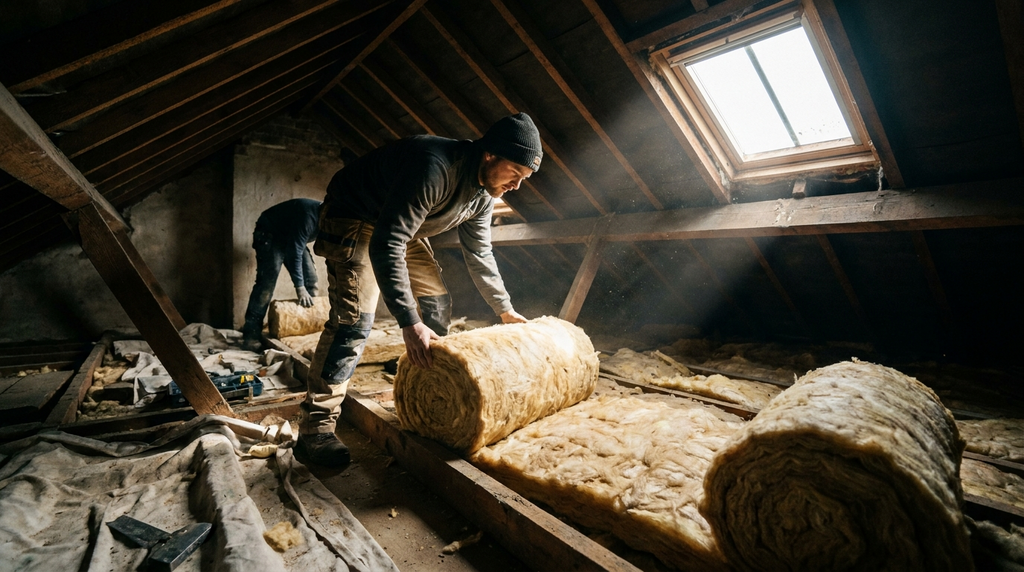
The recommended loft insulation thickness in the UK for 2026 is 270 mm, but this is a minimum, not a legal requirement for all homes
The most commonly cited figure for loft insulation thickness in 2026 is 270 mm. This depth refers specifically to mineral wool insulation and represents the point at which the Energy Saving Trust (EST) says further depth yields diminishing returns on energy savings (Energy Saving Trust, 2026). The 270 mm target is based on achieving a U-value of 0.16 W/m²K for the insulated area, which is the performance standard set out in Approved Document L of the Building Regulations (2021 edition, with 2023 amendments, enforceable in 2026) (GOV.UK Approved Document L, 2026).
For materials other than mineral wool, the required thickness to reach the same U-value will differ. Rigid PIR foam boards, for example, achieve the target at around 150–180 mm, while sheep’s wool and cellulose fibre typically need 250 mm. The regulatory target is the U-value, not the depth in millimetres. The 270 mm recommendation applies to both new installations and top-ups to existing insulation; topping up from a low depth to 270 mm is the most cost-effective approach for most homes (Energy Saving Trust, 2026).
Quick numbers loft insulation thickness, U-value targets, and cost savings for 2026
| Insulation type | Recommended thickness (mm) to achieve 0.16 W/m²K | Typical cost per m² (installed, 2026) | Annual saving on energy bills (detached house, 2026) |
|---|---|---|---|
| Mineral wool | 270 mm | £12–£18 | £180–£220 |
| Rigid PIR board | 150–180 mm | £25–£35 | £170–£210 |
| Sheep’s wool | 250 mm | £30–£45 | £160–£200 |
| Cellulose fibre | 250 mm | £20–£30 | £170–£210 |
Thickness figures are sourced from DESNZ technical guidance for 2026 (DESNZ, 2026). Cost and savings data are based on the EST typical house model for a detached property (Energy Saving Trust, 2026). Savings assume a gas-heated home; electric heating will yield higher savings.
The direct answer to “loft insulation thickness 2026” is 270 mm for mineral wool, but check your property’s specific U-value target
The most common thickness quoted for 2026 is 270 mm for mineral wool in a standard loft. However, this is a default figure for a typical home. For extensions, new builds, or loft conversions, the Building Regulations require a U-value of 0.16 W/m²K (GOV.UK Approved Document L, 2026). Achieving this U-value may need a different thickness if you use alternative materials. For existing homes (retrofit), the 270 mm is a best-practice recommendation, not a mandatory legal standard for the homeowner.
The only time thickness is legally enforced is when the loft insulation is part of building work, such as a loft conversion, or when applying for certain government grants. In those cases, the installer must meet the U-value target, and the thickness is a consequence of that target. If you are simply topping up existing insulation without any structural work, you are not legally required to reach 270 mm, though it is strongly advised for energy savings.
Eligibility for loft insulation grants in 2026 depends on your home’s energy performance and your income, not just the thickness
The Great British Insulation Scheme closed on 31 March 2026. It funded insulation measures only and never covered windows or glazing. For ECO4, you must be in receipt of certain benefits, such as Pension Credit or Universal Credit (Ofgem ECO4 rules, 2026). For GBIS, your home must have an EPC rating of D or below, and you do not need to be on benefits (GOV.UK Great British Insulation Scheme, 2026).
The grant covers the cost of upgrading insulation to the recommended thickness, usually 270 mm for mineral wool, but only if the home is eligible under the scheme’s criteria. There is no universal grant for loft insulation thickness; you must apply through a certified installer registered with Ofgem. The grant does not require you to achieve a specific thickness beyond the minimum needed to improve the property’s energy performance, but the installer will typically aim for 270 mm to maximise efficiency.
To confirm your installer is certified for loft insulation work, check for MCS or TrustMark registration
The Great British Insulation Scheme closed on 31 March 2026. It funded insulation measures only and never covered windows or glazing. For non-grant work, the installer does not legally need MCS, but TrustMark registration is recommended for consumer protection. MCS certification is only required if the job involves a renewable technology, such as insulation from natural fibres, or is part of a larger retrofit package (MCS, 2026).
Always verify the installer on the official MCS register or TrustMark website before paying a deposit. You can also check with Ofgem for authorised installers under the ECO4 or GBIS schemes. If you are paying privately, ask for references and confirm the installer’s insurance and guarantees. how to choose a loft insulation installer
How to measure your current loft insulation thickness to see if you need a top-up in 2026
Use a tape measure or ruler at several points across the loft floor. Insulation may settle over time. That makes it thinner than the original installation. If the current depth is less than 100 mm, a top-up to 270 mm is cost-effective and will pay back in energy savings within 2–3 years, according to EST data (Energy Saving Trust, 2026). If the depth is between 100 mm and 200 mm, a top-up is still recommended but the payback period is longer, typically 4–5 years.
If the depth exceeds 200 mm, the additional benefit of topping up to 270 mm is marginal and may not be worth the cost. EST states that the first 100 mm of insulation saves the most energy, with diminishing returns after that. Measure in multiple spots, as insulation depth can vary across the loft floor, especially near eaves or around pipes.
The thickness you need for a loft conversion in 2026 is different and must meet the building regulations for the roof structure
For a loft conversion, the insulation must be fitted between and over the rafters, not on the loft floor, to maintain habitable space. The Building Regulations require a U-value of 0.16 W/m²K for the roof, which typically means 150–200 mm of rigid PIR insulation between rafters plus 50 mm over them (GOV.UK Approved Document L, 2026). The thickness of the insulation will reduce the headroom in the converted room, so you must calculate the available space before starting.
A structural engineer or certified installer must confirm the thickness works with the roof pitch and joist depth. NHBC standards recommend a minimum of 100 mm of insulation between rafters and 50 mm over them for new conversions, but the 0.16 W/m²K target is the binding requirement (NHBC standards, 2026). If headroom is limited, you may need to use high-performance rigid boards to minimise thickness while meeting the U-value. loft conversion insulation requirements 2026
Frequently Asked Questions
The recommended thickness is 270 mm for mineral wool, according to the Energy Saving Trust. This depth achieves a U-value of 0.16 W/m²K as set out in Approved Document L (GOV.UK, 2026).
No, 270 mm is a recommendation, not a legal requirement for all homes. The Building Regulations (Approved Document L) set a U-value target of 0.16 W/m²K, so the thickness depends on the insulation material used (GOV.UK, 2026).
Mineral wool needs 270 mm, rigid PIR boards need 150–180 mm, and sheep’s wool or cellulose fibre need around 250 mm. The target is the U-value, not a fixed depth (DESNZ, 2026).
Mineral wool costs £12–£18 per m² installed, rigid PIR boards cost £25–£35, and sheep’s wool costs £30–£45. Cellulose fibre is £20–£30 per m² (Energy Saving Trust, 2026).
A detached house can save £180–£220 per year with mineral wool at 270 mm. Savings are similar for other materials, ranging from £160 to £210 (Energy Saving Trust, 2026).