The minimum loft insulation depth required by UK building regulations is 270mm
If you are planning a new build, a loft conversion, or significant roof work, you need to know the exact depth of insulation that meets current UK building regulations. The rules are set out in Approved Document L of the Building Regulations (2021 edition, amended 2025), which specifies a maximum U-value of 0.16 W/m²K for insulation at ceiling level (GOV.UK, Approved Document L, 2025).
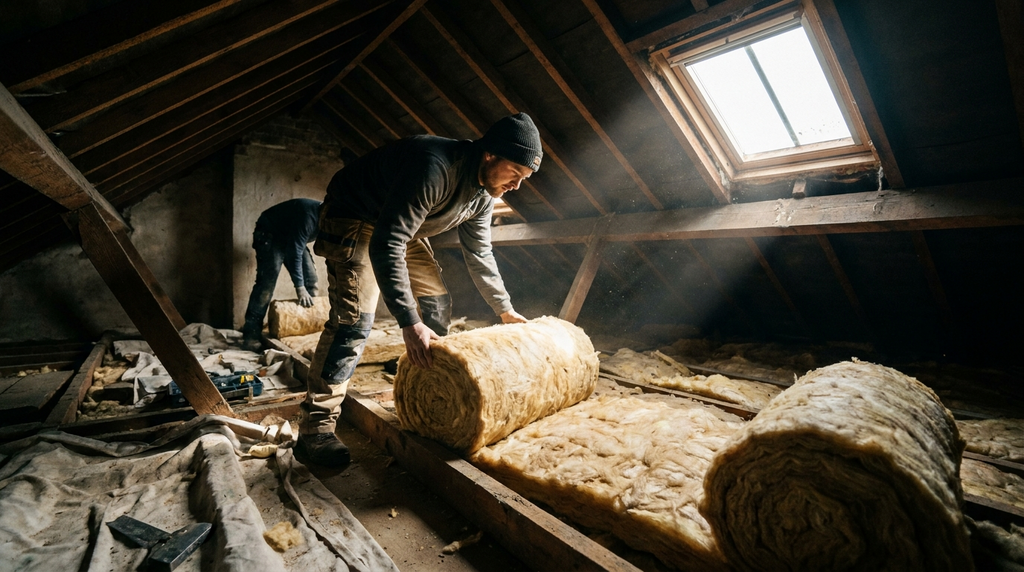
UK building regulations require at least 270mm of mineral wool loft insulation for new builds, extensions, and conversions to achieve a U-value of 0.16 W/m²K. Existing homes have no legal obligation to retrofit to this depth unless undertaking other alterations requiring building control approval.
- Minimum 270mm of mineral wool loft insulation required for new builds.
- Target U-value is 0.16 W/m²K under Approved Document L (2025).
- Existing homes have no legal obligation to retrofit to 270mm.
- Thickness varies by material lambda value, check product label.
- 2025 amendment raised depth from 250mm to 270mm for carbon targets.
- The minimum loft insulation depth required by UK building regulations is 270mm
- How the 270mm figure is calculated and why it changed from 250mm
- Quick numbers, depth, U-value, and cost comparison for common materials
- The direct answer to "how much loft insulation building regs", what you actually need to install
- How to verify your installer meets the correct certification standards
- When you must comply with the 270mm rule and when you can ignore it
- The cost implications of meeting or exceeding the 270mm standard
The direct answer is that you must install at least 270mm of mineral wool or fibreglass loft insulation to achieve this U-value. However, the exact thickness depends on the thermal conductivity (lambda value) of the material you choose, and the requirement applies only to new builds, extensions, and conversions, not to routine top-ups in existing homes.
For existing homes, the 270mm depth is the recognised standard for cost-effective energy efficiency, but there is no legal obligation to retrofit to this depth unless you are making other alterations requiring building control approval (Energy Saving Trust, 2026).
How the 270mm figure is calculated and why it changed from 250mm
The 2025 amendment to Approved Document L increased the recommended depth from 250mm to 270mm to meet tighter carbon reduction targets set by the Department for Energy Security and Net Zero (DESNZ, “Changes to Part L of the Building Regulations,” 2025). The calculation uses the formula R = thickness / lambda, where R is thermal resistance and lambda is the material’s conductivity (typically 0.044 W/mK for standard mineral wool).
To achieve the target U-value of 0.16 W/m²K, the total thermal resistance must be at least 6.25 m²K/W. For mineral wool with a lambda of 0.044 W/mK, this requires roughly 270mm of insulation. Homeowners should check the specific lambda value on the product label, as higher-performance materials (e.g., PIR rigid boards) may need less depth to meet the same U-value (BRE, 2026).
Quick numbers, depth, U-value, and cost comparison for common materials
| Material type | Typical depth for U-value 0.16 W/m²K | Approximate cost per m² (installed, 2026) | Source |
|---|---|---|---|
| Mineral wool (rolls) | 270mm | £12–£18 | EST, “Home Insulation Guide,” 2026 |
| Glass wool (batts) | 270mm | £14–£20 | EST, “Home Insulation Guide,” 2026 |
| Sheep’s wool (natural) | 280mm | £25–£35 | EST, “Home Insulation Guide,” 2026 |
| PIR rigid board | 150mm | £30–£45 | EST, “Home Insulation Guide,” 2026 |
All figures assume a standard pitched roof with 100mm joist depth, requiring over-rafter or counter-batten installation for deeper materials. Costs include labour for a professional installer; DIY costs are typically 40–50% lower (Energy Saving Trust, 2026).
What you actually need to install
For a new loft insulation installation in a home requiring Building Regulations compliance, you must achieve a U-value of 0.16 W/m²K or better. This means a minimum of 270mm of mineral wool (or the equivalent for other materials). If your existing loft has less than 270mm, top-up insulation to reach this depth is strongly recommended by the Energy Saving Trust but is not legally required unless you are undertaking a loft conversion or other regulated work (Energy Saving Trust, 2026).
The 270mm depth applies to the insulation layer itself, not the total depth including joists, you may need to raise the floor level or use counter-battening to fit it. For flat roofs, the requirement is a U-value of 0.18 W/m²K, typically achieved with 150–200mm of rigid insulation depending on the material (GOV.UK, Approved Document L, 2025).
How to verify your installer meets the correct certification standards
For loft insulation, the relevant certification schemes are TrustMark (for all home improvement work) and the National Insulation Association (NIA) membership for installers. If the work requires Building Regulations approval (e.g., loft conversion), the installer must be registered with a Competent Person Scheme for insulation, such as CERTASS or BBA (TrustMark, 2026).
For cavity wall or solid wall insulation alongside loft work, look for NICEIC or NAPIT registration if electrical work is involved, but for loft insulation alone, no specific electrical certification is needed. Always check the installer’s registration on the TrustMark website (trustmark.org.uk) and confirm they have public liability insurance covering at least £2 million (TrustMark, 2026).
How to check if your loft insulation installer is properly certified
When you must comply with the 270mm rule and when you can ignore it
You must comply if you are building a new home, adding a loft conversion, or replacing the roof covering (e.g., re-roofing), this triggers Building Regulations under Approved Document L. You must also comply if you are carrying out other work that requires a Building Regulations application, such as installing a dormer window or altering the roof structure (GOV.UK, Approved Document L, 2025).
You can ignore the 270mm rule for simple top-up insulation in an existing loft without any other structural work, this is not a controlled building regulation matter. However, if you later sell the home, a buyer’s survey may flag insufficient insulation, and the Energy Performance Certificate (EPC) rating will reflect the actual depth, potentially lowering the property’s value (GOV.UK, EPC, 2026).
The cost implications of meeting or exceeding the 270mm standard
Installing 270mm of mineral wool loft insulation in a typical 3-bedroom semi-detached house (approx. 50m²) costs £600–£900 professionally installed (Energy Saving Trust, “Cost of Loft Insulation,” 2026). Topping up from 100mm to 270mm costs £300–£500 for the same property, as the existing insulation may need removal or compaction.
Exceeding 270mm (e.g., 300mm) provides minimal additional energy savings, approximately 2–3% more heat retention, and is not cost-effective for most homes (EST, “Insulation Depth and Savings,” 2026). The payback period for installing 270mm from scratch is 2–4 years, based on average annual heating savings of £180–£250 (Ofgem, “Typical Domestic Consumption Values,” 2026).
Loft insulation grants and funding options in 2026
Frequently Asked Questions
The minimum depth is 270mm for mineral wool or fibreglass to achieve a U-value of 0.16 W/m²K, as specified in Approved Document L of the Building Regulations (2025). The exact thickness depends on the material's thermal conductivity.
No, there is no legal requirement to retrofit 270mm in existing homes unless you are doing a loft conversion or other work needing building control approval. The Energy Saving Trust recommends 270mm as a cost-effective standard.
The 2025 amendment to Approved Document L increased the depth to 270mm to meet tighter carbon reduction targets set by the Department for Energy Security and Net Zero (DESNZ, 2025). The change helps reduce heat loss further.
The depth is calculated using R = thickness / lambda, where R is thermal resistance. To achieve U-value 0.16 W/m²K, you need R of at least 6.25 m²K/W. For mineral wool with lambda 0.044 W/mK, that equals roughly 270mm (BRE, 2026).
Yes, higher-performance materials like PIR rigid boards have lower lambda values and may need less depth to meet the 0.16 W/m²K target. Always check the product's lambda value and calculate the required thickness.