A 270mm layer of mineral-wool loft insulation costs about £725 for a typical three-bedroom semi-detached house, while a thinner 100mm top-up costs roughly £280, the difference in annual heating bills is around £180.
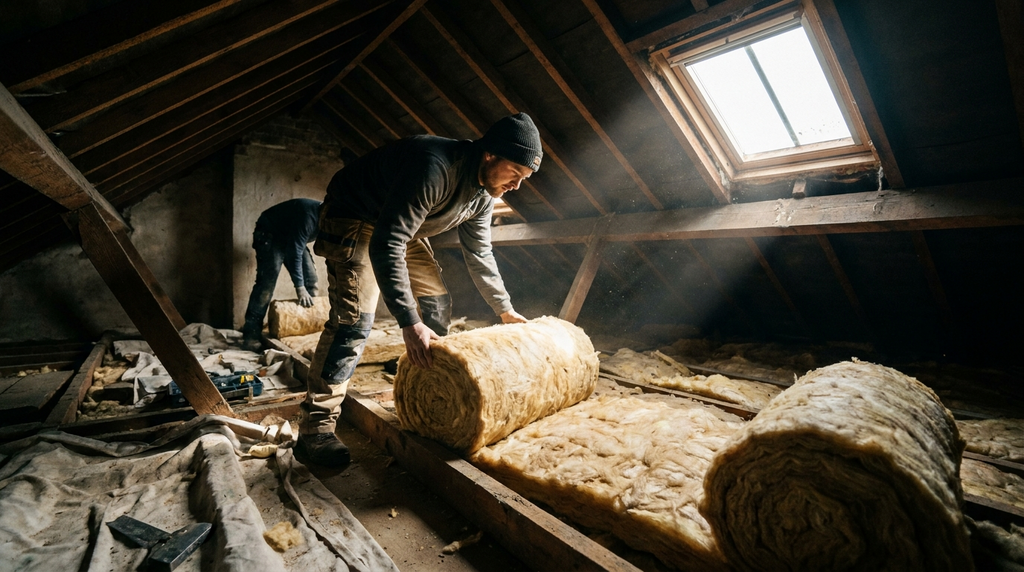
If you are wondering how thick your loft insulation should be, the short answer is 270mm for most UK homes. This is the current recommended minimum thickness, and it offers the best balance between upfront cost and long-term energy savings. For a typical three-bedroom semi-detached house, fitting a full 270mm layer of mineral wool costs around £725, while topping up an existing 100mm layer to 270mm costs roughly £280, and the difference in annual heating bills between those two scenarios is about £180 (Energy Saving Trust, 2026).
This guide explains the recommended thickness, how it affects your bills, the costs by material, and how to check if you qualify for a grant. All figures are based on 2026 energy prices and UK building regulations.
The recommended loft insulation thickness for UK homes in 2026
The current building-regulation minimum for new loft insulation is 270mm of mineral-wool or cellulose insulation, as set out in Approved Document L (2021 edition, updated 2025) (GOV.UK, 2025). For existing homes, the Energy Saving Trust advises a minimum of 270mm, but notes that older homes with 100mm or less will see the greatest savings (Energy Saving Trust, 2026).
A 270mm layer achieves a U-value of approximately 0.16 W/m²K, which is the standard target for loft insulation retrofits. A U-value measures how quickly heat passes through a material, lower numbers mean better insulation. Thicker layers (300mm–400mm) offer diminishing returns: the additional heat saved is small compared to the extra material cost. For most homes, 270mm is the sweet spot.
How loft insulation thickness affects your energy bills and carbon footprint
According to the Energy Saving Trust, topping up from 0mm to 270mm in a gas-heated semi-detached house saves roughly £590 per year on heating bills (Energy Saving Trust, 2026). Topping up from 100mm to 270mm saves about £180 per year, based on 2026 energy price cap figures from Ofgem (per unit rates as of January 2026) (Ofgem, 2026).
The carbon saving from a 0mm-to-270mm top-up is approximately 1,300 kg CO₂ per year, per DESNZ’s 2025 household emission factors (GOV.UK, 2025). Thickness beyond 270mm adds marginal savings, a 400mm layer saves an extra £20–£30 annually, per EST modelling. That is a small return for the extra material and labour cost.
Quick numbers thickness, cost, payback, and savings for a typical semi-detached house
| Thickness (mm) | Install cost (GBP) | Annual saving (GBP) | Payback period (years) | U-value (W/m²K) |
|---|---|---|---|---|
| 0mm (no insulation) | £0 | £0 | N/A | 2.30 |
| 100mm | £280 | £410 | 0.7 | 0.40 |
| 200mm | £500 | £540 | 0.9 | 0.21 |
| 270mm (recommended) | £725 | £590 | 1.2 | 0.16 |
| 400mm | £1,100 | £620 | 1.8 | 0.11 |
Sources: EST typical cost data (2026), Ofgem price cap (January 2026), BRE U-value calculator (BRE, 2026).
Which loft insulation thickness is right for your home, the direct answer
If your loft currently has no insulation, install 270mm of mineral wool or cellulose, this gives the fastest payback (under 2 years) and meets building regs. If your loft already has 100mm, topping up to 270mm is cost-effective (payback around 4–5 years) and cuts heat loss by roughly 60%. If you have 200mm or more, adding extra thickness is optional, the savings are small (under £50/year) and the payback is long (10+ years) (Energy Saving Trust, 2026).
For homes with flat roofs, the same 270mm target applies, but material type (e.g., rigid foam board) and installation method differ, consult a specialist. flat roof insulation guide
Cost breakdown by insulation material and thickness
Mineral-wool rolls are the most common option, costing £4–£6 per m² for 100mm and £10–£14 per m² for 270mm, per EST cost data (2026) (Energy Saving Trust, 2026). Cellulose fibre (loose-fill) costs £8–£12 per m² for 270mm, including professional installation, according to the National Insulation Association (NIA) 2026 pricing survey (NIA, 2026).
Rigid foam boards (e.g., PIR) cost £15–£25 per m² for 100mm, but their U-value per mm is better, a 150mm PIR board achieves a similar U-value to 270mm mineral wool. Spray foam costs £25–£40 per m², but it is less DIY-friendly and may affect future re-roofing or mortgage valuations, per RICS guidance note on spray foam (2025) (RICS, 2025).
How to verify an installer and check eligibility for loft insulation grants
For professional installation, use an MCS-certified installer for cellulose or spray foam; for mineral wool, a TrustMark-registered tradesperson is sufficient. Check the MCS Installer Database for cellulose or spray-foam specialists (MCS, 2026).
The Great British Insulation Scheme closed on 31 March 2026. It funded insulation measures only and never covered windows or glazing. For gas-safe or electrical work (e.g., moving loft lights or wiring), ensure the installer holds Gas Safe Register or NICEIC/NAPIT certification as applicable. Always obtain at least two itemised quotes and confirm the installer will provide a certificate of compliance (e.g., a signed installation receipt for Building Regulations Part L). how to find a trusted insulation installer
What happens if you install the wrong thickness or material for your loft type
Too little insulation (under 200mm) means you miss the building-regs target for new installations, this may cause issues when selling the home, as the EPC assessor will note the deficiency. Using a vapour-permeable material (e.g., mineral wool) in a loft that requires a vapour barrier (e.g., warm-roof construction) can lead to condensation and mould (BRE Digest 500, 2025).
Spray foam applied to the underside of a roof deck can trap moisture and void roof tiles, the RICS 2025 guidance note advises against it for most traditional UK lofts (RICS, 2025). Over-thick insulation (400mm+) can block eaves ventilation, causing condensation, ensure at least 50mm of ventilation gap at the eaves, per NHBC Standards (2026) (NHBC, 2026).