Loft insulation can cut heating costs by up to £300 a year. That makes it one of the most cost-effective home upgrades in the UK.
Heating a home with an uninsulated loft wastes a significant amount of energy. Heat rises and escapes through the roof, forcing your boiler to work harder. Adding loft insulation is a straightforward way to reduce that heat loss.
For a typical gas-heated semi-detached home with no existing loft insulation, the annual saving is around £300 to £400 (Energy Saving Trust, 2026). This makes loft insulation one of the fastest paying home improvements you can make.
The three main loft insulation materials and their 2026 costs per square metre
There are three common materials used for loft insulation in the UK. Each has a different cost and set of properties.
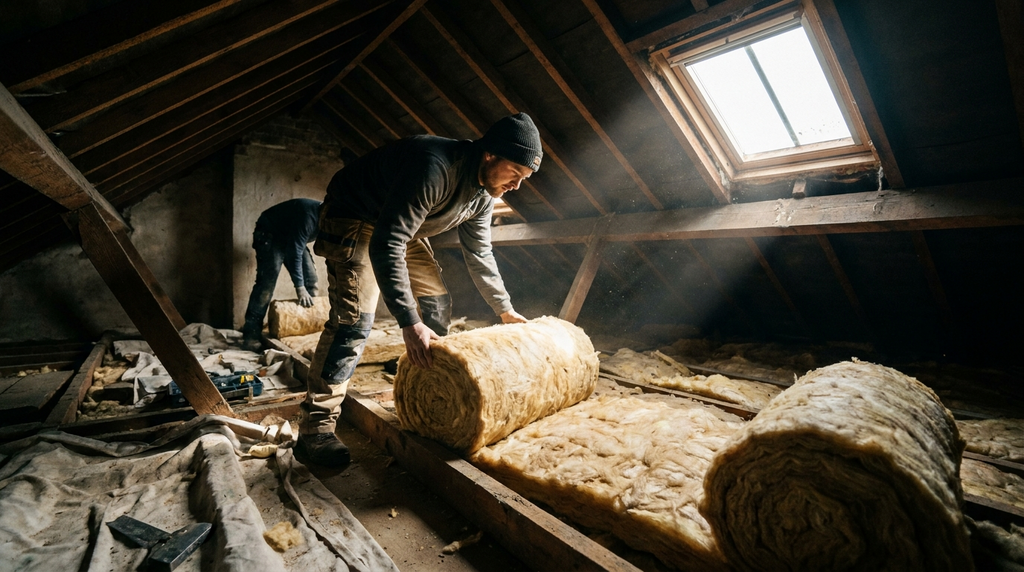
- Mineral wool (fibreglass or rockwool). This is the most widely used material. It comes in rolls or slabs. Installed cost is typically £10 to £20 per square metre (Energy Saving Trust, 2026).
- Sheep’s wool. This is a natural fibre insulation. It costs more than mineral wool. Installed cost is typically £25 to £40 per square metre (Energy Saving Trust, 2026).
- Rigid foam boards (PIR). These are stiff panels with a high insulation value per thickness. Installed cost is typically £20 to £35 per square metre (Energy Saving Trust, 2026).
All three materials are effective. The best choice depends on your budget, your loft space, and your priorities.
How much you save depends on your home’s current insulation level and fuel type
The savings you achieve depend on two main factors. The first is how much insulation you already have. The second is the type of fuel you use for heating.
For an uninsulated loft in a gas-heated semi-detached home, the typical annual saving is £300 to £400 (Energy Saving Trust, 2026). If you already have 100mm of insulation, topping it up to the recommended 270mm saves a smaller amount, around £50 to £100 per year (Energy Saving Trust, 2026).
Payback periods vary by material. Mineral wool typically pays back in 1 to 3 years. Sheep’s wool pays back in 3 to 6 years. Rigid foam boards pay back in 2 to 4 years (Energy Saving Trust, 2026). These figures assume a gas-heated home with no existing insulation.
Quick numbers Cost, savings, and payback for a typical semi-detached home
The table below shows typical figures for a 50 square metre loft in a gas-heated semi-detached home. All costs and savings are 2026 estimates.
| Material | Material cost per m² (installed) | Total cost for 50m² loft | Annual saving (gas-heated home) | Payback period (years) | Lifespan (years) |
|---|---|---|---|---|---|
| Mineral wool | £10–£20 | £500–£1,000 | £300–£400 | 1–3 | 40+ |
| Sheep’s wool | £25–£40 | £1,250–£2,000 | £300–£400 | 3–6 | 40+ |
| Rigid foam boards | £20–£35 | £1,000–£1,750 | £300–£400 | 2–4 | 40+ |
Sources for this table are the Energy Saving Trust cost data and savings estimates (Energy Saving Trust, 2026). Lifespan figures come from manufacturer data. All three materials can last 40 years or more if installed correctly and kept dry.
What is the best loft insulation for a UK home in 2026?
For most homes, 270mm of mineral wool offers the best balance of cost, fire safety, and performance (Energy Saving Trust, 2026). It meets the current Building Regulations standard and has a low upfront cost. Mineral wool is non-combustible, which adds a layer of fire safety.
Sheep’s wool is best for eco-conscious homeowners with a higher budget. It has similar thermal performance to mineral wool but is made from a renewable resource (Energy Saving Trust, 2026). It also handles moisture well and does not irritate the skin during installation.
Rigid foam boards are best for lofts with limited headroom. They provide a higher insulation value per thickness. For example, 150mm of rigid foam board can achieve the same U-value as 270mm of mineral wool (Energy Saving Trust, 2026). This is useful if you need to use the loft for storage or if the roof space is shallow.
How to check if your loft insulation meets the 2026 Building Regulations standard
Building Regulations Part L sets the minimum standard for insulation in existing homes. In 2026, the requirement is 270mm of mineral wool or an equivalent U-value of 0.16 W/m²K (GOV.UK, Building Regulations Part L, 2021 edition).
If your existing insulation is less than 100mm thick, you should remove it and install new insulation to the full 270mm depth. If your existing insulation is 100mm or more, you can top it up to 270mm (GOV.UK, Building Regulations Part L, 2021 edition).
You must also insulate the loft hatch to the same standard. An uninsulated hatch creates a cold spot and reduces the overall effectiveness of the insulation (GOV.UK, Building Regulations Part L, 2021 edition).
Installer certification who you must hire for a compliant loft insulation job
The Great British Insulation Scheme closed on 31 March 2026. It funded insulation measures only and never covered windows or glazing. MCS stands for Microgeneration Certification Scheme. It sets quality standards for installers (MCS, 2026).
If you are paying for the work yourself without government funding, you can use any competent installer. However, TrustMark registration is strongly recommended. TrustMark is a government-endorsed quality scheme for tradespeople (TrustMark, 2026). It gives you access to dispute resolution if something goes wrong.
Always check the installer’s MCS certificate number on the MCS register website before paying a deposit (MCS Installer Search, 2026). This confirms they are properly accredited.
Guide to finding a TrustMark registered insulation installer
Grants and schemes that can reduce your loft insulation cost to zero in 2026
Several government schemes can cover the full cost of loft insulation for eligible households.
The Great British Insulation Scheme closed on 31 March 2026. It funded insulation measures only and never covered windows or glazing.
The ECO4 scheme offers free loft insulation for low-income households that receive certain means-tested benefits, such as Pension Credit or Universal Credit (Ofgem, ECO4 Guidance, 2026). The energy supplier funds the work, so you pay nothing.
Some local councils also offer 100% grants for loft insulation. You should check your local council’s website for available schemes (GOV.UK, Energy Grants, 2026). Eligibility varies by area and household income.
Frequently Asked Questions
Mineral wool is the best all-round choice for most UK homes due to its low cost (£10-£20 per m²) and wide availability, according to the Energy Saving Trust. Sheep's wool is best for eco-conscious homeowners, while PIR boards suit tight loft spaces needing high insulation per thickness.
Mineral wool costs £10-£20 per m² installed, sheep's wool £25-£40 per m², and PIR rigid foam boards £20-£35 per m², based on Energy Saving Trust figures for 2026. Prices vary by installer and loft access.
For an uninsulated gas-heated semi-detached home, you save £300-£400 per year, per the Energy Saving Trust. Topping up from 100mm to 270mm saves £50-£100 yearly.
Yes, loft insulation is one of the most cost-effective upgrades, paying back within 1-2 years for an uninsulated loft (Energy Saving Trust). It also cuts carbon emissions and improves comfort year-round.
The recommended depth is 270mm of mineral wool or equivalent, as advised by the Energy Saving Trust. For PIR boards, 100-150mm typically achieves the same U-value.