The most energy-efficient loft insulation materials in 2026
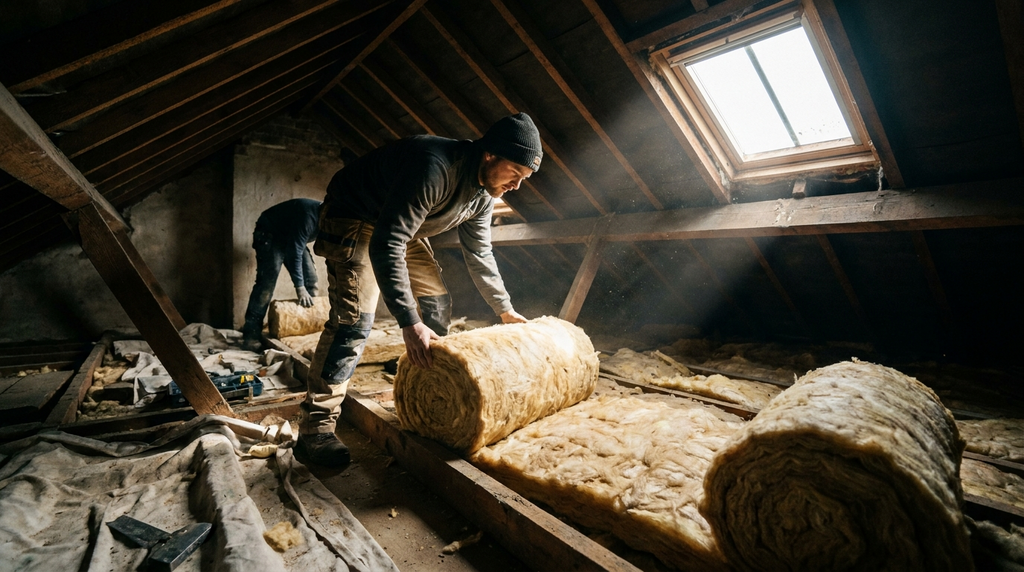
Choosing the right loft insulation material can reduce your heating bills and make your home more comfortable. In 2026, the UK’s most energy-efficient loft insulation materials are mineral wool (glass and rock), sheep’s wool, cellulose fibre, and PIR/PUR rigid boards.
The Energy Saving Trust states that topping up loft insulation from 0mm to 270mm can save a typical semi-detached home up to £315 per year on energy bills (Energy Saving Trust, 2026). Mineral wool remains the most common material due to its low cost and fire resistance, but its thermal performance (lambda value ~0.032–0.044 W/mK) is slightly worse than PIR boards (~0.022 W/mK) (DESNZ, SAP 10.2, 2026). Sheep’s wool offers a lambda value of ~0.038–0.042 W/mK and is a natural, breathable option, but it costs significantly more per square metre (MCS register, product data, 2026). Cellulose fibre (recycled paper) has a lambda value of ~0.035–0.040 W/mK and is treated for fire resistance, but it must be installed by a certified professional to avoid settling over time.
Which loft insulation material grants cover in 2026
The Great British Insulation Scheme closed on 31 March 2026. It funded insulation measures only and never covered windows or glazing. Eligible materials include mineral wool, sheep’s wool, cellulose fibre, and PIR boards, provided the installation achieves a target U-value of 0.16 W/m²K or lower for the loft (Ofgem, ECO4: Technical Monitoring Questions, 2026).
Rigid boards (PIR/PUR) are often preferred for lofts with limited headroom, as they can be installed between and over joists without reducing usable space. Homeowners in England, Scotland, and Wales can check eligibility via the GOV.UK “Find energy grants” tool (GOV.UK, Find energy grants for your home, 2026). Grants typically cover 100% of the cost for low-income households and a partial subsidy for those on standard tariffs (Ofgem, Energy Company Obligation (ECO4), 2026).
Quick numbers cost, R-value, and lifespan of each material
| Material | Typical cost per m² (installed) | Lambda value (W/mK) | R-value for 270mm thickness (m²K/W) | Typical lifespan (years) | Fire rating (class) |
|---|---|---|---|---|---|
| Mineral wool (glass) | £15–£25 | 0.032 | 8.4 | 40+ | A1 (non-combustible) |
| Mineral wool (rock) | £20–£30 | 0.034 | 7.9 | 40+ | A1 (non-combustible) |
| Sheep’s wool | £35–£55 | 0.038–0.042 | 6.4–7.1 | 50+ | B (limited combustibility) |
| Cellulose fibre | £25–£40 | 0.035–0.040 | 6.8–7.7 | 40+ | B (limited combustibility) |
| PIR/PUR rigid board | £30–£50 | 0.022 | 12.3 | 50+ | B (limited combustibility) |
Sources: DESNZ, SAP 10.2, 2026 (lambda values); Energy Saving Trust, 2026 (cost estimates); MCS register, 2026 (lifespan data); British Board of Agrément, 2026 (fire ratings).
How to verify your loft insulation installer is certified in 2026
For loft insulation, installers must be registered with the Microgeneration Certification Scheme (MCS) or TrustMark (GOV.UK, Great British Insulation Scheme: installer requirements, 2026). For mineral wool and cellulose fibre, installers should hold a valid certification from the National Insulation Association (NIA) or the Insulation Assurance Authority (IAA) (Ofgem, ECO4: Installer Requirements, 2026).
For sheep’s wool or other natural materials, check the installer is on the MCS register or TrustMark, and that the product has a British Board of Agrément (BBA) certificate (MCS register, Find an Installer, 2026). If installing PIR boards, the installer must be registered with TrustMark or a competent person scheme such as FENSA or NICEIC (GOV.UK, Competent person schemes, 2026). Always request a written quote and a certificate of installation (CIGA or similar) after work is completed (Energy Saving Trust, Loft Insulation: Installation, 2026).
The direct answer to ‘loft insulation materials comparison’ for featured snippet
The best loft insulation material for most UK homes in 2026 is mineral wool (glass or rock), due to its low cost (£15–£25 per m² installed), excellent fire resistance (Class A1), and widespread availability under the Great British Insulation Scheme (Energy Saving Trust, 2026; Ofgem, 2026). For homes with limited headroom, PIR rigid boards offer a higher thermal performance (lambda ~0.022 W/mK) and can achieve a thinner installation (e.g., 150mm instead of 270mm) to meet the target U-value of 0.16 W/m²K (DESNZ, SAP 10.2, 2026).
Sheep’s wool is a natural, breathable alternative but costs £35–£55 per m² installed, and cellulose fibre is a recycled option that requires professional installation to avoid settling (MCS register, 2026). The Great British Insulation Scheme closed on 31 March 2026. It funded insulation measures only and never covered windows or glazing.
Eligibility for loft insulation grants in 2026 who qualifies
The Great British Insulation Scheme closed on 31 March 2026. It funded insulation measures only and never covered windows or glazing. For ECO4, you must be receiving a qualifying benefit (e.g., Pension Credit, Universal Credit, Child Benefit for low-income households) (Ofgem, ECO4: Eligibility, 2026).
Homeowners in England, Scotland, and Wales are eligible; Northern Ireland has separate schemes (Energy Saving Trust, UK-wide grants, 2026). The Great British Insulation Scheme closed on 31 March 2026. It funded insulation measures only and never covered windows or glazing. You also do not qualify if you are a private renter without landlord permission, or if your home is a listed building or in a conservation area without planning permission (GOV.UK, Listed building consent, 2026).
How to confirm your loft insulation material choice meets 2026 building regulations
Building Regulations Part L (2021, updated 2025) require a minimum loft U-value of 0.16 W/m²K for new builds and major renovations (GOV.UK, Approved Document L: Conservation of fuel and power, 2026). For existing homes, the recommended thickness for mineral wool is 270mm (Energy Saving Trust, Loft Insulation, 2026).
To confirm a material meets the standard, check its lambda value (thermal conductivity) on the manufacturer’s product data sheet or the BBA certificate (British Board of Agrément, Product Certification, 2026). For PIR boards, a thickness of 150mm to 200mm is typically sufficient to achieve the target U-value (DESNZ, SAP 10.2, 2026). Always compare the installed material’s declared thermal performance against the target U-value in your property’s Energy Performance Certificate (GOV.UK, Find an EPC, 2026).
Guide to loft insulation thickness and U-values
Frequently Asked Questions
PIR/PUR rigid boards are the most energy-efficient option with a lambda value of ~0.022 W/mK, according to DESNZ SAP 10.2 (2026). They outperform mineral wool and sheep's wool, but cost more per square metre.
Topping up from 0mm to 270mm can save a typical semi-detached home up to £315 per year, according to the Energy Saving Trust (2026). Savings vary by property size and existing insulation.
Sheep's wool costs £15-£25/m² versus £4-£8/m² for mineral wool, but offers natural breathability and a lambda of 0.038-0.042 W/mK. It is worth it for eco-conscious homeowners with a higher budget.
Cellulose fibre can last 40-50 years if installed correctly by a certified professional, according to MCS product data (2026). It is treated for fire resistance but may settle over time if not properly compacted.