UK homes lose a quarter of their heat through an uninsulated roof, DESNZ data sets the baseline
The Department for Energy Security and Net Zero (DESNZ) published its Energy Follow-Up Survey in 2025, based on 2024 data. It found that 27% of heat loss in a typical semi-detached home is through the roof (DESNZ, 2025). The same survey identified 25% of heat loss through uninsulated solid walls and 35% through uninsulated cavity walls.
Building Regulations Approved Document L (2021 edition, updated 2026) sets minimum U-values for new and replacement insulation. A U-value measures how quickly heat passes through a material. Lower numbers mean better insulation. The target keyword “insulation thickness recommendations” applies to loft, cavity wall, and solid wall insulation in UK homes.
Loft insulation thickness recommendations 270 mm is the current UK standard
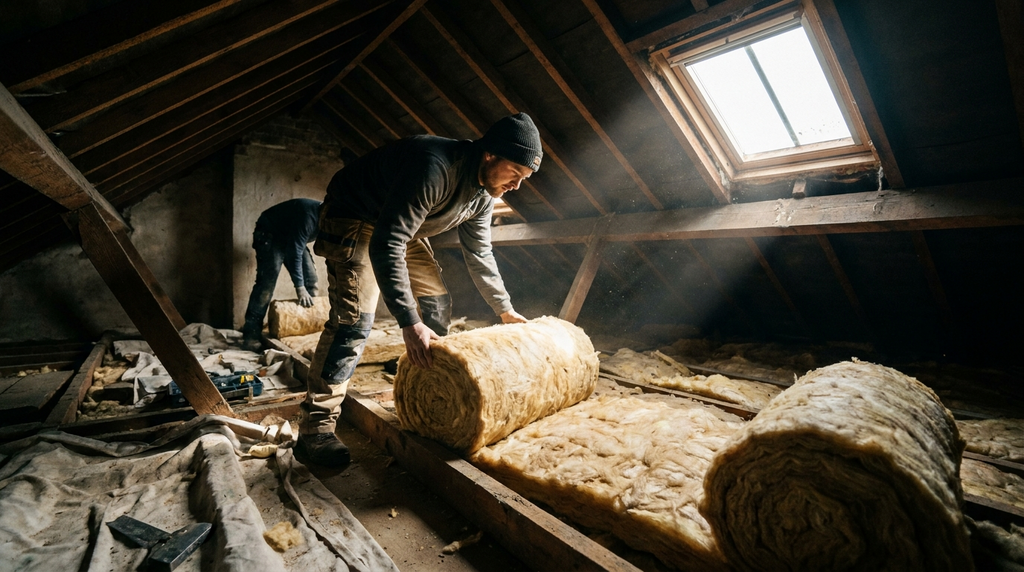
The Energy Saving Trust (EST) advises that loft insulation should be 270 mm (10–11 inches) thick for optimal performance. This thickness achieves a U-value of approximately 0.16 W/m²K, meeting Part L building regulations for new installations (Energy Saving Trust, 2026).
Adding insulation from 120 mm to 270 mm can save a typical semi-detached home £415–£490 per year on energy bills, based on the EST cost-savings calculator using 2026 fuel prices (Energy Saving Trust, 2026). The payback period for topping up from 120 mm to 270 mm is typically 2–3 years, according to EST calculations under the 2026 energy price cap.
Approved Document L, Table 4.2 specifies that for loft insulation, the target U-value of 0.16 W/m²K is achieved with 270 mm of mineral wool or 200 mm of rigid PIR boards (GOV.UK, 2026). PIR stands for polyisocyanurate, a rigid foam board with higher insulation value per millimetre than mineral wool.
Cavity wall insulation thickness recommendations 100–150 mm is typical
Standard cavity wall insulation uses mineral wool, EPS beads, or PIR boards. The cavity must be at least 50 mm wide, but 100–150 mm is common for full fill installations. For partial fill, the insulation layer should be at least 75 mm thick to achieve a U-value of 0.30 W/m²K (Energy Saving Trust, 2026).
Annual savings for a typical semi-detached home are £235–£295 per year, based on the EST cost-savings calculator using 2026 fuel prices. The payback period is 4–6 years, based on an average installation cost of £700–£1,200 (MCS, 2026). EPS stands for expanded polystyrene, a lightweight bead or board material commonly used in cavity fills.
Approved Document L, Table 4.2 confirms that a U-value of 0.30 W/m²K for cavity walls requires at least 100 mm of full-fill insulation or 75 mm of partial-fill insulation (GOV.UK, 2026).
Solid wall insulation thickness recommendations 60–100 mm internal, 100–150 mm external
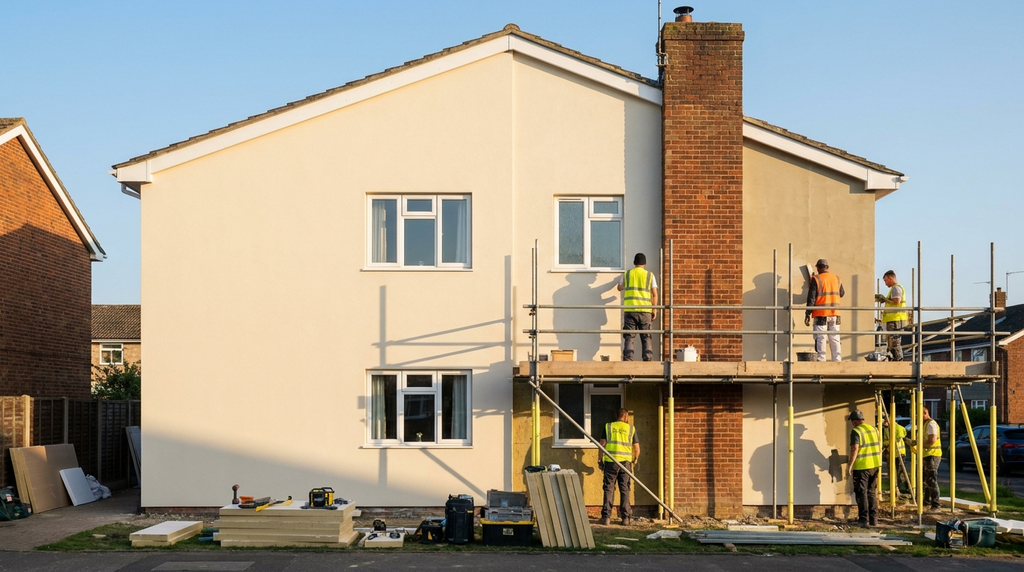
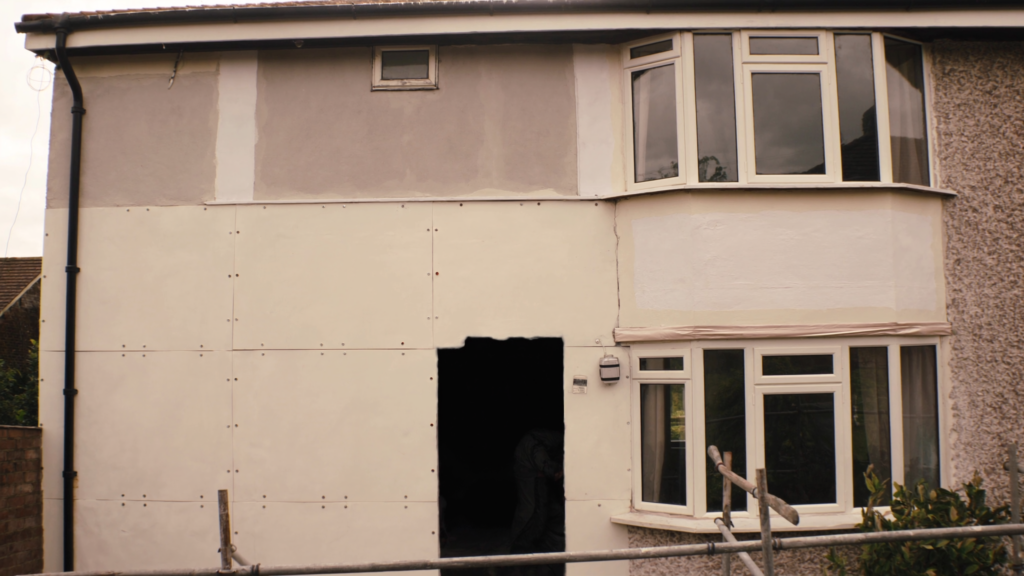
Internal solid wall insulation uses PIR boards or insulated plasterboard. It typically requires 60–100 mm thickness to achieve a U-value of 0.30 W/m²K. External solid wall insulation (EWI) usually needs 100–150 mm of mineral wool or EPS for the same target U-value (Energy Saving Trust, 2026).
Annual savings for a typical semi-detached home are £385–£485 for external walls, based on the EST cost-savings calculator using 2026 fuel prices. The payback period is 8–12 years for external insulation (cost £7,000–£12,000) and 6–10 years for internal insulation (cost £4,000–£8,000) (DESNZ, 2024).
Approved Document L, Table 4.2 specifies that solid wall insulation must achieve a U-value of 0.30 W/m²K, which governs the required thickness (GOV.UK, 2026). Solid wall insulation vs cavity wall insulation cost comparison
Quick numbers insulation thickness, U-values, annual savings, and payback
All figures below are sourced from the Energy Saving Trust (2026 updates), Approved Document L (2021 edition, 2026 revision), and MCS installation standards. The annual savings and payback periods are based on the EST cost-savings calculator using 2026 fuel prices for a typical semi-detached home.
| Insulation type | Recommended thickness (mm) | Target U-value (W/m²K) | Annual savings (£) | Payback period (years) | Installation cost range (£) |
|---|---|---|---|---|---|
| Loft (mineral wool) | 270 | 0.16 | 415–490 | 2–3 | 300–600 |
| Cavity wall (full fill) | 100–150 | 0.30 | 235–295 | 4–6 | 700–1,200 |
| Solid wall internal | 60–100 | 0.30 | 385–485 | 6–10 | 4,000–8,000 |
| Solid wall external (EWI) | 100–150 | 0.30 | 385–485 | 8–12 | 7,000–12,000 |
Source: Energy Saving Trust cost-savings calculator, 2026 and Approved Document L, Table 4.2, 2026.
The direct answer the minimum insulation thickness recommendation for a UK home is 270 mm for lofts and 100–150 mm for walls
For lofts, 270 mm of mineral wool or 200 mm of PIR boards achieves the recommended U-value of 0.16 W/m²K. For cavity walls, 100–150 mm of full-fill insulation achieves a U-value of 0.30 W/m²K. For solid walls, internal insulation needs 60–100 mm and external insulation needs 100–150 mm for a U-value of 0.30 W/m²K (GOV.UK, 2026).
These thicknesses are the current UK standard for new installations and upgrades. If your existing insulation is thinner than these figures, topping up to the recommended thickness will reduce your energy bills and pay back the cost within the payback periods shown above.
How to verify your installer MCS certification and TrustMark are essential
The Great British Insulation Scheme closed on 31 March 2026. It funded insulation measures only and never covered windows or glazing. MCS stands for Microgeneration Certification Scheme, which sets quality standards for insulation and renewable energy installations.
The Great British Insulation Scheme closed on 31 March 2026. It funded insulation measures only and never covered windows or glazing. For cavity wall insulation, the installer must be registered with the Cavity Insulation Guarantee Agency (CIGA) for a 25-year guarantee (CIGA, 2026).
How to check if your insulation installer is MCS certified Check these registrations before work begins. Without proper certification, you cannot access government funding and your installation may not meet building regulations. For gas boiler or heating system work, Gas Safe Register registration is required, though this is not directly relevant for insulation installations.
Frequently Asked Questions
The Energy Saving Trust recommends 270 mm (10-11 inches) of loft insulation for optimal performance. This meets the Building Regulations target U-value of 0.16 W/m²K, as set by Approved Document L (GOV.UK, 2026).
Adding loft insulation from 120 mm to 270 mm saves a typical semi-detached home between £415 and £490 per year on energy bills, based on the Energy Saving Trust's cost-savings calculator using 2026 fuel prices.
Standard cavity wall insulation requires a cavity width of at least 50 mm, with 100–150 mm being typical for most UK homes. The exact thickness depends on the material used and the target U-value of 0.30 W/m²K (GOV.UK, 2026).
Solid wall insulation typically requires 50–100 mm of PIR boards or EPS, applied internally or externally. The Energy Saving Trust advises that this thickness achieves a U-value of around 0.30 W/m²K, meeting Part L regulations.
Yes, thicker insulation generally reduces heat loss, but the law of diminishing returns applies. The Energy Saving Trust recommends 270 mm for lofts as the optimal balance of cost and performance, beyond which savings become marginal.