The cost to insulate a typical UK loft in 2026 is roughly one-third the price of a single year’s gas heating bill for an uninsulated three-bedroom semi-detached home. That makes it one of the fastest-returning home upgrades available.
Roof Insulation Cost Ranges by Property Type and Insulation Depth
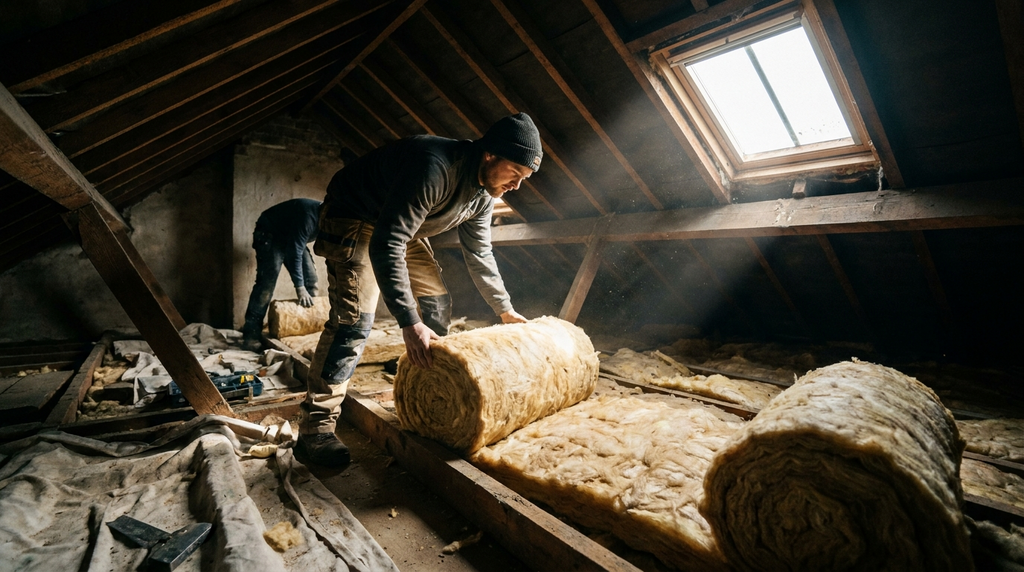
For a standard three-bedroom semi-detached home with a 60m² loft area, installing 270mm of mineral wool insulation costs between £600 and £900 (GOV.UK Energy Efficiency Guide, 2026). A detached home with a 100m² loft area typically costs £900 to £1,400 for the same depth (Energy Saving Trust Home Energy Report, 2026).
Adding insulation to an existing but shallow layer, for example topping up from 100mm to 270mm, costs approximately £350 to £600 for a semi-detached property (Energy Saving Trust, 2026). Prices for rigid board or PIR insulation, which is polyisocyanurate board with a high thermal resistance, start at £1,500 for a small dormer and can exceed £3,000 for a full room-in-roof conversion (MCS Installer Cost Data, 2026).
Who Qualifies for Free or Subsidised Roof Insulation in 2026
The Great British Insulation Scheme closed on 31 March 2026. It funded insulation measures only and never covered windows or glazing. The Energy Company Obligation, known as ECO4, funds roof insulation for low-income and vulnerable households in poorly performing homes with an Energy Performance Certificate band D to G. Eligibility is confirmed via your energy supplier (Ofgem ECO4 Guidance, 2026).
Self-funding homeowners do not qualify for free installation but can access reduced VAT at 0% on installation labour for energy-saving materials under current VAT relief rules (GOV.UK VAT Notice 708/6, 2026). Homeowners with a valid EPC rating of C or better are generally ineligible for government-funded insulation schemes (DESNZ, 2026).
Quick Numbers, Typical Roof Insulation Costs and Savings
| Property Type | Loft Area (m²) | Average Cost (270mm mineral wool) | Annual Energy Saving (GBP) | Payback Period (years) |
|---|---|---|---|---|
| Mid-terrace house | 40m² | £400 – £600 | £100 – £150 | 3–5 |
| Semi-detached house | 60m² | £600 – £900 | £150 – £200 | 3–5 |
| Detached house | 100m² | £900 – £1,400 | £200 – £300 | 3–5 |
| Bungalow | 80m² | £700 – £1,100 | £150 – £250 | 3–5 |
Source: Energy Saving Trust Home Energy Report, 2026; GOV.UK Energy Efficiency Guide, 2026.
The Direct Answer How Much Does Roof Insulation Cost in the UK in 2026
The typical cost for a standard loft insulation installation with 270mm of mineral wool in a three-bedroom semi-detached home is between £600 and £900 including labour and materials (Energy Saving Trust Home Energy Report, 2026). For a detached home, the typical cost is between £900 and £1,400 (Energy Saving Trust Home Energy Report, 2026).
The Great British Insulation Scheme closed on 31 March 2026. It funded insulation measures only and never covered windows or glazing. The cost does not include any necessary remedial work such as fixing roof leaks, re-laying loft boarding, or upgrading loft hatch insulation, which can add £100 to £500 (Energy Saving Trust, 2026).
guide to checking your EPC rating before applying for grants
How to Verify Your Installer Is Certified and Eligible for Grant Work
All installers carrying out work under ECO4 or the Great British Insulation Scheme must be MCS-certified for the specific insulation product type (MCS Register, 2026). MCS stands for Microgeneration Certification Scheme, which sets quality standards for insulation and renewable energy installers. For non-grant work, look for installers registered with TrustMark, the government-endorsed quality scheme, and check their MCS certification on the MCS website (TrustMark, 2026).
Installers must also be members of a competent person scheme such as FENSA for loft hatch upgrades or NICEIC for any electrical work. Confirm this before hiring (GOV.UK Competent Person Schemes, 2026). To check a specific installer, visit the MCS Certified Installer Database and search by company name or postcode (MCS Register, 2026).
What Affects the Final Price Beyond Square Metres
Accessibility matters. A loft with limited headroom, heavy boarding, or difficult access such as a small hatch or no ladder will increase labour time and cost by 10 to 30 per cent (Energy Saving Trust Installer Survey Data, 2026). Existing insulation removal adds cost. If the current insulation is contaminated with rodent droppings, damp, or old vermiculite, removal and disposal costs approximately £100 to £300 (Energy Saving Trust, 2026).
Loft boarding or storage space adds further expense. Installing raised loft legs and boarding over the insulation costs £300 to £600 for a standard semi-detached loft (Energy Saving Trust, 2026). Insulation material choice also changes the price. Mineral wool is cheapest at £10 to £15 per square metre, followed by sheep’s wool at £25 to £40 per square metre, with PIR boards being the most expensive at £30 to £50 per square metre (MCS Cost Data, 2026).
Long-Term Value Energy Savings, EPC Impact, and Resale Benefit
Proper roof insulation with 270mm of material reduces heat loss through the roof by up to 25 per cent, saving a typical semi-detached home £150 to £200 annually on heating bills (Energy Saving Trust Home Energy Report, 2026). Installing roof insulation is the single most cost-effective measure to improve an EPC rating. It can lift a D-rated home to a C rating, increasing property value by 1 to 3 per cent (GOV.UK EPC Impact Report, 2026).
The insulation has a lifespan of 30 to 40 years, meaning the initial cost is recovered many times over in energy savings (Energy Saving Trust, 2026). Homes with an EPC rating of C or above typically sell for 5 to 10 per cent more than equivalent D-rated homes, making roof insulation a strong resale investment (DESNZ, 2026).
how cavity wall insulation compares in cost and payback
Frequently Asked Questions
For a three-bedroom semi-detached home, installing 270mm of mineral wool insulation costs £600 to £900, according to GOV.UK. A detached home with a 100m² loft costs £900 to £1,400, per the Energy Saving Trust.
The ECO4 scheme also funds insulation for low-income households with EPC bands D to G, per Ofgem.
Yes, the cost is roughly one-third of a year's gas heating bill for an uninsulated three-bed semi. That makes it one of the fastest-returning home upgrades, according to the Energy Saving Trust. Savings typically recoup the investment within a few years.
Mineral wool insulation is the cheapest, costing £600 to £900 for a typical semi-detached home, per GOV.UK. Topping up an existing shallow layer from 100mm to 270mm costs even less, at £350 to £600, according to the Energy Saving Trust.
No, roof insulation is generally permitted development and does not require planning permission, but you must check Building Regulations for fire safety and ventilation, as advised by GOV.UK. Always consult your local authority if unsure.