Solid-wall flats lose heat faster than any other UK home type
A typical solid-wall flat loses heat at roughly three times the rate of a cavity-wall house, according to the Energy Saving Trust’s 2026 heat-loss modelling. The Energy Saving Trust states that uninsulated solid walls account for around 35–40% of a flat’s total heat loss (Energy Saving Trust, 2026). This article explains the specific insulation options available for flats and apartments, focusing on the trade-offs between internal and external wall insulation.
Internal wall insulation is the most common choice for flats
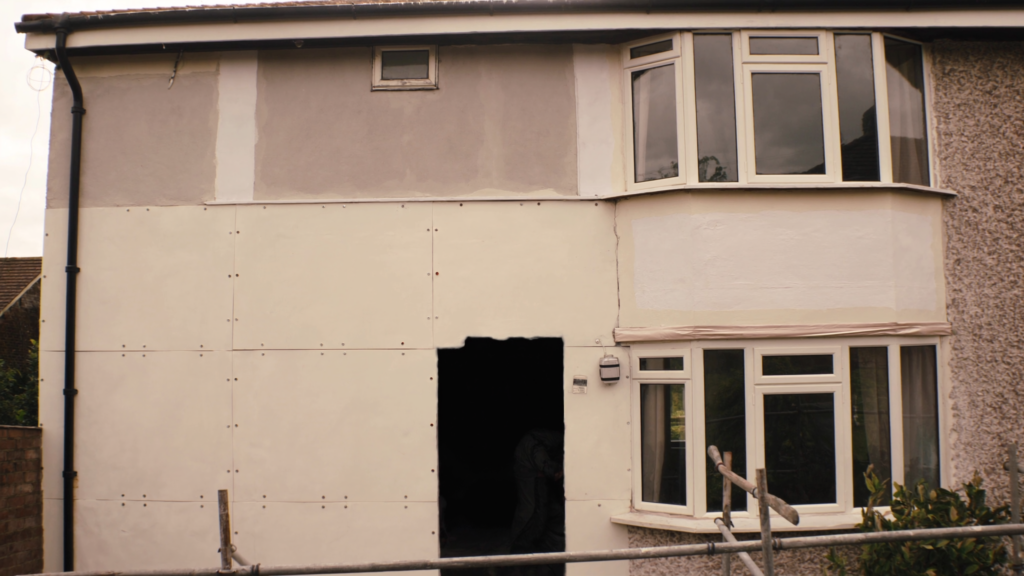
Internal wall insulation (IWI) involves fixing insulation boards or a stud-and-fill system to the inside face of external walls. The Energy Saving Trust notes that IWI can reduce heat loss through solid walls by up to 60%, depending on the system and thickness (Energy Saving Trust, 2026). The trade-off is that IWI reduces floor area by roughly 5–10 cm per wall, and requires redecoration of the room.
For leaseholders, IWI does not normally need freeholder permission because it stays within your flat’s interior. But you must check your lease, as some older leases restrict structural changes. The insulation boards are typically fixed directly to the wall, then plastered and decorated. A stud-and-fill system uses timber or metal frames filled with insulation, which can accommodate uneven walls but reduces room size slightly more.
guide to internal wall insulation costs and savings
External wall insulation is only possible with landlord or freeholder consent
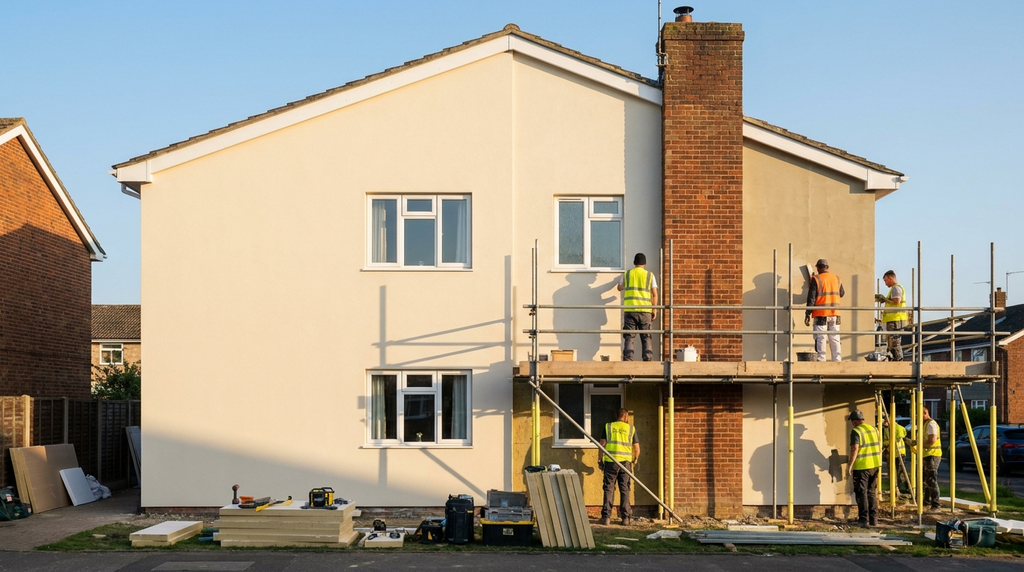
External wall insulation (EWI) is a continuous layer fixed to the outside of the building, then rendered or clad. For flats, EWI requires permission from the freeholder or management company, and often a party-wall agreement. The Department for Energy Security and Net Zero (DESNZ) states that EWI can achieve U-values as low as 0.30 W/m²K, compared to a typical solid-wall U-value of 2.1 W/m²K (DESNZ, 2026).
The trade-off is that EWI is more disruptive to install, requiring scaffolding, re-securing rainwater goods, and sometimes altering window reveals. It does not reduce internal floor space, which is its main advantage over IWI. But for leaseholders in a block, you cannot install EWI on your flat alone, the whole building facade must be treated, which means the freeholder must agree and often the other leaseholders must contribute.
Quick numbers, cost, savings, and payback for flat insulation
| Insulation type | Cost (per flat, 2026) | Annual saving on heating bill | Payback period (years) |
|---|---|---|---|
| Internal wall insulation (one-bed flat) | £3,500–£5,500 | £200–£350 | 12–20 |
| External wall insulation (one-bed flat) | £6,000–£10,000 | £250–£400 | 15–25 |
| Cavity wall insulation (1930s/1960s flat with cavity) | £1,200–£2,500 | £150–£250 | 5–12 |
| Internal wall insulation (two-bed flat) | £4,500–£7,500 | £300–£450 | 12–18 |
All figures are based on Energy Saving Trust 2026 data for typical UK flats (Energy Saving Trust, 2026). Payback periods assume current energy prices and typical heating patterns. Actual savings depend on your flat’s size, exposure, and how you heat it.
What insulation works best for flats in the UK in 2026
For most flats, internal wall insulation is the only practical option because it does not require external access or freeholder permission. For flats in a 1930s or 1960s block with cavity walls, cavity wall insulation (if the cavity is clear and the building is suitable) is cheaper and less disruptive. The Energy Saving Trust confirms that for solid-wall flats, internal insulation is the default, with external insulation only where the whole block is being treated (Energy Saving Trust, 2026).
If you live in a flat built before 1920, the walls are almost certainly solid, no cavity to fill. If your flat was built between 1930 and 1970, it may have cavity walls, but you need a survey to confirm. Cavity wall insulation costs less than half the price of IWI and has a shorter payback period. That makes it the best option where available.
Eligibility for grants and how to verify an MCS-certified installer
The Great British Insulation Scheme closed on 31 March 2026. It funded insulation measures only and never covered windows or glazing. Installers must be MCS certified for insulation work to qualify for government schemes. For internal wall insulation, check the installer is registered with TrustMark and has a current MCS certificate for “Internal Wall Insulation”.
To verify an installer, use the MCS search tool at mcscertified.com. You can also check TrustMark’s register to confirm the installer meets consumer protection standards (TrustMark, 2026). The Great British Insulation Scheme closed on 31 March 2026. It funded insulation measures only and never covered windows or glazing.
guide to insulation grants and funding in 2026
Ventilation and condensation risks must be addressed before insulating
The Energy Saving Trust warns that adding insulation to a flat without improving ventilation can trap moisture, leading to mould (Energy Saving Trust, 2026). In a flat, mechanical ventilation (e.g., an extractor fan in the kitchen and bathroom) or a whole-flat MVHR system may be needed. The trade-off is that proper ventilation adds £500–£1,500 to the project cost but prevents condensation damage.
Before any insulation work, check your flat for existing damp or mould. If you see condensation on windows in winter, your ventilation is already inadequate. A qualified installer should include a ventilation assessment as part of their quote. In some cases, you may need a passive vent in the wall or a heat recovery fan to maintain air quality without losing heat.
What to check before buying insulation for your flat
Check the building’s construction: is it solid wall (pre-1920s) or cavity wall (1930s–1970s)? Confirm with the freeholder or management company whether any insulation work is permitted. Get a full energy assessment (EPC) to identify the biggest heat losses, the Energy Saving Trust recommends this as the first step (Energy Saving Trust, 2026).
You can find your flat’s construction date from the Land Registry or your local council’s planning records. For leaseholders, your lease will specify what changes you can make to the interior walls. For cavity wall flats, a simple borescope inspection by an installer can confirm whether the cavity is clear and suitable for insulation. Do not proceed without written confirmation from your freeholder, as unauthorised work can lead to legal disputes.
Frequently Asked Questions
Internal wall insulation for a typical one-bedroom flat costs between £2,000 and £4,000, while a two-bedroom flat costs £3,000 to £7,000, according to the Energy Saving Trust. Costs vary by wall area and system type.
Internal wall insulation normally does not require freeholder permission as it stays within your flat, but you must check your lease. External wall insulation always requires consent from the freeholder or management company, as per DESNZ guidance.
Internal wall insulation is the most common option for flats because it avoids the need for external consent. The Energy Saving Trust recommends insulated plasterboard or a stud-and-fill system for best results.
Uninsulated solid walls account for 35-40% of a flat's total heat loss, according to the Energy Saving Trust's 2026 heat-loss modelling. This is roughly three times the loss through a cavity wall.
Check with Ofgem or your energy supplier for current offers.