Roof insulation is responsible for preventing up to 25% of a home’s heat loss. That makes it one of the single most impactful upgrades a UK homeowner can make to reduce energy bills and carbon emissions. In a country where heating accounts for around 55% of annual household energy costs, a properly insulated roof can save a typical semi-detached home between £150 and £400 per year on energy bills, depending on property size and insulation type. This guide covers everything you need to know about roof insulation in 2026, from materials and costs to grants, installation, and long-term maintenance.
How Roof Insulation Works
Heat moves naturally from warm areas to cold ones, a process called thermal transfer. In an uninsulated home, warm air generated by your heating system rises and escapes through the roof structure, effectively pumping expensive heat directly into the atmosphere. Roof insulation works by placing a thermally resistant barrier within or beneath the roof structure, dramatically slowing this transfer.
The effectiveness of any insulation material is measured by its thermal resistance value, or R-value, and its thermal conductivity, expressed as a lambda (λ) value. The lower the lambda value, the better the material resists heat flow. For roof insulation, a lambda value below 0.04 W/mK is considered good performance, with premium rigid foam boards achieving values as low as 0.022 W/mK.
There are two fundamentally different approaches depending on whether your roof space is used or unused. For a cold loft space, where the floor of the loft is insulated, warm air is kept in the living space below, and the roof void itself is allowed to stay cold. For a warm roof or converted loft, insulation is placed at rafter level or above the roof deck, keeping the entire roof structure warm. The right approach depends on how you use your roof space and the construction of your home.
Types of Roof Insulation
Choosing the right insulation material for your roof depends on your roof type, available space, budget, and whether you want to convert or simply seal the space. The main categories available to UK homeowners in 2026 are as follows.
Mineral Wool (Glass Wool and Rock Wool)
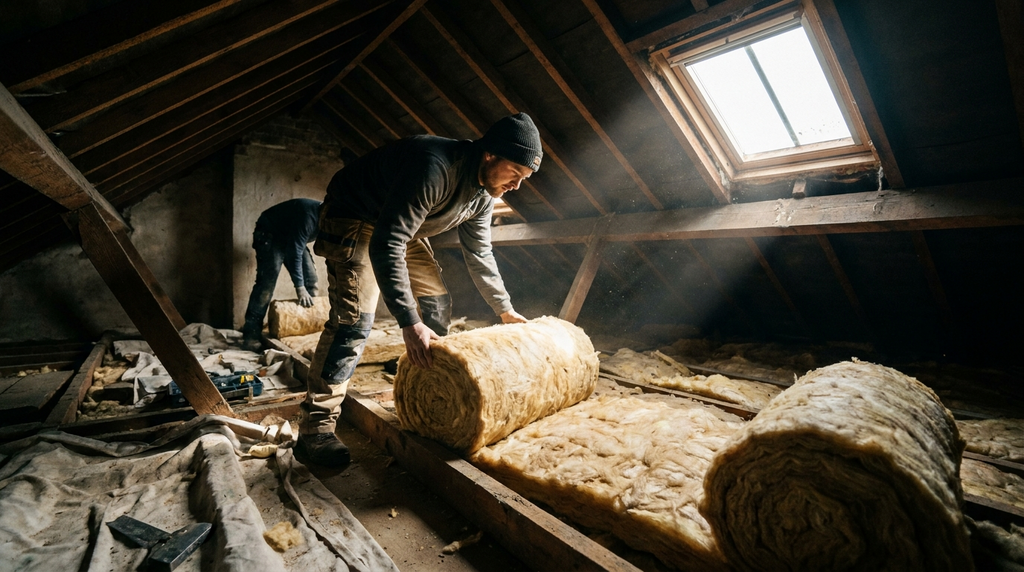
Mineral wool is the most widely used roof insulation material in the UK. It comes in rolls or batts and is particularly suited to cold loft insulation at joist level. It has a lambda value of around 0.032–0.044 W/mK and is non-combustible, moisture-resistant, and straightforward to install as a DIY project. A standard installation uses 100mm between joists topped with 200mm laid perpendicular, giving a combined 300mm depth that meets current building regulations.
Rigid Foam Boards
Rigid insulation boards, including polyisocyanurate (PIR), expanded polystyrene (EPS), and extruded polystyrene (XPS), offer the highest thermal performance per millimetre of thickness. PIR boards can achieve a lambda value of 0.022–0.028 W/mK, making them ideal where space is limited, such as between and below rafters in a loft conversion. They are more expensive than mineral wool but allow thinner profiles without sacrificing performance.
Spray Foam Insulation
Spray polyurethane foam is applied directly to the underside of roof tiles, expanding to fill gaps and adhere to the structure. While it offers good thermal performance, it has attracted significant controversy in recent years because it can make roofs difficult to inspect, repair, and re-tile. Mortgage lenders including major high street banks have raised concerns about spray foam insulation affecting property valuations. If you are considering spray foam, always seek independent advice first.
Loose Fill Insulation
Loose fill materials such as cellulose (recycled paper), vermiculite, or loose mineral wool can be blown or poured between joists. They are particularly effective at filling irregular spaces and around obstructions like pipes and beams. Blown cellulose has good environmental credentials, with a lambda value of around 0.038 W/mK.
| Material | Lambda Value (W/mK) | Typical Use | Relative Cost | DIY Friendly |
|---|---|---|---|---|
| Glass wool rolls | 0.032–0.044 | Cold loft at joist level | Low | Yes |
| Rock wool batts | 0.033–0.040 | Cold loft, rafter spaces | Low–Medium | Yes |
| PIR rigid board | 0.022–0.028 | Warm roofs, loft conversions | Medium–High | Partial |
| EPS rigid board | 0.030–0.038 | Flat roofs, warm roofs | Medium | Partial |
| Blown cellulose | 0.035–0.040 | Cold lofts with obstructions | Low–Medium | No (specialist) |
| Spray foam | 0.026–0.040 | Rafter underside sealing | High | No (specialist) |
How Much Does Roof Insulation Cost in 2026
Roof insulation costs vary significantly depending on the type of insulation, the size of your roof, whether the space is accessible, and whether a conversion is involved. The figures below represent typical installed costs from professional contractors in England, Scotland, and Wales in 2026, including materials and labour.
| Insulation Type | Property Size | Average Cost (Installed) | DIY Material Cost | Estimated Annual Saving |
|---|---|---|---|---|
| Cold loft (mineral wool) | Terraced house | £300–£500 | £80–£150 | £150–£200 |
| Cold loft (mineral wool) | Semi-detached | £400–£700 | £120–£200 | £200–£300 |
| Cold loft (mineral wool) | Detached house | £600–£1,000 | £180–£300 | £250–£400 |
| Warm rafter (PIR boards) | Terraced house | £1,500–£3,000 | £500–£900 | £180–£280 |
| Warm rafter (PIR boards) | Semi-detached | £2,500–£4,500 | £700–£1,400 | £220–£350 |
| Flat roof insulation | Garage or extension | £800–£2,500 | £300–£700 | £50–£150 |
| Blown loose fill | Semi-detached | £350–£600 | N/A (specialist) | £200–£300 |
For a standard cold loft insulation job on a semi-detached house, the payback period is typically 2 to 4 years when professionally installed and even shorter, often under 2 years, when done as a DIY project. Warm rafter insulation has a longer payback period of around 8 to 15 years, but the thermal comfort benefits and increased usable space often justify the investment.
Regional labour rates affect final costs. Expect to pay 15–25% more in London and the South East compared to the Midlands and North of England. Always obtain at least three quotes from accredited installers before committing.
Benefits of Roof Insulation
The advantages of a well-insulated roof extend beyond simply cutting your heating bill, though that benefit alone is substantial.
- Reduced energy bills. A properly insulated loft in a semi-detached home can save approximately £270 per year based on 2026 energy prices, according to the Energy Saving Trust.
- Lower carbon emissions. Effective roof insulation can reduce a typical home’s carbon footprint by around 610kg of CO₂ per year, equivalent to taking a car off the road for two months.
- Improved comfort year-round. Insulation doesn’t just retain heat in winter, it also reflects heat gain in summer, keeping bedrooms cooler during hot spells.
- Increased property value. Homes with an Energy Performance Certificate (EPC) rating of C or above command a premium of up to 6% over equivalent properties with lower ratings, according to research from Rightmove.
- Reduced condensation and damp risk. When correctly installed with appropriate vapour control, roof insulation stabilises internal temperatures and reduces surface condensation on cold structural elements.
- Sound insulation. Mineral wool and blown cellulose provide meaningful acoustic damping, reducing noise from rain, wind, and aircraft, particularly relevant for homes under flight paths.
- Long service life. Quality mineral wool and rigid foam insulation materials have an expected lifespan of 40 years or more with no maintenance required.
Building Regulations and Minimum Standards
Any new roof insulation work in England and Wales must meet the requirements of Part L of the Building Regulations, which governs the conservation of fuel and power. As of 2026, the minimum U-value requirement for a new or replacement pitched roof insulation is 0.16 W/m²K. For flat roofs, the minimum is 0.18 W/m²K.
Achieving a U-value of 0.16 W/m²K typically requires at least 270–300mm of mineral wool in a cold loft configuration, or around 100–120mm of PIR board in a warm rafter configuration. If you are retrofitting insulation to an existing roof without making a structural change, permitted development rules generally apply, and full Building Regulations approval is not required, but you should still aim to meet or exceed current minimum standards.
In Scotland, building standards are set under Section 6 of the Technical Handbooks. Northern Ireland follows the Technical Booklets. Standards are broadly similar to England and Wales, though the colder Scottish climate makes achieving lower U-values especially worthwhile.
How to Choose the Right Roof Insulation
Selecting the right approach requires you to answer a few key questions about your home and your priorities.
Is Your Loft Used or Unused
If your loft is purely for storage or is completely unused, a cold loft installation using mineral wool at joist level is the most cost-effective option and the fastest to deliver payback. If you use your loft as a room, have a loft conversion, or plan one, you need warm rafter insulation using rigid boards or a hybrid system.
What Is the Pitch and Condition of Your Roof
Steeply pitched roofs with generous rafter depth offer more flexibility for insulation depth. Shallow pitches and narrow rafter depths may require high-performance rigid boards to achieve required U-values without consuming the ventilation gap needed to prevent condensation. If your roof covering is nearing the end of its life, consider combining a re-roofing project with above-rafter insulation (a warm roof approach) to maximise value.
Flat Roofs Require a Different Strategy
Flat roofs, common on extensions, garages, and some modern homes, require insulation placed either above the roof deck (warm flat roof, the preferred method) or below it (cold flat roof, which risks condensation). The warm flat roof approach, using rigid EPS or XPS boards beneath the waterproofing membrane, is the industry-standard recommendation and what most contractors will specify.
Key Factors to Consider
- Budget. Cold loft mineral wool offers the fastest payback and lowest upfront cost. Warm rafter systems cost more but are essential for converted or heated loft spaces.
- Environmental priorities. If embodied carbon matters to you, choose mineral wool or blown cellulose over petrochemical-based foam boards.
- Airtightness requirements. In a warm roof or conversion, airtightness detailing is critical to prevent interstitial condensation, ensure your installer follows NHBC or equivalent guidance.
- Ventilation. Cold roofs with a breathable felt underlay must maintain a minimum 50mm ventilation gap above the insulation, never pack insulation tightly to the underside of the felt in a cold roof construction.
Roof Insulation Installation, What to Expect
The installation process varies significantly between cold loft and warm rafter systems. Here is what a typical project involves for each scenario.
Cold Loft Mineral Wool Installation
- Survey and preparation. The installer (or you, if DIY) inspects the loft, checks existing insulation depth, identifies any pipe or tank locations, and ensures the loft hatch is accessible.
- Sealing air gaps. Before laying insulation, any gaps around pipes, cables, and ceiling light fittings (using fire-rated covers) are sealed to prevent air leakage, this step is often skipped but significantly affects performance.
- First layer between joists. 100mm mineral wool rolls are cut and laid snugly between the joists, filling the full depth of the joist cavity.
- Second layer across joists. A 200mm layer is laid at right angles across the top of the joists, eliminating thermal bridging through the timber and achieving the 300mm total depth required for building regulations compliance.
- Loft hatch insulation. An insulated cover box is fitted to the loft hatch, a common heat loss point that is frequently overlooked.
- Ventilation check. The installer confirms that ventilation at the eaves remains clear and unobstructed by the new insulation.
A professional team can typically complete a standard cold loft insulation job in half a day to one full day. Experienced DIYers can complete the same work over a weekend.
Warm Rafter Insulation for Loft Conversions
For warm roof or loft conversion work, the process is more complex and almost always requires professional installers. Rigid PIR boards are cut precisely to fit between rafters, followed by a continuous board below the rafters to eliminate thermal bridging. A vapour control layer is then applied, followed by plasterboard. Particular care is needed at junctions with walls, dormers, and roof windows to maintain a continuous thermal envelope.
Grants and Funding for Roof Insulation in 2026
Several government and utility-backed funding schemes can reduce or eliminate the cost of roof insulation for eligible households.
The Great British Insulation Scheme
The Great British Insulation Scheme closed on 31 March 2026. It funded insulation measures only and never covered windows or glazing. Owner-occupiers and private renters may be eligible. Loft insulation, including roof insulation for occupied spaces, is one of the qualifying measures. Applications are handled through energy suppliers, and eligibility is assessed based on EPC rating and, in some cases, income or benefit receipt.
The Energy Company Obligation (ECO4)
The ECO4 scheme obliges large energy companies to fund energy efficiency improvements in low-income and vulnerable households. Roof and loft insulation is a core measure under this scheme. Households receiving qualifying benefits such as Universal Credit, Pension Credit, or Child Tax Credit are automatically eligible. Some local authorities also administer Flexible Eligibility provisions, which can extend support to households facing fuel poverty regardless of benefit status.
Home Upgrade Grant (HUG2)
The Home Upgrade Grant targets off-gas-grid properties in England, typically rural homes using oil or LPG for heating. Eligible homeowners can receive grant funding toward a package of energy efficiency improvements, which can include roof insulation as part of a broader retrofit.
Scotland, Wales, and Northern Ireland
- Scotland. Warmer Homes Scotland and the Area Based Schemes provide free insulation and heating improvements to eligible households.
- Wales. The Nest scheme and Optimised Retrofit Programme offer insulation support to low-income households and social housing respectively.
- Northern Ireland. The Affordable Warmth Scheme provides grants for insulation and heating improvements to eligible low-income homeowners and tenants.
Even if you do not qualify for a free scheme, the 0% VAT rate on insulation materials and installation (applicable since April 2022) remains in force in 2026, effectively reducing your net cost by 20% compared to standard-rated work.
Common Problems and Maintenance
Roof insulation is generally a fit-and-forget measure, but there are common issues to watch for, particularly in older installations or those that were not correctly installed in the first place.
Compressed or Settled Insulation
Mineral wool that has been walked on or has items stored directly on top loses its loft (thickness) and thermal resistance. If you use your loft for storage, ensure insulation boards or walkway panels are fitted on raised supports to protect the insulation beneath. Settled blown cellulose may also reduce in depth over time and may need a top-up after 20 years.
Damp and Moisture Ingress
Wet insulation performs dramatically worse than dry insulation, a saturated mineral wool batt can lose up to 80% of its thermal resistance. If you notice damp patches on bedroom ceilings or see daylight through your roof structure, investigate before adding insulation. Address any roof tile or flashing failures first. In warm roof constructions, a correctly specified and installed vapour control layer is critical to preventing interstitial condensation within the rafter build-up.
Blocking Eaves Ventilation
In a cold roof construction, the eaves must remain ventilated, a 50mm airway between insulation and the felt underlay is mandatory. Poorly installed insulation that fills the eaves void causes moisture to build up in the roof structure, potentially leading to timber rot and mould. Eaves ventilation baffles or trays are used to hold the insulation back at the edges and should be part of any cold loft installation.
Gaps and Thermal Bridges
Even well-specified insulation underperforms if gaps are left around pipes, roof trusses, or the loft hatch. A gap of just 1% in an insulated area can account for up to 10% of total heat loss through that element. An inspection with a thermal imaging camera, offered by some energy assessors and contractors, can identify cold spots quickly and accurately.
Pest Damage
Rodents and birds occasionally nest in roof insulation, compressing or contaminating it. If you notice evidence of activity, droppings, nesting material, or gnawed fibres, deal with the pest problem before addressing the insulation, and inspect the roof covering for entry points.
When to Replace or Top Up
Rigid foam boards and correctly installed mineral wool in a dry roof can last 40 years or more without intervention. However, if your loft insulation was installed before 2000, it is very likely to be under 100mm deep, significantly below current standards. Topping up existing mineral wool with an additional 200mm layer is a straightforward and low-cost exercise that can still deliver meaningful savings even if the existing insulation is in good condition.
Finding and Vetting an Installer
For cold loft insulation, competent DIY installation is entirely feasible. For warm rafter systems, loft conversions, flat roofs, or any work involving vapour control layers and airtightness detailing, using a qualified contractor is strongly recommended.
Look for installers who hold certification from one of the following bodies:
- The Great British Insulation Scheme closed on 31 March 2026. It funded insulation measures only and never covered windows or glazing.
- CIGA (Cavity Insulation Guarantee Agency) membership, provides a 25-year guarantee on installed insulation.
- NAPIT or NICEIC registration, relevant if the installation involves electrical work such as recessed lighting.
- Trustmark accreditation, the government-endorsed quality scheme covering all home improvement trades.
Always request a written specification detailing the insulation product, thickness, expected U-value, and any guarantees offered. A reputable installer should provide a completion certificate confirming the work meets current Building Regulations where applicable, and an insurance-backed guarantee of at least 10 years on the installation.
Get a minimum of three competitive quotes. For grant-funded work, your energy supplier or local authority will typically provide a list of approved contractors in your area.