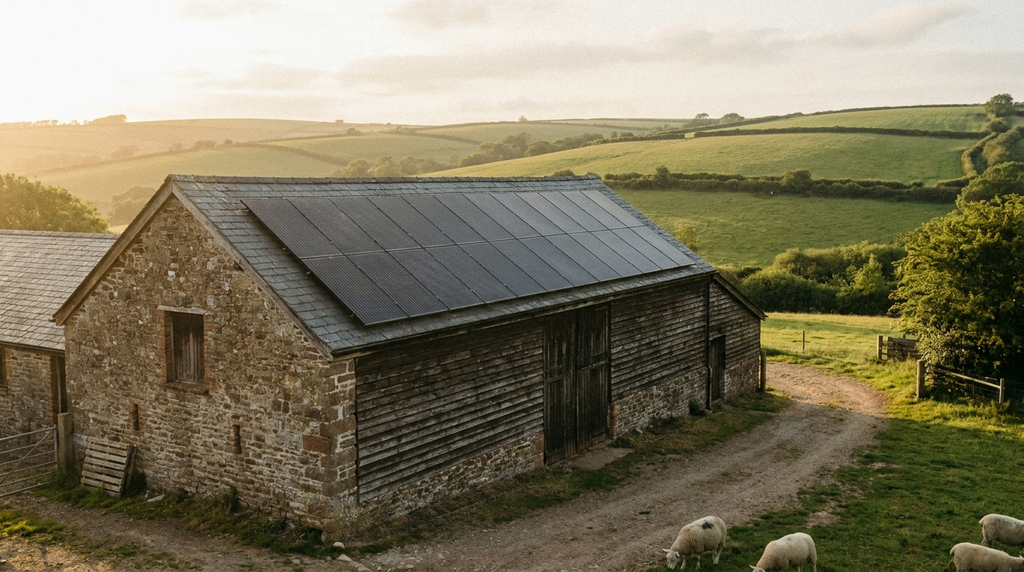
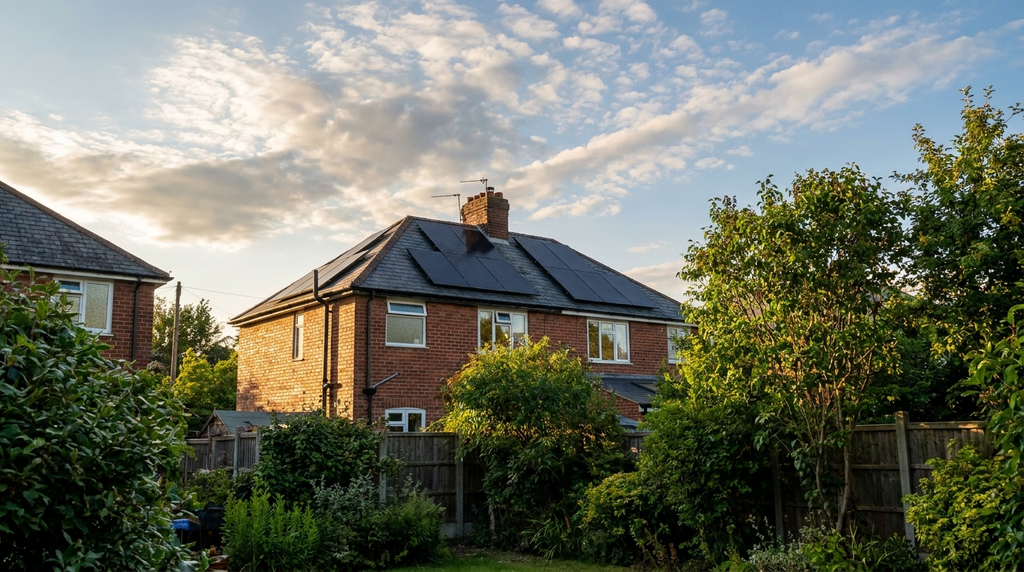
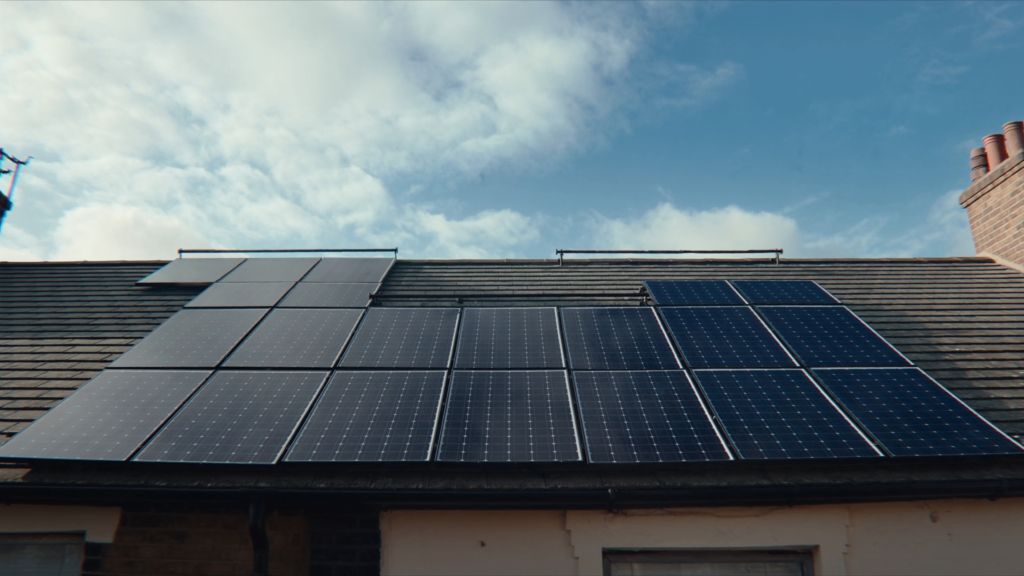
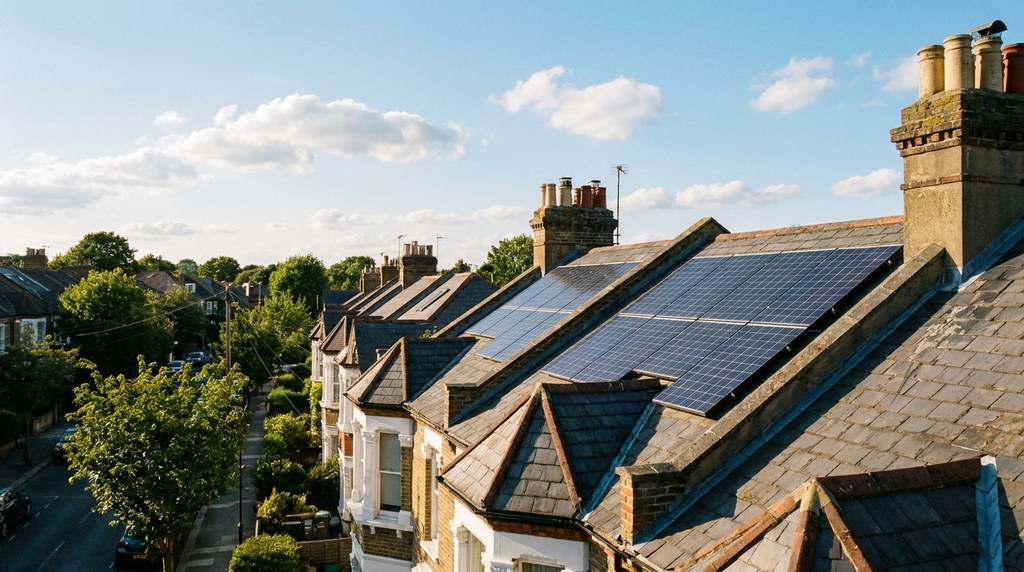
Solar thermal panels currently provide around 50–70% of a typical UK household’s annual hot water demand, making them one of the most cost-effective renewable technologies available to homeowners today. Unlike photovoltaic (PV) panels, which generate electricity, solar thermal systems capture the sun’s heat energy directly and use it to warm your domestic hot water, a simple, proven technology that has been installed in UK homes for over four decades. With energy bills remaining high and the ongoing push toward net zero, solar thermal remains a highly practical investment for homes with significant hot water needs.
How Solar Thermal Panels Work
A solar thermal system works by absorbing solar radiation through collector panels mounted on your roof, then transferring that captured heat to your hot water cylinder via a heat transfer fluid. The system has no moving parts beyond a small circulation pump, which makes it inherently reliable and low-maintenance.
Here is the core process, step by step:
- Sunlight strikes the collector panel and is absorbed by a dark-coated absorber plate or evacuated tubes.
- A heat transfer fluid, typically a water and glycol antifreeze mixture, circulates through the collector and picks up heat.
- The heated fluid travels down insulated pipework to a twin-coil hot water cylinder, usually located in an airing cupboard or utility room.
- A coil inside the cylinder transfers heat from the fluid to your domestic hot water supply.
- The cooled fluid returns to the collector to repeat the cycle, driven by a small pump controlled by a differential thermostat.
- A conventional boiler or immersion heater provides a top-up when solar gain is insufficient, typically during winter months.
Modern systems use a closed-loop, indirect circuit, meaning the heat transfer fluid never mixes with your drinking water. The differential controller constantly monitors the temperature difference between the collector and the cylinder bottom, activating the pump only when useful heat can be gained, typically when the collector is at least 5–8°C warmer than the stored water.
On a clear summer day, a well-sized system can raise 150–200 litres of water to above 60°C purely on solar energy. Even on overcast winter days, useful heat gain is still possible, though significantly reduced.
Types of Solar Thermal Panels
Two principal collector technologies dominate the UK market: flat plate collectors and evacuated tube collectors. Each suits different property types and budgets.
Flat Plate Collectors
Flat plate collectors consist of an insulated, glazed box containing a dark-coated metal absorber plate bonded to copper pipework. They are solid, relatively affordable, and perform well during the summer months. Their main limitation is greater heat loss in cold or overcast conditions, which reduces their winter performance compared to evacuated tubes. They are the more common choice for new installations in the south of England and are particularly well-suited to roof-integrated designs.
Evacuated Tube Collectors
Evacuated tube collectors use rows of glass tubes, each containing an absorber strip within a vacuum. The vacuum acts as near-perfect insulation, dramatically reducing heat loss. This makes evacuated tubes significantly more efficient in cold weather and on diffuse-light days, an important advantage in Scotland and northern England. They generate more heat per square metre annually in the UK climate, though they cost more to supply and install.
As a general guide, you need roughly 20–30% less roof area with evacuated tubes to achieve the same annual output as flat plates. Both types are suitable for the majority of UK properties and carry similar lifespans of 20–25 years with proper maintenance.
How Much Solar Thermal Panels Cost in 2026
Installation costs vary according to collector type, system size, property access, and whether a new hot water cylinder is required. The figures below reflect typical fully installed prices in the UK for 2026, including VAT at 0% (the zero-rate for energy-saving materials applies to solar thermal systems).
| System Type | Suitable For | Collector Area | Typical Installed Cost |
|---|---|---|---|
| Flat plate, small household | 1–2 people | 2–3 m² | £3,500 – £5,000 |
| Flat plate, medium household | 3–4 people | 3–4 m² | £4,500 – £6,500 |
| Flat plate, large household | 5+ people | 4–6 m² | £5,500 – £8,000 |
| Evacuated tube, small household | 1–2 people | 2–3 m² equivalent | £4,500 – £6,500 |
| Evacuated tube, medium household | 3–4 people | 3–4 m² equivalent | £5,500 – £8,000 |
| Evacuated tube, large household | 5+ people | 4–5 m² equivalent | £6,500 – £10,000 |
The largest single variable in cost is whether you already have a suitable hot water cylinder. Most solar thermal systems require a twin-coil cylinder, one coil for the solar circuit, one for your boiler. Replacing an existing single-coil cylinder adds £600–£1,200 to the project cost. Properties with combination boilers and no existing cylinder require a more substantial upgrade, potentially adding £1,500–£2,500 in cylinder and associated plumbing work.
Additional Cost Factors
- Roof access and scaffolding, typically £300–£600 for a straightforward two-storey property
- Roof-integrated collectors (replacing tiles), add £500–£1,500 but improve aesthetics significantly
- Remote monitoring, basic display units cost £100–£250; smart monitoring with app access costs £200–£400
- Ground-mounted or garage-roof frames, an option where roof orientation is unsuitable, adding £400–£900
Payback periods currently sit at 8–15 years for most UK households, depending on energy tariff, hot water usage, and system size. Given a system lifespan of 20–25 years, the majority of installations deliver a clear financial return over their lifetime in addition to the carbon savings.
Benefits of Solar Thermal Panels
Solar thermal systems deliver a range of measurable advantages for UK homeowners. Here are the headline benefits, backed by real data:
- Significant bill savings, a correctly sized system for a family of four typically saves £150–£300 per year on gas or electric water heating costs at current energy prices.
- High coverage of hot water demand, well-installed systems cover 50–70% of annual domestic hot water needs, rising to near 100% during summer months.
- Low carbon output, a 4 m² flat plate system saves approximately 200–300 kg of CO₂ per year when displacing gas heating, and significantly more when displacing electric immersion heating.
- Long system lifespan, quality collectors carry a 10-year manufacturer warranty as standard, with operational lifespans of 20–25 years widely documented.
- Minimal electricity consumption, the circulation pump typically uses just 25–60 watts, making the system’s own energy demand negligible.
- Compatibility with heat pumps, solar thermal integrates effectively with air source and ground source heat pumps, reducing the overall demand on the heat pump and improving its efficiency.
- Added property value, properties with renewable energy systems, including solar thermal, achieve a premium at sale, with research suggesting an uplift of 1–3% in property value in many areas.
- Low visual impact, collectors sit flush to or slightly above roof tiles and are considerably less conspicuous than large PV arrays, which can be important in conservation areas.
Grants and Funding for Solar Thermal Panels in 2026
The financial support landscape for solar thermal in the UK has evolved considerably since the closure of the domestic Renewable Heat Incentive in 2022. The current funding picture for 2026 is as follows.
Great British Insulation Scheme and ECO4
The Energy Company Obligation (ECO4) scheme continues to fund energy efficiency measures for low-income and vulnerable households. Solar thermal is an eligible measure under ECO4 where it contributes to overall home energy performance improvements. Households on qualifying benefits, including Pension Credit, Universal Credit, and certain disability benefits, may receive fully or substantially funded systems. Contact your energy supplier or your local council’s Home Energy team to check eligibility.
Home Upgrade Grant (HUG2 and Successors)
The Home Upgrade Grant scheme, administered through local authorities in England, targets owner-occupied and privately rented properties with an EPC rating of D or below that are not connected to the gas grid. Solar thermal is an eligible measure. Funding covers up to 100% of installation costs for eligible households. Wales and Scotland operate their own analogous schemes, Nest and Warmer Homes Scotland respectively, with similar eligibility criteria.
Zero VAT Rating
Since April 2022, solar thermal systems have attracted 0% VAT on both supply and installation. This is not a grant, but it is a meaningful cost reduction of what would otherwise be a 20% uplift on the total project cost. Ensure your installer quotes at 0% VAT, any installer quoting 20% VAT on a domestic solar thermal installation is applying the wrong rate.
Boiler Upgrade Scheme Interaction
The Boiler Upgrade Scheme (BUS) does not fund solar thermal directly, but if you are installing a heat pump under BUS alongside a solar thermal system, the combined approach is technically and financially sensible. The solar thermal reduces hot water demand on the heat pump, improving its seasonal performance and reducing your running costs.
Local Authority and Devolved Nation Schemes
A number of local authorities and housing associations run their own solar thermal funding programmes, particularly in Wales, Scotland, and some combined authority areas in England. It is worth contacting your local council’s energy or sustainability team to identify any schemes specific to your area.
How to Choose the Right Solar Thermal Panels
Selecting the correct system requires matching technology, sizing, and system design to your property and household. Work through the following decision framework before committing to any supplier.
Roof Orientation and Pitch
South-facing roofs at a pitch of 30–50° provide optimal output. East or west-facing roofs are viable but will deliver 15–25% less annual energy. North-facing roofs are generally unsuitable for roof-mounted collectors. Panels on an east or west pitch should be sized slightly larger to compensate. Evacuated tubes can be mounted at lower pitches than flat plates and still perform effectively, making them worth considering if your roof pitch is below 20°.
Household Hot Water Demand
Sizing is critical. Oversizing a solar thermal system leads to stagnation during summer, a condition where the system overheats because it is producing more heat than is being consumed. Use the following as a starting guide:
- 1–2 people: 2–3 m² flat plate or 20 evacuated tubes
- 3–4 people: 3–4 m² flat plate or 25–30 evacuated tubes
- 5–6 people: 4–5 m² flat plate or 30–40 evacuated tubes
Installers should carry out a proper sizing calculation based on your household’s daily hot water consumption in litres, not simply the number of bedrooms.
Cylinder Compatibility
Check what hot water cylinder you currently have. If you have a combi boiler with no cylinder, or a single-coil vented cylinder, budget for a replacement twin-coil cylinder. The cylinder should provide approximately 60–80 litres of capacity per person, so a family of four needs a 240–320-litre cylinder for good solar performance.
Collector Quality and Certification
Look for collectors carrying the Solar Keymark certification, which is the recognised European performance standard. Solar Keymark data tells you the collector’s optical efficiency and heat loss coefficients. This allows genuine performance comparison between products. MCS (Microgeneration Certification Scheme) certification of both the product and the installer is required for any grant-funded installation and remains good practice regardless.
Choosing an Installer
Use an MCS-certified installer for all solar thermal work. MCS certification requires demonstrated competency in system design and installation, and it is a prerequisite for accessing most funding schemes. Request at least two to three quotes and ask each installer to provide a written energy yield estimate (in kWh per year) based on your specific roof and household, not a generic figure from a brochure.
Solar Thermal Panel Installation, What to Expect
A standard residential solar thermal installation takes one to two days for a straightforward roof-mounted system on an accessible property. Here is what the process typically involves:
- Site survey, an MCS installer visits to assess your roof orientation, pitch, structural condition, and access to the existing hot water system. They confirm sizing and produce a formal design.
- Quote and acceptance, you receive a written quotation including the energy yield estimate, full specification, and any grant paperwork if applicable.
- Scaffolding erection, typically erected the day before installation, or on the morning of day one.
- Collector mounting, roof brackets are fixed to the rafters, a roof rail system is installed, and collectors are positioned and secured. Tiles are lifted and replaced around brackets; no large holes are cut in the roof.
- Pipework and pump station, insulated copper or stainless steel pipework is run from the collector down through the loft to the cylinder. A pre-assembled pump station unit (containing the pump, flow meter, pressure relief valve and expansion vessel) is mounted near the cylinder.
- Cylinder installation, if a new twin-coil cylinder is required, it is installed and connected to both the solar circuit and the existing boiler circuit.
- System commissioning, the circuit is pressure-tested, filled with heat transfer fluid, bled, and the differential controller is configured. The installer will check flow rates and confirm the system is operating correctly.
- Handover and documentation, you receive a handover pack including commissioning record, MCS certificate, manufacturer warranties, and operating instructions. The installer registers the installation on the MCS database.
Building regulations notification is required for solar thermal installations in England and Wales under Part P (electrical) and Part G (hot water). An MCS-certified installer will handle this as part of the installation process. Planning permission is not normally required for roof-mounted solar thermal in England and Wales under permitted development, provided the panels do not protrude more than 200mm from the roof surface, though properties in conservation areas or listed buildings require a separate assessment.
Common Problems and Maintenance
Solar thermal systems are genuinely low-maintenance, but they are not zero-maintenance. Understanding the common issues helps you catch problems early and protect your investment.
Annual Checks You Can Do Yourself
- Check the system pressure gauge on the pump station, it should read between 1 and 3 bar when cold. Consistently low pressure indicates a slow leak or expansion vessel failure.
- Inspect the controller display to confirm the pump is activating on sunny days and that temperatures look sensible (collector 40–80°C on a warm day; cylinder bottom rising through the morning).
- Visually inspect collectors from the ground for obvious physical damage, dirty glass, or standing water around roof penetrations.
Professional Servicing
A professional service every 3–5 years is recommended. This covers checking and topping up the heat transfer fluid (glycol degrades over time and should be replaced if the pH falls below 7 or the freezing point protection has been compromised), inspecting seals and connections, testing the expansion vessel pre-charge, and verifying controller settings. Typical service cost is £150–£300.
Stagnation
Stagnation occurs when the system cannot shed heat, typically during summer holidays when hot water demand drops while solar gain is high. Modern systems are built to tolerate limited stagnation, but repeated or prolonged stagnation degrades the heat transfer fluid rapidly and can stress collector seals. If you are away for more than two weeks in summer, covering the collectors with an old blanket or turning the system off via the controller is good practice.
Pump Failure
The circulation pump is the only active component in the system and has a typical lifespan of 10–15 years. A failed pump is the most common cause of a solar thermal system ceasing to work. Replacement pumps for common pump station units cost £80–£200 and are straightforward for a qualified plumber to replace.
Frost Protection
UK solar thermal systems use a glycol antifreeze mix, typically providing protection to −25°C or below. Provided the fluid is checked at service intervals, frost damage is very rare. However, systems that have been left unserviced for many years may have degraded glycol that no longer provides adequate frost protection, another reason to maintain the service schedule.
Solar Thermal Panels and Home Heating Integration
While solar thermal systems are primarily designed for domestic hot water, larger or more sophisticated installations can contribute to space heating as well. Solar combisystems use a larger collector array (typically 8–15 m²) and a large thermal store (500–1,500 litres) to provide both hot water and a meaningful contribution to underfloor or low-temperature radiator heating systems.
Solar combisystems are more complex and expensive, installed costs typically run from £12,000 to £25,000, and are most practical in well-insulated, low-energy homes where the heating demand has already been reduced significantly. They are more common in new-build or deeply retrofitted properties. For the majority of existing UK homes, a hot-water-only system delivers the best return on investment.
Solar thermal also works well alongside heat pump systems. The solar thermal handles hot water production during spring, summer, and autumn, and the heat pump handles space heating and winter hot water top-up. This reduces the hot water load on the heat pump and can improve its overall Coefficient of Performance (COP) by allowing it to operate at lower temperatures for space heating without compromising hot water supply.
Solar Thermal Performance Data, What to Realistically Expect
Understanding realistic performance helps you evaluate quotes and monitor your system effectively once installed. The table below shows indicative annual energy yields for typical UK installations, based on MCS performance methodology and average UK irradiation data.
| Location | Collector Type | Collector Area | Annual Yield (kWh) | % Hot Water Covered |
|---|---|---|---|---|
| South England | Flat plate | 3.5 m² | 1,400 – 1,700 | 60–70% |
| Midlands | Flat plate | 3.5 m² | 1,200 – 1,500 | 55–65% |
| North England / Scotland | Flat plate | 3.5 m² | 1,000 – 1,300 | 45–55% |
| South England | Evacuated tube | 3 m² equiv. | 1,500 – 1,800 | 65–75% |
| North England / Scotland | Evacuated tube | 3 m² equiv. | 1,200 – 1,500 | 55–65% |
These figures assume a south-facing roof at 35–45° pitch, a 4-person household with typical hot water consumption of around 120–150 litres per day, and a properly sized twin-coil cylinder. East or west-facing roofs should discount expected yields by 15–20%. Any installer quoting yields significantly above these ranges without a specific justification should be questioned carefully.
Is Solar Thermal Right for Your Home
Solar thermal panels suit a specific set of circumstances exceptionally well. They deliver their strongest case where gas or electricity costs for water heating are high, where hot water demand is consistent and substantial, and where a suitable south-to-east-to-west-facing roof exists with adequate unshaded area.
They are less well-suited to homes with combi boilers that have no cylinder, where the cost and disruption of adding a hot water cylinder may outweigh the benefit, though for families considering a longer-term move away from gas, a solar thermal system combined with a new cylinder and eventual heat pump forms a coherent, future-proof plan.
Properties in conservation areas or with flat roofs need slightly more planning before proceeding, but neither situation is a barrier, flat-plate systems can be mounted at an angle on flat roofs using purpose-made frames, and conservation area planning consent for solar thermal is routinely granted on non-principal elevations.
For any home that uses significant volumes of hot water, families, homes with regular guests, properties with swimming pools or hot tubs, solar thermal remains one of the most financially and environmentally sound investments available in 2026. The technology is mature, the supply chain is established, and the savings are predictable and measurable from day one.