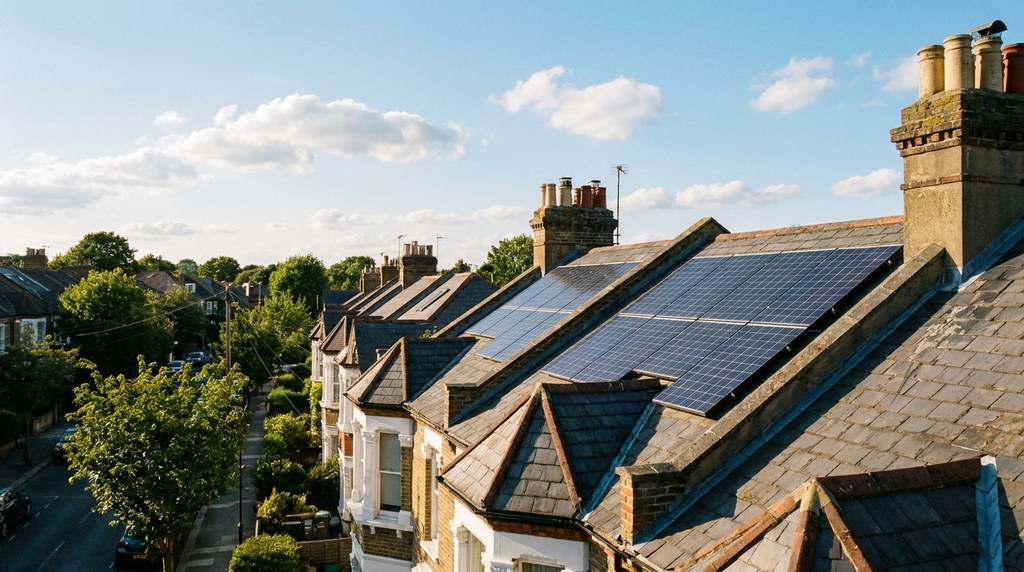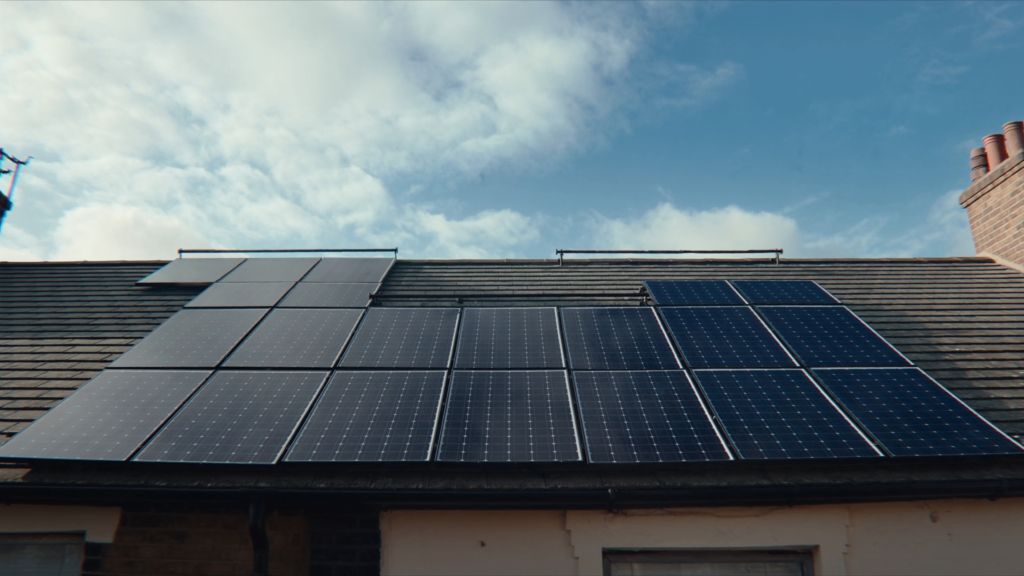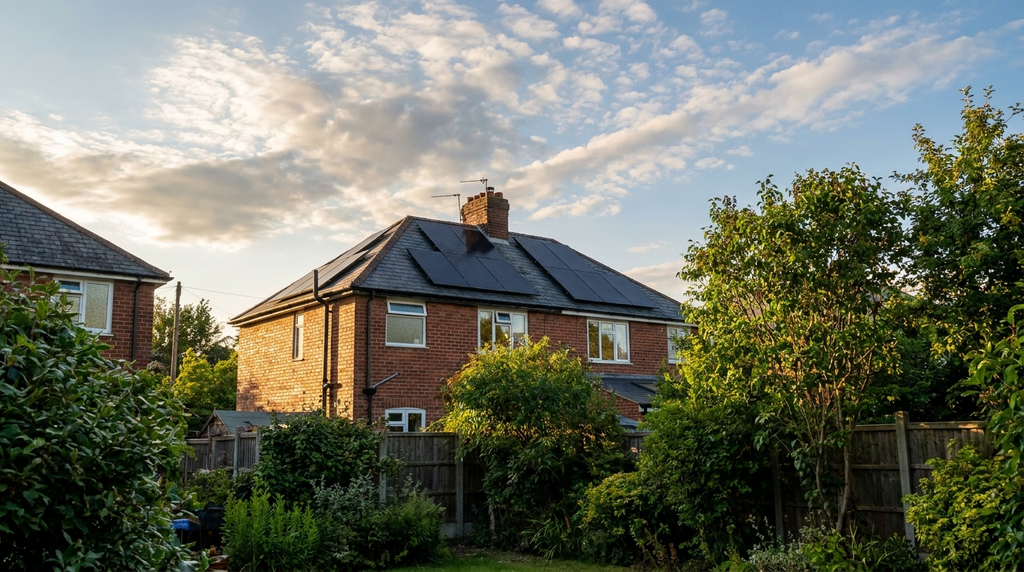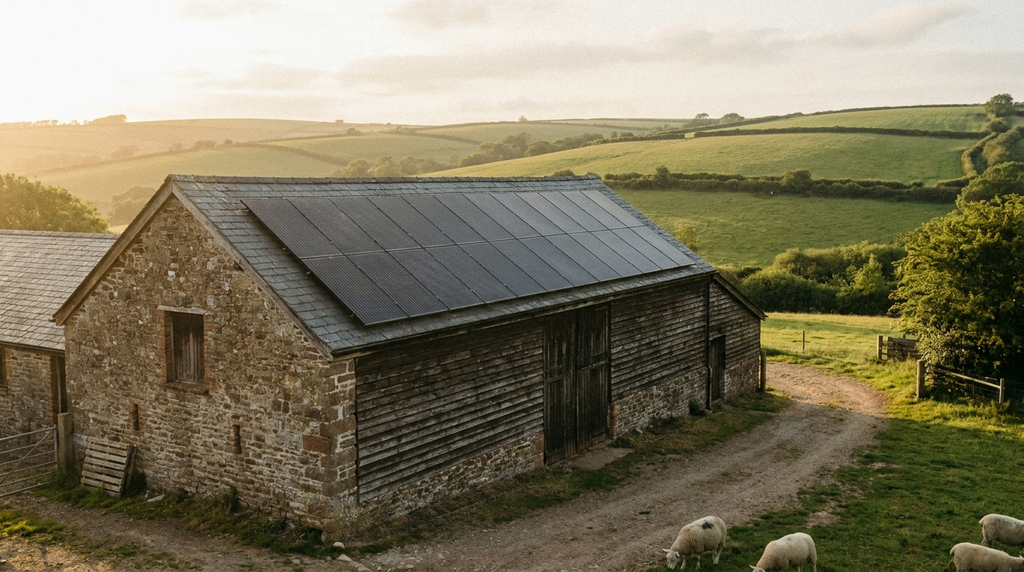
The number of solar panels you need depends first on your home’s annual electricity use, not its roof size
The starting point for any calculation is the household’s total annual electricity consumption in kilowatt-hours (kWh), typically found on an annual statement or via the Ofgem price-cap breakdown. A typical UK home uses roughly 2,700 kWh per year, according to DESNZ (Department for Energy Security and Net Zero) statistics for an average three-bedroom household (DESNZ, 2026). Roof area and orientation then determine whether that many panels can physically fit; a standard panel is about 1.9m by 1.0m and produces around 400–450 watts (W) peak. The target number of panels is the one that covers 80–100% of annual usage, not the maximum the roof can hold, oversizing leads to low self-consumption without a battery.
How to calculate the number of panels from your electricity bill
Divide your annual kWh consumption by the estimated annual output of a single panel in your region. A 430W panel in a south-facing, 30-degree roof in southern England generates roughly 350–400 kWh per year; in northern Scotland that drops to 300–350 kWh (source: Energy Saving Trust solar calculator methodology). Example: 2,700 kWh ÷ 375 kWh per panel = 7.2 panels, so 7–8 panels is the baseline for an average home. For households using 4,000 kWh (e.g., with electric heating or an EV), the same calculation gives 10–11 panels. The Energy Saving Trust (EST) provides a free online solar calculator that uses your postcode and bill data (Energy Saving Trust, 2026).
Quick numbers, panel count by household energy use
| Annual electricity use (kWh) | Typical home type | Estimated panel count (430W panels, south-facing) | Roof area needed (approx.) |
|---|---|---|---|
| 1,800 | Small flat / 1-bed | 4–5 | 8–10 m² |
| 2,700 | Average 3-bed | 7–8 | 14–16 m² |
| 3,500 | 4-bed with family | 9–10 | 18–20 m² |
| 4,500 | Large home + EV | 12–13 | 24–26 m² |
Rows show the direct relationship between usage and panel count; figures are rounded to whole panels. Source for kWh per panel: EST solar calculator assumptions (2026 update). Source for typical home usage: DESNZ “Energy Consumption in the UK” data tables.
How roof orientation, pitch, and shading change the number
South-facing roofs at 30–40° pitch are optimal; east/west-facing roofs produce about 75–85% of the output per panel, meaning you need 1–2 extra panels to match the same annual yield (source: MCS installation standards guidance). Flat roofs require tilted mounting frames, which use more space and may reduce the number of panels that fit. Heavy shading from trees or chimneys can cut a panel’s output by 20–50%; partial shading often makes a string inverter system less efficient, so microinverters or optimisers may be needed. The EST solar calculator accounts for orientation and shading when you input your roof details (Energy Saving Trust, 2026).
The direct answer to “how many solar panels do I need”, the one-sentence rule
For a typical UK home using 2,700 kWh per year, you need 7 to 8 standard 430W solar panels mounted on a south-facing roof with no significant shading. This is the featured-snippet target: a plain, actionable number based on the most common household profile. If your usage differs, adjust the count up or down by roughly one panel for every 350–400 kWh of annual consumption. This rule assumes a grid-connected system without battery storage; adding a battery allows you to oversize slightly (by 1–2 panels) without wasting excess generation.
how much a solar panel system costs in 2026
How to verify a solar installer, MCS certification and TrustMark
In the UK, any installer you use must be MCS (Microgeneration Certification Scheme) certified to qualify for the Smart Export Guarantee (SEG) payments (source: GOV.UK page “Smart Export Guarantee”). MCS certification covers both the installer company and the specific panel and inverter products they fit; check the MCS register at mcscertified.com. TrustMark registration is also recommended, it adds a layer of consumer protection through the Government-endorsed quality scheme (TrustMark, 2026). For electrical work, the installer should be registered with NICEIC or NAPIT; this is not mandatory for solar but is standard for a safe installation. Always ask for a written quote that includes the expected annual kWh output, the panel model, and the inverter type, this is required under MCS standards.
What the Smart Export Guarantee (SEG) means for your panel count
The SEG pays you for excess electricity exported to the grid; most suppliers pay 4–15 pence per kWh (source: Ofgem SEG rate data, current as of 2026). If you install 8 panels on a 2,700 kWh home, you might export 30–40% of generation (about 900–1,200 kWh per year), earning roughly £40–£180 annually depending on the tariff. Oversizing to 10 panels increases export but also increases upfront cost; the SEG rate is low enough that it rarely justifies extra panels beyond covering your own usage. A battery can store excess generation for evening use, reducing exports and improving self-consumption from 50% to 70–80% (source: EST research on solar-plus-battery performance).
whether solar panels are worth it in 2026