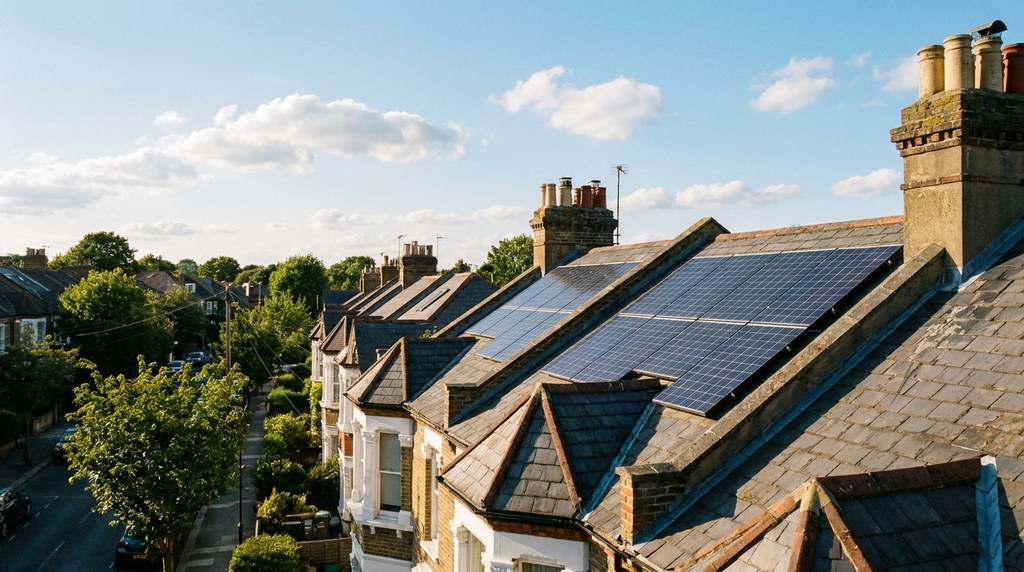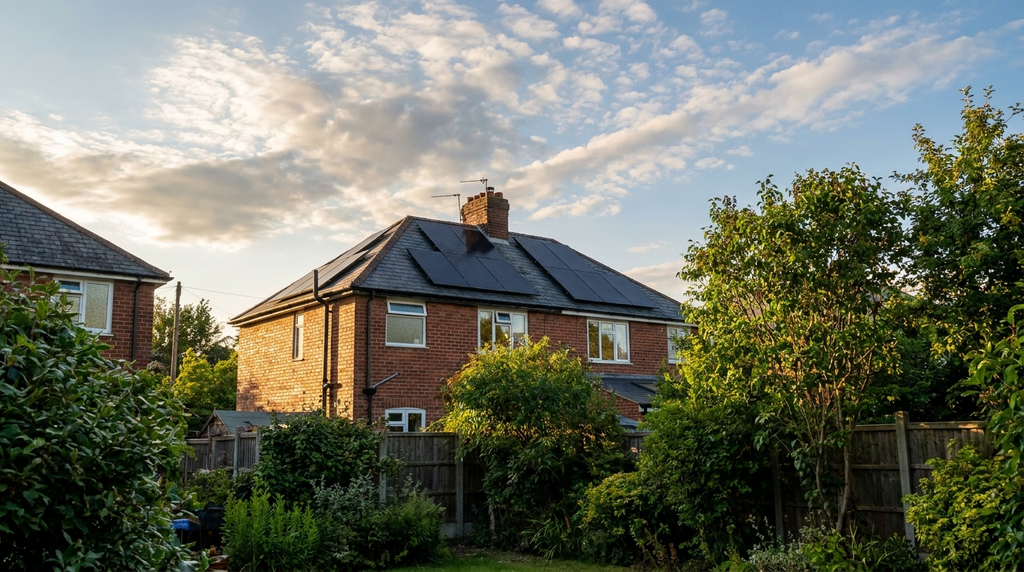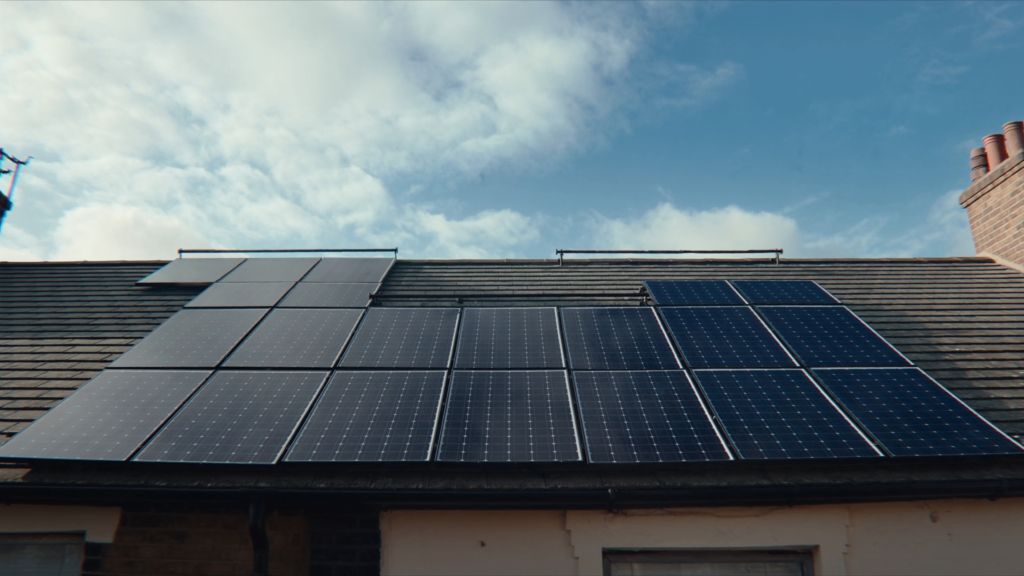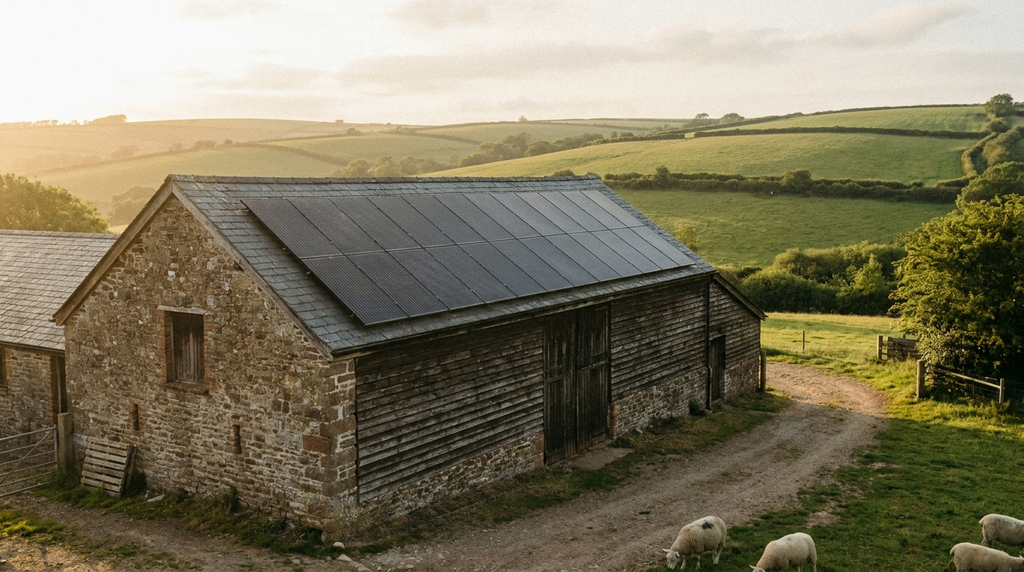
A typical 4 kW solar panel system needs about 20–25 square metres of roof space. That is roughly the size of a single garage roof or half a tennis court. Each standard panel (about 1.7m x 1.0m) covers 1.7 square metres, so a 4 kW system uses 10–12 panels.
To work out your exact space, divide your target system size (in kW) by 0.4. For example, a 3 kW system needs about 7.5 square metres ÷ 0.4 = 7.5 panels, but you should round up to 10 panels for realistic wiring. For a 5 kW system, you need about 12.5 panels, so 13 panels at 22.1 square metres. The Energy Saving Trust notes that most UK homes have enough south-facing roof for a 3–4 kW system, which covers 40–60% of a typical household’s annual electricity use.
| System size | Panels needed | Roof space required | Equivalent to |
|---|---|---|---|
| 3 kW | 10 | 17 m² | Two car parking spaces |
| 4 kW | 12 | 20.4 m² | Single garage floor |
| 5 kW | 13 | 22.1 m² | Small garden shed floor |
You also need clear space free from chimneys, vents, or dormers. The roof should face roughly south (east to west is acceptable but reduces output by 10–20%). Avoid north-facing slopes entirely. A 30–40 degree pitch is ideal, but flat roofs work with angled frames, though you lose about 10% efficiency.
When this matters more: if your roof is small, shaded, or has unusual angles, you may need fewer panels but higher-efficiency ones, which cost about 10–20% more per watt. When it does not matter: if you have a large south-facing roof over 30 m², almost any domestic system will fit without issue.
Bottom line: a typical 4 kW system needs 20–25 m² of clear south-facing roof. Measure your roof’s usable area and divide by 1.7 to see how many panels you can fit.
Sources
A worked example
A typical 1930s semi-detached home in Manchester with a south-facing roof can fit a 4 kW solar panel system using 12 panels, costing £6,500 after the 0% VAT saving (in place until March 2027). The roof space required is 20.4 square metres, which is roughly the size of two car parking spaces. Based on Energy Saving Trust figures, this system generates around 3,400 kWh per year, saving a household approximately £560 annually on electricity bills. With the Smart Export Guarantee paying about £120 per year for exported power, total yearly savings reach £680. The payback period is around 9.5 years, and over a 25-year lifespan the system delivers total savings of £17,000. A household earning under £31,000 may qualify for the ECO4 scheme, which can cover the full installation cost for eligible homeowners.
| Item | Figure |
|---|---|
| Upfront cost after grants | £6,500 |
| Yearly savings | £680 |
| Payback period | 9.5 years |
| 25-year lifetime savings | £17,000 |
What homeowners often get wrong
The most common mistake is assuming you need a perfectly unshaded south-facing roof, which stops many homeowners from installing panels on perfectly viable roofs. Here are three frequent errors to avoid
- Thinking north-facing roofs are useless A north-facing roof does reduce output by up to 50%, but if you have a large roof and use high-efficiency panels, you can still generate a worthwhile 1,500–2,000 kWh per year. Many homeowners miss out on savings by dismissing north-facing slopes entirely.
- Ignoring shading from chimneys and vents A single chimney casting shade on two panels can cut total system output by 15–20%. Microinverters or power optimisers cost about £200 extra but prevent this loss, saving you £100 per year in missed generation.
- Overlooking roof orientation for east-west setups An east-west roof split across two slopes can still generate 80–90% of a south-facing system. Some installers quote for a single south-facing array only, missing the chance to fit panels on both sides and boost total capacity by 30%.
Quick reference
- A standard 1.7m x 1.0m panel needs exactly 1.7 square metres of clear roof space with no obstructions.
- Most UK homes have enough south-facing roof for a 3–4 kW system, according to the Energy Saving Trust.
- To qualify for 0% VAT on solar panels, the installation must be carried out by an MCS-certified installer and completed before March 2027.
- East or west-facing roofs typically generate 10–20% less electricity than a south-facing array of the same size.
- Shading from a single chimney can reduce total system output by 15–20%, making microinverters a worthwhile investment.
Frequently Asked Questions
For a typical 4 kW solar panel system, you need about 20–25 square metres of clear, south-facing roof space. That's roughly the size of a single garage floor. The Energy Saving Trust says most UK homes have enough roof for a 3–4 kW system.
A 3 kW system typically needs 10 standard panels, requiring about 17 square metres of roof space. That's about the size of two car parking spaces. You should round up for realistic wiring, so 10 panels is a good estimate.
No, you should avoid north-facing slopes entirely as they receive very little direct sunlight. South-facing roofs are ideal, but east or west-facing is acceptable and reduces output by 10–20%. A 30–40 degree pitch is best for maximum efficiency.
A 4 kW solar panel system typically costs between £5,000 and £8,000 in the UK, depending on panel efficiency and installer. You may be eligible for the Smart Export Guarantee (SEG) to earn money for excess electricity, but there are no upfront grants currently available from the government.
If your roof is small or shaded, you can use fewer panels but choose higher-efficiency ones, which cost about 10–20% more per watt. Measure your roof's usable area and divide by 1.7 to see how many standard panels fit. For roofs under 17 m², a 3 kW system may still be possible.