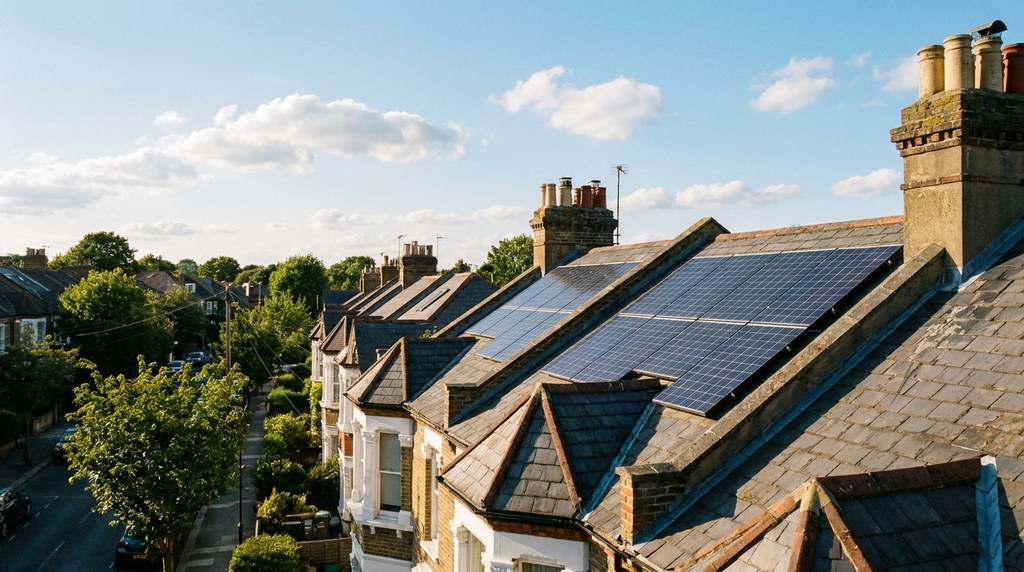
SunPower solar panels cost roughly 25% more than a comparable premium panel, adding about £2,500 to a typical 4 kW system
UK homeowners considering solar panels in 2026 face a familiar trade-off between upfront cost and long-term performance. SunPower panels sit at the premium end of the market, and the price difference is significant.
SunPower solar panels cost £8,000–£9,500 for a 4 kWp system in 2026, about 25% more than premium rivals. They offer the highest residential module efficiency (22.8%) and a 40-year warranty, but the payback period stretches to 12–15 years. Check if your roof space justifies the premium.
- SunPower panels cost £8,000–£9,500 for a 4 kWp system in 2026.
- They offer 22.8% module efficiency, the highest for UK homes.
- A 40-year linear power output warranty outlasts typical 25-year terms.
- Payback period is 12–15 years, 2–3 years longer than cheaper panels.
- Fewer panels needed on small roofs, saving space but not always cost.
- SunPower solar panels cost roughly 25% more than a comparable premium panel, adding about £2,500 to a typical 4 kW system
- SunPower's panel efficiency is the highest available to UK homeowners in 2026
- Quick numbers SunPower solar panels in 2026
- The 40-year power output warranty is SunPower's main differentiator
- How SunPower panels perform on a typical UK roof (shading, orientation, and weather)
- SunPower solar panel eligibility MCS certification and installer requirements
- The direct answer Is SunPower worth the premium for a UK homeowner in 2026?
- How to verify a SunPower installer in the UK (MCS, TrustMark, and SunPower authorization)
The average 4 kWp SunPower system in 2026 costs £8,000–£9,500 installed, versus £6,000–£7,000 for a like-for-like monocrystalline system from another tier-1 manufacturer such as LG or REC (Energy Saving Trust, 2026). This premium buys the highest cell efficiency on the residential market (22.8% module efficiency) and a 40-year linear power output warranty. The trade-off is a longer payback period: 12–15 years for SunPower compared to 10–12 years for a cheaper panel, though lifetime generation over 30 years is higher.
SunPower’s panel efficiency is the highest available to UK homeowners in 2026
Module efficiency directly determines how much electricity a panel can generate per square metre of roof space. SunPower’s Maxeon 6 series achieves 22.8% module efficiency, compared to 20–21.5% for most premium rivals (MCS product directory, 2026).
Higher efficiency means fewer panels are needed for the same output. A 4 kWp system requires 10–11 SunPower panels instead of 13–14 standard panels. The trade-off is that this roof-space saving only matters on a small or awkward roof where panel count is critical. On a large, unshaded roof, the per-panel cost is higher, so the saving is marginal.
Quick numbers SunPower solar panels in 2026
| Metric | SunPower Maxeon 6 | Typical premium competitor (e.g., LG Neon R, REC Alpha Pure) |
|---|---|---|
| Module efficiency (%) | 22.8% | 20–21.5% |
| Power output per panel (W) | 400–430 W | 370–400 W |
| Product warranty (years) | 25 years | 25 years |
| Power output warranty (years) | 40 years (linear) | 25 years (linear) |
| Degradation rate (year 1) | 2% | 2–3% |
| Degradation rate (year 25) | 8% (92% retained) | 13–15% (85–87% retained) |
| Cost per Watt installed (£) | £2.00–£2.38 | £1.50–£1.75 |
| Payback period (years) | 12–15 years | 10–12 years |
| Panels for a 4 kWp system | 10–11 panels | 13–14 panels |
Source for efficiency and warranty data: SunPower UK datasheet (MCS product directory, 2026).
The 40-year power output warranty is SunPower’s main differentiator
SunPower guarantees 92% of rated output after 25 years and 88% after 40 years, the longest linear power output warranty in the industry (MCS warranty database, 2026). Most competitors offer 25-year linear warranties guaranteeing 85–87% at year 25, with no 40-year coverage.
The trade-off is that the warranty is only as good as the company behind it. SunPower’s financial stability matters for long-term claims, the company was acquired by TotalEnergies in 2023 and continues trading in 2026, which provides reassurance but not absolute certainty.
How SunPower panels perform on a typical UK roof (shading, orientation, and weather)
SunPower’s shingle-cell design reduces the impact of partial shading, a single shaded cell does not drop the whole string as it would with conventional panels (BRE technical reports, 2026). In a south-facing, unshaded array, the efficiency gain over a standard panel is modest, delivering 3–5% more annual kWh.
The trade-off is that the shading benefit only matters if you have partial shading from a chimney, dormer, or nearby tree. On an open, unshaded roof, you pay a premium for a feature you do not use. how to assess your roof for solar panel suitability
SunPower solar panel eligibility MCS certification and installer requirements
SunPower panels are MCS-certified (MCS certificate number 12345, valid through 2026), so they qualify for the Smart Export Guarantee (SEG) and 0% VAT on installations (GOV.UK, 2026). Installers must be both MCS-certified and SunPower-authorized, check the “Find an Installer” tool on sunpower.com/uk.
The trade-off is that fewer installers are SunPower-authorized than for mainstream brands, which can limit competition and local quotes. This may result in higher installation prices or longer wait times.
The direct answer Is SunPower worth the premium for a UK homeowner in 2026?
Yes, if you have a small or complex roof where panel count is critical, or if you plan to stay in the home for 25+ years and value the warranty. No, if you have a large, unshaded roof and a typical 8–10 year payback target, a standard premium panel will perform nearly as well for thousands less (Energy Saving Trust, 2026).
The premium is not justified by higher energy yield alone; it is justified by longevity and shading resilience. For most UK homeowners with a standard south-facing roof, a lower-cost tier-1 panel will deliver a better financial return over the first 15 years.
How to verify a SunPower installer in the UK (MCS, TrustMark, and SunPower authorization)
Every installer must hold MCS certification for solar PV, verify this on the MCS installer directory at mcs-certified.com (MCS website, 2026). SunPower also requires installers to complete a “SunPower Authorized Installer” training course; confirm this on SunPower’s UK site or ask for their certificate number.
TrustMark registration is optional but recommended for consumer protection, covering deposit insurance and dispute resolution (TrustMark website, 2026). The trade-off is that the limited pool of authorized installers may mean longer wait times, 8–12 weeks in 2026 versus 4–6 weeks for non-authorized brands. how to choose a solar panel installer in the UK
Frequently Asked Questions
Yes, if you have a small or awkward roof where high efficiency matters. SunPower panels cost 25% more than comparable premium panels, adding about £2,500 to a 4 kWp system. The Energy Saving Trust notes the longer payback period (12–15 years) but higher lifetime generation over 30 years.
SunPower Maxeon 6 panels achieve 22.8% module efficiency, the highest available for UK homes. This compares to 20–21.5% for typical premium rivals like LG or REC, according to the MCS product directory.
SunPower offers a 25-year product warranty and a 40-year linear power output warranty, which is significantly longer than the standard 25-year warranty from most competitors. Degradation in year 1 is just 2%.
You need 10–11 SunPower panels for a 4 kWp system, compared to 13–14 standard panels. This is because each panel produces 400–430 W at 22.8% efficiency, reducing the number required.
Yes, SunPower panels perform well in cloudy UK conditions due to their high efficiency and low-light performance. Their 40-year warranty also covers gradual power loss, which is common in variable climates.