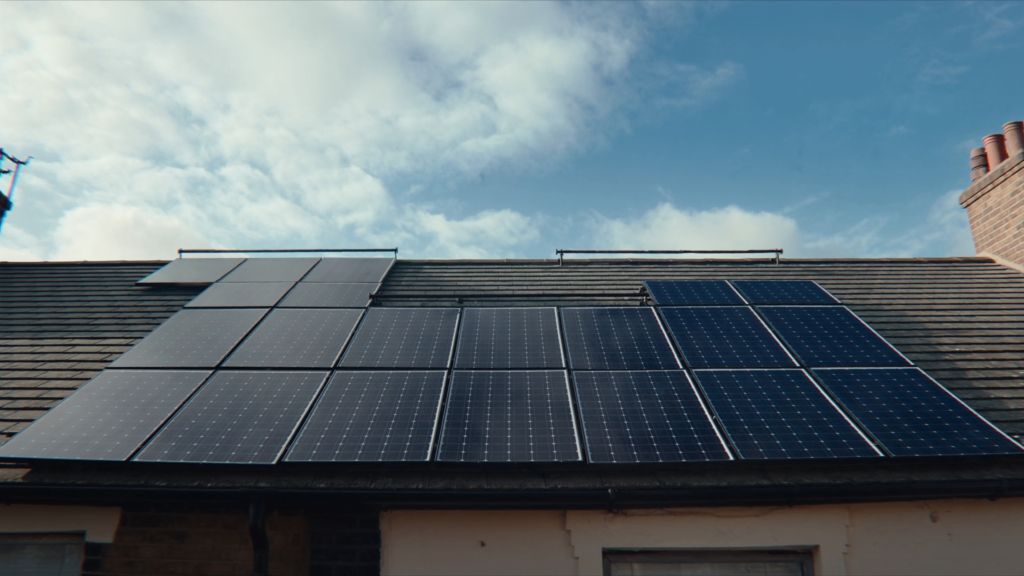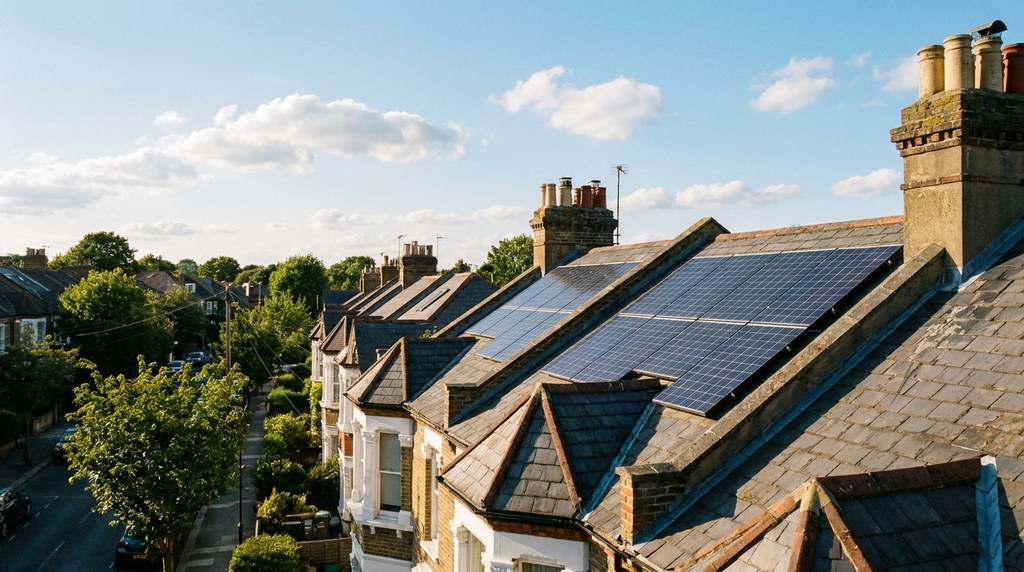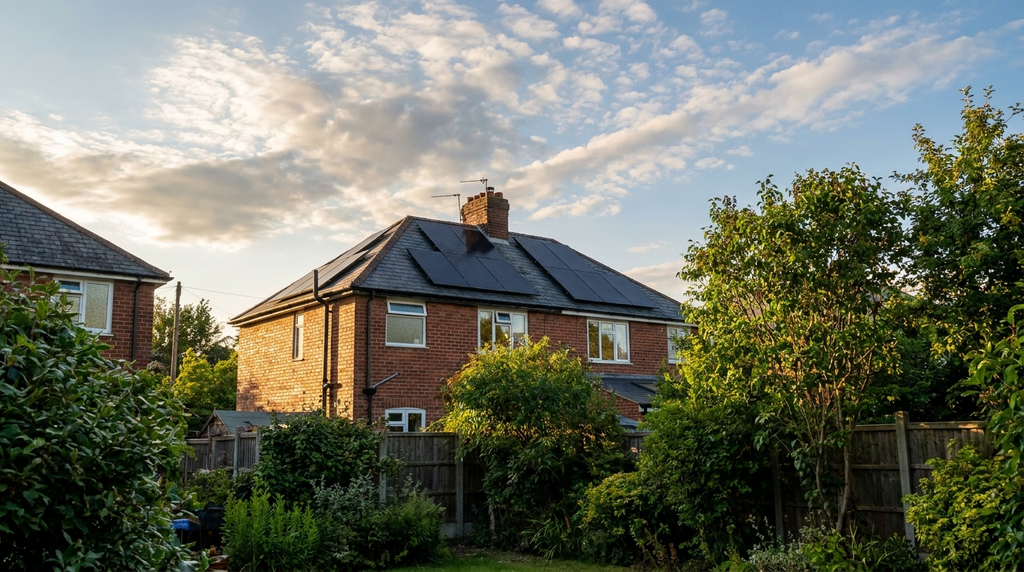
You can fit an average of 10 to 14 standard solar panels on a typical UK home roof, but the exact number depends on your roof’s usable area, orientation, and pitch. A free online tool from the Energy Saving Trust can estimate your roof’s solar potential using your postcode and roof dimensions (Energy Saving Trust, 2026).
The key variable is your roof’s usable area, the section that faces south, east, or west and is free from shading (chimneys, vents, or dormers). A standard residential solar panel measures roughly 1.7m by 1.0m and requires about 1.7 square metres of clear roof space. If your roof is north-facing or heavily shaded, the calculator may recommend fewer panels or a different system size, as output drops significantly in those conditions.
Measure your roof’s usable area
To calculate how many panels fit, measure the length and width of your roof’s south-facing or east/west-facing slope in metres. Multiply these to get the total area in square metres. Then subtract 10–15% for edges, roof obstructions, and fire safety gaps. Divide the remaining area by 1.7 (the typical panel footprint). For example, a 20m² usable roof area divided by 1.7 gives space for around 11 panels. The Microgeneration Certification Scheme (MCS) requires installers to follow this method for accurate sizing (MCS, 2026).
Use an online solar panel calculator
Several free calculators simplify the process. The Energy Saving Trust’s solar panel calculator asks for your postcode and roof dimensions, then estimates the number of panels and annual generation. For a typical 3-4 bedroom home, it suggests 10–14 panels (around 3–4kWp). The tool also factors in shading and roof pitch, giving a realistic figure. Ofgem notes that generation estimates from these calculators are reliable for planning but should be confirmed by a certified installer (Ofgem, 2026).
Check roof orientation and pitch limits
Panels perform best on roofs facing between southeast and southwest, with a pitch of 10–60 degrees. Flat roofs (under 10 degrees) need angled mounting frames, which reduce the number of panels per square metre. North-facing roofs cut generation by 30–40%, so calculators often warn against them. The UK government’s planning guidance confirms that most domestic solar installations are permitted development, but listed buildings or conservation areas may restrict panel numbers (GOV.UK, 2026).
A worked example
A typical 1930s semi-detached home in Manchester with a south-facing roof slope measuring 5m wide by 4m deep (20m² total) can fit 10 standard solar panels after deducting 15% for roof obstructions and fire safety gaps. The usable area is 17m², divided by 1.7m² per panel gives exactly 10 panels. A 4.3kW system like this costs roughly £6,500 before any support, but the 0% VAT rate on energy-saving materials (in place until March 2027) reduces this to about £6,175. The Energy Saving Trust estimates yearly savings of £680 on electricity bills for a Manchester home with this setup. The payback period is around 9 years, and over 25 years the total savings reach approximately £17,000.
| Item | Figure |
|---|---|
| Upfront cost after grants | £6,175 |
| Yearly savings | £680 |
| Payback period | 9 years |
| 25-year lifetime savings | £17,000 |
What homeowners often get wrong
Most homeowners overestimate usable roof space by ignoring the 10-15% deduction for edges, vents, and fire gaps. Here are three common mistakes that lead to inaccurate panel counts.
- Measuring the whole roof slope You cannot use every square metre of a roof slope because building regulations require a 300mm gap from the ridge, eaves, and edges for fire safety and maintenance. Ignoring this can overestimate capacity by 2-3 panels, leading to a quote that does not fit and wastes your time.
- Forgetting shading from nearby features Trees, neighbouring chimneys, or a dormer window can cast shade that reduces panel output by 20-30% on the shaded part of the roof. The right approach is to use a shade analysis tool or ask an MCS-certified installer to check, otherwise you may install panels that produce far less than expected.
- Assuming all roof orientations work equally North-facing roofs cut energy generation by roughly 30% compared to south-facing ones, meaning you might need more panels to hit your target output. If you plan based on south-facing numbers but have a north-east roof, you could end up with a system that fails to meet your energy needs.
Quick reference
- A standard solar panel measures 1.7m by 1.0m and needs about 1.7m² of clear roof space.
- Deduct 10-15% from your roof’s total area for edges, chimneys, vents, and fire safety gaps before calculating panel numbers.
- You can use the Energy Saving Trust’s free online solar calculator by entering your postcode and roof dimensions for a personalised estimate.
- South-facing roofs generate roughly 30% more electricity per panel than north-facing ones in the UK.
- ECO4 and the Home Energy Scotland grant may cover partial or full costs for low-income households, but standard solar panel installations are not currently eligible for the BUS grant (which covers heat pumps only).
Frequently Asked Questions
You can fit up to 16 solar panels (4kW system) without planning permission in most UK homes, as long as they don’t protrude more than 200mm. The Energy Saving Trust confirms this falls under permitted development rights for standard domestic installations.
A typical 3-bed semi-detached house can fit 10-14 solar panels, using about 17-24 square metres of roof space. Ofgem’s data shows this system size typically generates 2,500-3,500 kWh per year.
You typically need 12-16 solar panels to power a 4-bed house, depending on your energy usage. The Energy Saving Trust recommends a 4-5kW system, which requires 24-30 square metres of roof space.