The average cost to install loft insulation in a UK home in 2026 is between £300 and £700 for a standard DIY roll installation, with professional fitting adding £150–£300 to the labour cost
If you are looking into insulating your loft, the first question is usually about cost. The most frequently searched price range for loft insulation in the UK is £300 to £700 for DIY mineral wool rolls covering a typical 3-bedroom semi-detached house with a loft area of 50 to 60 square metres.
Professional installation of the same mineral wool material costs between £450 and £1,000, including labour, based on average quotes from the Energy Saving Trust (Energy Saving Trust, 2026). The actual cost for your home depends on your property type. A terraced house loft is cheaper, typically £250 to £500, while a large detached home can exceed £1,200.
Quick numbers cost, savings, and payback for different insulation types
| Insulation type | Material cost per m² (DIY) | Installed cost per m² | Typical U-value (W/m²K) | Annual heating bill saving | Payback period (years) |
|---|---|---|---|---|---|
| Mineral wool rolls | £4–£8 | £10–£15 | 0.20 | £180–£285 | 2–4 |
| Blown mineral fibre | N/A (professional only) | £10–£15 | 0.16–0.20 | £180–£285 | 2–5 |
| Rigid foam boards | £10–£20 | £20–£30 | 0.18 | £180–£285 | 3–6 |
| Sheep’s wool | £12–£20 | £22–£35 | 0.21 | £180–£285 | 4–7 |
| Multifoil | £15–£25 | £25–£40 | 0.35–0.50 | £100–£180 | 5–10 |
Savings figures are based on a gas-heated 3-bed semi-detached house with 270mm insulation depth, from the Energy Saving Trust loft insulation calculator (Energy Saving Trust, 2026). U-values come from the Building Regulations Approved Document L 2026 edition (DESNZ, 2026).
The direct answer for most UK homes
The annual saving on heating bills is typically £180 to £285 for a gas-heated semi-detached house, according to the Energy Saving Trust (Energy Saving Trust, 2026). This means the upfront cost is recovered in 2 to 5 years for most standard installations.
The exact saving depends on your current insulation depth. Topping up from 50mm to 270mm saves more than insulating from scratch because the biggest heat loss is stopped first. Homes with electric heating see larger savings, up to £400 per year, which shortens the payback period even further (Energy Saving Trust, 2026).
How to choose between DIY mineral wool and professional blown insulation
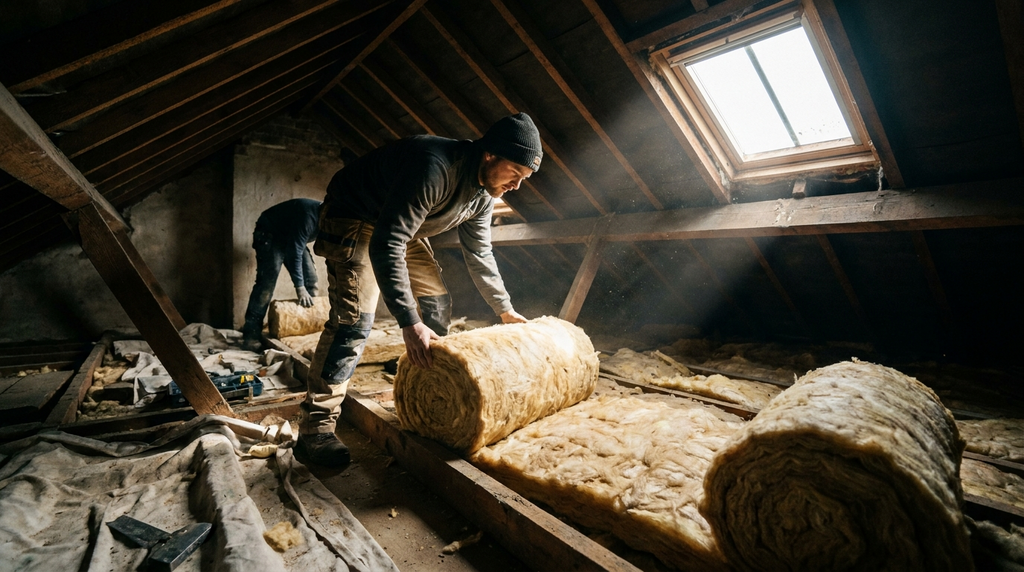
DIY mineral wool rolls cost £4 to £8 per square metre and are simple to lay between and over joists. However, they require careful handling and full coverage to avoid gaps that reduce performance (MCS, 2026).
Professional blown mineral fibre costs £10 to £15 per square metre installed and is better for irregular loft spaces with pipes or obstructions. The trade-off is clear. DIY is cheaper upfront but risks poor installation. Professional blown insulation achieves a more consistent U-value and comes with a 10-year workmanship guarantee under MCS certification (MCS, 2026).
The Great British Insulation Scheme closed on 31 March 2026. It funded insulation measures only and never covered windows or glazing.
The Great British Insulation Scheme closed on 31 March 2026. It funded insulation measures only and never covered windows or glazing. The qualification thresholds are a total household income under £31,000, or receiving means-tested benefits, or living in an area with a low EPC rating (DESNZ, 2026).
Local authority ECO4 flex schemes may also provide free or part-funded installation. You should check with your council’s energy advice officer. These grants cover the full cost of installation, meaning you pay nothing for professional blown insulation if you qualify.
How to verify an MCS-certified installer and what to check before paying
All professional loft insulation work must be carried out by an MCS-certified installer to qualify for grants or the Green Homes Grant voucher scheme if it reopens. You can verify an installer by checking the MCS register online (MCS, 2026).
You should also confirm the installer holds TrustMark for customer protection and request a written quote that includes the insulation type, depth, and target U-value (TrustMark, 2026). Non-MCS work may invalidate building regulations compliance under Approved Document L and void any future grant applications.
Why loft insulation U-values matter for your home’s energy performance certificate (EPC)
The target U-value for loft insulation in a 2026 new-build or retrofit is 0.16 W/m²K, according to Approved Document L (DESNZ, 2026). Topping up existing insulation to 270mm achieves about 0.20 W/m²K, which is still a significant improvement.
Improving loft insulation from 50mm (U-value around 0.50) to 270mm can boost an EPC rating by up to 2 bands, for example from D to C (DESNZ, 2026). This increase can raise property value and improve mortgage eligibility. how EPC ratings affect property value
The real cost of ignoring loft insulation higher bills
A home with only 50mm insulation loses an estimated £180 to £285 more per year in heating compared to a fully insulated loft (Energy Saving Trust, 2026). Over five years, that is £900 to £1,425 in wasted energy costs.
Insufficient insulation can also cause condensation in the loft space, leading to mould and timber rot, especially in homes with a warm roof design (BRE, 2026). Estate agents and surveyors increasingly flag poor insulation in EPC reports, which can reduce a home’s market value by 2 to 5% (RICS, 2026). condensation prevention in insulated lofts
Frequently Asked Questions
The average cost is £300–£700 for DIY mineral wool rolls in a 3-bed semi, or £450–£1,000 for professional installation, according to the Energy Saving Trust (2026).
Yes, loft insulation typically saves £180–£285 per year on heating bills and pays for itself in 2–5 years, based on Energy Saving Trust data (2026).
Mineral wool rolls are the cheapest at £4–£8 per m² for DIY, with a payback period of 2–4 years, per the Energy Saving Trust (2026).
Professional installation costs £450–£1,000 for a typical 3-bed semi, including labour, based on average quotes from the Energy Saving Trust (2026).
Loft insulation can improve EPC ratings and appeal to buyers, though the primary benefit is energy savings of £180–£285 yearly (Energy Saving Trust, 2026).