Loft insulation thickness recommendations UK 2026 270 mm vs 100 mm
Heat rises, and in a home with poor loft insulation a significant amount of that heat escapes through the roof. The Energy Saving Trust estimates that an uninsulated roof costs a typical semi-detached home roughly £200 to £300 per year in 2026 (Energy Saving Trust, 2026).
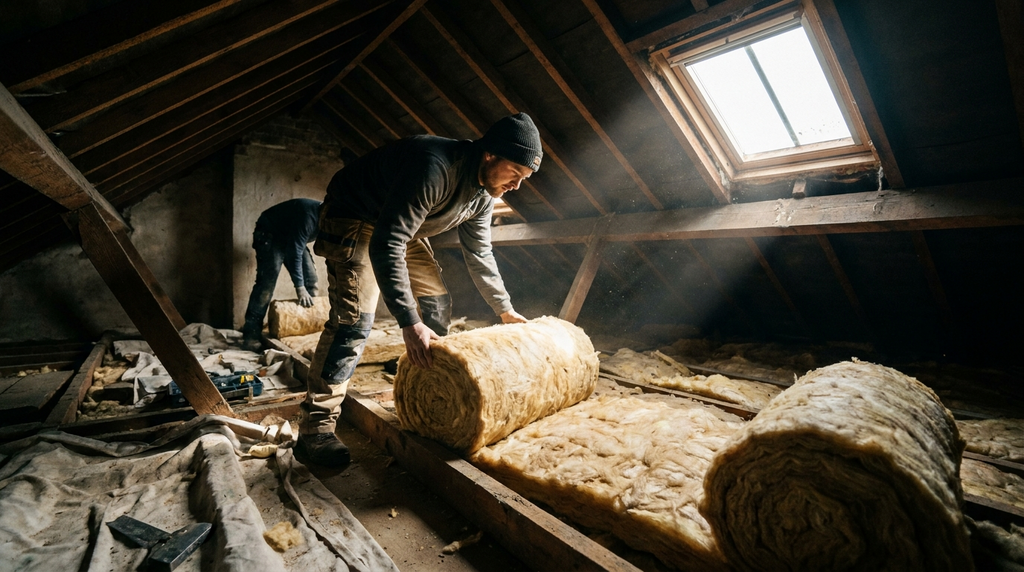
The recommended loft insulation depth in 2026 is 270 mm. Increasing loft insulation from 100 mm to 270 mm cuts heat loss by up to 20% per year, with a payback period for top-up installation typically under two years (Energy Saving Trust, 2026).
The U-value target for loft insulation at 270 mm is 0.16 W/m²K, as set by Building Regulations Part L 2021, which remains current in 2026 (GOV.UK, 2026). A 100 mm layer typically achieves a U-value around 0.30 W/m²K, meaning the extra 170 mm roughly halves the heat loss rate through the ceiling.
Cavity wall insulation thickness 100 mm vs 150 mm, U-value and annual savings
Current Building Regulations Part L (2021, updated 2026) require a U-value of 0.30 W/m²K or better for new cavity walls (GOV.UK, 2026). A standard 100 mm cavity fill achieves approximately 0.55 W/m²K, which is below the current standard. Upgrading to 150 mm or 200 mm can reach 0.30 W/m²K (BRE, 2026).
Annual savings for a typical semi-detached home upgrading from 100 mm to 150 mm cavity insulation are roughly £100 to £150, depending on heating fuel and local climate (Energy Saving Trust, 2026).
Cavity wall insulation thickness recommendations for retrofit in 2026 are 150 mm to 200 mm, depending on cavity width and wall type. Homes with narrower cavities (50 mm or less) may not be suitable for full fill and may need partial fill or alternative measures.
Solid wall insulation thickness external vs internal, 90 mm vs 120 mm
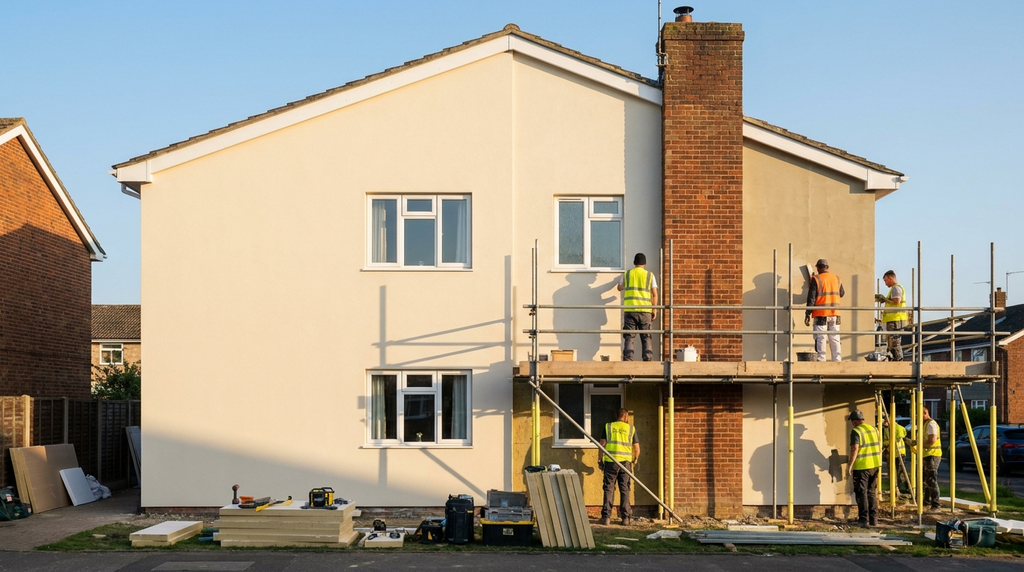
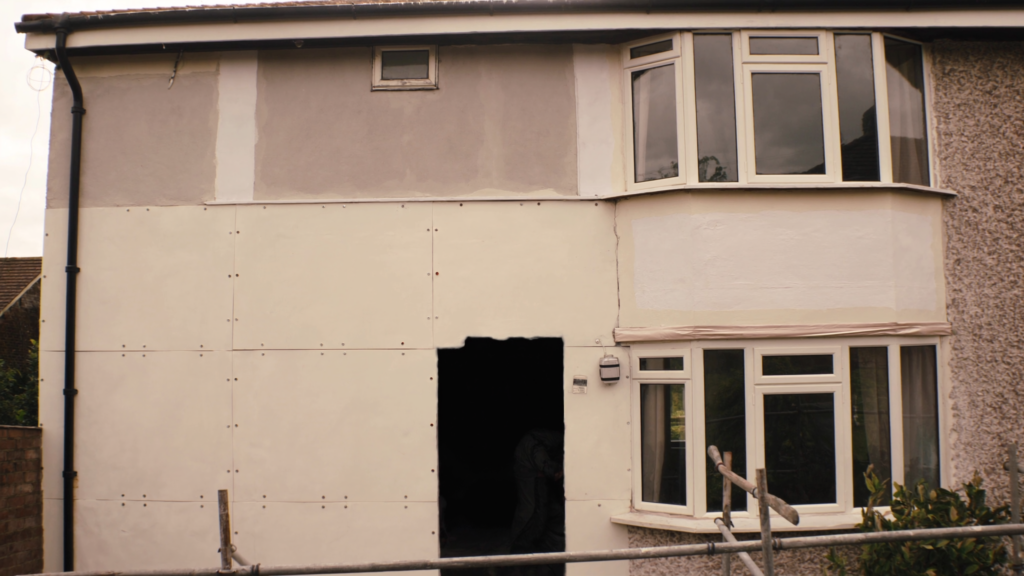
Solid walls have no cavity, so insulation must be added to the external or internal face. External wall insulation (EWI) typically requires 90 mm to 120 mm of rigid board to meet a U-value of 0.30 W/m²K (BRE, 2026). Internal wall insulation (IWI) needs 80 mm to 100 mm to achieve the same U-value, but reduces floor space by 10 cm to 15 cm per wall (MCS, 2026).
Annual savings for a solid-wall home adding EWI or IWI are £300 to £400 per year (Energy Saving Trust, 2026). Insulation thickness recommendations for solid walls in 2026 are 90 mm or more for EWI and 80 mm or more for IWI, with a target U-value of 0.30 W/m²K (GOV.UK, 2026).
Quick numbers, insulation thickness recommendations compared by type
| Insulation type | Recommended minimum thickness (2026) | U-value achieved | Annual savings (typical semi-detached) | Payback period |
|---|---|---|---|---|
| Loft insulation (100 mm vs 270 mm) | 270 mm | 0.16 W/m²K | £200–£300 | Under 2 years |
| Cavity wall insulation (100 mm vs 150 mm) | 150 mm | 0.30 W/m²K | £100–£150 | 3–5 years |
| Solid wall external (90 mm vs 120 mm) | 90 mm | 0.30 W/m²K | £300–£400 | 10–15 years |
| Solid wall internal (80 mm vs 100 mm) | 80 mm | 0.30 W/m²K | £300–£400 | 10–15 years |
U-value targets come from Building Regulations Part L 2021, current in 2026 (GOV.UK, 2026). Annual savings and payback periods are from the Energy Saving Trust (Energy Saving Trust, 2026).
What is the recommended insulation thickness for my home in 2026? (Featured snippet target)
The general answer is 270 mm for loft insulation, 150 mm for cavity walls (or 100 mm if cavity width limits), and 90 mm to 120 mm for solid walls (external or internal). These recommendations are based on the 2021 Building Regulations Part L (updated for 2026) and Energy Saving Trust guidance.
The exact thickness depends on your home’s construction, including loft depth, cavity width, and wall material. It also depends on whether you are retrofitting or building new. For a personalised figure, use the Energy Saving Trust home insulation calculator (Energy Saving Trust, 2026).
If your loft depth is less than 270 mm, you can top up with a second layer of insulation. For cavity walls, a survey is needed to confirm the cavity width. Solid wall insulation requires a site assessment to determine the best thickness for your wall type and budget.
How to verify your insulation installer MCS, TrustMark, and FENSA certification
For cavity wall insulation, installers must be registered with the Cavity Insulation Guarantee Agency (CIGA) or hold BBA certification (GOV.UK, 2026). For solid wall insulation (EWI or IWI), check for MCS certification if the work is linked to a renewable heating system (MCS, 2026).
The Great British Insulation Scheme closed on 31 March 2026. It funded insulation measures only and never covered windows or glazing. For loft insulation, a Gas Safe registered installer is not required, but check for TrustMark and CIGA if using a cavity wall system.
FENSA is relevant only for windows and doors, not insulation. Homeowners should verify the installer is a member of a competent person scheme such as TrustMark or CIGA (FENSA, 2026).
check if your insulation installer is properly certified
Insulation thickness and U-value how building regulations set the standard in 2026
Building Regulations Part L (2021, updated 2026) set minimum U-values for new builds: 0.16 W/m²K for roofs and 0.30 W/m²K for walls (GOV.UK, 2026). These U-values are the target for retrofit under ECO4 and the Great British Insulation Scheme (DESNZ, 2026).
Insulation thickness is the primary variable to hit these targets, but material type also matters. Mineral wool, PIR board, and EPS all achieve different U-values per millimetre. For existing homes, the recommended thickness is the same as for new builds to achieve the same U-value, though cost and space constraints may apply.
A lower U-value means less heat escapes. For example, a 270 mm loft insulation layer gives a U-value of 0.16 W/m²K, while 100 mm gives about 0.30 W/m²K. The difference in heat loss is roughly halved by the thicker layer.
The Great British Insulation Scheme closed on 31 March 2026. It funded insulation measures only and never covered windows or glazing.
The Great British Insulation Scheme closed on 31 March 2026. It funded insulation measures only and never covered windows or glazing. For loft insulation, the grant typically requires top-up to 270 mm (Ofgem ECO4 guidance, 2026).
For cavity walls, the grant requires a U-value of 0.30 W/m²K or better, which usually means 150 mm fill (Ofgem ECO4 guidance, 2026). Solid wall insulation grants cover both EWI and IWI, with thickness determined by the property survey (GOV.UK, 2026).
Eligibility for these schemes depends on your household income, benefits status, and the condition of your home. A survey will confirm whether your home qualifies and what thickness of insulation is needed to meet the scheme requirements. how to check your eligibility for ECO4 funding
Frequently Asked Questions
270 mm is the recommended loft insulation depth in 2026, according to the Energy Saving Trust. This achieves a U-value of 0.16 W/m²K under Building Regulations Part L.
Upgrading from 100 mm to 270 mm saves a typical semi-detached home roughly £100 to £150 annually, based on Energy Saving Trust estimates. Payback is usually under two years.
100 mm of loft insulation typically achieves a U-value around 0.30 W/m²K, as reported by the Energy Saving Trust. This is higher than the 0.16 W/m²K target for 270 mm.
For new cavity walls, 150 mm to 200 mm is recommended to meet the 0.30 W/m²K U-value target under Building Regulations Part L (GOV.UK, 2026). Narrower cavities may need partial fill.
Solid wall insulation typically needs 90 mm to 120 mm, applied externally or internally. The exact thickness depends on the U-value target and wall type, per BRE guidance.