A full EWI installation costs £8,000–£22,000 for a typical UK home
If your home has solid walls and you are struggling with high heating bills, external wall insulation (EWI) is one of the most effective upgrades you can make. The total cost for a full installation on a typical UK home ranges from £8,000 to £22,000, depending on property size, system type, and finish (Energy Saving Trust, 2026).
For most homeowners, the deciding factor is whether a government grant is available. The Great British Insulation Scheme closed on 31 March 2026. It funded insulation measures only and never covered windows or glazing. Without a grant, the payback period from reduced heating bills is 10–20 years, but with a grant it becomes immediate or under five years.
The cost breakdown depends on three main variables. Property size is the biggest factor: a mid-terrace house costs £8,000–£12,000, a semi-detached home costs £12,000–£16,000, and a detached house costs £16,000–£22,000 (Energy Saving Trust, 2026). The system type also matters: mineral wool systems are typically cheaper than expanded polystyrene (EPS) or polyisocyanurate (PIR) boards, but each has different thermal performance and durability. The finish you choose, render, brick-effect slip, or timber cladding, adds further variation.
Quick numbers cost, savings, U-value, and grant amounts
| Metric | Typical Value | Source |
|---|---|---|
| Average installation cost (semi-detached) | £12,000–£16,000 | Energy Saving Trust, 2026 |
| Annual energy bill saving | £200–£500 | Energy Saving Trust, 2026 |
| U-value improvement (before vs after) | 2.0 W/m²K → 0.30 W/m²K | MCS Standard 012, 2026 |
| ECO4 grant maximum per household | £15,000 | Ofgem ECO4 Guidance, 2026 |
| Great British Insulation Scheme grant cap | £5,000 | DESNZ GBIS Rules, 2026 |
The U-value improvement is dramatic. Uninsulated solid walls typically have a U-value around 2.0 W/m²K, meaning they lose heat rapidly. After EWI installation to MCS standard 012, that drops to 0.30 W/m²K or better, which is roughly the same as a modern insulated cavity wall (MCS Standard 012, 2026).
You qualify for a grant if your home has an EPC rating of D or below and you receive a qualifying benefit
The Great British Insulation Scheme closed on 31 March 2026. It funded insulation measures only and never covered windows or glazing. To qualify, your home must have an Energy Performance Certificate (EPC) rating of E, F, or G (and in some cases D), and you must receive a means-tested benefit (Ofgem ECO4 Eligibility Criteria, 2026).
The list of qualifying benefits includes Pension Credit, Universal Credit, Income Support, income-based Jobseeker’s Allowance, income-related Employment and Support Allowance, Housing Benefit, and Child Tax Credit (but not Working Tax Credit unless combined with Child Tax Credit). Non-means-tested benefits such as Child Benefit alone do not count. The full list is published on GOV.UK (DESNZ GBIS Rules, 2026).
If you own your home and live in it, you are eligible for the grant. Private tenants and social housing tenants have separate routes: your landlord must apply, but the tenant must still be on a qualifying benefit for the grant to be available.
You do NOT qualify for a grant if your EPC is C or above
Even if your walls are uninsulated, if your home already has an EPC rating of C or better, you cannot access grant funding for EWI. The Great British Insulation Scheme closed on 31 March 2026. It funded insulation measures only and never covered windows or glazing.
Homes with existing cavity wall insulation that is in good condition are also excluded. Only solid walls or walls with failed cavity insulation (confirmed by a survey) qualify. If you have cavity walls that are already filled, you will not receive a grant for EWI unless the existing insulation is found to be defective.
Landlords renting to tenants face an additional restriction. They can only access grants if the property has an EPC rating of E, F, or G and the tenant is on a qualifying benefit. Properties rated D or above are not eligible, even if the tenant qualifies on benefit grounds.
How to check your eligibility and apply for an EWI grant
The quickest way to check your eligibility is to use the government’s online energy grant checker. Visit the GOV.UK page “Check if you can get help with home energy improvements” and enter your postcode and household details (GOV.UK, 2026). The tool will tell you which schemes you may qualify for and which energy suppliers to contact.
If you are eligible, the next step is to contact a registered ECO4 installer. You can find certified installers on the MCS Installer Database (MCS Find an Installer, 2026). The installer will arrange a free survey of your home, measure the walls, check for damp, and provide a detailed quote. The quote should include the total cost, the grant amount, and your contribution (if any).
The installer must be certified to install EWI under the Microgeneration Certification Scheme (MCS) or the PAS 2030/2035 framework. If they are not, the grant will not be paid, and you could be left with the full bill.
Your installer must be MCS-certified and TrustMark-registered for the grant to apply
All ECO4 and Great British Insulation Scheme installations require the installer to hold MCS certification (or equivalent PAS 2030 certification) and be registered with TrustMark (MCS Find an Installer, 2026; TrustMark Registered Businesses, 2026). This is not optional, it is a legal condition of the grant scheme.
Before you sign any contract, ask the installer for their MCS certificate number and TrustMark membership number. You can check both on the respective databases. If the installer cannot provide these, walk away. Uncertified installers may offer a lower price, but the grant will not cover the work, and you will have no consumer protection if the installation fails.
Using a certified installer also protects your home’s value. If the EWI is not certified, an EPC assessor may not credit the insulation when you sell the property, potentially reducing its resale value.
The installation process takes 5–10 days and requires a survey
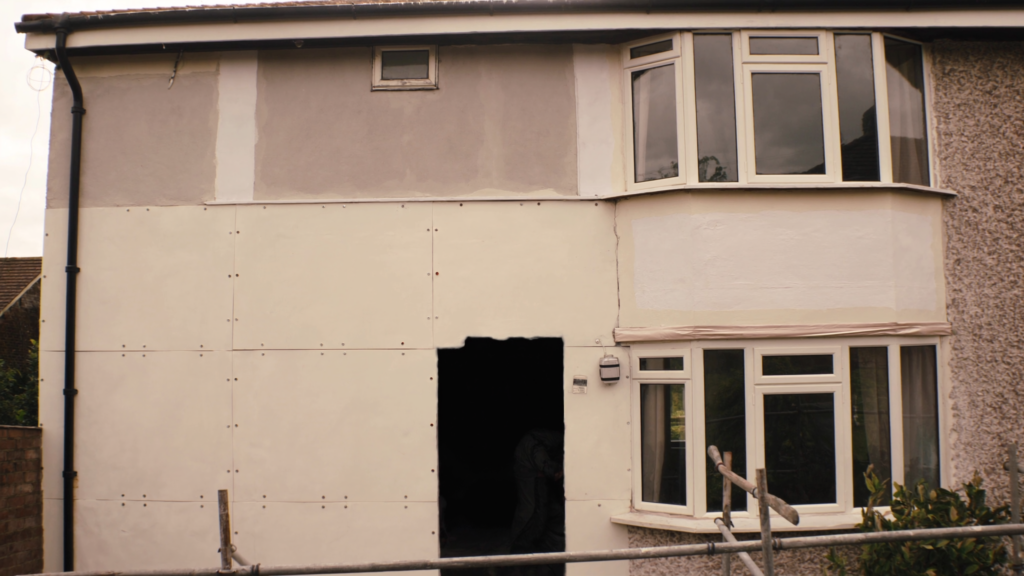
A full EWI installation on a typical semi-detached home takes 5–10 working days. The process begins with a survey, where the installer measures the walls, checks for damp or structural issues, and selects the insulation thickness (typically 60–100mm for solid walls) (MCS EWI Installation Standard, 2026; Energy Saving Trust, 2026).
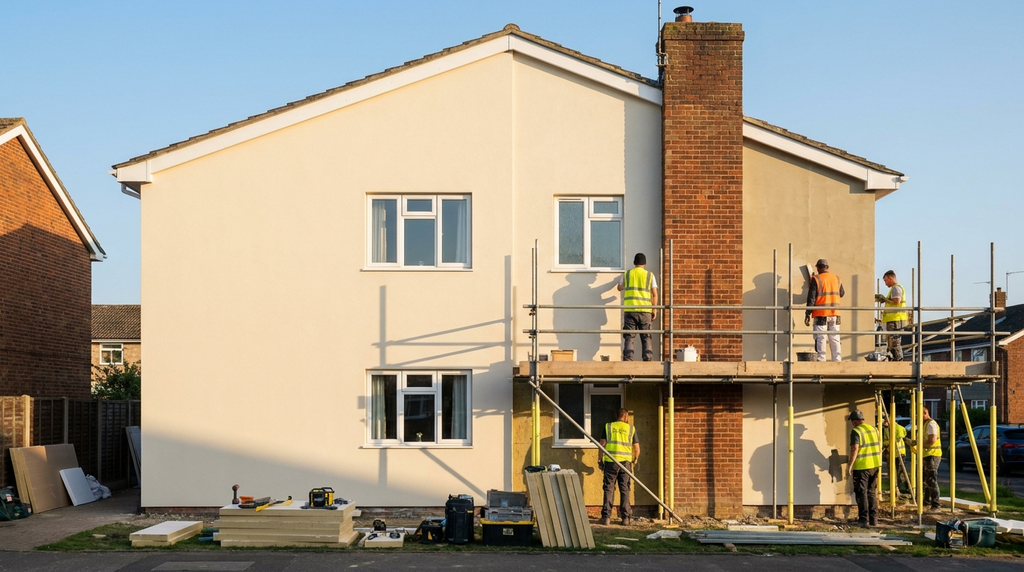
Scaffolding is erected around the whole property before work starts. The installation itself involves fixing insulation boards to the external walls, applying a base coat, embedding reinforcing mesh, and then applying the final render or cladding. The render must cure in dry weather above 5°C, so winter installations often face delays (Energy Saving Trust, 2026).
You will need to clear the area around your home and keep windows closed during the render application. The installer should provide a schedule and notify you of any weather-related changes.
After installation, your home’s EPC rating will typically rise by 2–4 bands, but only if the system is certified
A solid-wall EWI upgrade can lift your EPC rating from an E to a C or D, depending on the existing insulation and heating system. The annual heating bill saving is typically £200–£500 (Energy Saving Trust, 2026; DESNZ Energy Performance of Buildings Certificates Data, 2026).
However, the EPC improvement only counts if the installation is certified by the installer and registered with the relevant scheme (ECO4 or the Great British Insulation Scheme). Without certification, an EPC assessor may not credit the insulation, meaning your home’s rating stays the same. This can harm resale value because buyers rely on the EPC to estimate running costs.
To protect your investment, keep the installer’s certification documents and the scheme registration confirmation. Your solicitor or estate agent may ask for these when you sell.
Compare EWI with cavity wall insulation for solid-wall homes
How to find a TrustMark-registered installer in your area
Frequently Asked Questions
A full installation costs £8,000–£22,000 depending on property size and finish. The Energy Saving Trust (2026) reports £12,000–£16,000 for a semi-detached home.
Ofgem ECO4 Guidance (2026) confirms grants cover 70–100% of costs, often reducing them to £0.
Without a grant, payback is 10–20 years from £200–£500 annual savings. With a grant, payback is immediate or under five years (Energy Saving Trust, 2026).
EWI improves U-value from 2.0 to 0.30 W/m²K, meeting MCS Standard 012 (2026) for solid walls.
Mineral wool systems are typically cheaper than EPS or PIR boards. EPS offers higher thermal performance but costs more (Energy Saving Trust, 2026).