The Great British Insulation Scheme closed on 31 March 2026. It funded insulation measures only and never covered windows or glazing.
If you are a homeowner in the UK wondering about the cost and process of cavity wall insulation in 2026, the short answer is that a professional install typically runs between £2,500 and £6,500 for a semi-detached property. The Great British Insulation Scheme closed on 31 March 2026. It funded insulation measures only and never covered windows or glazing. That makes it a zero-upfront option for many.
The typical cavity wall insulation install cost in 2026 is £2,500–£6,500 for a semi-detached home, according to the Energy Saving Trust typical costs database (Energy Saving Trust, 2026). The Great British Insulation Scheme closed on 31 March 2026. It funded insulation measures only and never covered windows or glazing. For non-eligible households paying privately, the average out-of-pocket cost after any partial grant is £1,200–£3,800 (Energy Saving Trust householder survey data, 2026).
Cost varies by property size. Terraced homes typically cost £2,000–£3,500, semi-detached £2,500–£5,500, and detached £4,500–£6,500 (MCS installer cost data, 2026). All figures are for a standard 50mm–100mm cavity fill with mineral wool or EPS beads. Premium materials such as polyurethane foam add 15–20% to the total cost (Energy Saving Trust material cost breakdown, 2026).
Quick numbers cavity wall insulation savings and payback
The table below shows typical annual savings, payback periods, and carbon savings for common property types. All figures are based on a gas-heated and electric-heated home with a standard 50mm–100mm cavity fill.
| Property type | Average annual saving (gas-heated) | Average annual saving (electric-heated) | Typical payback period | CO₂ saving per year (kg) |
|---|---|---|---|---|
| Terraced (3-bed) | £180 | £290 | 6–10 years | 400 kg |
| Semi-detached (3-bed) | £240 | £380 | 7–12 years | 520 kg |
| Detached (4-bed) | £350 | £560 | 8–15 years | 750 kg |
| Bungalow (3-bed) | £210 | £340 | 6–11 years | 460 kg |
All figures are from the Energy Saving Trust cavity wall insulation savings calculator (Energy Saving Trust, 2026) and DESNZ carbon factors (DESNZ, 2026). Payback periods assume current energy price caps and typical usage patterns.
Who qualifies for a cavity wall insulation grant in 2026
Eligibility for a cavity wall insulation grant depends on your household income, benefits, and your property’s energy performance rating. The Great British Insulation Scheme closed on 31 March 2026. It funded insulation measures only and never covered windows or glazing.
The Energy Company Obligation (ECO4) is a separate scheme for low-income households receiving benefits such as Pension Credit or Child Benefit under the threshold. Your property must have a cavity wall with no existing insulation (Ofgem ECO4 guidance, 2026).
If you do not qualify for a grant, any homeowner with a cavity wall that is empty, clean, and at least 50mm wide can pay for installation privately (MCS standard for cavity wall insulation, 2026). Properties with existing cavity wall insulation installed before 2003 are generally ineligible for a new grant-funded install (DESNZ technical guidance, 2026). The Great British Insulation Scheme closed on 31 March 2026. It funded insulation measures only and never covered windows or glazing.
The cavity wall insulation install process step-by-step
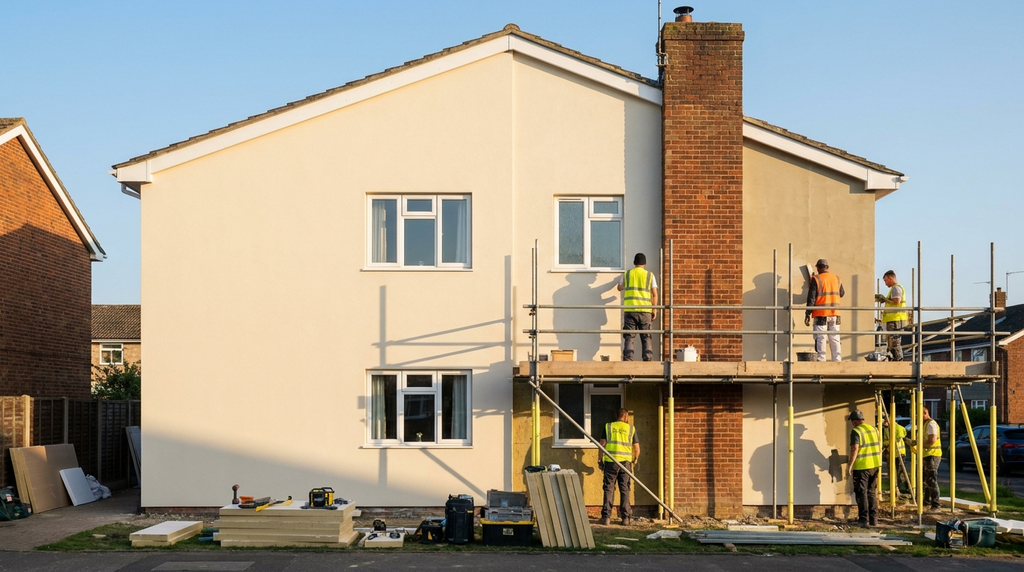
The installation process for cavity wall insulation is a same-day job that takes 2–4 hours for a semi-detached house. Here is the step-by-step process as set out by the Microgeneration Certification Scheme (MCS).
Step 1: Pre-install survey. A certified surveyor checks the cavity width, wall condition, and damp using a boroscope inserted through a small hole. This confirms the cavity is empty and suitable for filling (MCS cavity wall insulation installation standard, 2026).
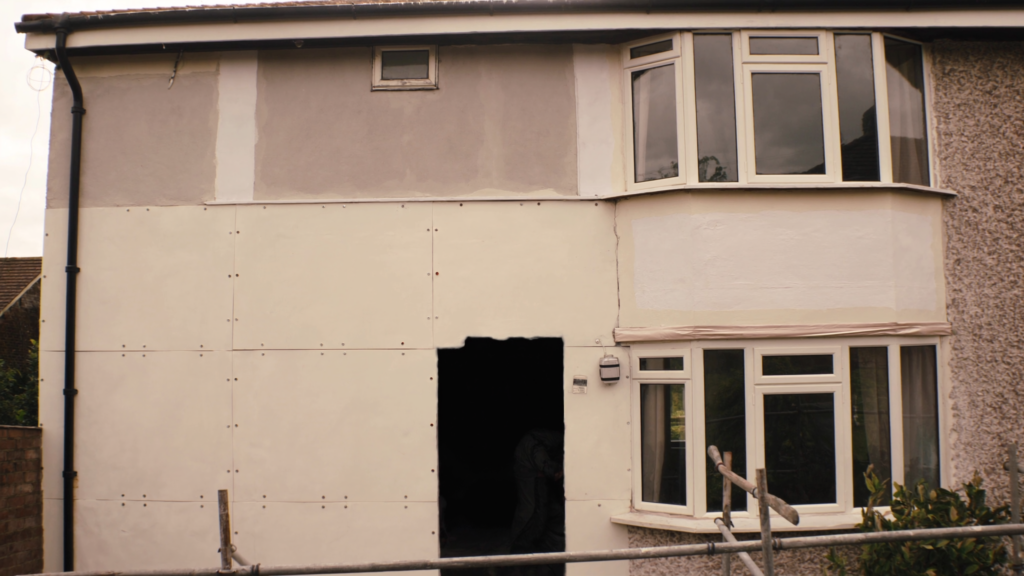
Step 2: Drilling. Holes of 20–25mm diameter are drilled in the external mortar joints at 1-metre intervals across the wall surface (MCS installation manual, 2026).
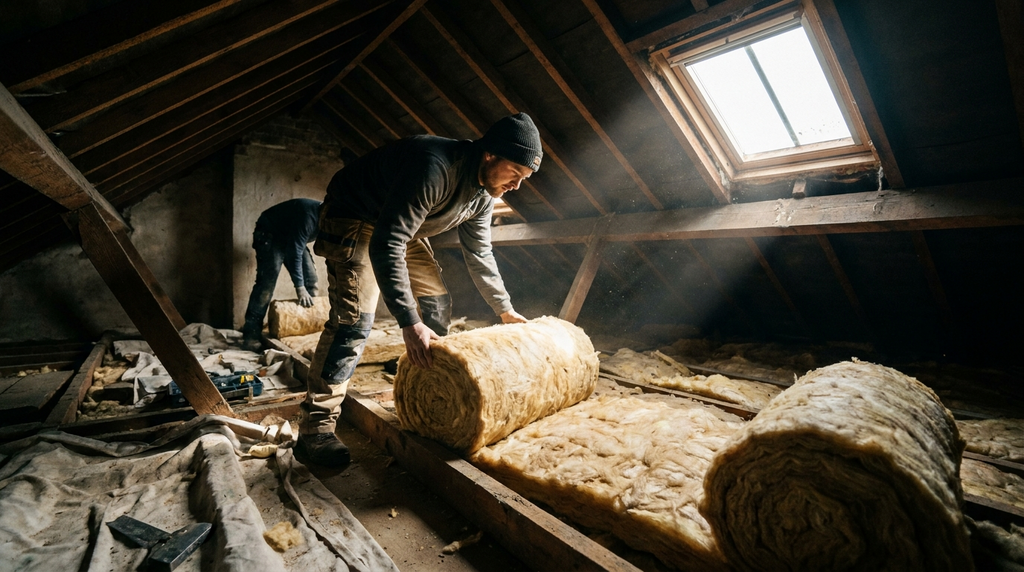
Step 3: Filling. The insulation material, typically mineral wool, EPS beads, or polyurethane foam, is blown into the cavity under controlled pressure to ensure even distribution (MCS material specification, 2026).
Step 4: Sealing. All drill holes are filled with matching mortar and finished flush with the wall surface (MCS installation standard, 2026).
Step 5: Final inspection. The installer checks for gaps, damp, and completes a photographic record of the work (MCS quality assurance, 2026). Total install time is 2–4 hours for a semi-detached house (Energy Saving Trust typical install duration, 2026).
Which installer certification is required for cavity wall insulation grants
For any grant-funded installation, the installer must be MCS-certified. This is a requirement of both the Great British Insulation Scheme and ECO4 (Ofgem ECO4 installer requirements, 2026). The installer must also be TrustMark-registered, which provides consumer protection and a route for complaints (TrustMark scheme rules, 2026).
For non-grant installations, MCS certification is recommended but not legally required. However, only MCS-certified work qualifies for the 10-year insurance-backed guarantee (MCS guarantee terms, 2026). To verify an installer, check the MCS Installer Database at mcscertified.com or call 020 7090 1081 (MCS website, 2026).
Note that Gas Safe Register is not relevant for cavity wall insulation. FENSA is for window installations only, and NICEIC/NAPIT covers electrical work (MCS scope of certification, 2026). Choosing a certified insulation installer
The direct answer to "cavity wall insulation install uk"
The Great British Insulation Scheme closed on 31 March 2026. It funded insulation measures only and never covered windows or glazing. The install involves a pre-survey, drilling, filling, and sealing – all completed in 2–4 hours by an MCS-certified installer.
You must check your property’s cavity width and condition via a professional survey before proceeding (MCS installation standard, 2026). The Great British Insulation Scheme closed on 31 March 2026. It funded insulation measures only and never covered windows or glazing. The average annual saving is £200–£400 for a semi-detached gas-heated home (Energy Saving Trust savings calculator, 2026).
How to confirm your cavity wall insulation install is done correctly
After installation, the installer must provide an MCS certificate and a 10-year insurance-backed guarantee (MCS guarantee terms, 2026). Check for uniform fill by asking the installer to show you photos of the boroscope inspection taken before and after filling (MCS quality assurance, 2026).
Verify that all drill holes are sealed flush and colour-matched to the mortar within 48 hours of installation (MCS installation standard, 2026). If you suspect poor installation, contact the installer first. If unresolved, escalate to the Cavity Insulation Guarantee Agency (CIGA) or TrustMark (CIGA complaints process, 2026). For grant-funded work, Ofgem can investigate if the installer is not MCS-certified (Ofgem ECO4 compliance, 2026). What to do if your insulation is installed poorly
Frequently Asked Questions
Cavity wall insulation costs £2,500–£6,500 installed for a semi-detached home in 2026, according to the Energy Saving Trust typical costs database.
Cavity wall insulation typically lasts 25 years or more, according to the Energy Saving Trust. The lifespan depends on the material used and proper installation.
Annual savings range from £180 for a gas-heated terraced home to £560 for an electric-heated detached home, based on Energy Saving Trust data for 2026.
A professional drills small holes in the external wall, injects insulation material like mineral wool or EPS beads, then seals the holes. The process takes 2–4 hours for a typical semi-detached home.