Free cavity wall insulation UK 2026
The question of whether you can get cavity wall insulation at no cost in 2026 is one of the most common energy-efficiency searches among UK homeowners. The direct answer is yes, but the offer is tightly targeted. According to the Energy Saving Trust, a typical household with uninsulated cavity walls can save between £250 and £400 annually on heating bills (Energy Saving Trust, 2026), yet these savings are only achievable if your property and circumstances meet the specific criteria of the government’s Energy Company Obligation (ECO4) scheme.
The term “free” under ECO4 means 100% grant-funded installation, not a loan, discount, or partial subsidy. The scheme is administered by energy suppliers and funded through a levy on household energy bills. However, eligibility is not universal. The figure of £250–£400 varies by property size, wall type, and heating system; savings are lower for well-insulated homes or those using heat pumps. If you do not meet the income or property rules, you will need to pay for installation privately, typically costing £700–£1,500 (Energy Saving Trust, 2026).
Quick numbers – what free cavity wall insulation costs
| Category | Value | Source |
|---|---|---|
| Typical installation cost without grant | £700–£1,500 | Energy Saving Trust, 2026 |
| Typical annual saving (gas heating) | £250–£400 | Energy Saving Trust, 2026 |
| Typical payback period if paid privately | 2–5 years | Energy Saving Trust, 2026 |
| Grant-funded installation cost to homeowner | £0 | GOV.UK, 2026 |
| Expected lifespan of insulation material | 25+ years | MCS, 2026 |
You qualify for free cavity wall insulation in 2026 if you receive a qualifying benefit or live in a low-income area
ECO4 eligibility is primarily based on household benefits. You or someone in your household must receive one of the following: Income Support, income-based Jobseeker’s Allowance, Universal Credit, Pension Credit, Child Tax Credit (with household income below the threshold), Working Tax Credit (with household income below the threshold), or Housing Benefit (GOV.UK, 2026). If you do not receive a qualifying benefit, you may still qualify if your property is in a low-income area, defined as Index of Multiple Deprivation (IMD) decile 1–3, and your gross household income is under £31,000 (OFGEM, 2026).
The property itself must have unfilled cavity walls – a survey is required to confirm suitability. Homes built after 1990 often already have cavity insulation, and some older properties have solid walls, which cannot be filled. If your home falls into either category, you will not qualify for free cavity wall insulation under ECO4, though alternative measures such as solid wall insulation may be available under the same scheme solid wall insulation grants 2026.
The direct answer – free cavity wall insulation UK 2026 is available through the ECO4 scheme, but only if your home is suitable and you meet income or location rules
The word “free” under ECO4 means 100% grant-funded installation, with no upfront or hidden costs to the homeowner, provided you pass a survey and eligibility check. The installer must be MCS-certified for cavity wall insulation, and the work is covered by a 25-year CIGA guarantee (GOV.UK, 2026). If your home is not suitable – for example, because of exposed walls, severe damp, or narrow cavities – the grant may be refused or redirected to other measures like loft insulation. The survey, which is free and arranged by the installer, determines suitability.
The grant does not cover pre-existing damp repairs, wall tie replacements, or structural work. These must be paid for separately by the homeowner. Also, if your walls already have cavity insulation, the grant typically will not fund a replacement unless the existing insulation is proven defective (OFGEM, 2026).
How to verify your installer – look for MCS certification
All cavity wall insulation installed under ECO4 must be carried out by an MCS-certified installer. You can check the MCS register at mcscertified.com to confirm the company name appears on the approved list (MCS, 2026). The installer must also be registered with TrustMark, the government-endorsed quality scheme. Verify this via trustmark.org.uk (GOV.UK, 2026).
After installation, you must receive a CIGA (Cavity Insulation Guarantee Agency) certificate, which covers the work for 25 years. This certificate is your proof that the installation meets industry standards and that you are protected if defects arise (CIGA, 2026). If an installer cannot provide MCS certification, TrustMark registration, or a CIGA certificate, do not proceed – the work will not be compliant with ECO4 requirements and may void any future claims.
What the survey checks – wall thickness
A surveyor will measure the cavity width, which must be at least 50mm and no more than 100mm for standard blown-fibre or bead insulation. The survey includes a boroscope inspection to confirm the cavity is empty and free from blockages like old mortar or debris (MCS, 2026). The surveyor will also check for signs of damp, both inside and outside the property, and assess the condition of the walls.
If the property has a history of penetrating damp or condensation, the grant may be refused or require remedial work first. The surveyor will also check the external wall finish – pebbledash or render can sometimes complicate installation, though modern techniques can often accommodate it. If the cavity is too narrow or the walls are unsuitable, the surveyor will explain why and may suggest alternative measures such as internal wall insulation (Energy Saving Trust, 2026).
What the grant covers and what it does not
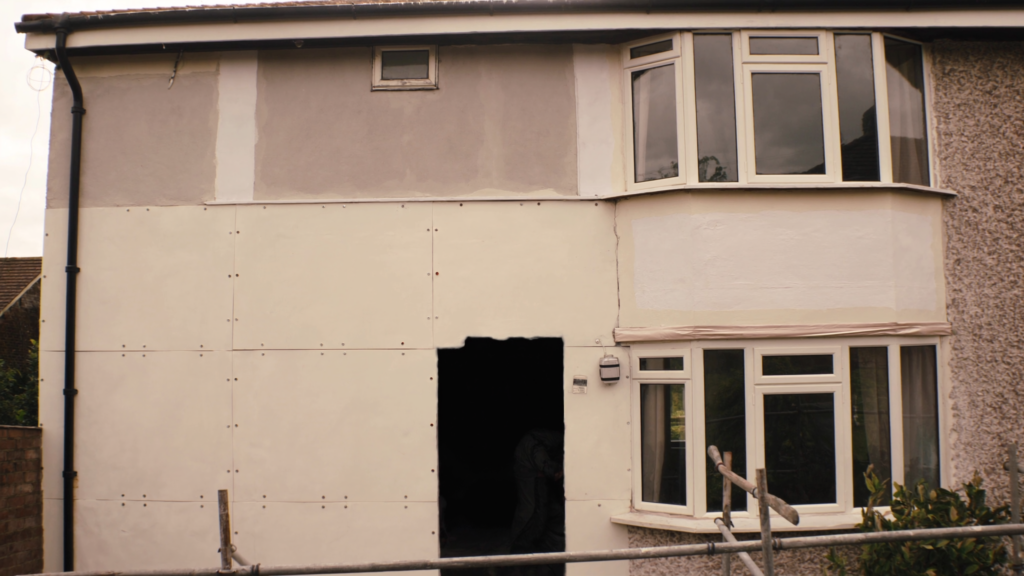
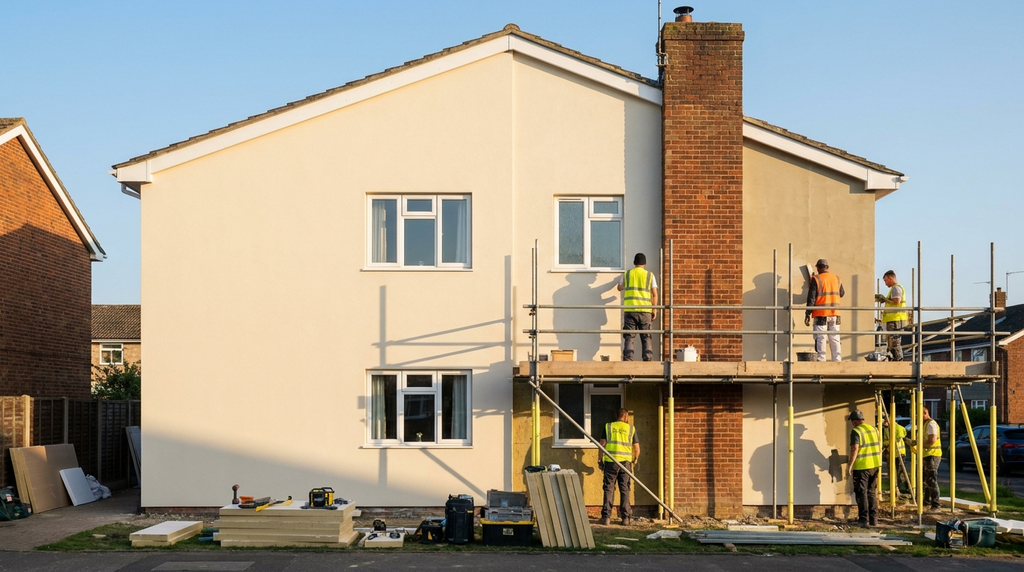
The ECO4 grant pays for the full cost of cavity wall insulation installation, including materials, labour, and a 25-year guarantee. This covers the drilling of holes, injection of insulation material (typically mineral wool or polystyrene beads), and sealing of holes. The grant does not cover pre-existing damp repairs, wall ties, or structural work – these must be paid for separately by the homeowner (OFGEM, 2026).
If your walls already have cavity insulation, even if it is poorly installed, the grant typically will not fund a replacement unless the existing insulation is proven defective. Defective insulation might include material that has slumped, become waterlogged, or been incorrectly installed. In such cases, the installer must remove the old insulation before installing new material, but removal costs are not always covered by the grant – check with your installer before proceeding (GOV.UK, 2026).
Frequently Asked Questions
You qualify if you receive a qualifying benefit like Pension Credit or Universal Credit, as per the ECO4 scheme. The Energy Saving Trust confirms that low-income areas also meet the property criteria.
The Energy Saving Trust states that typical savings are £250–£400 per year for gas-heated homes. Savings depend on property size and heating system.
Yes, under the ECO4 scheme, installation is 100% grant-funded with no cost to the homeowner. GOV.UK confirms it is a free installation, not a discount or loan.
MCS standards indicate the insulation material lasts 25+ years. Proper installation ensures long-term performance with no degradation.
You will need to pay privately, costing £700–£1,500 according to the Energy Saving Trust. Payback period is typically 2–5 years from energy savings.