Cavity wall insulation costs roughly half as much as external wall insulation but saves less energy
When choosing between cavity and external wall insulation, the cost difference is the first thing most homeowners notice. For a typical semi-detached house, cavity wall insulation (CWI) costs between £700 and £1,500, while external wall insulation (EWI) for the same property runs from £8,000 to £14,000, according to the Energy Saving Trust (Energy Saving Trust, 2026).
The direct answer is that cavity wall insulation costs roughly half as much as external wall insulation but saves less energy. Annual savings for a gas-heated semi-detached home are £200–£300 for CWI and £400–£600 for EWI, based on the DESNZ Energy Bills Factsheet (DESNZ, 2026).
Payback periods reflect this gap. CWI typically pays for itself in 2–5 years, while EWI takes 10–25 years depending on your fuel type and existing heating system. The lower upfront cost of CWI makes it accessible for more households, but the higher long-term savings of EWI can be worthwhile if you plan to stay in your home for decades.
Cavity wall insulation works only for homes with unfilled cavities and sound masonry
Cavity wall insulation is not suitable for every home. Eligibility requires a cavity width of at least 50mm, no significant damp problems, and brick or block walls in good condition, as outlined by the National Insulation Association (NIA, 2026). If the cavity is too narrow or contains rubble, CWI cannot be installed and EWI becomes the alternative.
Homes built after 1920 typically have cavity walls, while pre-1920 properties usually have solid walls that cannot use CWI at all (MCS register installation standards, 2026). For solid-wall homes, external wall insulation is the only external option. Internal wall insulation is possible but reduces floor space and requires relocating fixtures.
If you are unsure about your wall type, check your property’s build date on the Land Registry or look for a brick pattern where bricks are laid end-on (headers) across the wall width. A cavity wall will show all bricks laid lengthways (stretchers). A surveyor can confirm this for a small fee.
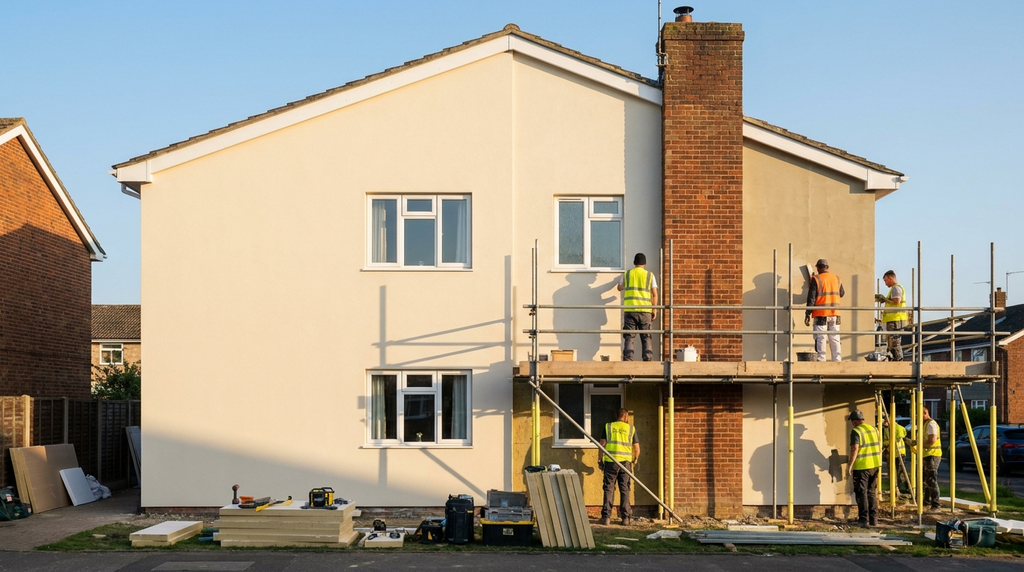
External wall insulation adds a weatherproof layer and changes the home’s appearance
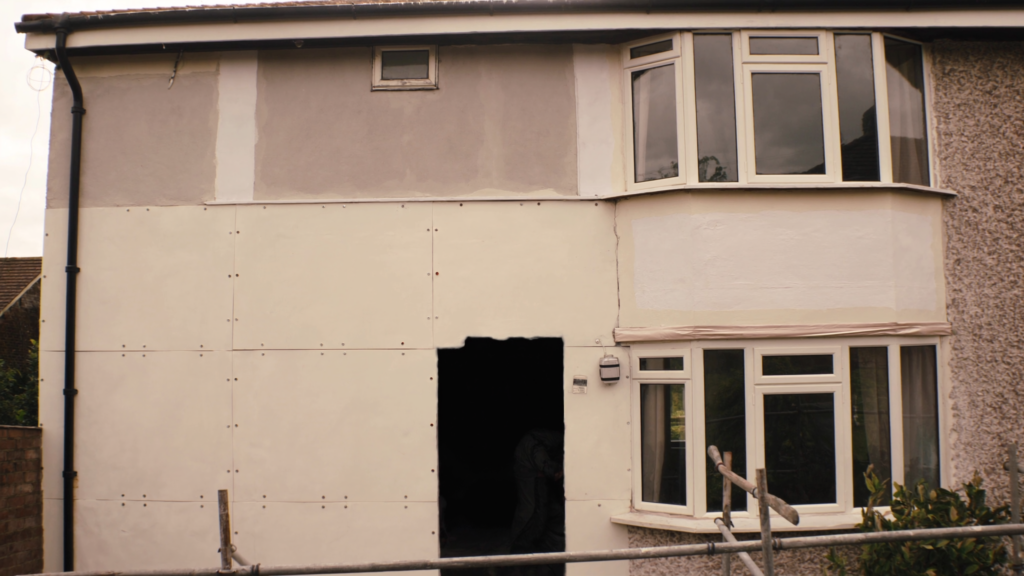
External wall insulation involves fixing rigid insulation boards to the outside wall, then rendering or cladding over them. This creates a continuous weatherproof layer that covers the entire wall surface. The typical U-value improvement is significant: solid walls go from around 2.0 W/m²K to 0.30 W/m²K after EWI, while unfilled cavity walls improve from 1.5 W/m²K to 0.55 W/m²K after CWI (Building Regulations Approved Document L1A, 2026).
EWI reduces thermal bridging more effectively than CWI because it covers the entire wall surface, including corners and junctions where heat often escapes. However, EWI changes your home’s exterior permanently. You may need planning permission if your home is in a conservation area or listed (GOV.UK planning portal, 2026). Check with your local planning authority before proceeding.
EWI also adds a layer of weatherproofing that can reduce draughts and protect the existing wall from rain penetration. This makes it particularly suitable for homes exposed to driving rain or in exposed coastal locations.
Quick numbers cost, savings, and payback comparison table
| Insulation type | Typical cost (semi-detached) | Annual energy saving | Payback period | U-value after installation |
|---|---|---|---|---|
| Cavity wall insulation | £700–£1,500 | £200–£300 | 2–5 years | 0.55 W/m²K |
| External wall insulation | £8,000–£14,000 | £400–£600 | 10–25 years | 0.30 W/m²K |
All figures are for a typical gas-heated semi-detached home in the UK. Sources: Energy Saving Trust cost and savings data (EST, 2026), DESNZ Energy Bills Factsheet (DESNZ, 2026), and Building Regulations L1A (GOV.UK, 2026).
The most important difference for UK homeowners is that cavity insulation is cheaper and faster, while external insulation is more effective and longer-lasting
Cavity wall insulation installation takes 1–2 days, with minimal disruption inside or outside your home. External wall insulation takes 1–2 weeks and involves scaffolding, which can affect access to your property. CWI has no visual impact, while EWI changes your home’s exterior permanently, including window reveals and door frames.
EWI can add an extra layer of weatherproofing and reduce draughts more than CWI because it creates a continuous barrier. However, CWI is best for budget-conscious homeowners with suitable cavities who want a quick return on investment. EWI is best for solid-wall homes or those wanting maximum energy efficiency and are prepared for a longer payback period.
Both types qualify under the ECO4 scheme, subject to eligibility criteria including household income or receipt of certain benefits (Ofgem ECO4, 2026). Check your eligibility before deciding which option to pursue.
How to check if you qualify for ECO4 insulation grants
Both types of insulation must be installed by certified professionals to avoid damp and failure
Poor installation is the main cause of problems with wall insulation. For cavity wall insulation, your installer must hold British Board of Agrément (BBA) certification and be registered with the Cavity Insulation Guarantee Agency (CIGA). A 25-year CIGA guarantee is mandatory for CWI (CIGA, 2026). For external wall insulation, the installer must be MCS certified if integrating renewable heat, and hold TrustMark registration (TrustMark, 2026).
EWI typically carries a 25-year system guarantee from the manufacturer, but this is only valid if installed by an approved contractor. Verify your installer on the MCS website or TrustMark website before paying a deposit. Ask for references and check recent installations if possible.
Never pay the full amount upfront. A reputable installer will ask for a deposit of no more than 25% and will provide a detailed written quote. If an installer pressures you to decide immediately or offers a price that seems too good to be true, walk away.
How to find a certified insulation installer and avoid rogue traders
Cavity wall insulation is the standard option for most UK homes; external insulation is the upgrade choice for solid walls or maximum performance
Approximately 70% of UK homes have cavity walls, and of those, about 60% already have cavity wall insulation installed (DESNZ Housing Energy Efficiency Statistics, 2026). This makes CWI the standard option for most homeowners. External wall insulation is more common in Scotland and Northern Ireland due to higher proportions of solid-wall housing built before 1920.
For homeowners with solid walls, EWI is the only external insulation option. Internal wall insulation is an alternative but reduces floor space by 50–100mm on each wall and requires moving radiators, sockets, and skirting boards. Historic England advises against internal insulation for listed buildings or those with historic fabric that could be damaged by reduced ventilation (Historic England, 2026).
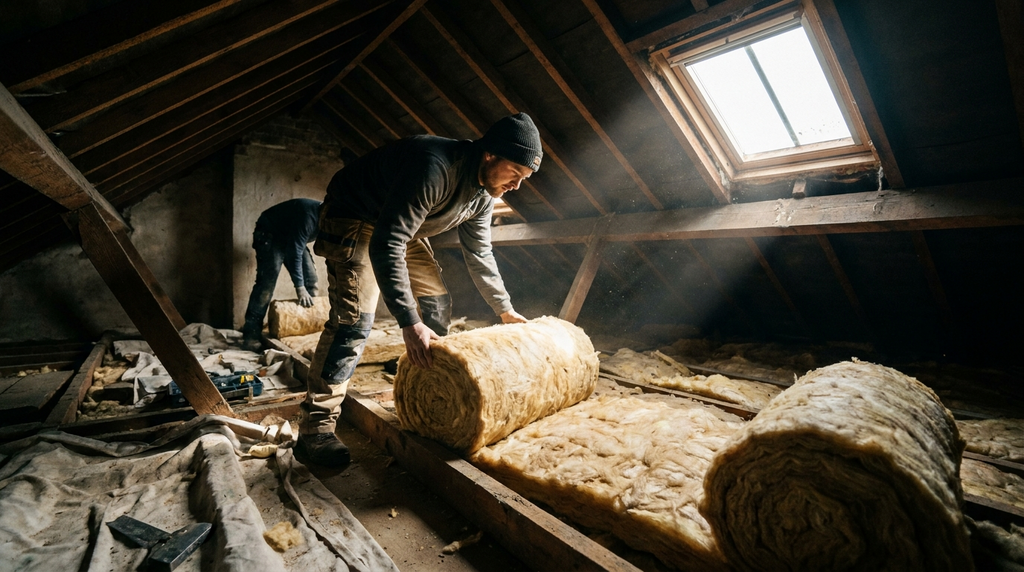
If you have cavity walls and want maximum performance, consider combining CWI with loft insulation and draught-proofing. This can achieve similar overall energy savings to EWI at a fraction of the cost. For solid-wall homes, EWI remains the most effective long-term solution despite the higher upfront cost.
Loft insulation vs wall insulation which should you prioritise
Frequently Asked Questions
Cavity wall insulation fills the gap between two brick layers, costing £700-£1,500 for a semi-detached home. External wall insulation wraps the outside of the house, costing £8,000-£14,000 for the same property, according to the Energy Saving Trust (2026).
Cavity wall insulation is cheaper, costing £700-£1,500 for a semi-detached home, while external wall insulation costs £8,000-£14,000, based on Energy Saving Trust figures. The lower upfront cost makes CWI more accessible.
Cavity wall insulation saves £200-£300 per year for a gas-heated semi-detached home, according to the DESNZ Energy Bills Factsheet (2026). Savings depend on fuel type and property size.
External wall insulation saves £400-£600 per year for a gas-heated semi-detached home, as per the DESNZ Energy Bills Factsheet (2026). This is roughly double the savings of cavity wall insulation.
No, pre-1920 homes typically have solid walls without cavities, so cavity wall insulation is not possible. External wall insulation or internal wall insulation are the alternatives, as noted by the National Insulation Association (2026).