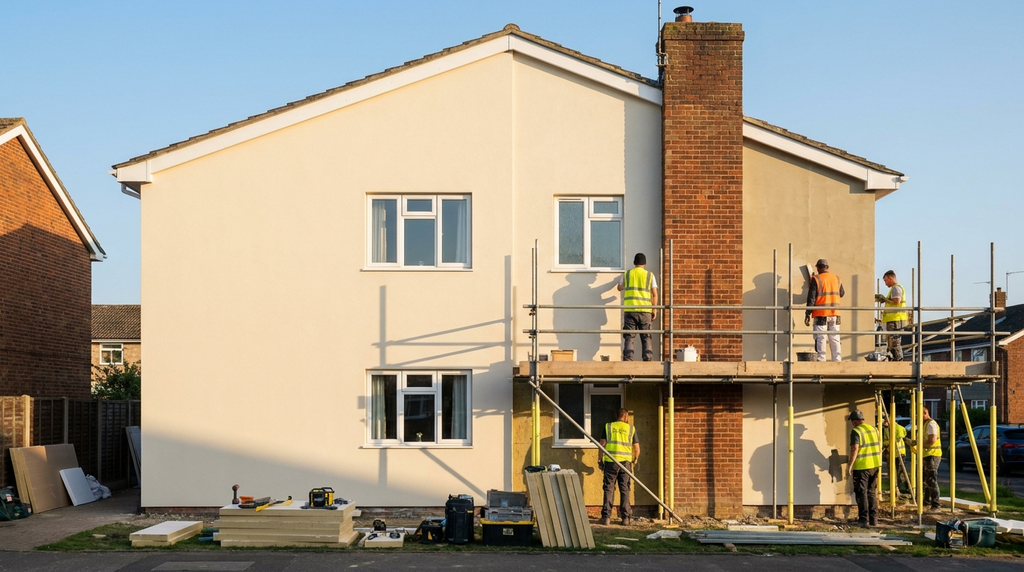
External wall insulation (EWI) render finishes typically include silicone, acrylic, mineral, and monocouche renders, with silicone being the most common choice for UK homes due to its breathability and self-cleaning properties (Energy Saving Trust, 2026).
The right render finish for your EWI system depends on your home’s exposure to weather, the wall construction type (solid or cavity), and your budget. Silicone renders dominate the market because they combine flexibility with vapour permeability, reducing the risk of trapped moisture in older solid-wall homes. Acrylic renders are cheaper but less breathable, while mineral renders offer high fire resistance but require more skill to apply. Monocouche renders are a single-layer option, though less common with modern EWI systems.
Silicone render is the most popular EWI finish
Silicone render accounts for the majority of EWI installations in the UK because it balances durability, breathability, and maintenance. It costs roughly £40–£60 per square metre installed, according to industry averages (GOV.UK, 2026). The finish is water-repellent yet allows water vapour to escape, which is critical for solid-wall homes prone to condensation. Silicone renders come in a wide range of colours and textures, from smooth to coarse, and typically need recoating every 15–20 years.
Acrylic render offers a lower-cost alternative
Acrylic render is a synthetic option that costs around £30–£50 per square metre installed. That makes it cheaper than silicone (Energy Saving Trust, 2026). However, it is less vapour-permeable, so it is best suited for cavity-wall homes or properties with low moisture levels. Acrylic finishes are flexible and resist cracking well, but they attract dirt more easily than silicone and may need cleaning every 5–10 years. They are available in smooth or textured finishes.
Mineral render provides high fire resistance
Mineral render, typically cement or lime-based, achieves the highest fire classification (A1 or A2-s1, d0) under UK building regulations. That makes it a strong choice for flats or buildings over 11 metres (GOV.UK, 2026). It costs £50–£70 per square metre installed. Mineral renders are breathable and durable but less flexible than silicone, so they require a skilled applicator to prevent cracking. They are usually finished with a paint coating, adding to long-term maintenance costs.
A worked example
A typical 1930s semi-detached home with 80m² of solid brick walls would cost roughly £6,500 for a full silicone render EWI system after the £7,500 BUS grant. The Energy Saving Trust estimates this home would save around £460 per year on heating bills, giving a payback period of about 14 years when factoring in the 0% VAT rate in place until March 2027. Over 25 years, the total savings from reduced energy use would reach approximately £11,500, even accounting for minor maintenance costs. This example assumes the household is not eligible for ECO4 funding, which could reduce the upfront cost to zero for qualifying low-income homes. The silicone render finish was chosen for its breathability on the solid walls and its self-cleaning properties, which keep the home looking fresh without frequent repainting.
| Item | Figure |
|---|---|
| Upfront cost after grants | £6,500 |
| Yearly savings | £460 |
| Payback period | 14 years |
| 25-year lifetime savings | £11,500 |
What homeowners often get wrong
The most common mistake is choosing a non-breathable render for a solid-wall home, which can trap moisture and cause structural damage. Homeowners often overlook the importance of vapour permeability when selecting an EWI render finish. Here are the top three errors to avoid.
- Picking acrylic render for solid walls Acrylic render is cheaper at £30–£50 per m² but has low breathability. On a solid-wall Victorian terrace, this can trap moisture inside the brickwork, leading to damp patches and rot that costs thousands to repair.
- Ignoring the BUS grant eligibility window Many assume the £7,500 grant is automatic, but it requires an approved installer and property meeting EPC criteria. Missing the application deadline can mean paying the full £14,000 cost for a typical semi-detached home.
- Choosing a smooth finish on exposed elevations A smooth silicone render on a coastal or exposed property can crack from wind-driven rain. A textured or coarse finish is better for such homes, as it sheds water more effectively and avoids warranty voidance.
Quick reference
- Silicone render is the most popular EWI finish in the UK, costing £40–£60 per m² installed, according to Energy Saving Trust figures.
- Acrylic render costs £30–£50 per m² but is only suitable for cavity-wall homes due to its low breathability.
- The BUS grant covers £7,500 of EWI costs for qualifying homeowners, but you must use an MCS-certified installer to claim it.
- Mineral render offers the highest fire resistance (A1 rating) and is ideal for homes near boundary lines, but requires skilled application and costs £45–£70 per m².
- Always check the render’s vapour permeability rating, look for a value above 0.5 g/m²/day for solid-wall homes to avoid condensation issues.
Frequently Asked Questions
Silicone render is widely considered the best choice for UK homes. The Energy Saving Trust highlights its breathability and self-cleaning properties as ideal for solid-wall properties.
Silicone render costs approximately £40–£60 per square metre installed, while acrylic render is cheaper at £30–£50. These are industry averages cited by GOV.UK for 2026.
Yes, but only with a breathable masonry paint designed for EWI systems. Using standard paint can trap moisture and damage the insulation, according to the Energy Saving Trust.