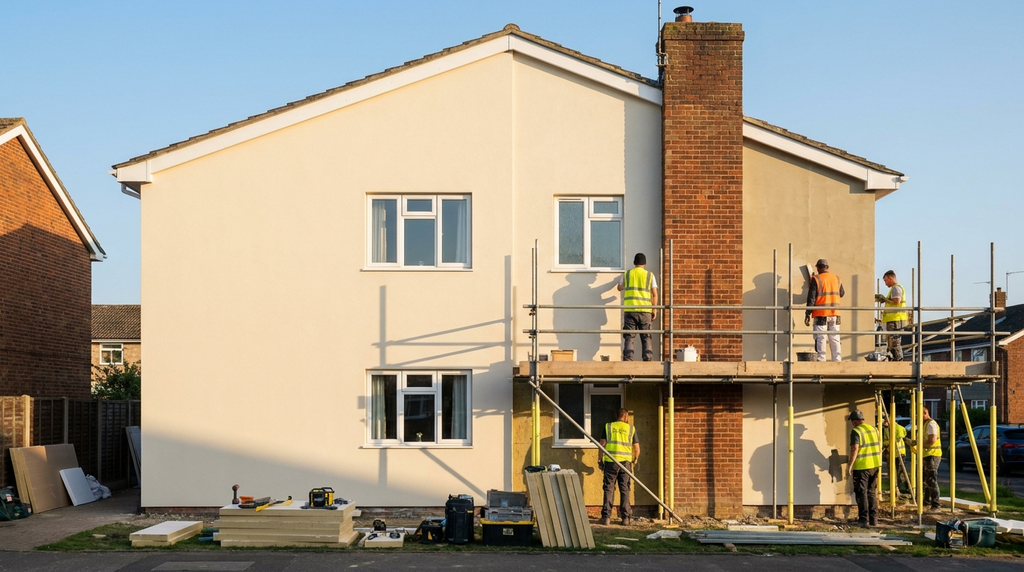
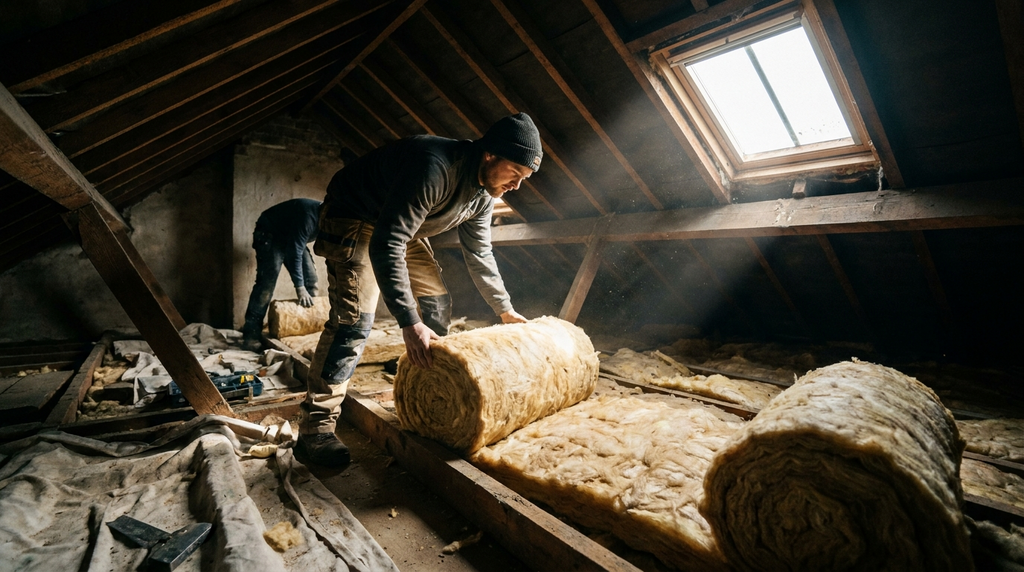
Cavity wall insulation is one of the most cost-effective ways to reduce heat loss through your home’s walls
Heat escapes through uninsulated cavity walls in two ways. First, heat conducts directly from the inner brick leaf, across the air gap, and out through the outer leaf. Second, air inside the cavity warms up, rises, cools against the outer wall, then falls back down, creating a continuous loop that carries heat outside.
Cavity wall insulation reduces heat loss by filling the air gap with low-conductivity material, stopping the convective loop that carries heat outside. This can cut wall heat loss by about 35% and save a detached home up to £395 per year.
- Uninsulated cavity walls lose heat via conduction and a convective loop.
- Cavity wall insulation cuts wall heat loss by about 35%.
- A detached home can save up to £395 per year on energy bills.
- Typical payback period is under five years at current energy caps.
- U-value drops from 1.5 to 0.30–0.35 W/m²K after installation.
- Cavity wall insulation is one of the most cost-effective ways to reduce heat loss through your home's walls
- The U-value of a cavity wall drops dramatically after insulation is installed
- Quick numbers Heat loss before and after cavity wall insulation
- Cavity wall insulation reduces heat loss by stopping the convective loop within the wall cavity
- The average cost of cavity wall insulation is £1,100–£1,800, with grants available that can reduce this to zero
- How do you know if your home has cavity walls and if they are suitable for insulation
- MCS, TrustMark, and CIGA certification are essential to ensure the insulation is installed correctly
Installing cavity wall insulation can save a detached home up to £395 per year on energy bills, according to a 2026 DESNZ report (DESNZ, 2026). The typical payback period is under five years based on current energy price caps set by Ofgem (Ofgem, 2026). Cavity wall insulation works by trapping air in a material with a low U-value, stopping the convective loop that moves heat out.
The U-value of a cavity wall drops dramatically after insulation is installed
A typical uninsulated cavity wall has a U-value of approximately 1.5 W/m²K, according to the Building Regulations Approved Document L (GOV.UK, 2026). After installing standard cavity wall insulation (mineral wool or EPS beads), the U-value falls to around 0.30–0.35 W/m²K. This reduction means the wall conducts roughly five times less heat to the outside.
The Energy Saving Trust states that this improvement alone can cut a home’s total heat loss through walls by about 35% (Energy Saving Trust, 2026). For a typical home, walls account for around one-third of all heat lost, so this is a significant single improvement you can make.
Quick numbers Heat loss before and after cavity wall insulation
| Property type | Annual heat loss through uninsulated cavity walls (kWh) | Annual heat loss through insulated cavity walls (kWh) |
|---|---|---|
| Detached house | 9,500 | 2,100 |
| Semi-detached house | 6,200 | 1,400 |
| Mid-terrace house | 3,800 | 850 |
| Flat (mid-floor, cavity wall) | 2,100 | 470 |
Source: EST estimate based on DESNZ modelling for a typical UK cavity wall property with 100mm cavity (Energy Saving Trust, 2026). The table assumes a 4-bed detached, 3-bed semi, 2-bed terrace, and a 1-bed flat. Figures are rounded and represent the heat that would otherwise need to be generated by a gas boiler at 2026 price cap rates.
Cavity wall insulation reduces heat loss by stopping the convective loop within the wall cavity
In an uninsulated cavity, air warms on the inner leaf, rises, cools on the outer leaf, and falls, creating a continuous circulation that carries heat outside. Filling the cavity with a low-conductivity material (mineral wool, EPS beads, or polyurethane foam) disrupts this air movement.
The insulation material itself has a thermal conductivity of 0.032–0.044 W/mK, which is the MCS standard for cavity insulation products (MCS, 2026). This stops the convective loop and adds a layer of still air within the material, which is a poor conductor of heat. The result is that heat can only escape by slow conduction through the insulation itself, rather than by rapid air movement across the cavity.
how to choose between cavity wall insulation materials
The average cost of cavity wall insulation is £1,100–£1,800, with grants available that can reduce this to zero
The Energy Saving Trust estimates the typical cost for a semi-detached house is £1,100, and for a detached house is £1,800 (2026 figures) (Energy Saving Trust, 2026). The Great British Insulation Scheme closed on 31 March 2026. It funded insulation measures only and never covered windows or glazing.
Eligibility is based on EPC band D or below and receipt of certain benefits, or living in a low-income area. Even without a grant, the payback period is typically 3–5 years based on current energy savings. That means the insulation pays for itself within half a decade, then saves you money every year after that.
How do you know if your home has cavity walls and if they are suitable for insulation
Cavity walls are common in homes built from the 1920s onwards. Solid walls are typical in pre-1920 properties. A simple check: measure the wall thickness at a window or door reveal. Cavity walls are usually 250–300mm thick, solid walls are 200–225mm.
The MCS installer must conduct a pre-installation survey to check for damp, structural issues, and cavity width (MCS, 2026). Not all cavities are suitable. Walls with severe damp, narrow cavities (under 50mm), or exposed to high wind-driven rain may need alternative solutions. The survey will also check that the cavity is clear of rubble or old mortar that could block the insulation.
what to do if your cavity walls are unsuitable for insulation
MCS, TrustMark, and CIGA certification are essential to ensure the insulation is installed correctly
Installers must be MCS certified for cavity wall insulation to qualify for any government grant or scheme. TrustMark accreditation provides a guarantee of workmanship and consumer protection (TrustMark, 2026). The Cavity Insulation Guarantee Agency (CIGA) provides a 25-year guarantee on installations by its registered installers (CIGA, 2026).
Homeowners should check the MCS register at MCScertified.com and the CIGA register before hiring an installer. Without these certifications, the work may not meet building standards, and you could lose protection if problems arise later. A properly installed cavity wall insulation system should last the lifetime of the building, but poor installation can cause damp issues that are expensive to fix.
Frequently Asked Questions
It fills the air gap with mineral wool or EPS beads, stopping the convective loop that carries heat outside. The Energy Saving Trust says this can cut wall heat loss by about 35%.
A typical uninsulated cavity wall has a U-value of about 1.5 W/m²K, dropping to around 0.30–0.35 W/m²K after insulation, according to GOV.UK Building Regulations. That means the wall conducts roughly five times less heat.
A detached home can save up to £395 per year on energy bills, based on a 2026 DESNZ report. Savings vary by property type and current energy price caps set by Ofgem.
The typical payback period is under five years for most homes, based on current Ofgem energy price caps. Actual payback depends on property size and insulation cost.
Yes, it reduces annual heat loss through walls from about 9,500 kWh to 2,100 kWh for a detached house, per Energy Saving Trust estimates. Walls account for roughly one-third of all heat lost in a typical home.