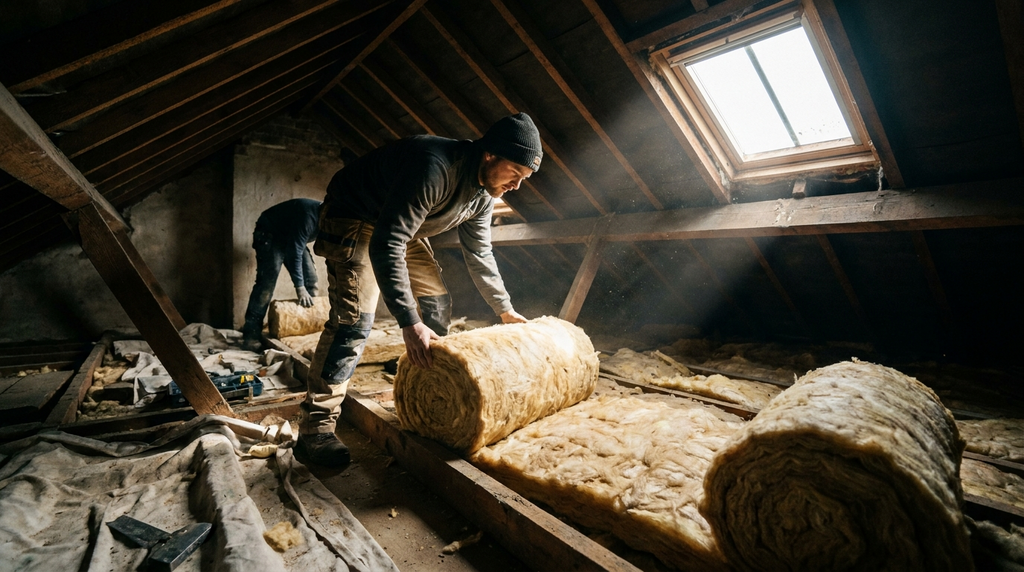
Cavity wall insulation removal costs roughly £800–£1,500, while replacement insulation runs £300–£600, a total that can exceed the original installation cost.
If your cavity wall insulation is causing damp or has settled, you may be weighing the cost of removal against the cost of leaving it in place. The financial stakes are clear from the outset. According to the Energy Saving Trust’s 2026 cost database, professional removal of cavity wall insulation typically costs between £800 and £1,500 for an average three-bedroom semi-detached home (Energy Saving Trust, 2026). By contrast, the National Insulation Association’s 2026 price survey puts the cost of new cavity wall insulation at £300–£600 for the same property type (National Insulation Association, 2026). This means that removing and replacing faulty insulation can cost £1,100–£2,100, significantly more than the original installation. Understanding the removal process and its costs is essential before making a decision.
Cavity wall insulation removal costs £800-£1,500 for a 3-bed semi. Two approved methods exist: vacuum extraction for loose-fill materials and chemical foam removal for injected foams. Compare quotes before deciding.
- Removal costs £800-£1,500 for a 3-bed semi-detached home.
- Replacement insulation adds £300-£600 to the total bill.
- Vacuum extraction removes loose-fill or bead insulation only.
- Chemical foam removal dissolves urea-formaldehyde foam into slurry.
- Choose the method based on the original insulation material type.
- Cavity wall insulation removal costs roughly £800–£1,500, while replacement insulation runs £300–£600, a total that can exceed the original installation cost.
- The two removal methods are vacuum extraction and chemical foam removal
- Quick numbers removal costs, duration, and energy impact
- The removal process involves a survey, access holes, and a vacuum
- Cavity wall insulation is removed because of damp, settlement, or poor installation
- The direct answer to “how is cavity wall insulation removed” is vacuum extraction through small drilled holes
- Only MCS-certified installers can legally remove cavity wall insulation in the UK
- Re-insulating after removal is not always necessary, but it improves energy efficiency
The two removal methods are vacuum extraction and chemical foam removal
The method used to remove cavity wall insulation depends entirely on the type of material that was originally installed. The Insulation Manufacturers Association’s 2026 technical guide lists only two approved removal techniques (Insulation Manufacturers Association, 2026). Vacuum extraction uses industrial-grade suction equipment to pull loose-fill or bead insulation, typically mineral wool, polystyrene beads, or perlite, from the cavity. A commercial vacuum unit is connected to small holes drilled in the external wall, and the material is drawn out into a sealed collection bag. Chemical foam removal is reserved for injected foams, most commonly urea-formaldehyde foam. A solvent is injected into the cavity to soften and dissolve the foam, turning it into a slurry that is then vacuumed out. The choice of method is not optional: vacuum extraction cannot remove foam, and chemical solvents cannot remove loose-fill materials. A survey must confirm the insulation type before any work begins.
Quick numbers removal costs, duration, and energy impact
| Item | Typical Value | Source |
|---|---|---|
| Average removal cost | £800–£1,500 | Energy Saving Trust, 2026 |
| Average removal time | 1–2 days | National Insulation Association, 2026 |
| Post-removal U-value improvement | 0.18–0.30 W/m²K | Building Regulations Approved Document L, 2025 (updated for 2026) |
| Energy bill saving after re-insulating | £150–£300 per year | DESNZ, 2026 household energy consumption statistics |
The U-value figures above refer to the rate of heat loss through the wall: a lower number means better insulation. The Building Regulations Approved Document L (2025 edition, updated for 2026) recommends a maximum U-value of 0.30 W/m²K for cavity walls in existing dwellings (Legislation.gov.uk, 2026). The bill saving figure comes from DESNZ’s 2026 household energy consumption statistics and assumes the cavity is re-insulated with modern materials after removal (GOV.UK, 2026).
The removal process involves a survey, access holes, and a vacuum
The Microgeneration Certification Scheme standard MCS 001 (2019, reaffirmed 2026) sets out the four-step removal procedure (MCS, 2026). First, a certified surveyor inspects the cavity using a borescope camera, a thin, flexible tube with a lens, to confirm the insulation type and its condition. Second, small holes measuring 20–50 mm in diameter are drilled into the external wall at the base of each cavity section. The spacing and number of holes depend on the wall layout and the insulation material. Third, a vacuum hose is inserted into each hole to extract the insulation into a sealed collection unit. For foam removal, the solvent is injected first and allowed to dwell before vacuuming. Fourth, after all material is removed, the holes are plugged with weatherproof caps or matching mortar, and the wall is left to air out for 24 hours to allow any residual moisture or solvent vapour to dissipate.
Cavity wall insulation is removed because of damp, settlement, or poor installation
The Cavity Insulation Guarantee Agency (CIGA) 25-year guarantee covers remedial work for faulty installations, and its 2026 annual report identifies the three most common reasons for removal (CIGA, 2026). Damp ingress accounts for 42% of removal cases. This occurs when insulation bridges the cavity. This allows moisture to transfer from the outer leaf to the inner leaf of the wall. Settlement, the sinking of loose-fill insulation over time, is responsible for 28% of removals, leaving an uninsulated gap at the top of the wall that reduces thermal performance. Poor installation, including incomplete filling or using the wrong material for the wall type, triggers 18% of removals. The Building Research Establishment report BR 262 (2026 update) confirms that these three factors account for the vast majority of cavity wall insulation failures (BRE, 2026).
The direct answer to “how is cavity wall insulation removed” is vacuum extraction through small drilled holes
The primary method is vacuum extraction, where a commercial-grade vacuum draws out loose-fill or bead insulation from the cavity through small drilled holes. For foam insulation, a chemical solvent is injected first to soften the foam, then it is vacuumed out as a slurry. The process takes 1–2 days for an average semi-detached home and does not require structural changes to the property. According to the MCS 001 standard and the National Insulation Association’s 2026 removal guidance, both methods are classified as non-structural and leave the wall fabric intact (MCS, 2026). The holes are typically 20–50 mm and are sealed after removal, so the wall’s appearance and structural integrity are preserved.
Only MCS-certified installers can legally remove cavity wall insulation in the UK
The Microgeneration Certification Scheme (MCS) is the required certification for all cavity wall insulation removal and installation work in the UK. Installers must also hold TrustMark registration, which verifies compliance with consumer protection standards including transparency, complaints handling, and financial protection. Homeowners should verify the installer’s MCS certificate number on the MCS register at mcscertified.com before hiring (MCS, 2026). The GOV.UK page “Cavity wall insulation: choosing an installer” (updated 2026) states that using an uncertified installer may invalidate building regulations approval and void any guarantee (GOV.UK, 2026). Gas Safe Register is not relevant for cavity wall insulation, it applies only to gas appliances.
What is cavity wall insulation and how does it work?
Re-insulating after removal is not always necessary, but it improves energy efficiency
After removal, the cavity can be left empty if the homeowner prioritises breathability, particularly in older homes with solid walls where moisture management is critical. However, re-insulating with modern materials, such as closed-cell foam or hydrophobic beads, can restore or improve the original U-value. The Energy Company Obligation (ECO4) scheme may fund re-insulation for eligible low-income households: DESNZ’s ECO4 guidance (2026) states that cavity wall insulation is a qualifying measure under the scheme (GOV.UK, 2026). Building Regulations Part L (2025, for 2026) recommends a maximum U-value of 0.30 W/m²K for cavity walls in existing dwellings, so re-insulating to at least this standard is advisable if energy efficiency is a priority. A surveyor can advise whether your property’s cavity is suitable for re-insulation based on the wall construction and exposure to wind-driven rain.
Cavity wall insulation grants and funding options 2026
Frequently Asked Questions
Two methods exist: vacuum extraction for loose-fill materials like mineral wool or beads, and chemical foam removal for injected foams. The Insulation Manufacturers Association's 2026 guide confirms only these techniques are approved.
Professional removal costs £800-£1,500 for an average three-bedroom semi-detached home, according to the Energy Saving Trust's 2026 cost database.
Yes, both vacuum extraction and chemical foam removal use small drilled holes that are filled after the process. The National Insulation Association's 2026 guide states minimal structural impact when done by a certified installer.
Removal typically takes one to two days for a standard three-bedroom semi, depending on the insulation type and cavity size. The Energy Saving Trust's 2026 guide estimates 6-12 hours for vacuum extraction.
Yes, if you want to maintain energy efficiency. Replacement costs £300-£600 per the National Insulation Association's 2026 price survey, bringing the total removal and replacement to £1,100-£2,100.