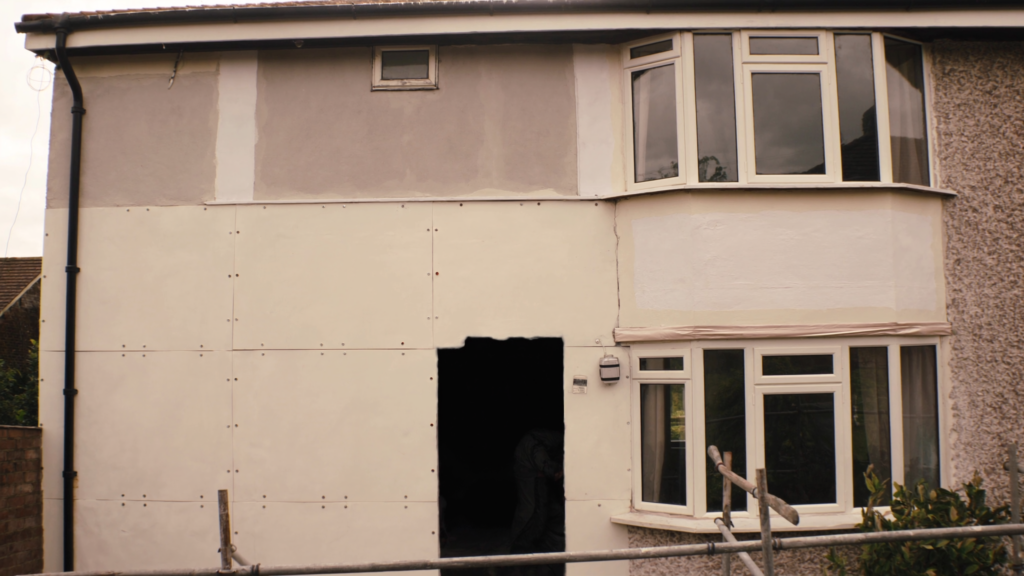
Cavity wall insulation costs roughly £35–£55 per m² for a typical semi-detached home. That makes it one of the cheapest whole-house insulation measures available in 2026.
A typical semi-detached home with 40–50 m² of cavity wall area will cost £1,400–£2,750 total, including installation and materials, according to the Energy Saving Trust (Energy Saving Trust, 2026). The per-m² rate varies by property size: smaller homes (30 m²) pay a higher per-m² rate (£55–£65) due to minimum call-out charges, while larger homes (70 m²) pay a lower rate (£30–£40), based on data from the Department for Energy Security and Net Zero (DESNZ, 2026 Q1).
Cavity wall insulation costs £35–£55 per m² installed in 2026, with a typical semi-detached home (40–50 m²) totalling £1,400–£2,750. This makes it one of the cheapest whole-house insulation measures available, with annual savings of £200–£300.
- Cavity wall insulation costs £35–£55 per m² installed in 2026.
- A typical semi-detached home with 40–50 m² costs £1,400–£2,750 total.
- Smaller homes under 30 m² pay £55–£65 per m² due to minimum call-out charges.
- Annual savings of £200–£300 mean payback in 5–10 years for semi-detached homes.
- Mineral wool is cheapest at £35–£45 per m²; polystyrene beads cost £45–£55.
- Cavity wall insulation costs roughly £35–£55 per m² for a typical semi-detached home. That makes it one of the cheapest whole-house insulation measures available in 2026.
- How cavity wall insulation cost per m² compares to other insulation types
- The main factors that affect the per m² price
- Quick numbers cost and savings at a glance
- How much does cavity wall insulation cost per m² in 2026?
- How to check if your home is eligible and how to verify an installer
- How to get a free or subsidised cavity wall insulation installation
How cavity wall insulation cost per m² compares to other insulation types
Cavity wall insulation at £35–£55 per m² is cheaper than solid wall insulation (external: £80–£130 per m²; internal: £50–£80 per m²) but more expensive than loft insulation (£10–£20 per m²), as the Energy Saving Trust notes (Energy Saving Trust, 2026). Per m², cavity wall insulation delivers the fastest payback: typical annual savings of £200–£300 on a semi-detached home mean payback in 5–10 years, versus 15–30 years for solid wall options (Energy Saving Trust, 2026). Cavity wall insulation also has the lowest disruption: installation takes 2–4 hours, with no scaffolding needed for most homes, unlike external solid wall insulation.
The main factors that affect the per m² price
Property size and cavity width: larger cavities (over 75 mm) require more material and are priced at the higher end of the range, according to MCS installation standards (MCS, 2026). Access and location: homes with limited access (e.g., narrow alleys, no driveway) add 10–20% to the per m² cost. London and South East regions are typically 15–25% more expensive than the UK average, based on DESZN regional data (DESNZ, 2026 Q1). Type of insulation material: mineral wool (rockwool) is the standard at £35–£45 per m², while polystyrene beads or foam are £45–£55 per m². The latter are used in damp-prone areas (Energy Saving Trust, 2026).
Quick numbers cost and savings at a glance
| Home type | Typical cavity wall area (m²) | Total cost (£) | Annual saving (£) | Payback period (years) |
|---|---|---|---|---|
| Mid-terrace | 30 | £1,050–£1,950 | £150–£200 | 5–10 |
| Semi-detached | 45 | £1,575–£2,475 | £200–£300 | 5–10 |
| Detached | 60 | £1,800–£3,300 | £250–£400 | 5–10 |
| Bungalow | 40 | £1,400–£2,200 | £180–£280 | 5–10 |
Savings based on a gas-heated home with standard insulation before installation. Actual savings depend on heating system and usage. Sources: Energy Saving Trust (Energy Saving Trust, 2026) and DESNZ (DESNZ, 2026 Q1).
How much does cavity wall insulation cost per m² in 2026?
The straightforward answer: £35–£55 per m² installed, or £1,400–£2,750 for a typical semi-detached home (Energy Saving Trust, 2026). This price includes a survey, drilling, injection of insulation material, and sealing of holes. It does not include any remedial work for damp or wall defects (Energy Saving Trust, 2026). The cost per m² is lower for larger homes because the fixed costs (survey, travel, minimum charge) are spread over more square metres.
Compare cavity wall insulation costs with solid wall insulation options
How to check if your home is eligible and how to verify an installer
Your home must have been built between the 1920s and 1990s (brick cavity walls), with a cavity width of at least 50 mm and no existing insulation. Homes built after 1990 usually have insulation already (GOV.UK, 2026). You must use an installer registered with the Cavity Insulation Guarantee Agency (CIGA) or the National Insulation Association (NIA) to qualify for the 25-year guarantee (CIGA, 2026). The installer should also hold a valid MCS certificate for cavity wall insulation (if using a grant) and be registered with TrustMark for quality assurance (TrustMark, 2026; MCS, 2026).
How to get a free or subsidised cavity wall insulation installation
The Great British Insulation Scheme closed on 31 March 2026. It funded insulation measures only and never covered windows or glazing. You must be a homeowner or private tenant (with landlord permission) and live in England, Scotland, or Wales. The scheme covers the full cost of installation for eligible homes (DESNZ, 2026 Q1). Alternatively, the Energy Company Obligation (ECO4) scheme provides free insulation for low-income households in England and Wales. Check with your energy supplier (Ofgem, 2026). If you are not eligible for a grant, the £35–£55 per m² cost is still the cheapest whole-house insulation option, and the typical £200–£300 annual saving means the investment pays for itself within a decade.
Frequently Asked Questions
Cavity wall insulation costs £35–£55 per m² installed in 2026, according to the Energy Saving Trust. The exact rate depends on your property size, cavity width, and location.
Yes, at £35–£55 per m², cavity wall insulation is one of the most cost-effective insulation measures. The Energy Saving Trust reports annual savings of £200–£300 on a semi-detached home, giving a payback period of 5–10 years.
A 3-bed semi-detached home with 40–50 m² of cavity wall area costs £1,400–£2,750 total in 2026, based on Energy Saving Trust data. This equals £35–£55 per m² installed.
The main factors are property size (smaller homes pay more per m²), cavity width (over 75 mm costs more), access difficulty (adds 10–20%), region (London and South East are 15–25% higher), and material type (mineral wool vs polystyrene beads), as per DESNZ and MCS data.
Cavity wall insulation at £35–£55 per m² is cheaper than solid wall insulation (£50–£130 per m²) but more expensive than loft insulation (£10–£20 per m²), according to the Energy Saving Trust. It also offers the fastest payback at 5–10 years.