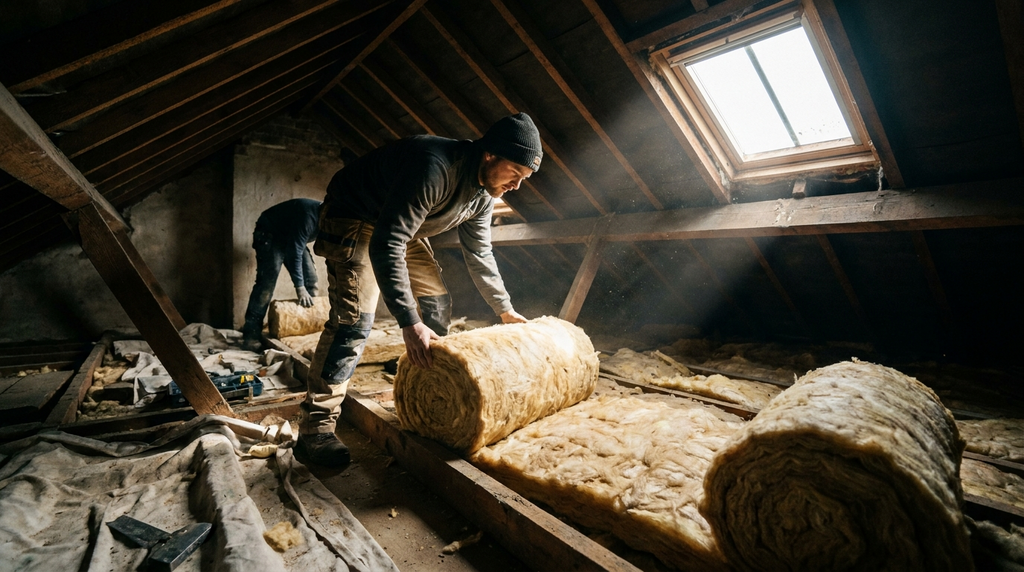
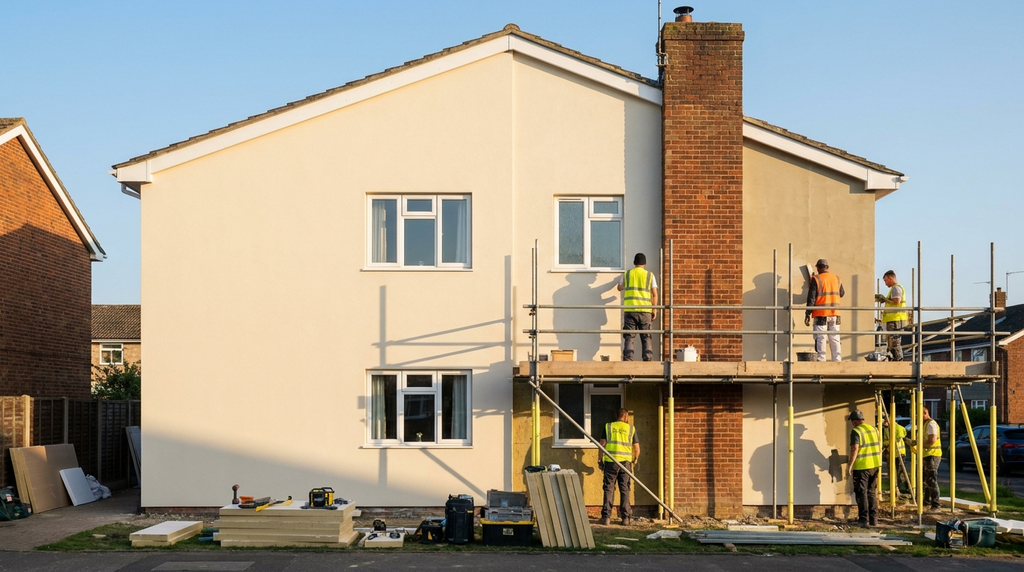
Cavity wall insulation became standard practice in the UK from the mid-1980s
If you own a home built before the mid-1980s, its cavity walls are very likely empty. The question of when cavity wall insulation became standard in the UK has a clear answer: the 1985 Building Regulations made it effectively mandatory for all new homes. Before that year, cavity walls were built to stop rainwater penetrating the inner leaf, not to keep heat inside.
Cavity wall insulation became standard in the UK in 1985, when Building Regulations Part L required a U-value of 0.6 W/m²K for external walls. If your home was built before that year, its cavity walls are very likely empty and need insulation.
- Cavity wall insulation became standard in 1985 under Building Regulations Part L.
- Pre-1985 homes likely have empty cavity walls needing insulation.
- The 1985 regulations required a U-value of 0.6 W/m²K for external walls.
- Uninsulated cavity walls typically perform at 1.0–1.5 W/m²K.
- By the early 1990s, cavity wall insulation was universal for new homes.
- Cavity wall insulation became standard practice in the UK from the mid-1980s
- The exact year cavity wall insulation was required by law in the UK
- How the 1985 Building Regulations changed home construction
- What the U-value standard of 0.6 W/m²K meant for cavity walls
- Quick numbers Cost, savings, and payback for retrofitting cavity wall insulation
- How to check if your home already has cavity wall insulation
- Eligibility and installer certification for retrofitting cavity wall insulation
The direct answer is that cavity wall insulation became standard practice from 1985, when the Building Regulations (Part L) first required a U-value of 0.6 W/m²K for external walls. This could not be achieved with an uninsulated cavity, so builders began injecting insulation as a routine step. By the early 1990s, the practice was universal for new cavity-wall properties (HM Government, The Building Regulations 1985: Conservation of Fuel and Power (Part L)).
The exact year cavity wall insulation was required by law in the UK
The legal pivot point is 1985. The Building Regulations that year set a thermal performance target of 0.6 W/m²K for external walls. An uninsulated cavity wall typically performs at around 1.0–1.5 W/m²K, so meeting the new standard forced builders to add insulation. The regulation applied to all new dwellings from 1985 onwards (DESNZ, Building Regulations: Approved Document L1A, 1985 edition).
This is the direct answer to the query “when did cavity wall insulation become standard in the uk”. It was not a voluntary trend or a gradual market shift. It was a regulatory requirement that changed how every new home was built from that year forward.
How the 1985 Building Regulations changed home construction
Before 1985, cavity walls were typically left empty. Insulation was optional and rare, used only by forward-thinking builders or in specific energy-efficient designs. The 1985 Part L update changed this by making insulation a mandatory element of the wall assembly for all new dwellings (BRE, Thermal Insulation of Cavity Walls, 1986).
The regulation was phased in over 1985–1986, with full enforcement by 1987. Builders had to adapt their construction methods, specifying cavity widths of at least 50mm to accommodate insulation. This was a major shift from the previous approach, where the cavity was simply an air gap to prevent damp bridging.
What the U-value standard of 0.6 W/m²K meant for cavity walls
A U-value measures how quickly heat passes through a building element. The lower the number, the better the insulation. The 1985 standard of 0.6 W/m²K meant that a standard 250mm cavity wall needed at least 50mm of injected foam or mineral wool insulation to comply (Energy Saving Trust, Cavity Wall Insulation: A Guide for Householders, 2026).
Homes built between 1985 and 2002 typically have insulation that meets this standard, though thicknesses and materials vary. After 2002, the U-value target was tightened further to 0.35 W/m²K, requiring thicker insulation. But the 1985 change was the first time insulation became a standard expectation in cavity wall construction.
Quick numbers Cost, savings, and payback for retrofitting cavity wall insulation
| Item | Value | Source |
|---|---|---|
| Average cost for a semi-detached home | £2,000–£3,000 | Energy Saving Trust, 2026 |
| Annual saving on heating bills | £200–£300 | Ofgem, Energy Efficiency Advice, 2026 |
| Typical payback period | 8–12 years | DESNZ, Energy Efficiency Statistics, 2026 |
| U-value before insulation | 1.0–1.5 W/m²K | BRE, Thermal Performance of Walls, 2026 |
| U-value after insulation | 0.3–0.5 W/m²K | BRE, Thermal Performance of Walls, 2026 |
These figures apply to a typical semi-detached home with standard cavity width. Actual costs and savings depend on your property size, wall condition, and local installer rates. cavity wall insulation costs and grants article
How to check if your home already has cavity wall insulation
Homes built before 1985 are unlikely to have cavity wall insulation unless it was retrofitted later. Homes built between 1985 and 2002 almost certainly have it as a standard feature (Energy Saving Trust, Check if Your Home Has Cavity Wall Insulation, 2026).
A simple visual check: look for circular drill holes in the external brickwork, typically 12–16mm in diameter, often filled with matching mortar. These are the injection points where insulation was pumped in. You might also see them on the inner leaf if the insulation was installed during construction. If you cannot see any holes and your home was built before 1985, it is almost certainly uninsulated.
Eligibility and installer certification for retrofitting cavity wall insulation
If you are considering retrofitting cavity wall insulation, the installer must hold MCS (Microgeneration Certification Scheme) certification if you plan to claim any government funding or finance. TrustMark registration is also recommended for consumer protection (MCS Register, Find an Installer, 2026; TrustMark, Scheme Rules, 2026).
For cavity wall insulation specifically, check that the installer holds a BBA (British Board of Agrément) certificate for the product being used. This ensures the insulation material has been independently tested for performance and durability. Without these certifications, you risk poor installation or voiding your building warranty. how to find a certified cavity wall insulation installer
Frequently Asked Questions
Cavity wall insulation became mandatory in the UK in 1985, when the Building Regulations Part L first required a U-value of 0.6 W/m²K for external walls. This regulation was introduced by HM Government and applied to all new dwellings.
If your house was built after 1990, it almost certainly already has cavity wall insulation installed as standard. The 1985 Building Regulations made it mandatory, and by the early 1990s it was universal for new cavity-wall properties.
Cavity wall insulation became common from 1985, when the Building Regulations Part L made it a legal requirement for new homes. By the early 1990s, the practice was universal across the UK.
You can check by looking at the external walls for small drill holes that were filled after injection, or by arranging a professional thermal imaging survey. Homes built before 1985 are very likely to have empty cavities.
The 1985 Building Regulations Part L required a U-value of 0.6 W/m²K for external walls. Uninsulated cavity walls typically perform at 1.0–1.5 W/m²K, so insulation was essential to meet this standard.