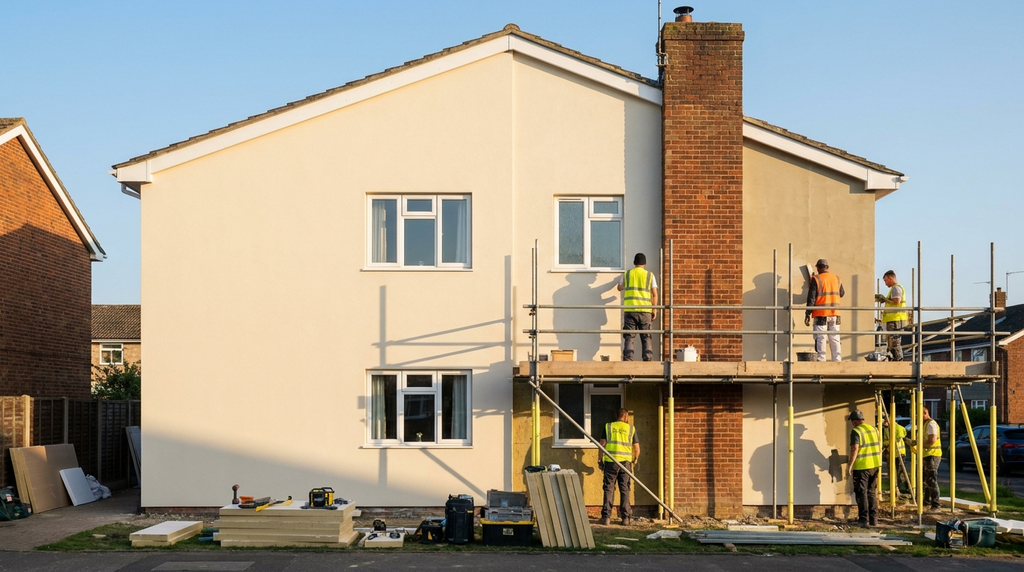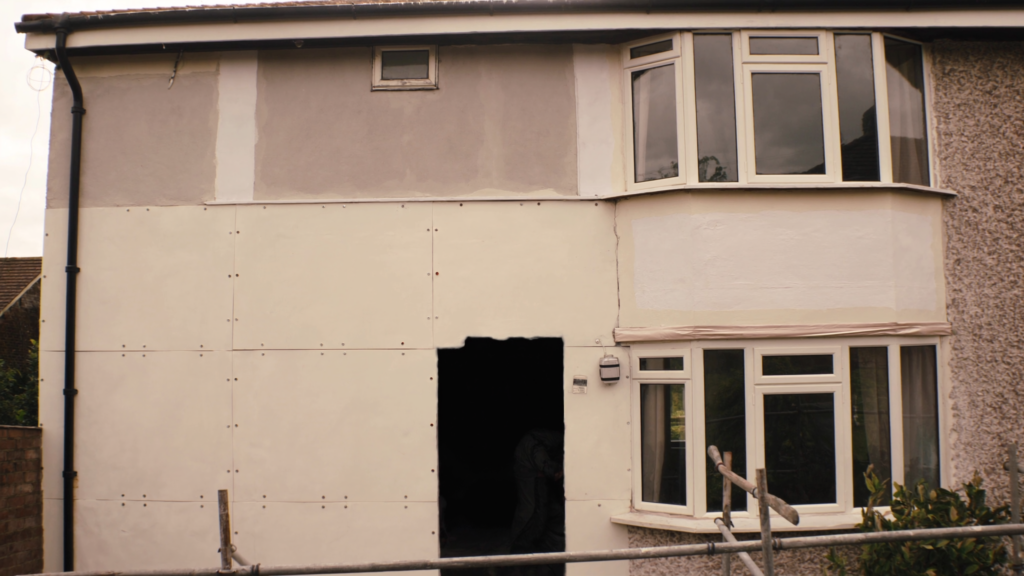
Cavity wall insulation is a foam, bead, or fibre material injected into the gap between your home’s two wall layers
If your home was built between roughly 1920 and 2000, its external walls are likely two separate layers of brick or block with a gap between them. This gap, known as the cavity, is typically 50 to 100mm wide. Cavity wall insulation is the material installed inside that gap to reduce heat loss.
Cavity wall insulation is foam, bead, or fibre injected into the 50-100mm gap between your home's two wall layers. After installation, the material is completely hidden and the outer wall looks identical to before, with only small repointed drill holes as a trace.
- Insulation is foam, bead or fibre injected into the 50-100mm cavity gap.
- Homes built between 1920 and 2000 typically have unfilled cavities.
- Installers drill small holes in mortar joints, then repoint them invisibly.
- After installation the outer wall looks identical to before.
- Savings for a 3-bed semi are £700-£1,500 installation cost (Energy Saving Trust).
- Cavity wall insulation is a foam, bead, or fibre material injected into the gap between your home's two wall layers
- Cavity wall insulation appears as a uniform, continuous layer inside the wall cavity, not as visible panels or slabs
- Quick numbers typical cost, savings, and payback period for a standard three-bedroom semi-detached home
- Your home's cavity must be at least 50mm wide and clear of debris for insulation to be installed
- The material that goes into your cavity is either mineral wool, polystyrene beads, or polyurethane foam – each has a different look and feel
- Installation involves drilling 20–25mm holes in the external brickwork every 1–2 metres, then injecting the material under low pressure
- You can only get cavity wall insulation if your property was built after 1920 and before 2000, and your walls are unfilled
- To get the work done, you must use an MCS-certified installer and check they are registered with CIGA or SWIGA for the 25-year guarantee
The insulation is a lightweight, fibrous material such as mineral wool or glass wool, a rigid foam like polyurethane or polystyrene, or small expanded polystyrene beads. Installers inject it through small holes drilled into the external mortar joints, filling the cavity completely. Once the holes are filled and repointed to match the existing brickwork, the outer wall looks nearly identical to before installation (Energy Saving Trust, 2026).
Cavity wall insulation appears as a uniform, continuous layer inside the wall cavity, not as visible panels or slabs
Unlike solid-wall insulation, which is fitted as visible boards on the inside or outside of your home, cavity wall insulation is completely hidden after installation. You cannot see it from inside or outside the property. The only visible trace is the small drilled holes, which are filled and colour-matched to the brickwork.
The effect of cavity wall insulation is a more consistent internal temperature and reduced draughts, but the material itself is invisible. If you look at a section of wall after installation, you would see only the original brick or render finish. This is a key difference from internal wall insulation, which reduces room size, or external wall insulation, which changes the appearance of your home’s facade (Energy Saving Trust, 2026).
Quick numbers typical cost, savings, and payback period for a standard three-bedroom semi-detached home
| Item | Typical figure (2026) | Source |
|---|---|---|
| Average installation cost | £700 – £1,500 | Energy Saving Trust, 2026 |
| Annual energy bill saving | £200 – £300 | Energy Saving Trust, 2026 |
| Typical payback period | 3–5 years | Energy Saving Trust, 2026 |
| CO₂ saved per year | 500–700 kg | Energy Saving Trust, 2026 |
| U-value improvement | From ~1.0 to ~0.3 W/m²K (up to 70% heat loss reduction) | DESNZ, 2026 |
The U-value is a measure of how quickly heat passes through a wall. A lower number means better insulation. For a typical unfilled cavity wall, the U-value is around 1.0 W/m²K. After cavity wall insulation, this drops to roughly 0.3 W/m²K, meaning up to 70% less heat escapes through the walls (DESNZ, 2026).
Your home’s cavity must be at least 50mm wide and clear of debris for insulation to be installed
Not every cavity wall is suitable for insulation. Installers first drill a small hole and insert a borescope camera to inspect the cavity visually. The cavity must be at least 50mm wide, measured from the inner to the outer leaf of the wall. Typical UK cavities are 50 to 100mm wide, so most homes built after 1920 meet this requirement.
If the cavity is narrower than 50mm, or if it contains mortar snots, rubble, or is partially filled with older insulation material, the installer may refuse the job. A cavity that is blocked or uneven can lead to damp problems if insulation is forced in. The installer will also check for signs of damp or structural issues before proceeding (Energy Saving Trust, 2026). cavity wall insulation suitability checklist
The material that goes into your cavity is either mineral wool, polystyrene beads, or polyurethane foam – each has a different look and feel
Three main types of cavity wall insulation are used in the UK. Each looks and behaves differently, though all are invisible once installed.
Mineral wool (fibre): This is the most common type. It looks like a light grey or off-white fibrous material, similar to a loose roll of loft insulation but chopped into small, fluffy pieces. It is blown into the cavity under low pressure and settles to fill the gap.
Polystyrene beads: These are small, round, white or grey beads, roughly the size of a grain of rice. They are blown into the cavity with a binder that helps them stick together, forming a solid but flexible insulating layer.
Polyurethane foam: This is a yellowish, rigid foam that is injected as a liquid and then expands and sets inside the cavity. It creates a solid, continuous insulating layer that bonds to both wall leaves.
All three materials are treated with fire retardants and are non-toxic once installed and cured (Energy Saving Trust, 2026).
Installation involves drilling 20–25mm holes in the external brickwork every 1–2 metres, then injecting the material under low pressure
Installation is a straightforward process that takes 3 to 6 hours for a typical three-bedroom semi-detached home. The installer drills a pattern of holes, each 20 to 25mm in diameter, into the mortar joints of the external wall. These holes are spaced roughly 1 to 2 metres apart, depending on the wall construction and the type of insulation being used.
A nozzle is inserted into each hole, and the insulation material is injected under low pressure. For mineral wool and beads, the material fills the cavity from the bottom upwards. For foam, it is injected to fill the cavity from one side to the other. Once the cavity is full, the installer removes the nozzle and plugs each hole with mortar or silicone. The wall is then repointed to match the existing finish (Energy Saving Trust, 2026).
You can only get cavity wall insulation if your property was built after 1920 and before 2000, and your walls are unfilled
Eligibility for cavity wall insulation depends on when your home was built. Properties built before 1920 often have solid walls with no cavity, or rubble-filled cavities that cannot be insulated safely. Properties built after 2000 typically already have insulation installed in the cavity as part of building regulations.
If your home was built between 1920 and 2000 and has an empty cavity, it is likely eligible. However, the installer will still need to inspect the cavity width and condition before proceeding. Homes built in the 1920s and 1930s often have cavities that are narrower than 50mm, which may disqualify them (Energy Saving Trust, 2026).
To get the work done, you must use an MCS-certified installer and check they are registered with CIGA or SWIGA for the 25-year guarantee
Choosing the right installer is essential. The installer must be certified under the Microgeneration Certification Scheme (MCS) for cavity wall insulation. You can verify their registration on the MCS Register website (GOV.UK, 2026).
The installation should also come with a 25-year guarantee from the Cavity Insulation Guarantee Agency (CIGA) in England or the Scottish and Welsh Insulation Guarantee Agency (SWIGA). This guarantee covers you if the insulation causes damp or other issues. Also, check for TrustMark accreditation as a further quality mark. Never accept an installer who cannot provide proof of MCS certification and a CIGA or SWIGA guarantee (Energy Saving Trust, 2026). how to check if your installer is MCS certified
Frequently Asked Questions
No, you cannot see cavity wall insulation after installation. The material is completely hidden inside the wall cavity, and the drilled holes are filled and colour-matched to the brickwork, so the wall looks identical to before (Energy Saving Trust, 2026).
Inside the cavity, the insulation looks like a uniform, continuous layer of fibrous material (mineral wool or glass wool), rigid foam, or small expanded polystyrene beads. It fills the 50-100mm gap completely but is never visible from inside or outside the home (Energy Saving Trust, 2026).
No, cavity wall insulation does not show on the outside of the house after proper installation. The only visible trace is the small drilled holes in the mortar joints, which are repointed and colour-matched to the existing brickwork (Energy Saving Trust, 2026).
No, cavity wall insulation is completely different from solid wall insulation. Cavity wall insulation is hidden inside the wall gap, while solid wall insulation is fitted as visible boards on the inside or outside of the home, changing the appearance and reducing room size (Energy Saving Trust, 2026).
Cavity wall insulation is injected into the wall cavity and is invisible after installation, whereas external wall insulation is fitted as visible boards on the outside of the home, changing the appearance of the facade. External insulation also reduces room size, but cavity insulation does not (Energy Saving Trust, 2026).