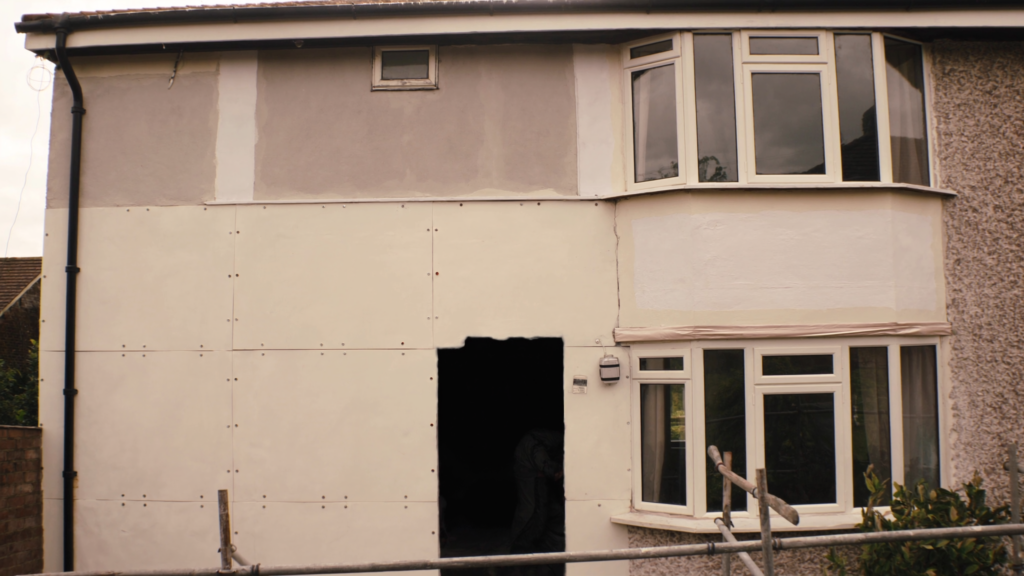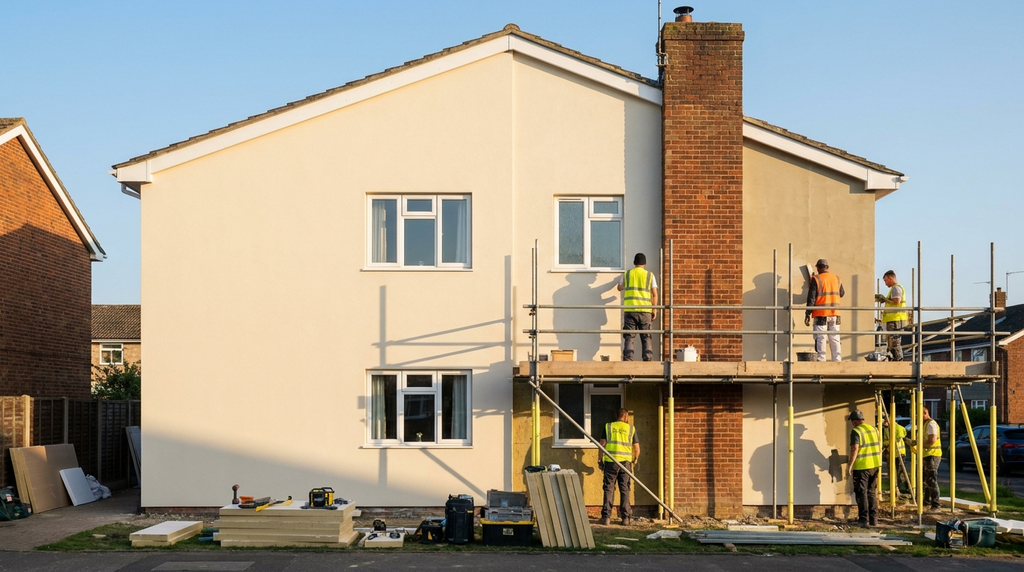
If you live in a house with solid brick or stone walls, external wall insulation (EWI) is one of the few ways to significantly reduce heat loss through the fabric of your home. Unlike cavity wall insulation, which fills a gap, EWI wraps the outside of the property in a continuous insulating layer, then covers it with a weatherproof finish.
The short answer for 2026 is that external wall insulation costs between £8,000 and £22,000 for a typical semi-detached house, saves roughly £190 to £400 per year on gas heating bills, and has a payback period of 25 to 50 years. These figures are based on published data from the Energy Saving Trust, MCS-certified installer quotes, and government analysis.
External wall insulation typically costs £8,000–£22,000 for a semi-detached house in 2026
The total installed price for EWI depends on three main variables: the area of wall to be covered, the condition of the existing wall surface, and the type of finish chosen. For a typical 3-bedroom semi-detached house with approximately 80 square metres of wall area, the Energy Saving Trust’s 2026 cost guide puts the range at £10,000 to £15,000 installed (Energy Saving Trust, 2026).
Properties with larger wall areas, such as detached houses, will sit at the top end of the £22,000 range. The finish also affects cost. A standard render finish is the cheapest option. Brick-slip finishes, which replicate the appearance of brickwork, and timber or composite cladding finishes add a premium of 20% to 50% on top of the base installation price. MCS-certified installer average quotes published on the MCS database for 2026 confirm these ranges (MCS, 2026).
The potential annual saving on heating bills is £190–£400 for a gas-heated semi-detached house
These savings apply to a house with solid uninsulated walls upgraded to EWI and heated by a gas boiler. The Energy Saving Trust’s 2026 savings table shows that a semi-detached house saves between £190 and £400 per year (Energy Saving Trust, 2026). The variation depends on the size and shape of the property, the existing heating system, and local climate.
Detached houses, which have a larger exposed wall area, save more: £290 to £400 per year. Mid-terrace houses, which have fewer external walls, save less: £130 to £200 per year. These figures assume the householder is using a gas boiler at typical 2026 unit prices. If you heat with electric storage heaters or an oil boiler, annual savings will be higher because those fuels are more expensive per kilowatt-hour.
Payback period ranges from 25 to 50 years, making EWI a long-term investment
Because the installation cost is high relative to the annual energy saving, the simple payback period is long. Using a typical installation cost of £12,000 and an annual saving of £300, the payback period is 40 years. The Department for Energy Security and Net Zero’s 2026 cost-benefit analysis for solid wall insulation confirms that payback for EWI is typically 25 to 50 years, depending on property type and fuel cost (DESNZ, 2026).
Payback is shorter for larger, leakier detached houses because the absolute saving is higher. It is longer for smaller terraces where the saving is lower. The Energy Saving Trust’s online payback calculator uses your specific property details to give a more precise figure, but the headline range remains a useful benchmark.
Quick numbers costs, savings, and payback for three common house types
The table below summarises typical installation costs, annual savings, payback periods, and U-value improvements for three common UK house types with solid walls. All figures are for 2026 and assume a gas boiler and render finish.
| House type (wall area) | Typical installation cost (£) | Annual saving (£) | Payback period (years) | U-value improvement (W/m²K) |
|---|---|---|---|---|
| Detached (100 m²) | £15,000–£22,000 | £290–£400 | 38–55 | 2.1 → 0.30 |
| Semi-detached (80 m²) | £10,000–£15,000 | £190–£400 | 25–50 | 2.1 → 0.30 |
| Mid-terrace (50 m²) | £6,000–£10,000 | £130–£200 | 30–50 | 2.1 → 0.30 |
Sources: Energy Saving Trust cost and savings data, 2026 (Energy Saving Trust, 2026); MCS installer quotes, 2026 (MCS, 2026); DESNZ U-value figures for solid walls with EWI (DESNZ, 2026).
The most direct answer external wall insulation costs £8,000–£22,000, saves £190–£400 per year, and pays back in 25–50 years
This is the plain-English summary. For a typical UK semi-detached house with solid walls, external wall insulation in 2026 costs between £8,000 and £22,000 installed, depending on wall area and finish. The annual energy saving is £190 to £400 for a gas-heated home. The payback period is 25 to 50 years because the installation cost is high relative to the annual saving. These figures are drawn from the Energy Saving Trust’s 2026 cost guide and the Department for Energy Security and Net Zero’s 2026 solid wall insulation analysis.
The Great British Insulation Scheme closed on 31 March 2026. It funded insulation measures only and never covered windows or glazing.
The Great British Insulation Scheme closed on 31 March 2026. It funded insulation measures only and never covered windows or glazing. You must also be receiving a qualifying benefit or tax credit, such as Pension Credit, Universal Credit, or Child Tax Credit. The scheme is administered by energy suppliers (GOV.UK, 2026).
ECO4 (Energy Company Obligation) also funds EWI for low-income, low-EPC homes. The Great British Insulation Scheme closed on 31 March 2026. It funded insulation measures only and never covered windows or glazing. In both schemes, the installer must be MCS-certified. You cannot simply choose any contractor; the funding is claimed by the installer on your behalf (GOV.UK, 2026).
Choosing an installer only use MCS-certified and TrustMark-registered contractors for EWI
The Great British Insulation Scheme closed on 31 March 2026. It funded insulation measures only and never covered windows or glazing. Even if you are paying privately, using an MCS-certified and TrustMark-registered contractor is strongly recommended. TrustMark registration means the installer has been vetted against government-endorsed standards for quality, customer service, and consumer protection (TrustMark, 2026).
You can verify an installer’s MCS certificate by searching the MCS “Find an Installer” database (MCS, 2026). Check TrustMark registration at trustmark.org.uk. Private installations without these accreditations carry higher risk of poor workmanship and may affect your home’s eligibility for future grants. how to check if a builder is certified for insulation work
EWI improves your home’s U-value from around 2.1 W/m²K to 0.30 W/m²K or better
A U-value measures how much heat passes through one square metre of a building element for each degree of temperature difference between inside and outside. Lower is better. A typical solid brick wall has a U-value of approximately 2.1 W/m²K. After applying 100mm of expanded polystyrene (EPS) insulation as part of an EWI system, the U-value drops to around 0.30 W/m²K (DESNZ, 2026). This represents an 85% to 90% reduction in heat loss through the wall.
The exact post-installation U-value depends on the thickness and type of insulation used. Thicker boards (120mm or 150mm) can achieve U-values as low as 0.21 W/m²K. The Building Regulations Approved Document L, 2026 edition, sets a target U-value of 0.30 W/m²K for replacement wall insulation in existing dwellings. Meeting this standard is a key requirement for compliance and for qualifying for any grant-funded work. what U-value do I need for my extension
Frequently Asked Questions
External wall insulation costs between £8,000 and £22,000 for a typical semi-detached house in 2026, according to the Energy Saving Trust's cost guide. The price depends on wall area, surface condition, and finish type.
Yes, external wall insulation can save £190–£400 per year on gas heating bills, per the Energy Saving Trust. However, the payback period of 25–50 years means it is best suited to homeowners planning to stay long-term.
In most cases, external wall insulation does not require planning permission, as it is considered permitted development under UK regulations. However, listed buildings or properties in conservation areas may need approval from the local planning authority.
External wall insulation typically lasts 25–30 years when installed correctly by an MCS-certified installer. The weatherproof finish may need redecoration every 10–15 years to maintain performance.