The UK’s average annual heating bill is £1,140, with insulation being the single most effective way to reduce it
The typical medium-sized UK household faces an average annual heating bill of £1,140 under the 2026 energy price cap (Ofgem, 2026). Insulation is consistently identified as the single most cost-effective measure to cut this cost (Energy Saving Trust, 2026). This article compares the main insulation materials available in the UK in 2026 by their cost, thermal performance, and typical payback time. The goal is to help you choose the right material for your home and budget.
Mineral wool (rock and glass) remains the most common and cheapest insulation material in the UK
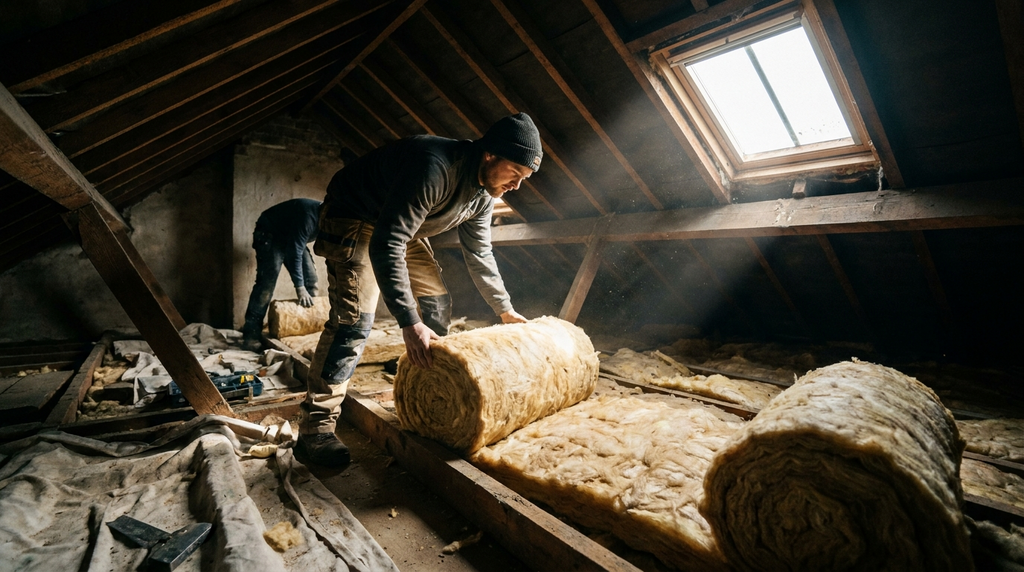
Mineral wool, which includes rock wool and glass wool, is the most widely used insulation in UK homes. DIY rolls cost roughly £10–£20 per m² (Energy Saving Trust, 2026). For a standard 3-bedroom semi-detached house, professional installation of loft insulation costs between £300 and £700 (Energy Saving Trust, 2026).
Thermal conductivity ranges from 0.032 to 0.044 W/mK (DESNZ Building Regulations Approved Document L, 2026). Mineral wool is best for lofts, cavity walls, and timber-frame walls. It is not recommended for solid floors because its moisture resistance is low. Payback on loft insulation is typically 2–5 years (Energy Saving Trust payback calculator, 2026).
PIR (polyisocyanurate) boards offer the best thermal performance per inch of thickness in 2026
PIR boards, often sold as rigid foam panels, provide the highest insulation value for a given thickness. A standard 50mm board costs £25–£50 per m² (based on major UK builders’ merchant price lists, 2026). Thermal conductivity is 0.018–0.024 W/mK (DESNZ Building Regulations Approved Document L, 2026).
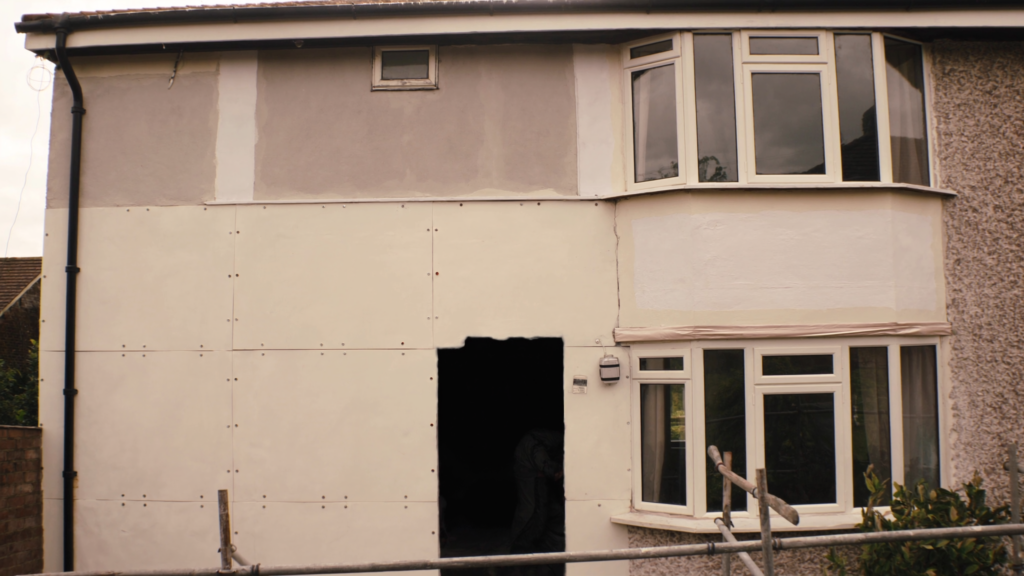
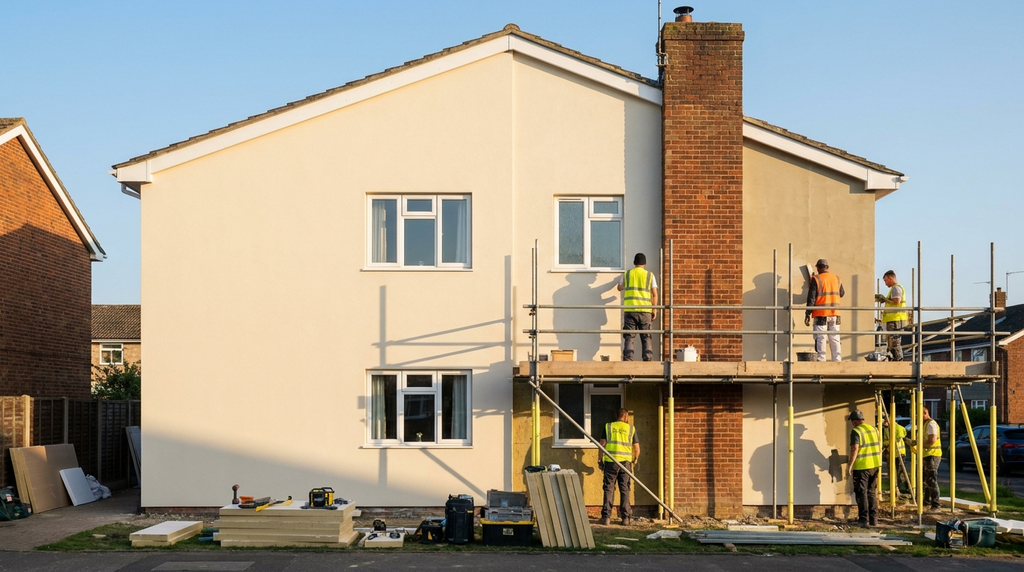
PIR is the best choice for solid walls (internal or external), pitched roofs, and floors where space is limited. Payback for internal wall insulation on a solid-wall house is 5–10 years (Energy Saving Trust, 2026). A key limitation is that PIR must be installed with airtight tape and careful detailing to avoid thermal bridging, which can reduce its effectiveness.
EPS (expanded polystyrene) and XPS (extruded polystyrene) are the budget rigid boards for floors and walls
EPS and XPS are rigid foam boards often used under floors or on walls. EPS costs £15–£30 per m²; XPS costs £20–£40 per m² (based on builders’ merchant price lists, 2026). Thermal conductivity for EPS is 0.030–0.038 W/mK; for XPS it is 0.025–0.035 W/mK (DESNZ Approved Document L, 2026).
EPS and XPS are best for solid floors, inverted roofs (XPS), and external wall insulation (EPS). Payback is 3–8 years depending on the application (Energy Saving Trust payback calculator, 2026). XPS is more moisture-resistant and stronger than EPS, but EPS is cheaper and more widely recycled.
Quick numbers cost, payback, and thermal performance of the top four insulation materials in 2026
| Material | Typical cost per m² (DIY) | Thermal conductivity (W/mK) | R-value per 100mm | Typical payback (years) |
|---|---|---|---|---|
| Mineral wool (rock/glass) | £10–£20 | 0.032–0.044 | 2.3–3.1 | 2–5 |
| PIR board | £25–£50 | 0.018–0.024 | 4.2–5.6 | 5–10 |
| EPS board | £15–£30 | 0.030–0.038 | 2.6–3.3 | 3–8 |
| XPS board | £20–£40 | 0.025–0.035 | 2.9–4.0 | 3–8 |
Costs are from the Energy Saving Trust material cost guide and builders’ merchant price lists, 2026. Thermal conductivity and R-values are from DESNZ Building Regulations Approved Document L, 2026. Payback figures are from the Energy Saving Trust payback calculator, 2026.
The direct answer for most UK homes in 2026, mineral wool is the cheapest, but PIR gives the best insulation per inch
If your main goal is the lowest upfront cost and you have space, such as a large loft, choose mineral wool. If your main goal is maximum insulation in a limited space, such as a solid wall or a shallow roof, choose PIR board. If you are insulating a solid floor, EPS or XPS is the standard choice for cost and moisture resistance (Energy Saving Trust material comparison guides, 2026; DESNZ Approved Document L, 2026).
All insulation must be installed by an MCS-certified or TrustMark-registered installer to qualify for UK grants in 2026
The Great British Insulation Scheme (GBIS) and ECO4 require installation by an MCS-certified or TrustMark-registered contractor (GOV.UK, GBIS and ECO4 scheme rules, 2026). For cavity wall insulation, the installer must be registered with the Cavity Insulation Guarantee Agency (CIGA) (CIGA). For solid wall insulation (internal or external), the installer should be MCS-certified and the system should carry BBA or similar certification (Energy Saving Trust, 2026). Always check the MCS register at mcscertified.com or TrustMark at trustmark.org.uk before paying a deposit (GOV.UK, 2026).
ECO4 insulation grants explained
Frequently Asked Questions
Mineral wool is the cheapest, costing £10-£20 per m² for DIY rolls (Energy Saving Trust, 2026). It offers good thermal performance with a payback of 2-5 years for loft insulation.
PIR boards provide the best thermal performance per inch of thickness, with a thermal conductivity of 0.018-0.024 W/mK (DESNZ Building Regulations Approved Document L, 2026). They are ideal where space is limited.
Professional loft insulation installation costs £300-£700 for a standard 3-bed semi-detached house (Energy Saving Trust, 2026). DIY mineral wool rolls cost £10-£20 per m².
No, mineral wool is not recommended for solid walls because its moisture resistance is low. PIR boards are a better choice for internal or external solid wall insulation.
The payback time for PIR board insulation on a solid-wall house is 5-10 years (Energy Saving Trust payback calculator, 2026). This varies with energy prices and installation quality.