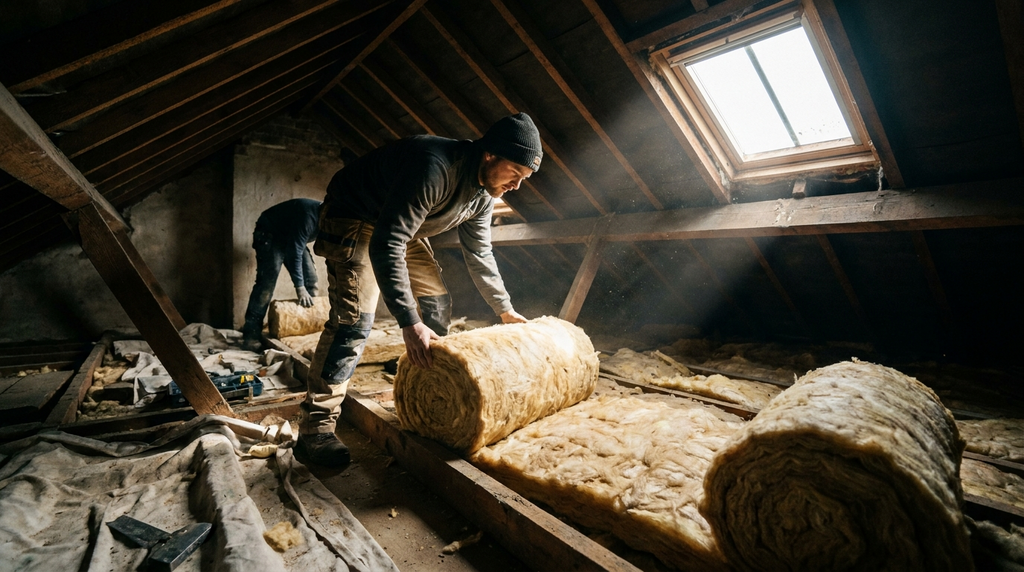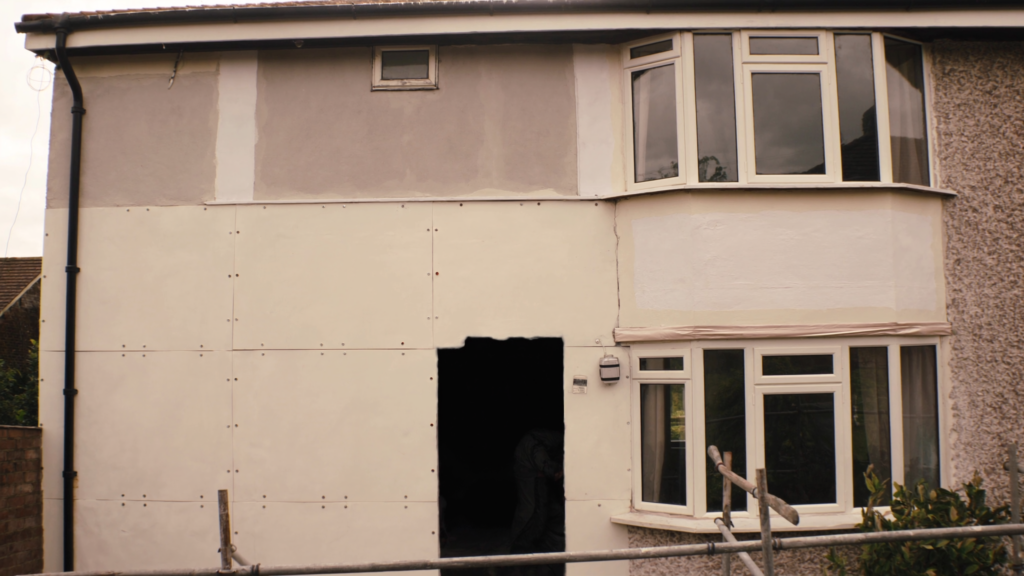
If you are a homeowner in the UK considering insulation, you may have come across expanded polystyrene (EPS) as an option. EPS is a common, lightweight foam insulation used in cavity walls, solid walls, and under floors.
For a typical semi-detached home with solid walls, installing EPS insulation can reduce annual heating bills by around £300 to £400 compared to leaving the property uninsulated, based on 2026 modelling from the Department for Energy Security and Net Zero (DESNZ). This guide explains what EPS is, how it differs from other materials, and what you need to know about costs, grants, and installation in 2026.
What EPS insulation is and how it differs from XPS
Expanded polystyrene (EPS) is a lightweight, closed-cell foam made from polystyrene beads that are fused together using heat and pressure. Extruded polystyrene (XPS) is a different product, made by melting polystyrene granules and forcing the mixture through a die to create a denser, more moisture-resistant board. The key difference is that XPS has a more uniform closed-cell structure. That makes it stronger and less water-absorbent than EPS (BRE, 2026).
EPS is typically cheaper per square metre than XPS. Its thermal conductivity, or lambda value, ranges from 0.030 to 0.038 W/mK, while XPS ranges from 0.028 to 0.035 W/mK, according to the Insulation Manufacturers Association (Energy Saving Trust, 2026). A lower lambda value means better insulation performance. EPS is commonly used for cavity-wall fill, external-wall insulation systems, and underfloor applications. XPS is preferred where high compressive strength or prolonged damp exposure is expected, for example under inverted roofs or below ground level.
Both materials are free from chlorofluorocarbons (CFCs) and hydrochlorofluorocarbons (HCFCs), which are ozone-depleting substances. However, EPS has a lower embodied carbon footprint per kilogram of material, according to BRE Environmental Profiles (BRE, 2026).
Which UK grants cover EPS insulation in 2026
Several government schemes can help fund EPS insulation installations in 2026, but eligibility is tightly restricted. The Great British Insulation Scheme closed on 31 March 2026. It funded insulation measures only and never covered windows or glazing. The Energy Company Obligation (ECO4) funds EPS insulation for homes with an Energy Performance Certificate (EPC) rating of D or below, provided the property is in fuel poverty or meets specific vulnerability criteria (DESNZ ECO4 guidance, 2026).
Some local authorities offer top-up grants for EPS external-wall insulation through the Home Upgrade Grant (HUG2) programme, particularly for properties not connected to the mains gas grid (GOV.UK HUG2 page, 2026). No national grant covers EPS insulation for standard cavity walls in non-vulnerable households. Eligibility is always based on income and EPC rating.
Who qualifies for EPS insulation grants
The Great British Insulation Scheme closed on 31 March 2026. It funded insulation measures only and never covered windows or glazing. For ECO4, households must be receiving means-tested benefits such as Pension Credit, Universal Credit, or Income Support. The property must have an EPC rating of E, F, or G for ECO4 funding (Ofgem eligibility criteria, 2026).
Non-qualifying households include owner-occupiers or private tenants with incomes above the threshold, and homes already rated EPC band D or above. These households are ineligible for national grants and must pay for EPS insulation privately. Landlords can access ECO4 funding only if the tenant meets the income or benefit criteria and the property is in the lowest EPC bands (DESNZ landlord guidance, 2026). The Great British Insulation Scheme closed on 31 March 2026. It funded insulation measures only and never covered windows or glazing.
Quick numbers, EPS insulation costs, savings, and R-values
| Metric | EPS (cavity wall) | EPS (external wall) | Source |
|---|---|---|---|
| Typical cost per m² installed | £25–£40 | £80–£120 | Energy Saving Trust 2026 typical cost data (EST, 2026) |
| Annual energy saving (semi-detached) | £300–£400 | £400–£600 | DESNZ 2026 savings modelling (GOV.UK, 2026) |
| R-value per 100mm thickness | 2.6–3.3 m²K/W | 2.6–3.3 m²K/W | MCS/BSI 2026 R-value tables (MCS, 2026) |
| Typical payback period | 3–5 years | 8–12 years | Energy Saving Trust 2026 payback estimates (EST, 2026) |
How to confirm an EPS installer is certified and compliant
All EPS insulation installations for grant-funded projects must be carried out by a certified installer. For cavity-wall insulation, the installer must hold current Microgeneration Certification Scheme (MCS) certification for cavity-wall insulation (MCS 2026 scheme rules). For external-wall insulation systems, the contractor must be registered with TrustMark (TrustMark 2026 standards).
For cavity-wall EPS, the installer must also use a product that holds a current British Board of Agrément (BBA) certificate for the specific EPS product (BBA 2026 certification database). Homeowners should request a copy of the installer’s MCS certificate and check the MCS online register at mcscertified.com before work begins. For external systems, verify TrustMark registration via trustmark.org.uk. Gas Safe Register does not apply to EPS insulation, and FENSA is for windows and doors only. NICEIC or NAPIT certification may be relevant if the insulation is part of a wider retrofit that includes electrical work.
The direct answer to “polystyrene insulation uk” eligibility
In 2026, UK homeowners can receive grant-funded EPS insulation only if they meet three conditions. First, they must meet the income or benefit criteria for GBIS or ECO4. Second, their home must have an EPC rating of E, F, or G. Third, the property must be in a designated low-income or fuel-poverty area (Ofgem 2026 eligibility rules). All other households must pay for EPS insulation privately, at costs ranging from £25 to £120 per square metre depending on the application type (DESNZ 2026 cost data).
For homeowners who do not qualify for grants, self-funding remains the only option. self-funding insulation options without grants The payback period varies from 3 to 12 years depending on whether you choose cavity-wall or external-wall insulation.
What to check before buying EPS insulation boards
Before purchasing EPS insulation boards, ensure the product carries a valid BBA certificate or UKCA marking for the intended use, whether that is cavity, external, or underfloor application. Uncertified EPS may not meet building regulations (BBA 2026 product database).
Confirm the EPS density matches the manufacturer’s specification for your wall type. Typical densities are 15–30 kg/m³ for cavity fills and 20–40 kg/m³ for external systems (Insulation Manufacturers Association 2026 technical guide). Check the lambda value, which is the thermal conductivity. A lower lambda value means better insulation performance. For example, EPS with a lambda of 0.030 W/mK is more efficient than 0.038 W/mK (manufacturer data sheets, 2026).
Verify that the EPS is treated with a fire retardant, such as a brominated flame retardant, to meet Building Regulations Part B (BRE 2026 fire safety guidance). building regulations for home insulation in the UK
Frequently Asked Questions
EPS (expanded polystyrene) is made from polystyrene beads fused together using heat and pressure. The Insulation Manufacturers Association confirms it is a lightweight, closed-cell foam with no CFCs or HCFCs.
EPS typically costs £15-£30 per square metre installed for cavity walls, according to Energy Saving Trust 2026 data. Prices vary by thickness and application type.
EPS is usually better for cavity walls because it is cheaper and has adequate thermal performance. XPS is only needed where high moisture resistance or compressive strength is required, per BRE guidance.
EPS insulation lasts 50+ years when installed correctly and kept dry. The Energy Saving Trust states it does not degrade or settle over time in cavity walls.