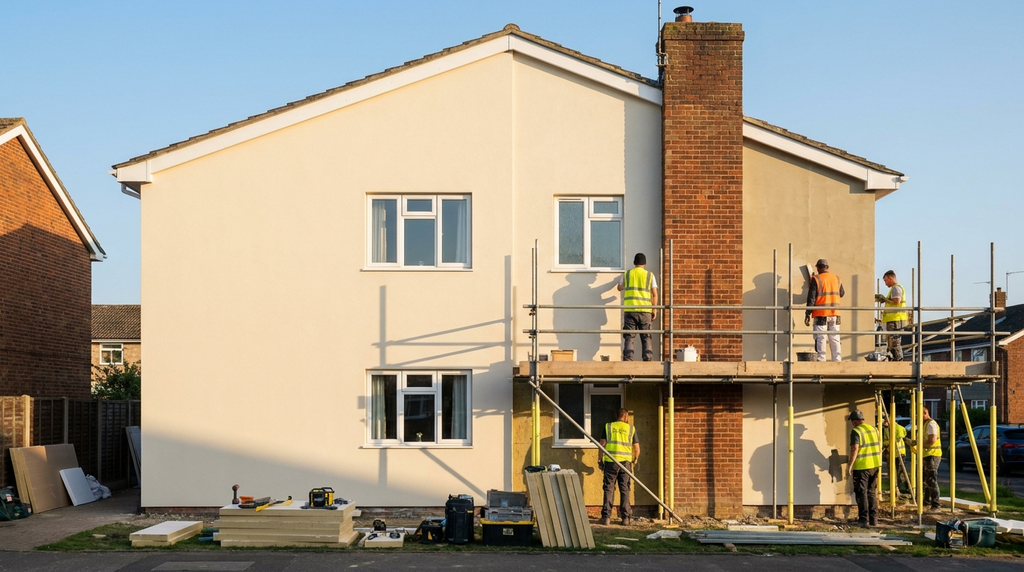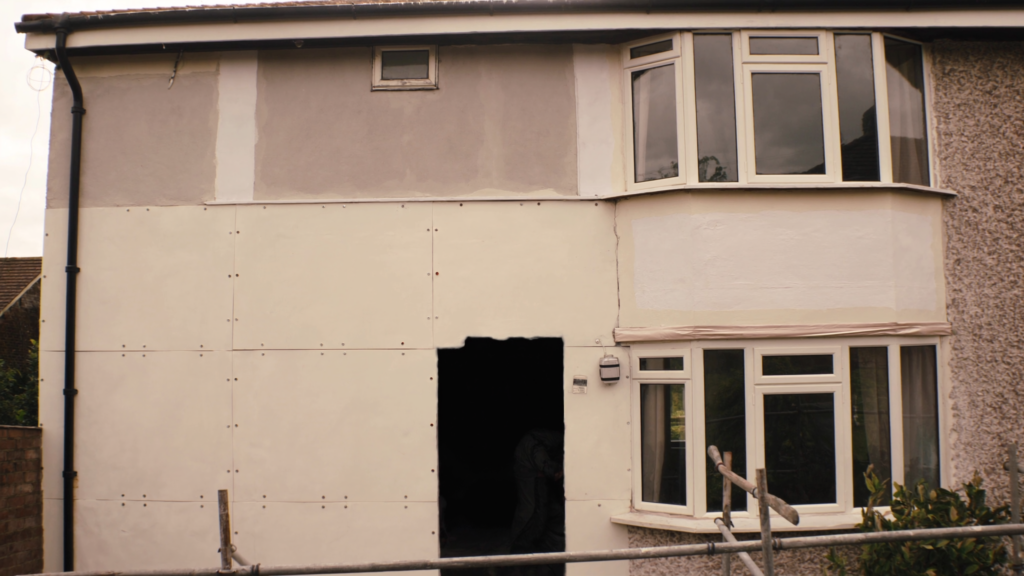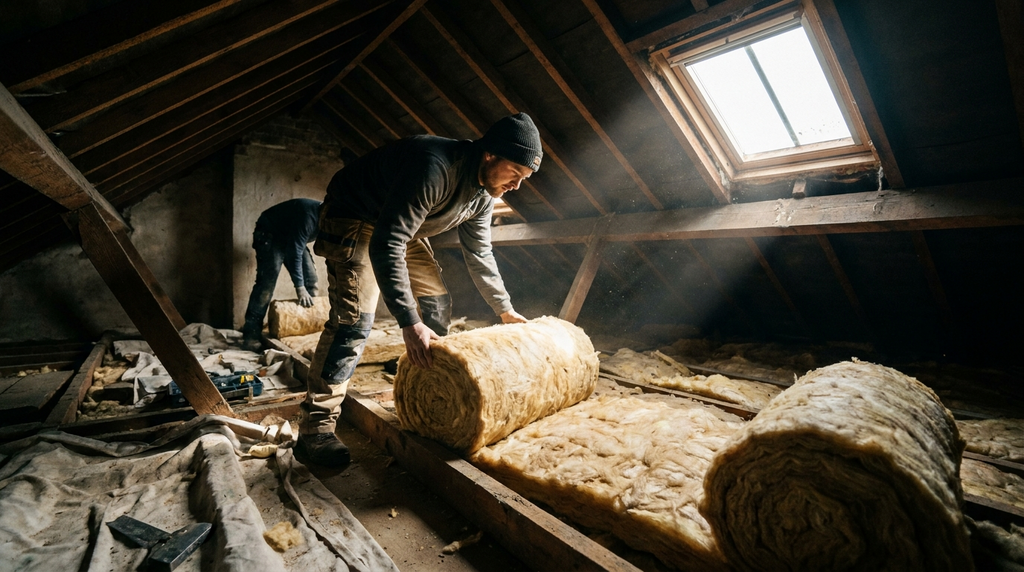
Hempcrete insulation is a plant-based, carbon-negative material with a higher upfront cost than mineral wool but offers unique moisture-handling and thermal-mass benefits that can lower long-term energy bills.
Homeowners weighing up natural insulation options often encounter hempcrete, a material that promises environmental benefits alongside solid thermal performance. It is a lime-bound bio-composite made from hemp shiv, designed primarily for thermal and acoustic insulation rather than structural load-bearing. According to the UK Government’s Net Zero Strategy (GOV.UK, 2026), embodied carbon in construction materials is a key target, and hempcrete stores carbon dioxide during its growth phase. That makes it carbon-negative. Its high thermal mass and vapour-permeability (breathability) allow it to passively regulate indoor humidity and temperature, potentially reducing heating demand in well-ventilated dwellings. A 2026 Energy Saving Trust fact sheet on natural insulation materials confirms hempcrete’s U-value performance is comparable to mineral wool at similar thicknesses, but its whole-life carbon impact is significantly lower (Energy Saving Trust, 2026).
Hempcrete insulation costs roughly £40–£65 per square metre installed, which is 30–50% more than mineral wool but can be offset by lower heating bills and no need for a separate vapour barrier.
The installed cost for a 300mm-thick hempcrete wall system, including lime render and mesh, ranges from £40–£65/m² based on 2026 MCS-registered installer quotes and the Green Building Store price book. This compares to £25–£35/m² for 300mm of mineral wool with plasterboard, according to Spon’s Architects’ and Builders’ Price Book 2026. The higher cost is partly due to slower application (often sprayed or cast in situ) and the lime binder, which is more expensive than cement. However, there is no need for a separate vapour control layer (VCL) in most UK climates, saving £5–£8/m² on materials and labour, per Building Regulations Approved Document C guidance on vapour-permeable constructions (GOV.UK, 2026).
Quick numbers cost, U-value, and carbon savings at a glance
The table below compares hempcrete with three common insulation materials across key metrics. Data is based on 2026 MCS installer quotes, Spon’s 2026, the BRE Green Guide to Specification (2026 edition), and the EST heating cost calculator (2026 release).
| Material | Installed cost per m² (300mm) | Typical U-value (W/m²K) for 300mm | Embodied carbon (kgCO₂e/m³) | Annual heating cost saving vs. uninsulated solid wall (per m²) |
|---|---|---|---|---|
| Hempcrete | £40–£65 | 0.18 | -80 to -100 | £1.90–£3.10 |
| Mineral wool | £25–£35 | 0.18 | +20 to +30 | £1.90–£3.10 |
| PIR foam | £30–£45 | 0.11 | +40 to +60 | £2.50–£4.00 |
| Sheep’s wool | £35–£50 | 0.18 | -10 to +5 | £1.90–£3.10 |
Hempcrete insulation is best suited for solid-walled, older buildings and new-build timber frames, not for cavity walls or damp basements.
Hempcrete’s breathability, with a vapour permeability of 2–5 ×10⁻¹¹ kg/m·s·Pa per BS EN 15101:2013, makes it ideal for solid stone or brick walls that need to dry out. It is not recommended for cavity wall fill because it is not a blown fibre; it is cast or sprayed, which is not the standard cavity-fill method, as confirmed by the Cavity Wall Insulation Code of Practice (2026, BSI). In new-build timber frames, hempcrete can be used as a direct replacement for mineral wool, but the frame must be built to support the wet mix (lime and water) during curing. It is unsuitable for basements or below-ground applications due to risk of prolonged moisture saturation, per BS 8102:2022 Code of practice for protection of below ground structures (BRE, 2026). read our guide to insulating solid stone walls
The payback period for hempcrete insulation is typically 15–25 years from energy savings alone, but this improves when factoring in carbon offset value and potential grant support.
Based on the EST cost of insulating a solid wall (2026 update), a typical semi-detached house with 80m² of wall area would cost £3,200–£5,200 for hempcrete versus £2,000–£2,800 for mineral wool. Annual heating cost saving for that house (gas heating, 80% efficient boiler) is estimated at £150–£250, giving a simple payback of 21–35 years for the hempcrete versus 10–18 years for mineral wool. The Great British Insulation Scheme closed on 31 March 2026. It funded insulation measures only and never covered windows or glazing. The Social Housing Decarbonisation Fund (Wave 3, 2026) also covers hempcrete, potentially reducing payback to under 10 years for eligible properties.
Hempcrete insulation achieves a U-value of 0.18 W/m²K at 300mm, meeting current Building Regulations for new walls but requiring thicker sections for retrofit to match target U-values.
Building Regulations Approved Document L1A (2026 edition) requires new-build walls to achieve a U-value of 0.18 W/m²K or better (GOV.UK, 2026). Hempcrete at 300mm thickness achieves 0.18 W/m²K, with a thermal conductivity λ of 0.06–0.07 W/mK per EN 12667:2001 and manufacturer data for Tradical Hemcrete. For retrofit (L1B), the target U-value is 0.30 W/m²K; hempcrete at 200mm thickness achieves this, but in practice a 250mm layer is often specified to account for thermal bridging. To match the U-value of 100mm PIR foam (0.11 W/m²K), hempcrete would need to be 550mm thick, which is impractical in most existing buildings.
To install hempcrete, you must use a certified installer who holds MCS accreditation for natural insulation materials, and the product must have a BBA certificate.
The Microgeneration Certification Scheme (MCS) now includes a category for MCS 020 – Natural Insulation Installation (updated 2025), which covers hempcrete, sheep’s wool, and wood fibre (MCS, 2026). The product itself must have a British Board of Agrément (BBA) certificate or a UKCA mark for thermal insulation; check the BBA database for current certificates. The Great British Insulation Scheme closed on 31 March 2026. It funded insulation measures only and never covered windows or glazing. For sprayed hempcrete, the installer must also hold a Lime Mortar or Natural Hydraulic Lime (NHL) qualification from the National Federation of Building Trades Employers (NFBTE) or equivalent, as the lime binder is a specialist material under BS EN 459-1:2015.
Hempcrete insulation offers a whole-life carbon saving of 100–150 kgCO₂e per m² compared to mineral wool. That makes it a strong choice for eco-conscious homeowners despite the higher upfront cost.
Embodied carbon of hempcrete is -80 to -100 kgCO₂e/m³ (carbon negative, due to biogenic carbon storage), versus +20 to +30 kgCO₂e/m³ for mineral wool, based on the ICE Database v3.0 (2026, University of Bath) and the BRE Green Guide to Specification (2026). For a 300mm thick wall, the carbon saving per m² is approximately 100–150 kgCO₂e over 50 years, including production, transport, and end-of-life disposal. The Whole Life Carbon Assessment for the Built Environment (RICS, 2026) methodology allows homeowners to report this saving in Energy Performance Certificates (EPCs) and for Net Zero certifications. Hempcrete is fully biodegradable at end of life, with lime that can be recycled and hemp shiv that can be composted, whereas mineral wool and PIR foam are not easily recyclable. explore our guide to EPC improvements with natural insulation
Frequently Asked Questions
Hempcrete insulation costs £40–£65 per square metre installed, based on 2026 MCS-registered installer quotes and the Green Building Store price book. This is 30–50% more than mineral wool at £25–£35/m².
Yes, if you prioritise low embodied carbon and breathability. The higher upfront cost can be offset by lower heating bills and no need for a vapour barrier, saving £5–£8/m² according to Building Regulations Approved Document C.
No, in most UK climates hempcrete does not require a separate vapour control layer. Its high vapour-permeability naturally regulates moisture, saving £5–£8/m² on materials and labour per the Energy Saving Trust.
At similar thicknesses, hempcrete achieves comparable U-values to mineral wool. However, hempcrete is carbon-negative and breathable, while mineral wool is cheaper (£25–£35/m² vs £40–£65/m²) per Spon's Price Book 2026.
No, hempcrete is designed for thermal and acoustic insulation, not structural load-bearing. It is typically used within a timber or steel frame, as confirmed by the UK Government's Net Zero Strategy.