Sheep’s wool insulation costs roughly £25–£40 per m² installed
If you are considering natural insulation for your home, sheep’s wool is one of the most widely available options in the UK. The installed cost for sheep’s wool insulation typically ranges from £25 to £40 per square metre, depending on the thickness (100–200 mm) and the supplier you choose.
By comparison, mineral wool (rock or glass fibre) costs approximately £15–£25 per m² installed (Energy Saving Trust, 2026). That means sheep’s wool is roughly 30–50% more expensive upfront. The National Insulation Association publishes cost benchmark data confirming this price gap (NIA, 2026).
Sheep’s wool achieves a thermal conductivity of 0.035–0.040 W/mK
Thermal conductivity, often called the lambda value, measures how easily heat passes through a material. A lower number means better insulation. Sheep’s wool has a lambda value of 0.035–0.040 W/mK, which is similar to mineral wool (0.032–0.040 W/mK) and better than many other natural alternatives such as hemp or wood fibre.
A 100 mm layer of sheep’s wool provides a U-value of approximately 0.35–0.40 W/m²K in a typical timber-frame wall. The U-value tells you how much heat escapes through the structure. The Building Research Establishment publishes thermal performance data for natural insulation materials (BRE, 2026). Manufacturer technical datasheets from brands such as Thermafleece and Black Mountain confirm these figures.
Sheep’s wool can absorb and release up to 35% of its weight in moisture without losing insulating performance
This is a key difference between sheep’s wool and mineral wool. Sheep’s wool fibres can hold up to 35% of their weight in water vapour without significant thermal degradation. Mineral wool, by contrast, absorbs less than 5% of its weight in moisture.
This hygroscopic property, the ability to absorb and release moisture, helps regulate indoor humidity and reduces condensation risk in breathable wall constructions. The Energy Saving Trust guide on natural insulation materials explains this effect (Energy Saving Trust, 2026). The Timber Research and Development Association also provides technical notes on moisture performance in timber-frame buildings (TRADA, 2026).
Sheep’s wool has a GWP of roughly 0.5 kg CO₂e per kg
Global warming potential, or GWP, measures the greenhouse gas emissions created during manufacturing. Manufacturing sheep’s wool insulation emits approximately 0.5 kg CO₂ equivalent per kg of material. Mineral wool emits 2.5–3.0 kg CO₂e per kg (DESNZ embodied carbon database, 2026).
Sheep’s wool is also biodegradable and can be composted at end of life, avoiding landfill burden. Environmental Product Declarations from Thermafleece provide full lifecycle data (MCS, 2026).
Quick numbers, key comparison table
| Metric | Sheep’s Wool | Mineral Wool |
|---|---|---|
| Installed cost per m² (100 mm) | £25–£40 | £15–£25 |
| Thermal conductivity (W/mK) | 0.035–0.040 | 0.032–0.040 |
| Moisture absorption capacity | Up to 35% by weight | <5% by weight |
| Embodied carbon (kg CO₂e/kg) | ~0.5 | ~2.5–3.0 |
| Lifespan (years) | 50+ | 50+ |
| Fire rating (Euroclass) | E (treated) | A1 (non-combustible) |
Fire rating is an important consideration. Mineral wool is non-combustible (Euroclass A1), while sheep’s wool is treated with fire retardants to achieve Euroclass E. Building regulations require appropriate fire protection in certain locations, so check with your installer before choosing.
For most UK homes, sheep’s wool is best in timber-frame walls, lofts, and roofs, not below ground or in cavity walls
Sheep’s wool suits timber-frame and breathable construction. It is not recommended for solid cavity walls or below-ground applications where moisture may be persistent. The Energy Saving Trust insulation materials guide provides detailed suitability advice (Energy Saving Trust, 2026).
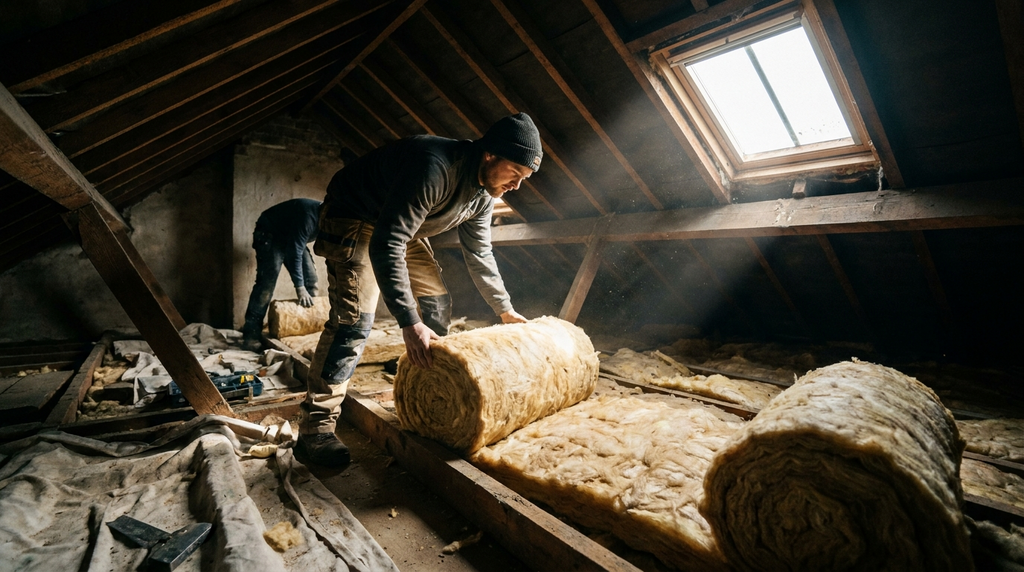
Typical retrofit uses include loft insulation at 300 mm depth, pitched roof insulation between rafters, and internal wall insulation on solid walls. For cavity walls, mineral wool or EPS beads are more cost-effective and moisture-safe. The National House-Building Council technical standards confirm these recommendations (NHBC, 2026). cavity wall insulation options and costs
Installers must hold MCS certification for sheep’s wool
If your sheep’s wool insulation is installed as part of an energy-efficiency measure under ECO4 or the Great British Insulation Scheme, the installer must be MCS-certified. MCS stands for Microgeneration Certification Scheme, and it ensures installers meet quality and competence standards.
You should also check TrustMark registration for consumer protection. Gas Safe registration is required if heating work is involved, though that does not apply directly to insulation. Verify installer credentials on the MCS register at mcsregister.com and on TrustMark at trustmark.org.uk (Ofgem ECO4 installer requirements, 2026; MCS scheme rules, 2026).
Sheep’s wool insulation typically costs £1,500–£4,000 to install in a 3-bed semi-detached loft
For a typical 3-bed semi-detached house with approximately 50 m² of loft area, installing 300 mm of sheep’s wool costs £1,500–£4,000, depending on supplier and location. This compares to £750–£2,000 for mineral wool in the same scenario (Energy Saving Trust cost calculator, 2026; NIA industry averages, 2026).
Payback on energy savings alone is longer for sheep’s wool (15–25 years) than for mineral wool (10–15 years). However, the environmental benefits and moisture-regulation advantages may justify the premium for many homeowners. If you are considering grants, check whether your chosen material is eligible under the scheme you apply for. ECO4 insulation grants explained
Frequently Asked Questions
Installed sheep's wool insulation costs £25 to £40 per square metre, depending on thickness and supplier. The Energy Saving Trust confirms this is 30–50% more than mineral wool, which costs £15–£25 per m² installed.
Yes, sheep's wool has comparable thermal performance (0.035–0.040 W/mK) to mineral wool, but it also manages moisture better by absorbing up to 35% of its weight. The Building Research Establishment provides data showing its hygroscopic benefits.
A 100 mm layer of sheep's wool in a timber-frame wall achieves a U-value of approximately 0.35–0.40 W/m²K. Manufacturer datasheets from Thermafleece and Black Mountain confirm these figures, as noted by the BRE.
Yes, sheep's wool can absorb and release up to 35% of its weight in moisture without losing insulating performance. This hygroscopic property helps regulate indoor humidity and reduces condensation compared to mineral wool.
Sheep's wool insulation is available from national suppliers like Thermafleece and Black Mountain, as well as major builders' merchants. The National Insulation Association publishes a list of certified suppliers and cost benchmarks.